
How did Linux become a mainstream embedded
- perating system?
Chris Simmonds
2net Limited Winchester, UK chris@2net.co.uk
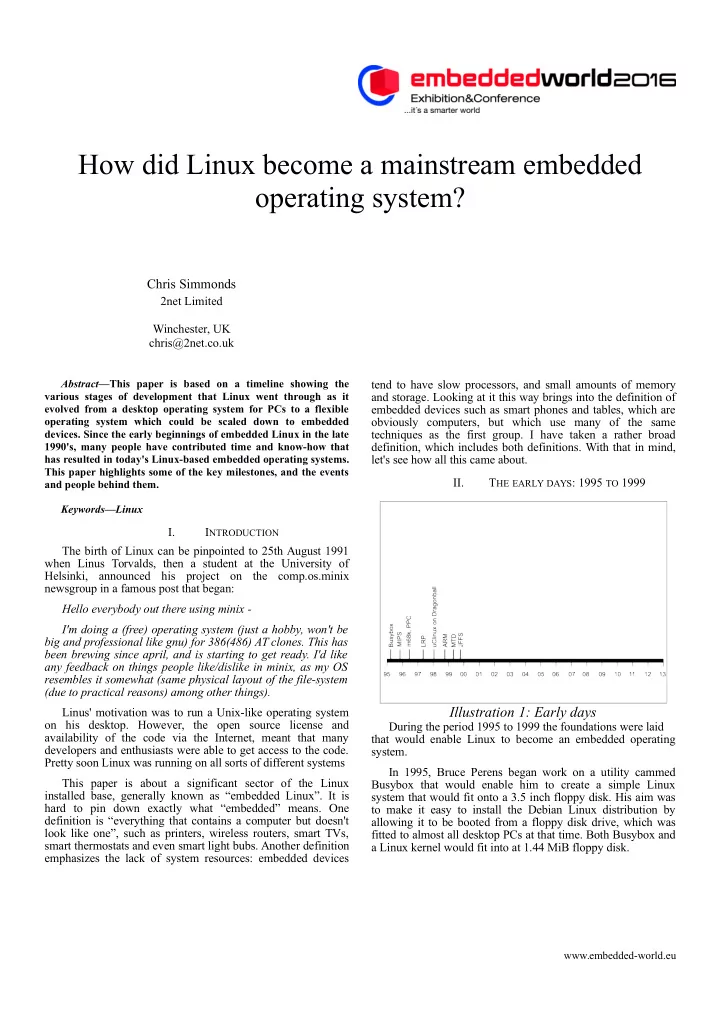
Abstract—This paper is based on a timeline showing the various stages of development that Linux went through as it evolved from a desktop operating system for PCs to a flexible
- perating system which could be scaled down to embedded
- devices. Since the early beginnings of embedded Linux in the late
1990's, many people have contributed time and know-how that has resulted in today's Linux-based embedded operating systems. This paper highlights some of the key milestones, and the events and people behind them. Keywords—Linux
I. INTRODUCTION The birth of Linux can be pinpointed to 25th August 1991 when Linus Torvalds, then a student at the University of Helsinki, announced his project on the comp.os.minix newsgroup in a famous post that began: Hello everybody out there using minix - I'm doing a (free) operating system (just a hobby, won't be big and professional like gnu) for 386(486) AT clones. This has been brewing since april, and is starting to get ready. I'd like any feedback on things people like/dislike in minix, as my OS resembles it somewhat (same physical layout of the file-system (due to practical reasons) among other things). Linus' motivation was to run a Unix-like operating system
- n his desktop. However, the open source license and
availability of the code via the Internet, meant that many developers and enthusiasts were able to get access to the code. Pretty soon Linux was running on all sorts of different systems This paper is about a significant sector of the Linux installed base, generally known as “embedded Linux”. It is hard to pin down exactly what “embedded” means. One definition is “everything that contains a computer but doesn't look like one”, such as printers, wireless routers, smart TVs, smart thermostats and even smart light bubs. Another definition emphasizes the lack of system resources: embedded devices tend to have slow processors, and small amounts of memory and storage. Looking at it this way brings into the definition of embedded devices such as smart phones and tables, which are
- bviously computers, but which use many of the same
techniques as the first group. I have taken a rather broad definition, which includes both definitions. With that in mind, let's see how all this came about. II. THE EARLY DAYS: 1995 TO 1999 During the period 1995 to 1999 the foundations were laid that would enable Linux to become an embedded operating system. In 1995, Bruce Perens began work on a utility cammed Busybox that would enable him to create a simple Linux system that would fit onto a 3.5 inch floppy disk. His aim was to make it easy to install the Debian Linux distribution by allowing it to be booted from a floppy disk drive, which was fitted to almost all desktop PCs at that time. Both Busybox and a Linux kernel would fit into at 1.44 MiB floppy disk.
www.embedded-world.eu