How do you Improve on the Internet? The eXpressive Internet - - PowerPoint PPT Presentation

how do you improve on the internet
SMART_READER_LITE
LIVE PREVIEW

How do you Improve on the Internet? The eXpressive Internet - - PowerPoint PPT Presentation

5/15/2012 How do you Improve on the Internet? The eXpressive Internet Architecture: The Internet has been tremendously successful From Architecture to Network Has sustained tremendous growth g Supports very diverse set of applications


slide-1
SLIDE 1

5/15/2012 1

The eXpressive Internet Architecture: From Architecture to Network

Peter Steenkiste Dave Andersen, David Eckhardt, Sara Kiesler, Jon Peha, Adrian Perrig, Srini Seshan, Marvin Sirbu, Hui Zhang Carnegie Mellon University Aditya Akella, University of Wisconsin John Byers Boston University

1

John Byers, Boston University

Winlab FIA, May 14, 2012

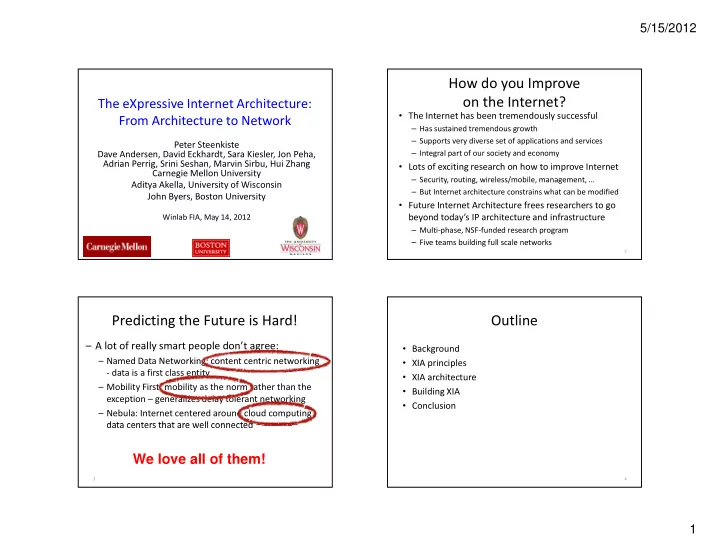
How do you Improve

  • n the Internet?
  • The Internet has been tremendously successful

– Has sustained tremendous growth g – Supports very diverse set of applications and services – Integral part of our society and economy

  • Lots of exciting research on how to improve Internet

– Security, routing, wireless/mobile, management, … – But Internet architecture constrains what can be modified

  • Future Internet Architecture frees researchers to go

beyond today’s IP architecture and infrastructure

– Multi‐phase, NSF‐funded research program – Five teams building full scale networks

2

Predicting the Future is Hard!

– A lot of really smart people don’t agree:

Named Data Networking: content centric networking – Named Data Networking: content centric networking ‐ data is a first class entity – Mobility First: mobility as the norm rather than the exception – generalizes delay tolerant networking – Nebula: Internet centered around cloud computing data centers that are well connected

3

data centers that are well connected

We love all of them!

Outline

  • Background

XIA i i l

  • XIA principles
  • XIA architecture
  • Building XIA
  • Conclusion

4

slide-2
SLIDE 2

5/15/2012 2

XIA Vision

We envision a future Internet that:

  • Is trustworthy

– Security broadly defined is the biggest challenge

  • Supports long‐term evolution of usage models

– Including host‐host, content retrieval, services, …

  • Supports long term technology evolution

– Not just for link technologies, but also for storage and computing capabilities in the network and end points computing capabilities in the network and end‐points

  • Allows all actors to operate effectively

– Despite differences in roles, goals and incentives

5

Today’s Internet

Src: Client IP Dest: Server IP

  • Client retrieves document from a specific web server

– But client mostly cares about correctness of content timeliness

Client IP Server IP

TCP

But client mostly cares about correctness of content, timeliness – Specific server, file name, etc. are not of interest

  • Transfer is between wrong principals

– What if the server fails? – Optimizing transfer using local caches is hard

  • Need to use application‐specific overlay or transparent proxy – bad!

6

eXpressive Internet Architecture

Src: Client ID Dest: Content ID

  • Client expresses communication intent for content explicitly

– Network uses content identifier to retrieve content from appropriate

Dest: Content ID PDA Content

Network uses content identifier to retrieve content from appropriate location

  • How does client know the content is correct?

– Intrinsic security! Verify content using self‐certifying id: hash(content) = content id

  • How does source know it is talking to the right client?

– Intrinsic security! Self‐certifying host identifiers

7

A Bit More Detail …

Dest: Service ID Content Name?

Flexible Trust Management

Dest: Client ID Content ID Dest: Content ID

Diverse Communicating Entities

Hash( ) = CID? Anywhere

Intrinsic Security

8

slide-3
SLIDE 3

5/15/2012 3

Evolvable Set of Principals

  • Identifying the intended communicating

entities reduces complexity and overhead entities reduces complexity and overhead

– No need to force all communication at a lower level (hosts), as in today’s Internet

  • Allows the network to evolve

Content

a581fe9 ...

9

Host Services Future Entities

d9389fa … 024e881 … 39c0348 …

Security as Intrinsic as Possible

  • Security properties are a direct result of the

design of the system g y

– Do not rely on correctness of external configurations, actions, data bases – Malicious actions can be easily identified

Content

a581fe9 ...

10

Host Services Future Entities

d9389fa … 024e881 … 39c0348 …

Other XIA Principles

  • Narrow waist for all principals

– Defines the API between the principals and the network t l h i protocol mechanisms

  • Narrow waist for trust management

– Ensure that the inputs to the intrinsically secure system match the trust assumptions and intensions of the user – Narrow waist allows leveraging diverse mechanisms for trust management: CAs, reputation, personal, … g , p , p ,

  • All other network functions are explicit services

– Keeps the architecture simple and easy to reason about – XIA provides a principal type for services (visible)

11

Look familiar?

XIA: eXpressive Internet Architecture

  • Each communication operation expresses the

intent of the operation intent of the operation

– Also: explicit trust management, APIs among actors

  • XIA is a single inter‐network in which all

principals are connected

Not a collection of architectures implemented – Not a collection of architectures implemented through, e.g., virtualization or overlays – Not based on a “preferred” principal (host or content), that has to support all communication

12

slide-4
SLIDE 4

5/15/2012 4

What Applications Does XIA Support?

  • Since XIA supports host‐based communication,

today’s applications continue to work today s applications continue to work

– Will benefit from the intrinsic security properties

  • New applications can express the right principal

– Can also specify other principals (host based) as fallbacks – Content‐centric applications Explicit reliance on network services – Explicit reliance on network services – Mobile users – As yet unknown usage models

13

Outline

  • Background

XIA i i l

  • XIA principles
  • XIA architecture

– Multiple principals – DAG‐based addressing – Intrinsic security

  • Building XIA
  • Conclusion

14

What Do We Mean by Evolvability?

  • Narrow waist of the Internet has allowed the

network to evolve significantly network to evolve significantly

  • But need to evolve the waist as well!

– Can make the waist smarter

IP: Evolvability of: XIA adds evolvability at the waist: Applications

15 15

Applications Link technologies Applications Evolving set of principals Link technologies

Multiple Principal Types

  • Hosts XIDs support host‐based communication

similar to IP – who?

  • Service XIDs allow the network to route to

possibly replicated services – what does it do?

– LAN services access, WAN replication, …

  • Content XIDs allow network to retrieve content

from “anywhere” – what is it?

– Opportunistic caches, CDNs, …

  • Autonomous domains allow scoping, hierarchy
  • What are conditions for adding principal types?

16

slide-5
SLIDE 5

5/15/2012 5

Multiple Principal Types

Host HID SID CID Content Service Host HID SID Host HID

Choice involves tradeoffs:

  • Control
  • Efficiency
  • Trust
  • Privacy

CID Content CID Content CID Content CID Content CID SID

y y

17

Service SID CID Content CID CID CID Content CID Content CID Service SID

Supporting Evolvability

  • Introduction of a new principal type will be

incremental – no “flag day”!

– Not all routers and ISPs will provide support from day one

  • Creates chicken and egg problem ‐ what comes first:

network support or use in applications

  • Solution is to provide an

intent and fallback address

dd ll

CID ….

Dest

AD:HID

18

– Intent address allows in‐ network optimizations based

  • n user intent

– Fallback address is guaranteed to be reachable

AD:HID …. Payload

Src

Addressing Requirements

  • Fallback: intent that may not be globally understood

must include a backwards compatible address must include a backwards compatible address

– Incremental introduction of new XID types

  • Scoping: support reachability for non‐globally

routable XID types or XIDs

– Needed for scalability Generalize scoping based on network identifiers – Generalize scoping based on network identifiers – But we do not want to give up leveraging intent

  • Iterative refinement: give each XID in the hierarchy
  • ption of using intent

19

Our Solution: DAG‐Based Addressing

  • Uses direct acyclic graph (DAG)

N d t d ID (XID i id tifi ) – Nodes: typed IDs (XID; expressive identifier) – Outgoing edges: possible routing choices

  • Simple example: Sending a packet to HIDS

Dummy source: special node indicating packet sender Intent: final destination of packet with no outgoing edges

HIDS

20

slide-6
SLIDE 6

5/15/2012 6

Support for Fallbacks with DAG

  • A node can have multiple outgoing edges

CIDA HIDS

Fallback edge (low priority edge) Primary edges Intermediate node

  • Outgoing edges have priority among them

– Forwarding to HIDS is attempted if forwarding to CIDA is not possible – Realization of fallbacks

21

Support for Scoping with DAG

Client side Server‐side domain hierarchy AD0 AD1 HIDS

1

Support scalable routing, binding, migration, mobility, …

22

Iterative Refinement: Scoping while Maintaining Intent

Client side Server‐side domain hierarchy hierarchy AD0 HIDS CIDS AD1

S

23

DAG Addressing Research Questions

  • DAG addressing supports is flexible …

llb k b d b l – Fallback, binding, source routing, mobility, ..

  • … but many questions remain:

– Is it expensive to process? – How big will the addresses be? – How do ISPs verify policy compliance? How do ISPs verify policy compliance? – Can they be used to attack network? – Can it be deployed incrementally?

24

slide-7
SLIDE 7

5/15/2012 7

Intrinsic Security in XIA

  • XIA uses self‐certifying identifiers that guarantee

security properties for communication operation y p p p

– Host ID is a hash of its public key – accountability (AIP) – Content ID is a hash of the content – correctness – Does not rely on external configurations

  • Intrinsic security is specific to the principal type
  • Example: retrieve content using …

Example: retrieve content using …

– Content XID: content is correct – Service XID: the right service provided content – Host XID: content was delivered from right host

25

Example of Secure Mobile Service Access

Server S2: HIDS2 SIDBoF Register “bof.com”

  • > ADBOF:SIDBOF

ADBoF:HIDS:SIDBoF ADC:HIDC:SIDC XIA Internet ADBoF Server S: HIDS SIDBoF SIDBoF ADBoF:SIDBoF SIDBOF  S

X

2 ADBoF:HIDS2:SIDBoF ADC:HIDC:SIDC ADBoF:HIDS2:SIDBoF ADC2:HIDC:SIDC

26

SIDResolv ADC Name Resolution Service Client C: HIDC SIDC ADC2 Client C: HIDC SIDC bof.com  ADBOF:SIDBOF

Path Selection in SCION Architecture Overview

  • Source/destination can choose

among up/down hill paths

  • Path control shared between

ISPs, receivers, senders

  • Desirable security properties:
  • High availability, even in presence
  • f malicious parties
  • Explicit trust for operations

PCB PCB PCB PCB

27

  • Minimal TCB: limit number of

entities that must be trusted

  • No single root of trust
  • Simplicity, efficiency, flexibility,

and scalability Source Destination

Distributed Control in XIA

  • Customers have more choices:

– Choice of XID type, i.e. how is communication ti f d i l diff t t d ff

  • peration performed; involves different tradeoffs

– DAGs add flexibility: fallback, services, … – Scion offers some control over path selection

  • Service providers have choices as well

– Use of XID types to optimize new services Scion allows new path optimization options – Scion allows new path optimization options – Use DAGs for binding, scoping, mobility, …

  • Provides opportunities for customizing

interactions to context

28

slide-8
SLIDE 8

5/15/2012 8

Outline

  • Background

XIA i i l

  • XIA principles
  • XIA architecture
  • Building XIA

– Forwarding packets – Building a network g – Prototype

  • Conclusion

29

Putting Address into Packet Headers

Per‐node view Graphic view CIDA HIDS HIDS Node 0 Node ‐1 Node 1 Node 0 Node 1

S

CIDA Node 1

30

XIP Packet Header

  • DAGs represent source and destination addresses
  • Array of nodes with pointers
  • Maintains a LastNode field in the header

– Routers to know where to begin forwarding lookups

Version=XIP1.0 Next Header Payload length Hop Limit #Destination nodes #Source nodes Last node = AD1 XID type i s 160 Bit ID Edge0 Edge1 Edge2 Edge3 … XID type 160 Bit ID Edge 0 Edge 1 Edge 2 Edge 3 …. Destinat

  • n nodes

Source nodes

Router’s View on Packet Forwarding

SIDS ADS HIDS SIDS Last visited node (In packet header)

32

  • 1. Forward to SIDS if possible
  • 2. Otherwise, forward to ADS
  • If router is ADS itself,

update last visited node to ADS

slide-9
SLIDE 9

5/15/2012 9

Packet Processing Pipeline

Source XID Type Classifier AD HID SID Next‐Dest XID Type Classifier AD HID SID Route Success ? Input Output

  • Principle‐independent processing defines how to

interpret the DAG

  • The core XIA architecture

Classifier SID CID Classifier SID CID ?

33

The core XIA architecture

  • Principle‐dependent processing realizes forwarding

semantics for each XID type

  • Optimizations possible: fast path processing, packet

level and intra‐packet parallelism

Evaluation Setup

  • Router
  • Packet generator

Software: PacketShader I/O Engine Click modular router – multithreaded(12 threads) H d Hardware: 10Gbit NIC : 4 ports (multi‐queue support) 2x 6 Core Intel Xeon @ 2.26GHz

Forwarding Performance Comparison

351K FIB entries Workload Identifiers generated sing Pareto

XIP forwarding is fast! @128 byte FB0 is 8% slower than IP @192 byte FB3 is 26% slower than IP

Workload: Identifiers generated using Pareto distribution

Fast Path Performance

8% drop 20% drop Look-aside cache of 1024 entries

Using fast-path processing, the gap between FB0 and FB3 is reduced significantly !

slide-10
SLIDE 10

5/15/2012 10 Path Selection in SCION Architecture Overview

  • Source/destination can choose

among up/down hill paths

  • Path control shared between

ISPs, receivers, senders

  • Desirable security properties:
  • High availability, even in presence
  • f malicious parties
  • Explicit trust for operations

PCB PCB PCB PCB

37

  • Minimal TCB: limit number of

entities that must be trusted

  • No single root of trust
  • Simplicity, efficiency, flexibility,

and scalability Source Destination

XIP Protocol Stack

Chunking Applications

XHCP BIND Routing XIP XDP XSP XChunkP Cache

Xsockets

XCMP ARP

38

Datalink

  • Open source release of complete prototype this month
  • Support for GENI and VM‐based experiments

XIA Components and Interactions

‐Network User‐Network Applications Users Services

Intrinsic Security

rthy Network Operation Network‐ eXpressive Internet Protocol Host Support Content Support Services Support …

y

39

Trustwor

Conclusion

  • XIA supports evolution,

expressiveness, and trustworthy operation trustworthy operation.

– Multiple principal types, flexible addressing, and intrinsic security

  • But research has just started!

– Transport protocols, applications, services, … – Trustworthy protocols that fully utilizes intrinsic security of XIA

  • More information on

http://www.cs.cmu.edu/~xia

40