How to Construct a Successful Research Grant Afsie Sabokbar, PhD - - PDF document

how to construct a successful research grant
SMART_READER_LITE
LIVE PREVIEW

How to Construct a Successful Research Grant Afsie Sabokbar, PhD - - PDF document

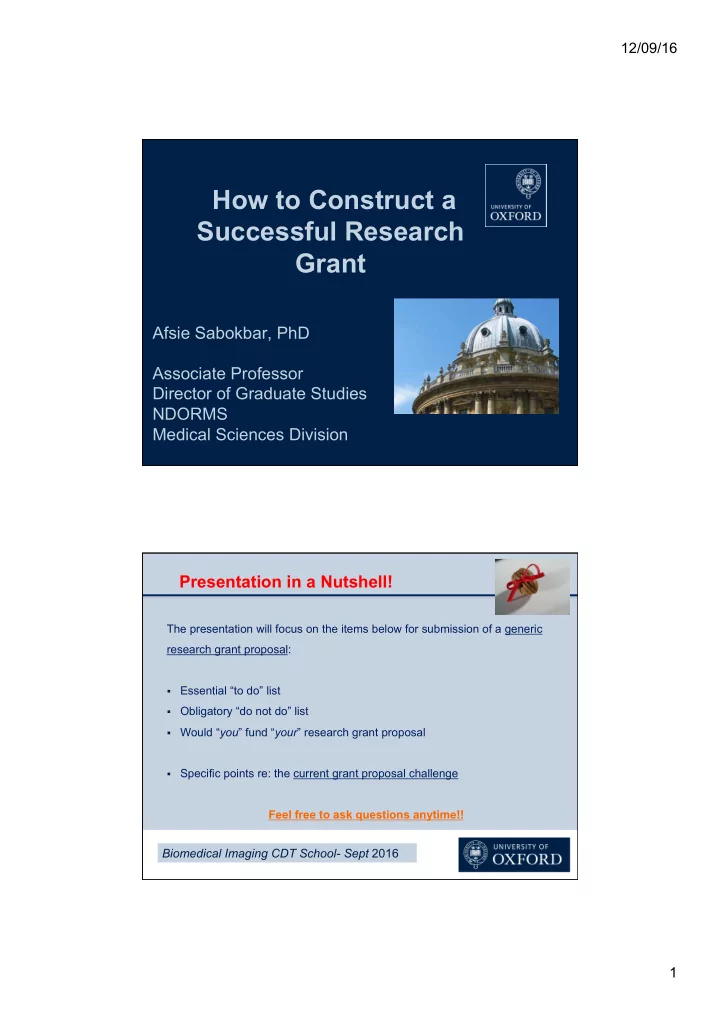
12/09/16 How to Construct a Successful Research Grant Afsie Sabokbar, PhD Associate Professor Director of Graduate Studies NDORMS Medical Sciences Division Presentation in a Nutshell! The presentation will focus on the items below for


slide-1
SLIDE 1

12/09/16 1

Afsie Sabokbar, PhD Associate Professor Director of Graduate Studies NDORMS Medical Sciences Division

How to Construct a Successful Research Grant

Biomedical Imaging CDT School- Sept 2016 The presentation will focus on the items below for submission of a generic research grant proposal:

§ Essential “to do” list § Obligatory “do not do” list § Would “you” fund “your” research grant proposal § Specific points re: the current grant proposal challenge

Feel free to ask questions anytime!!

Presentation in a Nutshell!

slide-2
SLIDE 2

12/09/16 2

Biomedical Imaging CDT School- Sept 2016

TO DO LIST

Biomedical Imaging CDT School- Sept 2016

1.

Identify the most suitable research funding organisation

2.

Check their website for specific guidelines and deadlines

3.

EOI (often a max number of pages) - check dates for the

  • utcome and time required to submit a full research proposal

4.

Check the specific themes fitting your research category

5.

FOLLOW the instructions provided ABSOLUTELY

6.

Research proposal must be novel, scientifically-relevant & well-thought through with noted clinical/scientific relevance/ impact

Essential ’to-do’ list…Preparation

slide-3
SLIDE 3

12/09/16 3

Biomedical Imaging CDT School- Sept 2016

1.

Do a literature review on your research question

2.

Compile all the available evidence & references on any studies conducted…READ the papers and not just the abstract

3.

How does your proposal differ from previously published work?

4.

Is it ‘doable’ in ‘your’ research institution?

5.

Could it be conducted in X years and with £Y?

6.

Do you have any preliminary data to submit?

Stage 1: “MUSTs...”:

Biomedical Imaging CDT School- Sept 2016

1.

Title …does it actually reflect the research question?

2.

Abstract ...be concise

3.

Lay summary ...ask a novice person to read it

4.

Background info ...Must be up-to-date Lit review

5.

Specific project aims ...(no more than 3 if possible)

6.

Detailed methodology ...is it achievable? (Gantt chart – allow time for difficulties; justify sample sizes with a power calculation)

7.

What is the potential clinical/scientific impact of your research?

8.

Track record of the applicant(s)

Usual structure…be aware of word limits

slide-4
SLIDE 4

12/09/16 4

Biomedical Imaging CDT School- Sept 2016 Find out:

a)

Who is responsible for grant submission from your institution?

b)

What are their “internal” deadlines?

c)

Seek advice from finance team: re: salary & overheads (if funding from commercial sources)

d)

Availability of the responsible person to sign the forms (HoD, finance, research services, animal facilities/licence)

e)

Will you use other departments’ facilities? If so, need to acquire the necessary collaboration letter So plan in advance & do not rush it!!

Stage 2. “MUSTs”

Biomedical Imaging CDT School- Sept 2016

What NOT TO DO….

slide-5
SLIDE 5

12/09/16 5

Biomedical Imaging CDT School- Sept 2016

ü Ignore the guidelines…font sizes, margins, number of

pages, word count, etc.

ü Expect your reviewer be an expert in the field. So set the

scene and provide motivation for your project

ü Assume they are not scientists…so provide a ‘managable

& affordable experimental plan of investigation’

ü Avoid the “what if” questions...the reviewer would want to

know if you have thought about the consequences of negative findings

ü Exaggerate – you cannot be in charge of 100s of projects

& students

Do not…

Biomedical Imaging CDT School- Sept 2016

Would you fund your research proposal?

slide-6
SLIDE 6

12/09/16 6

Biomedical Imaging CDT School- Sept 2016

§ Is the research proposal up-to-date? § Is it well-structured? § Are the research questions & hypotheses clearly laid out? § Do the aims/objectives reflect the title, abstract & lay

summary?

§ Does the economic impact seem realistic? § Is it achievable/deliverable in the time proposed?

Be impartial if you can…

Biomedical Imaging CDT School- Sept 2016

§ Success rates can be quite low.. § Accept the suggestion/recommendations of the reviewers &

improve the proposal

§ Be patient and try to understand that NOT all proposals can be

funded

§ Do not be disheartened…you will be successful next time § If in doubt seek advice from a dept research facilitator

Be prepared to be disappointed…

slide-7
SLIDE 7

12/09/16 7

Biomedical Imaging CDT School- Sept 2016

Mini Grant Challenge

Biomedical Imaging CDT School- Sept 2016

1.

Two years and for a maximum of £150k

2.

Proposal no more than 3 pages & no smaller than 10 font size

3.

Title, abstract & lay summary (250 words max)

4.

Scientific proposal (1.5 pages only)

5.

Budget justification (max 0.5 page)

6.

Presentation (5 minutes & no more than 3 slides)

What do the guidelines indicate?

slide-8
SLIDE 8

12/09/16 8

Biomedical Imaging CDT School- Sept 2016

http://www.mrc.ac.za/researchdevelopment/researchgrant.pdf http://twp.duke.edu/uploads/media_items/research-and-grant- proposal.original.pdf http://www.ninds.nih.gov/funding/write_grant_doc.htm http://www.esrc.ac.uk/funding/guidance-for-applicants/how-to- write-a-good-research-grant-proposal/

Other sources of information for ‘generic’ grant proposals

Biomedical Imaging CDT School- Sept 2016

THANK YOU FOR LISTENING…

ANY QUESTIONS ? ? ?