How to Detect How to Actually . . . Linear Dependence Resulting - - PowerPoint PPT Presentation

how to detect
SMART_READER_LITE
LIVE PREVIEW

How to Detect How to Actually . . . Linear Dependence Resulting - - PowerPoint PPT Presentation

Linear Dependencies . . . How Linear . . . Detecting Linear . . . Detecting Linear . . . How to Detect How to Actually . . . Linear Dependence Resulting Algorithm Heavy-Tailed . . . on the Copula Level? Utility: Reminder Case of


slide-1
SLIDE 1

Linear Dependencies . . . How Linear . . . Detecting Linear . . . Detecting Linear . . . How to Actually . . . Resulting Algorithm Heavy-Tailed . . . Utility: Reminder Case of Approximate . . . Home Page Title Page ◭◭ ◮◮ ◭ ◮ Page 1 of 13 Go Back Full Screen Close Quit

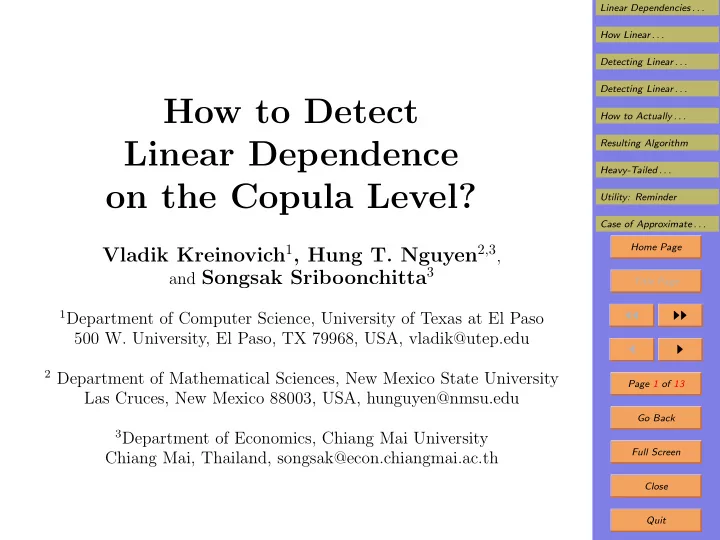
How to Detect Linear Dependence

  • n the Copula Level?

Vladik Kreinovich1, Hung T. Nguyen2,3,

and Songsak Sriboonchitta3

1Department of Computer Science, University of Texas at El Paso

500 W. University, El Paso, TX 79968, USA, vladik@utep.edu

2 Department of Mathematical Sciences, New Mexico State University

Las Cruces, New Mexico 88003, USA, hunguyen@nmsu.edu

3Department of Economics, Chiang Mai University

Chiang Mai, Thailand, songsak@econ.chiangmai.ac.th

slide-2
SLIDE 2

Linear Dependencies . . . How Linear . . . Detecting Linear . . . Detecting Linear . . . How to Actually . . . Resulting Algorithm Heavy-Tailed . . . Utility: Reminder Case of Approximate . . . Home Page Title Page ◭◭ ◮◮ ◭ ◮ Page 2 of 13 Go Back Full Screen Close Quit

1. Linear Dependencies Are Ubiquitous

  • Dependencies between quantities are often described

by smooth (even analytical) functions y = f(x1, . . . , xn): y = f(x(0))+

n

  • i=1

ci·(xi−x(0)

i )+ n

  • i=1

n

  • j=1

cij·(xi−x(0)

i )·(xj−x(0) j )+. . .

  • For values xi close to x(0)

i , we can safely ignore terms

which are quadratic in xi − x(0)

i

(or of higher order): y ≈ f(x(0)) +

n

  • i=1

ci · (xi − x(0)

i ).

  • Linear dependencies often extend beyond local.
  • Linear dependencies make computations easier; e.g.:

– systems of linear equations can be efficiently solved, – systems of non-linear equations are NP-hard.

  • It is thus important to detect linear dependencies.
slide-3
SLIDE 3

Linear Dependencies . . . How Linear . . . Detecting Linear . . . Detecting Linear . . . How to Actually . . . Resulting Algorithm Heavy-Tailed . . . Utility: Reminder Case of Approximate . . . Home Page Title Page ◭◭ ◮◮ ◭ ◮ Page 3 of 13 Go Back Full Screen Close Quit

2. How Linear Dependence is Detected Now

  • Exact linear dependence can be detected by whether

the corr. system of linear equations has a solution: y(k) = f(x(0)) +

n

  • i=1

ci ·

  • x(k)

i

− x(0)

i

  • ,

k = 1, . . . , K.

  • There exist efficient algorithms for checking solvability
  • f such a linear system.
  • Approximate linearity can be gauged by computing the

Pearson’s correlation coefficient r(F) = CXY σX · σY .

  • In the case of an exact linear dependence Y = c0+c1·X,

we have r(F) = 1 if c1 > 0 and rF = −1 if c1 < 0.

  • The square R2 = (r(F))2 is a measure of fit with the

linear model: the closer R2 to 1, the better the fit.

slide-4
SLIDE 4

Linear Dependencies . . . How Linear . . . Detecting Linear . . . Detecting Linear . . . How to Actually . . . Resulting Algorithm Heavy-Tailed . . . Utility: Reminder Case of Approximate . . . Home Page Title Page ◭◭ ◮◮ ◭ ◮ Page 4 of 13 Go Back Full Screen Close Quit

3. Detecting Linear Dependence Based on a Cop- ula: 1st Problem

  • A joint distribution of X and Y can be described by

the cdf F(x, y)

def

= Prob (X ≤ x & Y ≤ y).

  • This description depends on the units in which we de-

scribe x and y: m to cm, log scale, etc.

  • A unit-independent description is known as a copula:

C(a, b)

def

= F(x, y) for x, y s.t. a = FX(x) and b = FY (y).

  • Here, F(x, y) = C(FX(x), FY (y)), i.e.,

C(a, b) = F(F −1

X (a), F −1 Y (b)).

  • How can we detect linear dependence between the quan-

tities x and y based only on the copula C(a, b)?

slide-5
SLIDE 5

Linear Dependencies . . . How Linear . . . Detecting Linear . . . Detecting Linear . . . How to Actually . . . Resulting Algorithm Heavy-Tailed . . . Utility: Reminder Case of Approximate . . . Home Page Title Page ◭◭ ◮◮ ◭ ◮ Page 5 of 13 Go Back Full Screen Close Quit

4. Detecting Linear Dependence Based on a Cop- ula: Main Idea and the Resulting Definition

  • For a given copula C(a, b), possible cdfs are of the form

F(x, y) = C(FX(x), FY (y)).

  • A dependence is linear if r = ±1 for some marginals

FX(x) and FY (y).

  • So, we define measures of linearity as

L− def = min

FX(x),FY (y) r(C(FX(x), FY (y));

L+ def = max

FX(x),FY (y) r(C(FX(x), FY (y)).

  • The values L− and L+ depend only on the copula.
  • As a measure of fit, we can use M = max((L−)2, (L+)2).
  • M = 1 if and only if the dependence is linear for some

marginals.

slide-6
SLIDE 6

Linear Dependencies . . . How Linear . . . Detecting Linear . . . Detecting Linear . . . How to Actually . . . Resulting Algorithm Heavy-Tailed . . . Utility: Reminder Case of Approximate . . . Home Page Title Page ◭◭ ◮◮ ◭ ◮ Page 6 of 13 Go Back Full Screen Close Quit

5. How to Actually Compute L− and L+: Towards an Algorithm

  • For any X and Y corr. to the copula, all others are
  • btained by re-scaling X′ = A(X) and Y ′ = B(Y ).
  • Thus, L− is min and L+ is max of the expression

L

def

= r(C(A(x), B(y)) over all possible A(x) and B(y).

  • Min, max are attained when

δL δA(x) = δL δB(y) = 0, so: A(x) = a1+a2·E[B(Y ) | X = x]; B(y) = b1+b2·E[A(X) | Y = y].

  • W.l.o.g., we can take A(0) = B(0), A(1) = B(1) = 1;

then: A(x) = E[B(Y )) | X = x] − E[B(Y ) | X = 0] E[B(Y ) | X = 1] − E[B(Y ) | X = 0] ; B(y) = E[A(X) | Y = y] − E[A(X) | Y = 0] E[A(X) | Y = 1] − E[A(X) | Y = 0].

slide-7
SLIDE 7

Linear Dependencies . . . How Linear . . . Detecting Linear . . . Detecting Linear . . . How to Actually . . . Resulting Algorithm Heavy-Tailed . . . Utility: Reminder Case of Approximate . . . Home Page Title Page ◭◭ ◮◮ ◭ ◮ Page 7 of 13 Go Back Full Screen Close Quit

6. Resulting Algorithm

  • We start with some initial functions A(0)(x) and B(0)(y).
  • For example, we can take A(0)(x) = x and B(0)(y) = y.
  • Once we know A(k)(x) and B(k)(y), we compute:

A(k+1)(x) = E[B(k)(Y )) | X = x] − E[B(k)(Y ) | X = 0] E[B(k)(Y ) | X = 1] − E[B(k)(Y ) | X = 0] , B(k+1)(y) = E[A(k)(X) | Y = y] − E[A(k)(X) | Y = 0] E[A(k)(X) | Y = 1] − E[A(k)(X) | Y = 0].

  • We stop when

|A(k+1)(x)−A(k+1)(x)| ≤ ε; |B(k+1)(y)−B(k+1)(y)| ≤ ε.

  • We then compute L± = r(A(k+1)(x), B(k+1)(y)).
  • Testing: for jointly distributed Gaussian variables, this

indeed leads to Pearson’s correlation r(F).

slide-8
SLIDE 8

Linear Dependencies . . . How Linear . . . Detecting Linear . . . Detecting Linear . . . How to Actually . . . Resulting Algorithm Heavy-Tailed . . . Utility: Reminder Case of Approximate . . . Home Page Title Page ◭◭ ◮◮ ◭ ◮ Page 8 of 13 Go Back Full Screen Close Quit

7. Two Important Mathematical Subtleties

  • 1. X is not well correlated with Y = X when X ≥ 0 and

Y = Z = X for X < 0.

  • However, L(A(X), B(Y )) = 1 when A(x) = x and

B(y) = y for x, y ≥ 0 and A(x) = B(y) = 0 else.

  • We thus need to make sure that A(x) and B(y) are

never constant.

  • So, for some δ > 0, we require that A′(x) ≥ δ and

B′(y) ≥ δ for all x and y.

  • 2. Max, min are always attained only on a compact set.
  • Due to Ascoli-Arzela theorem, compactness means that

functions should be uniformly continuous.

  • So, we select M > 0 and require that A′(x) ≤ M and

B′(y) ≤ M for all x and y. Under these requirements, the definition works.

slide-9
SLIDE 9

Linear Dependencies . . . How Linear . . . Detecting Linear . . . Detecting Linear . . . How to Actually . . . Resulting Algorithm Heavy-Tailed . . . Utility: Reminder Case of Approximate . . . Home Page Title Page ◭◭ ◮◮ ◭ ◮ Page 9 of 13 Go Back Full Screen Close Quit

8. Heavy-Tailed Distribution: 2nd Problem

  • Pearson’s correlation r(F) =

CXY σX · σY assumes that the marginal distributions have finite variance.

  • In reality, however, many econometric-related distribu-

tions are heavy-tailed, with infinite variance.

  • In the 1960s, B. Mandelbrot showed that large-scale

fluctuations have pdf ρ(y) = A · y−α, with α ≈ 2.7.

  • For this distribution, variance is infinite.
  • Since then, similar heavy-tailed distributions have been

empirically found in other financial situations.

  • We thus need to extend our definitions to the heavy-

tailed case.

slide-10
SLIDE 10

Linear Dependencies . . . How Linear . . . Detecting Linear . . . Detecting Linear . . . How to Actually . . . Resulting Algorithm Heavy-Tailed . . . Utility: Reminder Case of Approximate . . . Home Page Title Page ◭◭ ◮◮ ◭ ◮ Page 10 of 13 Go Back Full Screen Close Quit

9. Utility: Reminder

  • People’s behavior is determined by their preferences.
  • A standard way to describe preferences of a decision

maker is to use the notion of utility u.

  • A user prefers an alternative for which the expected

value

n

  • i=1

pi · ui of the utility is the largest possible.

  • Alternative, we can say that the expected value

n

  • i=1

pi · Ui of the disutility U

def

= −u is the smallest.

  • For a random variable, we select an estimate m that

minimizes expected disutility: dU(X)

def

= min

m E[U(Y −m)] = min m

  • U(y−m)·ρ(y) dy.
slide-11
SLIDE 11

Linear Dependencies . . . How Linear . . . Detecting Linear . . . Detecting Linear . . . How to Actually . . . Resulting Algorithm Heavy-Tailed . . . Utility: Reminder Case of Approximate . . . Home Page Title Page ◭◭ ◮◮ ◭ ◮ Page 11 of 13 Go Back Full Screen Close Quit

10. Case of Approximate Linear Dependence

  • If we only know the variable Y , then we select the

estimate m minimizing disutility: dU(Y )

def

= min

m E[U(Y −m)] = min m

  • U(y−m)·ρ(y) dy.
  • If Y ≈ c0 + c1 · X, then using this estimate instead of

m decreases disutility to: dU(Y | X) = min

c0,c1

  • U(y − (c0 + c1 · x)) · ρ(x, y) dx dy.
  • The corresponding decrease DU(Y | X) in disutility can

be thus estimated as DU(Y | X)

def

= dU(Y ) − dU(Y | X) d(Y ) .

  • When U(d) = d2, we get mean and Pearson’s correla-

tion: m = E[Y ] and DU(Y | X) = R2 = (r(F))2.

slide-12
SLIDE 12

Linear Dependencies . . . How Linear . . . Detecting Linear . . . Detecting Linear . . . How to Actually . . . Resulting Algorithm Heavy-Tailed . . . Utility: Reminder Case of Approximate . . . Home Page Title Page ◭◭ ◮◮ ◭ ◮ Page 12 of 13 Go Back Full Screen Close Quit

11. Approximate Linear Dependence (cont-d)

  • In the above definitions, we only got (r(F))2, i.e., only

the absolute value |r(F)| of the correlation r(F).

  • To get the sign of the correlation, we must separately

consider ↑ and ↓ linear dependencies c0 + c1 · X: d+

U(Y | X) = min c0;c1≥0

  • U(y − (c0 + c1 · x)) · ρ(x, y) dx dy;

d−

U(Y | X) = min c0;c1≤0

  • U(y − (c0 + c1 · x)) · ρ(x, y) dx dy;

and D±

U(Y | X) def

= dU(Y ) − d±

U(Y | X)

d(Y ) .

  • When U(d) = d2, then:
  • (r(F))2 = D+

U(Y | X) when r(F) ≥ 0, and

  • (r(F))2 = D−

U(Y | X) when r(F) ≤ 0.

slide-13
SLIDE 13

Linear Dependencies . . . How Linear . . . Detecting Linear . . . Detecting Linear . . . How to Actually . . . Resulting Algorithm Heavy-Tailed . . . Utility: Reminder Case of Approximate . . . Home Page Title Page ◭◭ ◮◮ ◭ ◮ Page 13 of 13 Go Back Full Screen Close Quit

12. Acknowledgments This work was supported in part:

  • by the National Science Foundation grants:

– HRD-0734825 and HRD-1242122 (Cyber-ShARE Center of Excellence) and – DUE-0926721,

  • by Grants 1 T36 GM078000-01 and 1R43TR000173-01

from the National Institutes of Health, and

  • by a grant N62909-12-1-7039 from the Office of Naval

Research.