How to grow London How to grow London Londons growth how big and - - PDF document

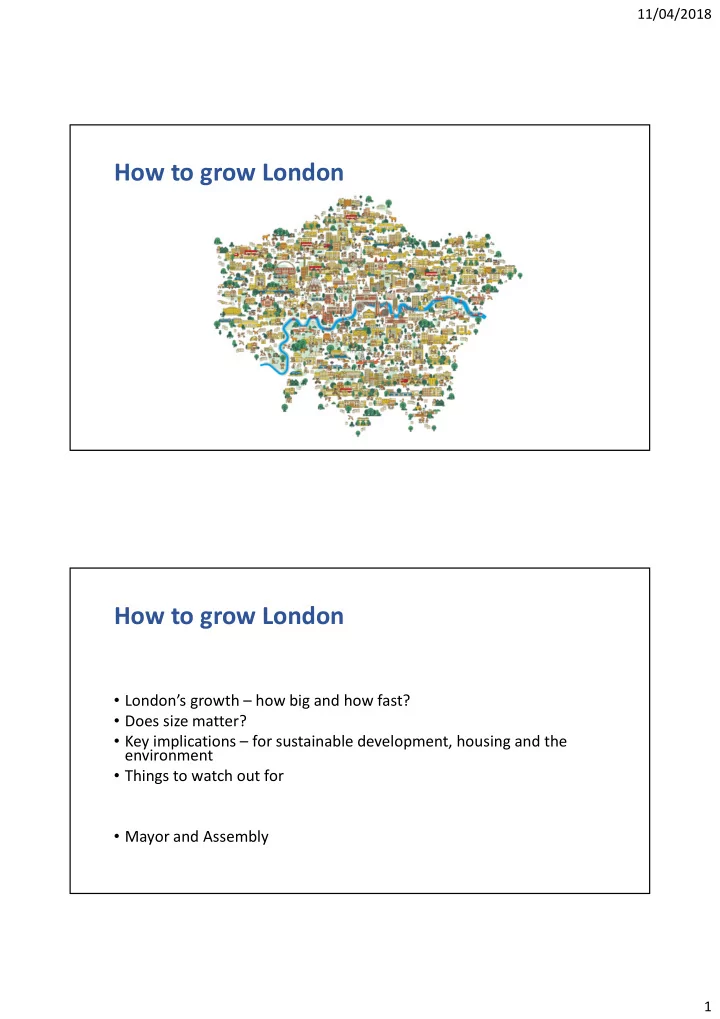
how to grow london how to grow london
SMART_READER_LITE
LIVE PREVIEW

How to grow London How to grow London Londons growth how big and - - PDF document

11/04/2018 How to grow London How to grow London Londons growth how big and how fast? Does size matter? Key implications for sustainable development, housing and the environment Things to watch out for Mayor and


slide-1
SLIDE 1

11/04/2018 1

How to grow London How to grow London

  • London’s growth – how big and how fast?
  • Does size matter?
  • Key implications – for sustainable development, housing and the

environment

  • Things to watch out for
  • Mayor and Assembly
slide-2
SLIDE 2

11/04/2018 2

The Mayor of London

  • A directly elected Mayor with executive powers
  • Largest personal mandate of any UK politician
  • Principal roles set down in the GLA Act:
  • Promote economic development and wealth creation
  • Promote social development
  • Promote the improvement of the environment
  • Seven statutory strategies – including the London

Plan

The Mayor of London

slide-3
SLIDE 3

11/04/2018 3

TfL £3,737m MOPAC GLA LFEPA

I£460mI I£187mI

LLDC

£2,014m

£9,456m

Expenditure by GLA body

The GLA group’s budget

The London Assembly

slide-4
SLIDE 4

11/04/2018 4

London Assembly 2016 London’s growth - how big and how fast?

London is already the same size as 24 of the country’s biggest cities combined

slide-5
SLIDE 5

11/04/2018 5

London’s growth – will be big and fast

ONS estimates are even higher…

  • 2014 – 8.5 million
  • 2018 – 9.1 million
  • 2020 – 9.3 million
  • 2025 – 9.8 million
  • 2030 – 10.2 million
  • 2035 – 10.7 million

Southwark’s growth

  • Southwark population 306,745 -

estimated to increase by 47,018

  • ver the next 10 years
  • Represents a 15% increase,

compared to a 10% increase in London

  • The 65+ age group is predicted

to grow, the fastest (32%) and the 20-39 group the slowest (9%) Has Southwark reached ‘peak primary’?

12000 14000 16000 18000 20000 22000 24000 26000 28000 2016/17 2017/18 2018/19 2019/20 2020/21 2021/22 2022/23 2023/24 2024/25 2025/26 2026/27 2027/28

Southwark school age projections

Primary population Secondary population

slide-6
SLIDE 6

11/04/2018 6

Does size matter?

Not if it’s managed sustainably - with adequate supporting infrastructure

Cities can be densely populated without being overpopulated

Overpopulation - having more people in one place that can live there comfortably, or more than the resources available can cater for. Singapore, a small island, has a high population density – about 10,200 per sq km – but few people would call it

  • verpopulated.
slide-7
SLIDE 7

11/04/2018 7

By 2050 London will need…

  • 1.5 million new homes
  • More than 800,000 new jobs
  • 600 more schools and colleges
  • 50% increase in public transport

capacity

  • 20% increase in energy capacity
  • £1 billion investment in extra healthcare
  • 9000 hectares of accessible green space
  • 40 new recycling facilities

All London Mayors have had their red lines in terms of managing growth

slide-8
SLIDE 8

11/04/2018 8

Managing growth – Mayoral policy choices

Current London Plan Policy 1.1 A) Growth and change in London will be managed in order to realise the Mayor’s vision for London’s sustainable development. B) Growth will be supported and managed across all parts of London to ensure it takes place within the current boundaries of Greater London without:

  • encroaching on the Green Belt, or on London’s protected open spaces
  • having unacceptable impacts on the environment

New Mayoral policy

Continues the overall ‘compact city’ approach but with ‘a twist’ Policy Good Growth 2: Making the best use of land To create high-density, mixed-use places that make the best use of land, those involved in planning and development must… Proactively explore the potential to intensify the use of land… promoting higher density development… Protect London’s open spaces, including the Green Belt, Metropolitan Open Land… and promote the creation of new green infrastructure and urban greening.

slide-9
SLIDE 9

11/04/2018 9

What does this approach mean for managing London’s growth?

  • Increases in density
  • Housing delivery
  • Co-location and mixed use development
  • Protecting open space and promoting ‘urban greening’
  • Shifting transport patterns and improving air quality

Increasing density

Continuing the ‘compact city’ approach means that… By 2041, population density will reach levels that cities like Rio, Osaka and Bangkok experience today, or double the density levels

  • f cities like Paris, Rome and

Berlin

slide-10
SLIDE 10

11/04/2018 10

Southwark has high population density - already

Southwark is the 9th most densely populated in England & Wales Southwark more than twice as densely populated as London Newington is the most densely populated ward – nearly 3 times higher than London average 10,632 persons / Sq. Km compared to Singapore 10,200

More to come?

This? Or this?

slide-11
SLIDE 11

11/04/2018 11

Density does not have to mean high rise

But it must be well designed with good space standards and

  • ffer facilities for

families… Family homes can be provided with private gardens at street and roof level providing a mix of housing types and sizes on one site

Delivering new housing will be vital

The Mayor has identified need for 66,000 additional homes a year and there are sites available to accommodate 64,500 new homes a year. But the key factor is delivering new homes. And the record is not good. But is this improving? In 2016-17, London supplied 39,560 net additional homes. This was a 30 per cent increase over the previous year, when 30,390 homes were supplied.

slide-12
SLIDE 12

11/04/2018 12

How is it looking for Southwark? Southwark’s housing targets are increasing

slide-13
SLIDE 13

11/04/2018 13

Southwark rarely meets the housing targets

500 1000 1500 2000 2500 2011/12 2012/13 2013/14 2014/15 2015/16 2016/17

Southwark: new homes vs London Plan target

Housing completions LP 2011 target

Southwark – affordable housing completions average 532 per year

  • 200

400 600 800 1,000 1,200 2008-09 2009-10 2010-11 2011-12 2012-13 2013-14 2014-15 2015-16 2016-17 2017-18

slide-14
SLIDE 14

11/04/2018 14

Failure to deliver these homes will have an impact on overcrowding and affordability

  • Households experiencing multiple housing

problems have increased children’s risk of ill- health and disability by up to 25 per cent.

  • Overcrowding affects larger households

disproportionately

  • Overcrowding has a negative impact on

children, especially health and educational attainment.

  • About 331,000 London children live in

crowded conditions

  • One in three children in social rented housing

are overcrowded.

slide-15
SLIDE 15

11/04/2018 15

Children in overcrowded housing are up to ten times more likely to contract meningitis than children in general. There is a direct link between childhood tuberculosis and overcrowding. Mental health issues such as anxiety and depression have also been linked to

  • vercrowded and unfit housing.

Overcrowded housing affects children’s ability to learn at school and study at home. Children in overcrowded homes miss more school due to illnesses and infections. Overcrowding is linked to delayed cognitive development.

London’s unaffordable housing

Price to earning ratio Average house price

  • 100,000

200,000 300,000 400,000 500,000 600,000 2 2 2 3 2 4 2 5 2 6 2 7 2 8 2 9 2 1 2 1 1 2 1 2 2 1 3 2 1 4 2 1 5 London UK excl London 2 4 6 8 10 12 14 16 Inner London Outer London London England

slide-16
SLIDE 16

11/04/2018 16

Southwark house prices have increased 602% in twenty years

100000 200000 300000 400000 500000 600000 1995 1996 1997 1998 1999 2000 2001 2002 2003 2004 2005 2006 2007 2008 2009 2010 2011 2012 2013 2014 2015 2016

Average house prices now 16 times median Southwark earnings

Density - Co-location and mixed use development

Policy Good Growth 2: Making the best use of land To create high-density, mixed-use places that make the best use of land … Opportunities for intensification of industrial land and co-location of industrial and residential uses [should be] fully explored… Co-location of different forms of social infrastructure… Examples of this include schools opening their facilities out of hours for use by the community…

slide-17
SLIDE 17

11/04/2018 17

Co-location – Holy Trinity Primary, Dalston

With no funding available and increasing demand for primary school places, the design solution was simple… within the dense urban context. A replacement two form entry primary school built at ground and first floor with a double height play deck at second; and 101 new apartments above to cross-subsidise the school's expansion programme.

Protecting open space and promoting ‘urban greening’

Mayor’s long-term target of making more than 50 per cent of London green by 2050. New provision or improved access particularly encouraged in areas of deficiency in access to open space. Local open space audits. Urban greening covers a wide range of options including street trees, green roofs, green walls, and rain gardens. Urban greening factor will determine how new development will be required to meet the 50 per cent target

slide-18
SLIDE 18

11/04/2018 18

The urban greening factor – looks complicated but isn’t (really?)

Policy G5 Urban greening The Urban Greening Factor for a proposed development is calculated in the following way: (Factor A x Area) + (Factor B x Area) + (Factor C x Area) etc. divided by Total Site Area So, for example, an office development with a 600 sqm footprint on a site of 1,000 sqm including a green roof, 250 sqm car parking, 100 sqm open water and 50 sqm of amenity grassland would score the following; (0.7 x 600) + (0.0 x 250) + (1 x 100) + (0.4 x 50) / 1000 = 0.54 So in this example, the proposed office development exceeds the interim target score of 0.3 for a predominately commercial development under part B of Policy G5 Urban greening.

Shifting transport patterns and improving air quality

slide-19
SLIDE 19

11/04/2018 19

London’s air quality

One-third of nursery schools, nearly 20% of primaries and 18% of secondary schools in the capital are in areas where toxic levels of nitrogen dioxide threaten children’s health The European nitrogen dioxide (NO2) legal limit is 40 micrograms of nitrogen dioxide per cubic metre of air
slide-20
SLIDE 20

11/04/2018 20

London’s schools with the worst air quality

Of the top 100 primary schools – 13 are in Southwark

% FSM NO2 average St George's Cathedral Catholic Primary School 12.1 64.3 St Jude's Church of England Primary School 12 55.6 Tower Bridge Primary School 26.3 55.0 Saint Joseph's Catholic Primary School, the Borough 16.8 53.2 The Cathedral School of St Saviour and St Mary Overy 9.7 51.4 Charlotte Sharman Primary School 10.3 51.1 Townsend Primary School 25.4 50.2 Grange Primary School 24.1 49.9 Victory School 10 49.7 Charles Dickens Primary School 22.2 49.0 Friars Primary Foundation School 17.1 47.8 St John's Walworth Church of England Primary School 20.8 47.8 St James' Church of England Primary School 24.6 46.6

Of the top 100 secondary schools – 11 are in Southwark

NO2 average Notre Dame Roman Catholic Girls' School 55.9 St Saviour's and St Olave's Church of England School 54.9 Ark All Saints Academy 44.6 Sacred Heart Catholic School 44.5 Ark Globe Academy 43.5 Ark Walworth Academy 43.3 Harris Academy Peckham 42.6 University Academy of Engineering South Bank 41.7 Harris Academy Bermondsey 40.7 City of London Academy (Southwark) 40.5 Harris Boys' Academy East Dulwich 39.7

The European nitrogen dioxide (NO2) legal limit is 40 micrograms of nitrogen dioxide per cubic metre of air

slide-21
SLIDE 21

11/04/2018 21

Transport and Healthy Streets….

Overall strategic target of 80% of all trips to be made by foot, cycle or public transport by 2041 Healthy Streets aims to improve health and reduce health inequalities, reduce car use, improve road safety, reduce vehicle emissions, increase walking, cycling and public transport use. Development should be planned to deliver patterns of land use that enable people to make shorter and regular trips by walking and cycling.

Ten Healthy Streets Indicators

The Healthy Streets Approach uses 10 indicators based on evidence of what is needed to create a healthy, inclusive environment in which people choose to walk, cycle and use public transport. New developments and public realm schemes should deliver improvements against the Healthy Streets Indicators.

slide-22
SLIDE 22

11/04/2018 22

Air quality – the London Plan says….

Ensure that new developments are designed and built, as far as is possible, to improve local air quality and reduce the extent to which the public are exposed to poor air quality. Air quality assessments Inventory of emission sources Air Quality Focus Areas Further guidance will be published on Air Quality Neutral and Air Quality Positive standards as well as guidance on how to reduce construction and demolition impacts

The Draft Environment Strategy says…

Achieve legal compliance with UK and EU limits as soon as possible A zero emission London by 2050, meeting World Health Organisation guidelines for air quality

  • Impose restrictions on the emissions allowed from buildings and transport

e.g. The Ultra-Low Emissions Zone.

  • Introduce standards that London should be encouraged to meet e.g. Euro

emissions standards for vehicles.

  • Invest in or promote the use of technologies that either improve air quality
  • r have a reduced impact e.g. Ultra-Low Emission Vehicles
  • Encourage Londoners’ to change their behaviour to mitigate the impacts of

poor air quality e.g. through promoting active travel or school education programmes

slide-23
SLIDE 23

11/04/2018 23

Other Mayoral air quality initiatives

Toxicity Charge (T-Charge) A £10 T- charge now applies during peak congestion polluting vehicles aren't welcome. Ultra Low Emission Zone - World’s first Ultra Low Emission Zone is to start April 2019, supersedes the T-charge and create stricter emissions standards for diesel vehicles, 24 hours, 7 days a week. Expected to reduce Nitrogen Oxide emissions by about 50 per cent in central London, 40 per cent in inner London and 30 per cent in outer London. London's buses - The Mayor is spending more than £300 million retrofitting thousands of buses and committing to phase out pure diesel double deck buses from 2018. Protecting schools from pollution. 50 'air quality' audits will take place at primary schools in areas exceeding legal limits of nitrogen dioxide. London's taxis. New taxis licensed after 1 January 2018 will need to be zero emission capable.

Things to watch out for

  • Are housing targets being met – and are they affordable?
  • What densities are being proposed – how do they affect family

housing?

  • What is the council doing to address overcrowding?
  • Do new developments deliver new open space and play space?
  • Are proposals for co-locating new schools sustainable?
  • Is the council and TfL delivering healthy streets?
  • What action is being taken to address air quality?