SLIDE 1
How To Navigate The Publication Of Books: From Proposal to Indexing
Inside Perspectives on the Editorial Process Nick Anguelov, Ph.D., Department of Public Policy
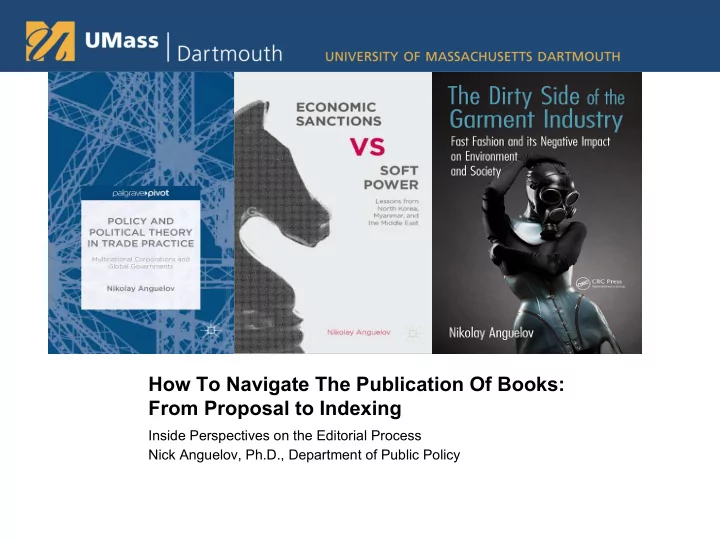
Nikolay Anguelov
SLIDE 2
Query Letter – It’s a sales pitch. Think “Shark Tank” – propose a product that fills a gap in the market. Discuss the market – “this text can be assigned in curricula in these particular courses at those levels” Explain the need for the book – offer examples of lack of texts that address the gap you identified Explain how the book adds to the literature
Common mistake: Focusing on the originality of the idea. While it is important, the editor is most concerned how this original idea can be sold.
SLIDE 3 The Query Letter Format: One page only because if the query letter is successful the editor will ask for a summary. The Summary Format: All about the literature. Focus on gaps in the literature, the reasons for the gaps and how your book will fill them with
- EVIDENCE. Includes many citations and a
list of references of the most important works in the field(s) Summary Layout – two pages of text, two pages of references
Common Mistake: Not providing a list of references but philosophizing about what you would like to write. The editor wants only evidence. Do not use future tense. Write as although the book is finished.
SLIDE 4
The Actual Proposal – once the summary has caught the attention of the editor, you will receive either an outline to fill out of an actual proposal, or you can just be told to submit an actual proposal without a template Most important is a chapter by chapter table of contents. Include subheadings. If there is an “executive summary part” do not resubmit the “summary” you sent to your editor. Prepare a new summary which is briefer (6 paragraphs) with no citations.
Common Mistake: No chapter subheadings and general language in the title of each chapter. Your table of contents is a map that helps the editor visualize the flow of your logic.
SLIDE 5 The proposal goes forward: getting in front
Sample chapters – if your proposal is based on your dissertation DO NOT SEND THE ENTIRE DISSERTAION Send the “introduction” or first chapter and the last chapter and explain how the “in between” will be “developed”. If your dissertation was a three-paper format, then you can attach the individual papers
Common Mistake: Sending the finished dissertation. For one thing, nobody wants to read it. For another, the editorial board will not read it, but will defer to the recommendation of your editor.
SLIDE 6
The review process: only the sample chapters go out for review. In your proposal you’ll be asked to identify reviewers. Choose such scholars that a) will be aligned with your logic but won’t be jealous that you had the idea, not them and b) are likely to “commit” to the project Those sample chapters can make you or break you. If reviews come back with “suggestions” you have to prepare a response. It is that response, with the reviews themselves and the sample chapters that your editor will bring to the editorial board for final decision. The ONLY thing the board will “glance at” is the reviews themselves and your responses
Common Mistake: Underestimating the editor’s role in this dynamic. Editors are content experts so in effect their opinion may be more important to the editorial board than the reviewers. Still, they can ONLY bring in a full proposal to the board, so your attention to the reviews and your responses to each of the comments are ESSENTIAL.
SLIDE 7 The Contract: Once the board meets, a contract is drawn. You will be “given” a new title for your
You have NO wiggle room on royalties, don’t even bring up the subject Understand the importance of length – Pivot, vs. Monograph, vs. Textbook formats Dates are of the essence because of the
- utsourcing of the production process
Common mistake: Not thanking your editor and the editorial assistant enough. This is where you can strategically begin to get
- n your editor’s good side because from this point on his/her role
becomes even more important.
SLIDE 8
Manuscript Delivery – make sure it’s stellar Do not “create” work for your editor as he/she will go over your manuscript extremely carefully Make sure all graphics are high resolution Make sure they are SIMPLE Make sure all your references are consistent Prepare all forms – marketing form, authorization form, permission forms. Without them the manuscript cannot go into production.
Common Mistake: Sending one long file. Create separate chapter files, a separate references file, and separate acknowledgements, introduction, and author bio files.
SLIDE 9
The Production Process - this is where the power of your editor maximally manifests itself If he/she is unhappy with any portion of your work, he/she can request a second round of reviews. This process can get ugly. On the other hand, if it all looks good, the book goes into production and the editor is done From this point on the editorial assistant drives the process The process is in India Indexing – HIRE SOMEONE
Common Mistake: Drastic changes in the content that were not part of the proposal. Even small changes can seem drastic to the editor.