How universities can assess employability skills? V ronique PELT - - PDF document

how universities can assess employability skills
SMART_READER_LITE
LIVE PREVIEW

How universities can assess employability skills? V ronique PELT - - PDF document

IIIst International Workshop at the University of Konstanz, AG Hochschulforschung and FREREF Rseau Uni 21 How universities can assess employability skills? V ronique PELT & Mich ronique PELT & Mich le BAUMANN le BAUMANN V


slide-1
SLIDE 1

How universities can assess employability skills?

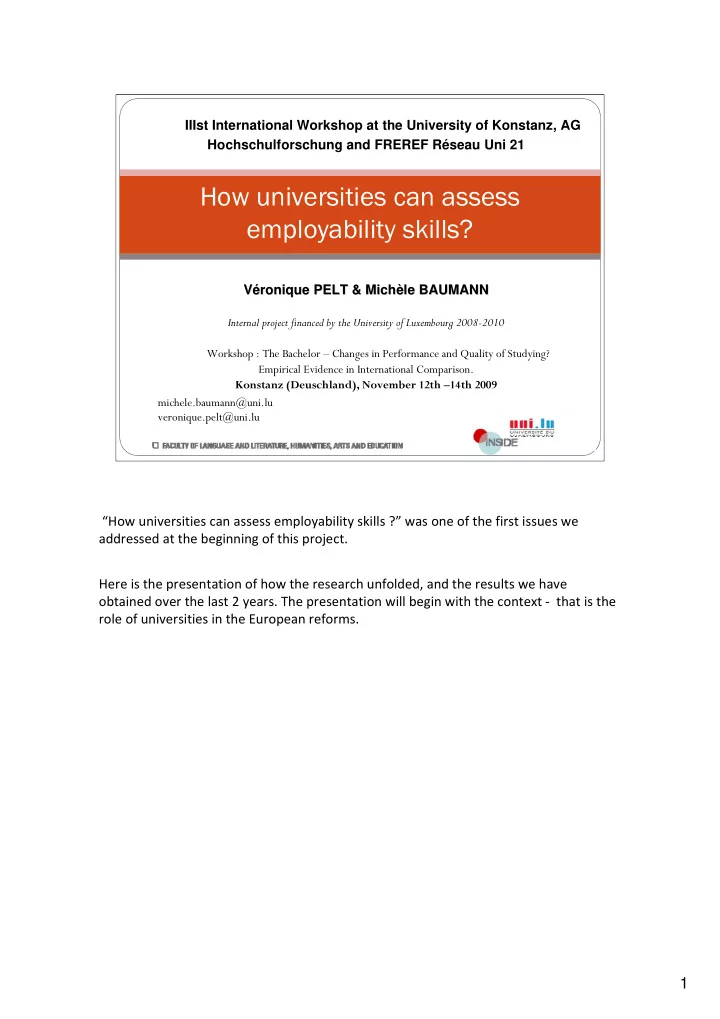
IIIst International Workshop at the University of Konstanz, AG Hochschulforschung and FREREF Réseau Uni 21 V Vé éronique PELT & Mich ronique PELT & Michè èle BAUMANN le BAUMANN

Internal project financed by the University of Luxembourg 2008-2010 Workshop : The Bachelor – Changes in Performance and Quality of Studying? Empirical Evidence in International Comparison. Konstanz (Deuschland), November 12th –14th 2009 michele.baumann@uni.lu veronique.pelt@uni.lu

“How universities can assess employability skills ?” was one of the first issues we addressed at the beginning of this project. Here is the presentation of how the research unfolded, and the results we have

  • btained over the last 2 years. The presentation will begin with the context ‐ that is the

role of universities in the European reforms.

1

slide-2
SLIDE 2

Introduction : The Bologna Process

Evolution of the university missions:

Guarantee students a quality of life favourable to their studies

(European Council, 1997)

Promote employability skills (Bologna declaration, 1999) Encourage and develop a participative process (Lisbon, 2000). Evaluate their satisfaction (Berlin Communiqué, 2003) Orientate and accompany students (Bergen Communiqué,

2005).

When we are talking about the place of university, we are speaking about the role of universities as manifested in the evolution of the Bologna Process. Within the framework of that Process (European Council 1997), Ministers responsible for higher education “stress the need for appropriate studying and living conditions for the students, so that they can successfully complete their studies within an appropriate period of time without obstacles related to their social and economic background.” As saw since this morning, Intense pressure has been put on universities by current reforms initiated as part of the Bologna Process. They have become, as Strecker said in 2004, work environments where the objective is to make students more competitive and ready to face the demands of professional life. In 2000, the Lisbon Council emphasised these objectives to increase growth and employment, and support durable development. This new role for universities makes them places of high level of productivity. If we are looking to this evolution we note that university had : 1.in 1997, after the European Council: to guarantee students a quality of life favourable to their studies 2.in 1999, with the Bologna declaration, to promote employability skills.

  • 3. in 2000, to encourage and develop a participative process.
  • 4. In 2003, in the Berlin Communiqué to evaluate their satisfaction.
  • 5. In 2005, in Bergen to orientate and accompany students.

In reality more than 16 million students attending European universities (with an annual growth rate of over 2% for 1998‐2002 ‐ European Commission 2005) and they are expected to be competitive and to learn more and more employability skills; but what are employability skills and how the university can assess them?

2

slide-3
SLIDE 3

Before presenting our method and results, we will turn to theory and our understanding

  • f what politicians really want from universities and for definite what gaining

competency.

3

slide-4
SLIDE 4

1.The key competences : an European priority

1970 : Departure of a new concept : “Competence” 1997 – 2009 : OECD Projects

DeSeCo: Definition and Selection of Competences. Its conceptual

framework classifies competencies in 3 broad categories:

It drove PISA: Program for International Student Assessment

In the 70’s the concept of competences appeared in the CEFR: “Common European Framework of Reference for Languages: Learning, Teaching, Assessment”. That notion grew, thanks in particular to 2 projects: the DeSeCo and PISA from the OECD (Organisation for Economic Co‐operation and Development). The OECD’s DeSeCo Project was designed to bring a wide range of expert and stakeholder opinion together, to produce a coherent and widely shared analysis of which key competences are necessary for coping with the manifold challenges of today’s world. A core element of DeSeCo’s overarching conceptual framework consists of a holistic model of competence grounded in 3 key categories of competence – interacting in socially heterogeneous groups, acting autonomously, and using tools interactively.

4

slide-5
SLIDE 5

The key-competencies

1999-2009: From Bologna to Leuven

UE assigned to the education system (including universities) new aims -

among them the development of competences. There is now a link between higher education and the labour market

After the OECD, politicians took this concept as a call to action. That philosophy was established in Bologna and continues in Leuven this year. The challenge is not only to give students employability skills but also to promote sustainable employability. So what is that?

5

slide-6
SLIDE 6
  • 2. Sustainable employability:

a new mission for the universities

In 2000, Lisbon, universities were invited to include

employability in their programs of study:

Student should acquire knowledge necessary for academic success, and

the skills wanted by employers. (knowledge + skills = competence)

Employability becomes day after day a finality of study In the year 2000, European universities were invited to introduce employability into their programs of study. Students now have to acquire not only knowledge but also the skills wanted by employers. They must develop competences. As commonly defined, a competence is a combination of knowledge and skills, but in reality it is more than that. It involves the ability to meet complex demands by drawing

  • n and mobilising psychological resources (including skills and attitudes) in a particular

context. So now employability becomes an finality of study. In the presentation we will speak about both competences and employability skills.

6

slide-7
SLIDE 7
  • 3. Employability skills:

Identify them to assess them

3 kinds of employability skills:

Multi-fields : such as communicating, working with others Linked with a domain of speciality Specific to the organisation or the employment

CORCAN (key rehabilitation program of the Correctional Service of

Canada-CSV integrated in The Conference Board of Canada-1998) concerns

multi-fields skills. It proposed:

To identify the competences the literature points to 3 kinds of employability skill: The first directly enables one to carry out tasks without a specific training. The second is linked with a domain of speciality and should be acquired with external training. Finally, competences specific to an organisation or type of employment can be acquired only after recruitment. After working on these definitions, we were interested to hear the views of the Conference Board of Canada, an organisation whose mission is to aid in the safe reintegration of offenders into Canadian society by providing employment and employability skills training to offenders incarcerated in federal penitentiaries and, for brief periods of time, after they are released into the community. Its members proposed different skills needed in the world of work, which could be acquired by training at school/university (ie, the multi‐fields kind) called them ‘employability skills 2000+’.

7

slide-8
SLIDE 8

Employability skills 2000+

A total of 57 employability skills were identified, divided into 11 classes and then ranged into 3 groups: fundamental skills: skills needed as a basis for further development; personal management skills: correspond to the personal skills, attitudes, and behaviours that drive one’s potential for growth; and finally teamwork skills: those skills and attributes needed to contribute productively. We will cover the latter briefly.

8

slide-9
SLIDE 9
  • A. Fundamental Skills

That tool was endorsed by professionals (organisations of the Employability skills and Science Forums) and presents the skills needed by everyone, I quote, “to enter, stay in and progress in the world of work”. 1) For Corcan, acquisition of fundamental skills prepares people to progress more successfully in the world of work. To do that, they have to: communicate (6 skills); Manage information (2 skills); Use numbers (3 skills); Think and problem solve (9 skills).

9

slide-10
SLIDE 10
  • B. Personal Management Skills

Personal management skills are, as I said, personal skills, attitudes, and behaviours that drive one’s potential for growth. They allow people to offer others greater opportunity for achievement when they can: Demonstrate positive attitudes and behaviours (5 skills); be responsible (5 skills); be adaptable (6 skills); learn continuously (5 skills) and work safely (1 skill).

10

slide-11
SLIDE 11
  • C. Teamwork Skills

Teamwork skills and attributes are needed to contribute productively. People will be better prepared to add value to outcomes of a task, project, or team when they can: Work with others (9 skills) and participate in projects and tasks (6 skills)

11

slide-12
SLIDE 12
  • D. Assess employability skills : The final tool

From the Corcan, Statistics Canada created a self- evaluation instrument for university graduates, which can assess employability skills. It’s comprises 6 items:

writing critical thinking problem solving working effectively with others leading/supervising others ability to learn & use new technology

The evaluation is based on 3 components :

Possession- Acquisition- Utilisation

We didn’t use directly this approach because it was impossible to have a questionnaire to evaluate so many skills even if it was very interesting. We choose a approach more practical drawn from Corcan, 57 employability skills have been identified as important by the Conference Board of Canada (1998). After that, Statistics Canada altered them and proposed 3 types of skill they labelled: communication (writing & speaking), interpersonal skills (working effectively with others, and leading/supervising others) and innovative skills (critical thinking, problem solving, and learning & using new technology). They then introduced three components: possession, which indicates a graduate's belief that he or she possesses those skills; acquisition, which refers to their assessment of the degree to which they acquired these skills as a consequence of their university education; and utilisation, which refers to their opportunity to apply the skills in their current job. Having made this theoretical detour, we know now what an employability skill is and I can present our research.

12

slide-13
SLIDE 13

13

slide-14
SLIDE 14

Students’ QuAlity of Life and Employability Skills

  • 1. Aims and Objectives

The SQALES project aims to help universities:

Create a tool for assessing employability skills (ES) and address issues

raised by the Bologna Process and the European Higher Education Area (EHEA, European Council, 2009)

Create an evaluation device with which to establish benchmarks Facilitate a dialogue between the all those involved in order to meet

students’ needs

Adopt new activities and make use of new resources Compare themselves with other European universities

Objectives of SQALES :

Describe ES, WHOQoL domains and socio-demographic characteristics Analyse the links between ES and other variables Determine how students feel about their faculty as reflected in the scores

The SQALES (Students' Quality of Life and Employability Skills) project aims to help universities adopt the recommendations from Bergen (Communiqué of 2005) within the framework of the Bologna Process and the European Higher Education Area (EHEA, Communiqué of Louvain and European Council, 2009). Under the European Council declaration of 1999, universities have become subject to assessment in terms of productivity and competitiveness. Against that background, we aim to help universities: ‐ Create a tool for assessing employability skills (ES) and addressing the requirements of the Bologna Process and the European Higher Education Area (EHEA, European Council, 2009) ‐ Create an evaluation device with which to establish benchmarks ‐ Facilitate a dialogue between all those involved in order to meet students’ needs ‐ Adopt new activities and make use of new resources ‐ Compare themselves with other European universities The objectives of Sqales are to: ‐ Describe Employability skills, WHOQoL domains and socio‐demographic characteristics ‐ Analyse the links between employability skills and other variables ‐ Identify students' feelings about their faculties using a range of scores

14

slide-15
SLIDE 15
  • 2. Population

The research is conducted in the context of a university with 1131 first-registered students. To explain what that means, our administrative data come from the university staff who think in semesters rather than years. So, we identified students who were just beginning their studies, labelled them as first registered and restricted our attention to them. 34% are in the Faculty of Language and Literature, Humanities, Arts and Education, FLSHASE, (referred to as Social Sciences) 28% are in the Faculty of Science, Technology and Communication, FSTC, (or Science and Technology) 38% are in the FDEF, (or Law and Finance) The proportion of grant-aided students is small (about 3%, other than in Social Sciences) Women are very much a majority in the Social Sciences and a minority in Science and Technology - it is a matter of vocation. The sexes are equally represented in Law and

  • Finance. If the mean age appears high to you, it is because in Luxembourg, as in Germany,

students receive 13 years of schooling before graduation This result also reflects the multicultural nature of Luxembourg, which had an immigrant population reaching almost 37% in 2001 (Statec) and the will of the university to be open to Great Region: Saar, Lor Lux (Saarland, Lorraine, Belgian Luxembourg and Great Duchy of Luxembourg)

15

slide-16
SLIDE 16
  • 3. Methods

Ethics:

The design of the study was approved by a research ethics committee Participants were informed of the aim of the study and told that results

would be published anonymously

Data collection: Online questionnaire

Each student received a personal e-mail with an address for the web site They could choose to complete the questionnaire in French, German or

English

We adopted a series rules under which to conduct this survey. The first rule was that we would establish an ethics committee and obtain approval of the design and all

  • questionnaires. Of course, participants were informed of the aim of the study and told

about the anonymous character of the survey. With regard to data collection, students were contacted via their personal university e‐ mail addresses and asked to complete an online self‐reported questionnaire. No computer knowledge was required to complete the form, other than how to use a

  • mouse. The volunteers could choose their preferred language (French, German or

English) which are the three official languages of the university.

16

slide-17
SLIDE 17
  • 4. The Instrument

Sqales’ questionnaire comprises 4 parts:

Employability skills Quality of life in 4 domains (physical, psychological, social relationships and

environmental)

Socio-demographics characteristics (age, sex, parents’ level of education &

professional status…)

ECTS : 2 groups, under 25, and 25 or more: number require to succeed.

Students participated in two measures :

  • ne at the beginning of the first semester,

the second in the middle of the second semester.

The instrument itself: First, the study and its aims were presented to students by the research team (with the cooperation of representatives of students’ associations). Representatives of the steering committee of students and instructors validated the content of the questions

  • asked. The study protocol was approved by the Ethical Research Committees of the

universities concerned, and an informed consent was obtained from respondents immediately before they completed the questionnaire. The questionnaire was translated and back‐translated by professional experts. The survey comprised 4 parts: employability skills, quality of life in 4 domains (physical, psychological, social relationships and environmental), socio‐demographic characteristics (age, sex, parents’ level of education and professional status, etc.) and finally the ECTS (European Credit Transfer and accumulation System) which was split into 2 groups: under 25 and 25 or more; [25 was chosen because it is the minimal required to be able to continue after 2 semesters. We administered 2 measures : one at the beginning of the first semester (October), and another in the middle of the second semester (April)

17

slide-18
SLIDE 18

Employability Skills in SQALES

1.The results did not show significant differences. 2.Too difficult to administer two measures at separate times.

With regard to Employability Skills, we employed a new strategy ‐ using different

  • measures. In October, we asked students what competences they already possessed. In

April, we asked what competences they thought they had acquired thanks to their university education. Canadian Statistics introduced three components: possession, acquisition and

  • utilisation. We didn’t assess utilisation because in the Canadian version they assessed

students at the end of their studies; our students had just begun theirs, so it was too early. Results of the measures and review of progress revealed 2 points: ‐ possession and acquisition showed no significant differences ‐ it was too difficult to administer two measures at separate times. As we wanted to administer a questionnaire yearly, we kept only ‘acquisition’ with one assessment in December or January.

18

slide-19
SLIDE 19

19

slide-20
SLIDE 20
  • 1. Samples

significant difference between the 3 faculties: ***p<.001; **p<.01; *p<.05

The survey was conducted during the school year 2008/2009 among 321 first-year student volunteers from the 3 faculties of the University of Luxembourg: 26% are from the Social sciences; 26% are from the Science & Technology; and the remaining 34% are from the Law and Finance Some disparate data can be observed: in particular for sex and nationality: smaller proportions of Social sciences students were non‐Luxembourg natives and men. This can be explained by the fact that bachelor's degree students need to be able to speak Luxembourger (in education science to teach and in social sciences to work as an social educator). Both traditionally attract more females. Now here are some socio‐demographic results and some variables we used in the hierarchical cluster I will show you later.

20

slide-21
SLIDE 21
  • 2. Diploma of secondary studies

significant difference between the 3 faculties: ***p<.001

Here we can see the different diplomas obtained by students in each of the faculties. We decided to look closely at this issue when we discovered a significant difference (p<.001***). As you can see, students recruited by the Social Sciences faculty typically have a classical diploma. Recruited because the majority of their bachelor's degree candidates undergo an examination (written and oral) or a ‘numerus clausus’, to enable the academic staff to choose the type of diploma they want their students to have. The other 2 faculties had no such requirements. Law and finance had a rough balance between the two types of diploma of secondary studies, and even the proportion of students from other countries. FSTC had fewer non‐National students, certainly because the language of education is English and that of Law, French

21

slide-22
SLIDE 22
  • 3. Level of education of students’ parents

significant difference between parents: ***p<.001

As there is no significant difference between faculties, this represents a global view of the level of education among parents of students who completed the questionnaire. There is a significant difference between the level of education of the parents (p<0.001***). Fathers are still educated to a higher level than mothers; 23% had a master's degree or more, compared to just under 16% of mothers. These proportions are similar but reversed at the first level (end of compulsory studies).

22

slide-23
SLIDE 23
  • 4. Professional status of students’ parents (%)

significant difference between the parents: ***p<.001

As for their level of education, the professional status of parents did not differ significantly between faculties, but there was a difference between the parents (p<0.001***). As would be expected, professional status was related to level of

  • education. So, fewer mothers than fathers were executive managers. More mothers

were employees or had never worked.

23

slide-24
SLIDE 24

24

slide-25
SLIDE 25
  • 1. Satisfaction with the university’s reputation

significant difference between faculties: p=0,037*

When we asked students if they were satisfied with their university's reputation, we

  • bserved a significant difference between the faculties: p=0.037*. Students in the

faculty of Law and Finance were clearly the most satisfied. We assume that is because

  • f their environment ‐ the faculty is based in Luxembourg City and the oldest in the

university

25

slide-26
SLIDE 26
  • 2. Importance of job, test scores and student status

Constructed from 3 items, this score presents what S.J. Dollinger named 'university identity’. The 3 items are the importance of choosing a job, 'Test scores’ and of student

  • status. There were no significant differences between faculties in items or score ‐ as we

can see from the line, which represents the average of each faculty. In this figure we can see that students think that choosing what job they will do is the most important during university.

26

slide-27
SLIDE 27
  • 3. ECTS – European Credit Transfer System

significant difference between faculties: ***p<.001

There is a significant difference in European Credit Transfer System score between faculties p<0.001*** This illustration reveals two patterns: Up: presentation in 3 classes: a student needed 25 ECTS after 2 semesters to succeed, so to have fewer than 13 after 1 semester was not very good. Thirty‐three percent of students in Science & communication and Law & Finance did not get enough ECTS. Down: presentation in 2 classes. Two thirds of students in the Social sciences had already succeeded, in contrast to the other faculties. 25 was chosen as the determinant level because the median for the whole population is 25 and because that is the number of ECTS needed to progress to the next year

27

slide-28
SLIDE 28

After having observed the variables alone, we studied them together as scales.

28

slide-29
SLIDE 29
  • 1. Employability Skills Averages

In this Figure, we can see differences between the faculties. Students did not agree about what training can increase their employability. Those in Science & Communication emphasised the ability to learn and use new technologies, for Law & Finance students problem solving was most important, and those in the social sciences faculty saw most value in the ability to write and the ability to work with or lead others. In this representation, the profiles of each faculty are very apparent

29

slide-30
SLIDE 30
  • 2. Employability Skills %

FSTC Science & Technology FDEF Law & Finance FLSHASE Social Sciences Writing 50,0% 59,5% 77,0% Critical Thinking 61,1% 78,5% 76,9% Solving problems 66,7% 85,7% 69,2% Working effectively with others*** 77,7% 42,8% 84,6% Leading/supervising others* 38,9% 28,6% 51,3% Ability to learn & use new technology*** 94,5% 31,0% 58,9%

significant difference between the 3 faculties: ***p<.001; **p<.01; *p<.05

Said differently: Students seem to be in the right courses! There is a coherence between the major competences and the aims of faculties.

30

slide-31
SLIDE 31
  • 3. WHOQOL Domains

Here we can see the extended scores for Psychological WHOQoL. As we observed, Social sciences students felt they had a better Quality of Life. Their scores were better than in the other faculties. There was a difference in Quality of Life between Science & Communication and Social sciences (p=0.020), but nothing similar was seen when we compared Law & Finance and Science & Communication , Law & Finance and Social sciences . or the 3 faculties together. There is a hierarchy between faculties. The best average in each domain is the Social Sciences, then Law and Finance, followed by Science and Technology.

31

slide-32
SLIDE 32
  • 4. Employability Skills & WHOQOL Global Scores

The distance for Law & Finance between ‘good Quality of Life’ and ‘worse employability skills’ suggests teaching problems that need new activities to resolve. The distance for Science & Communication is very small, but the scores are weak. Quality of Life and ES must be improved. Social sciences scores are satisfactory but changes over time must be assessed.

32

slide-33
SLIDE 33
  • 5. Hierarchical Cluster Analysis

ECTS (<25) ES (<65) QoL(<75) Class 1

  • Class 2

+

  • Class 3

+ + + FSTC Science & Technology FDEF Law & Finance FLSHASE Social Sciences Class 1 50,0% 43,9% 18,9% Class 2 27,8% 24,4% 24,3% Class 3 22,2% 31,7% 56,8%

Students who reported having a good Quality of Life said they had acquired Employability Skills and had a satisfactory number of ECTS. This is important information because if we just looked at ECTS we can deduce that either it was easy to get ECTS, or that the professor gave them to everyone. This cluster reveals that ‘Get ECTS’ depends

  • n Quality of Life and Employability Skills in Social sciences .

33

slide-34
SLIDE 34
  • 6. Employability Skills & WHOQOL Global Scores

from three Social Sciences Faculties in Europe

Here is a comparison between social sciences faculties in three European countries. The slide illustrates data from the FLSHASE in Luxembourg, the Institute of Social and Human Sciences (ISHS) in Liege, Belgium, and the Department of Social Assistance (DSA), Iasi, Romania. The results are interesting. As for Law & Finance , at DSA (Romania) and ISHS (Belgium), the distances between ‘good Quality of Life’ and ‘worse employability skills’ are long. The ISHS scores, like those from the Law & Finance , point to pedagogical problems that need new activities to resolve. The DSA scores, in contrast to the Law & Finance , suggest the need to encourage activities to improve students' Quality of Life and their will to learn in order to be employable and improve their future Quality of Life.

34

slide-35
SLIDE 35

35

slide-36
SLIDE 36

Conclusion

Innovative step allowing an ethical debate:

This method integrates student and faculty framing. It’s ask student’s opinion about employability skills acquired in university

Still questions :

Does this tool include all competences needed by a student to be

recruited?

How can we help university in its step to transmit these skills and to

assess them?

The benefits of research such as ours are real. We took an innovative step that integrates student concerns and faculty framing. It could facilitate a dialogue between them in order to: Meet the requirements of Bologna Process and EHEA Make universities centres of excellence, helping students to be employable and meet the needs of the job market But some questions remain to be addressed: Does this tool include all the competences a student needs to be recruited? How can we help universities transmit and assess these skills?

36

slide-37
SLIDE 37

Here are the last questionnaire we will propose in December in three languages English French & German.

37

slide-38
SLIDE 38
slide-39
SLIDE 39
slide-40
SLIDE 40
slide-41
SLIDE 41
slide-42
SLIDE 42
slide-43
SLIDE 43
slide-44
SLIDE 44

44

slide-45
SLIDE 45
slide-46
SLIDE 46