HS-PS2-5. Plan and conduct an investigation to provide evidence that - - PowerPoint PPT Presentation

hs ps2 5 plan and conduct an investigation to provide
SMART_READER_LITE
LIVE PREVIEW

HS-PS2-5. Plan and conduct an investigation to provide evidence that - - PowerPoint PPT Presentation

HS-PS2-5. Plan and conduct an investigation to provide evidence that an electric current can produce a magnetic field and that a changing magnetic field can produce an electric current. HS-PS3-3. Design, build, and refine a device that works


slide-1
SLIDE 1

1 Patterns Physics Electricity, Magnetism, & Power Production

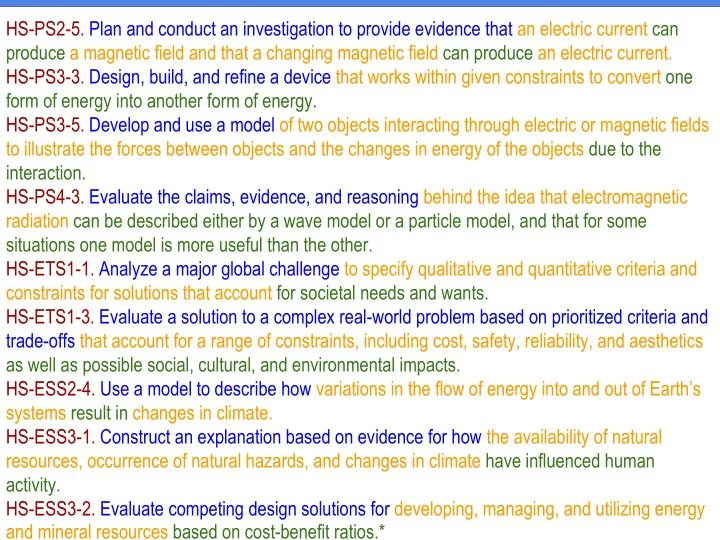
HS-PS2-5. Plan and conduct an investigation to provide evidence that an electric current can produce a magnetic field and that a changing magnetic field can produce an electric current. HS-PS3-3. Design, build, and refine a device that works within given constraints to convert one form of energy into another form of energy. HS-PS3-5. Develop and use a model of two objects interacting through electric or magnetic fields to illustrate the forces between objects and the changes in energy of the objects due to the interaction. HS-PS4-3. Evaluate the claims, evidence, and reasoning behind the idea that electromagnetic radiation can be described either by a wave model or a particle model, and that for some situations one model is more useful than the other. HS-ETS1-1. Analyze a major global challenge to specify qualitative and quantitative criteria and constraints for solutions that account for societal needs and wants. HS-ETS1-3. Evaluate a solution to a complex real-world problem based on prioritized criteria and trade-offs that account for a range of constraints, including cost, safety, reliability, and aesthetics as well as possible social, cultural, and environmental impacts. HS-ESS2-4. Use a model to describe how variations in the flow of energy into and out of Earth’s systems result in changes in climate. HS-ESS3-1. Construct an explanation based on evidence for how the availability of natural resources, occurrence of natural hazards, and changes in climate have influenced human activity. HS-ESS3-2. Evaluate competing design solutions for developing, managing, and utilizing energy and mineral resources based on cost-benefit ratios.*

slide-2
SLIDE 2

2 Patterns Physics Electricity, Magnetism, & Power Production

slide-3
SLIDE 3

3 Patterns Physics Electricity, Magnetism, & Power Production

Timeline for the Year

slide-4
SLIDE 4

4 Patterns Physics Electricity, Magnetism, & Power Production

Overview of the Unit

This unit is loaded with phenomena. The real world task that propels students through an arc of electricity, magnetism, power production, and climate science is a 50-Year Energy Plan. After the Request for a 50-Year Energy Plan, students jig-saw innovative power solutions. Next, they build and explore motors (starting with speakers which also connect to the Waves & Technology unit) and inefficient generators. The need for massive, efficient generators leads us to harness energy in nature so we will be engineer designing wind turbines and optimizing solar cells for a local parks use. Creating the rubric to evaluate large scale power production launches us into climate

  • science. With all the learning of the unit students and many real world constraints

student finally complete their 50-Year Energy Plan.

slide-5
SLIDE 5

5 Patterns Physics Electricity, Magnetism, & Power Production

Electricity, Magnetism, & Power Production - Day 1 Agenda: Voices Around the World Introduction to Our Engineering Challenge Where do we get power from? Due Next Class: Background Research on Power Production Due This Class: Voices of the World

Warm Up Question:

What do you know about climate science, global warming, and climate change? What do you want to learn about these topics?

slide-6
SLIDE 6

6 Patterns Physics Electricity, Magnetism, & Power Production

On the front page of the packet, using a scale of 1 - 4: where is your current understanding? Self Assessment on the Big Ideas of this Unit

slide-7
SLIDE 7

7 Patterns Physics Electricity, Magnetism, & Power Production

By the End of this Day You Should Be able to Answer:

Focus Question What are the different perspectives on climate change? Language Focus Be able to convey important characteristics about different energy sources used for Power Production.

slide-8
SLIDE 8

8 Patterns Physics Electricity, Magnetism, & Power Production

slide-9
SLIDE 9

9 Patterns Physics Electricity, Magnetism, & Power Production

Voices of the World - 1 Page Per Student

  • 1. Get acquainted with the your role/identity your

were given**, you want to be able to share your perspective without reading your card. **Note, this

can be difficult if the person is different from you.

  • 2. Now form medium sized groups of 6-9.
  • 3. Then get acquainted with each other, spending

about a minute to share your story.

  • 4. Then listen to the stories of the other person you

are with. Be sure to take notes in your packet.

  • 5. Next form a new smaller group of 4-5 of mostly

new people and repeat.

*Adapted from Bill Bigelow with Rethinking Schools, see his instructions here.

slide-10
SLIDE 10

10 Patterns Physics Electricity, Magnetism, & Power Production

Getting a Handle on

  • ur Challenge

With some context from voices of the world and the charge to the Energy Plan Commission we need to define our problem. Then, let us get a clear, focused statement of the design problem in

  • ur Engineering Portfolio.

We as (role) seek to (problem) that must address (goal) for (stakeholders).

slide-11
SLIDE 11

11 Patterns Physics Electricity, Magnetism, & Power Production

What do you know about power production, electricity, and energy sources?

When you plug your phone into the wall, what is going on? Where does that energy come from?

What do you want to learn about power production, electricity, and energy sources? K-W-L in Formative

slide-12
SLIDE 12

12 Patterns Physics Electricity, Magnetism, & Power Production

Background Research on Power Production What are the three main points?

slide-13
SLIDE 13

13 Patterns Physics Electricity, Magnetism, & Power Production Description: Describe the energy strategy here. Include any unique costs or benefits that are not listed in the columns to the right.

First:

Let us brainstorm considerations when thinking through energy sources -- that is, the top three criteria we will use to evaluate them.

slide-14
SLIDE 14

14 Patterns Physics Electricity, Magnetism, & Power Production First: Let us brainstorm considerations when thinking through energy sources -- that is, the top three criteria we will use to evaluate them.

Environmental Impact / Land Use: Describe how this energy strategy affects the land/water it is on or

  • around. Does it need to be

in specific locations? Climate Impact / Air Quality: Describe any impact on CO2 emissions or air quality associated with this strategy Lifetime Cost: Describe any costs, both short and long term, directly and indirectly associated with this strategy.

slide-15
SLIDE 15

15 Patterns Physics Electricity, Magnetism, & Power Production

  • 1. Everyone investigates Wind, Coal, Solar Cells

(photovoltaics or PV) or Hydro.

  • 2. Then you will be assigned one more Energy Source

for Power Production.

Background Research on Power Production

slide-16
SLIDE 16

16 Patterns Physics Electricity, Magnetism, & Power Production

Background Research on Power Production

www.studentenergy.org/map Note: NIMBY means “Not in my Backyard” and refers to when people do not want a power plant

  • f a certain type near where they live.
slide-17
SLIDE 17

17 Patterns Physics Electricity, Magnetism, & Power Production

Check In: You Should Be able to Answer:

Focus Question What are the different perspectives on climate change? Language Focus Be able to convey important characteristics about different energy sources used for power production.

slide-18
SLIDE 18

18 Patterns Physics Electricity, Magnetism, & Power Production

slide-19
SLIDE 19

19 Patterns Physics Electricity, Magnetism, & Power Production

Electricity, Magnetism, & Power Production - Day 2

Agenda: Finishing Background Research

  • n Power Production

Exploring Engineering Solutions Energy City Simulation

Due Next Class Due This Class Complete Background Research

Upcoming

Warm Up Question:

Read the overview of Oregon’s electricity mix

  • n page 20 of State of

Oregon Biennial Energy Plan 2015-17 (linked in your 6EP doc).

slide-20
SLIDE 20

20 Patterns Physics Electricity, Magnetism, & Power Production

What did you notice or learn from reading the overview

  • f Oregon’s electricity mix on page 20 of State of

Oregon Biennial Energy Plan 2015-17

slide-21
SLIDE 21

21 Patterns Physics Electricity, Magnetism, & Power Production

What did you notice or learn from reading the overview

  • f Oregon’s electricity mix on page 20 of State of

Oregon Biennial Energy Plan 2015-17

slide-22
SLIDE 22

22 Patterns Physics Electricity, Magnetism, & Power Production

Hear is another similar representation Oregon Department of Energy now uses. What do you think?

slide-23
SLIDE 23

23 Patterns Physics Electricity, Magnetism, & Power Production

Power Production in the West (map linked)

List of all Oregon Power Production Plants

slide-24
SLIDE 24

24 Patterns Physics Electricity, Magnetism, & Power Production

Jump Back to Finish your Background Research

slide-25
SLIDE 25

25 Patterns Physics Electricity, Magnetism, & Power Production

Let’s Get Focused

Now with more research into power production, we need to further explore our problem. We already have our focused statement of the design problem in our Engineering Portfolio. We as the Energy Plan Commision seek to create a 50-Year Energy Plan that must address the energy needs and environmental concerns of Oregonians.

slide-26
SLIDE 26

26 Patterns Physics Electricity, Magnetism, & Power Production

What are our Constraints in this Project?

Constraints for the 50 Year Energy Plan:

  • 1. ClickHereToType
  • 2. ClickHereToType
  • 3. ClickHereToType
slide-27
SLIDE 27

27 Patterns Physics Electricity, Magnetism, & Power Production

What are our Constraints in this Project?

Constraints for the 50 Year Energy Plan:

  • 1. Must provide enough power to meet future demand/increase
  • 2. Cannot use coal after 2035 (Clean Electricity & Coal Transition Act)
  • 3. It is due by ClickHeretoType
  • 4. Respond to the values of Oregonians (clean technologies,

environment with focus on wildlife)

slide-28
SLIDE 28

28 Patterns Physics Electricity, Magnetism, & Power Production

What are our Criteria in this Project?

Criteria that your energy source choices will be measured by:

  • 1. ClickHereToType
  • 2. ClickHereToType
  • 3. ClickHereToType
slide-29
SLIDE 29

29 Patterns Physics Electricity, Magnetism, & Power Production

What are our Criteria in this Project?

Criteria that your energy source choices will be measured by:

  • 1. ClickHereToType
  • 2. ClickHereToType
  • 3. ClickHereToType

Environmental Impact / Land Use: Describe how this energy strategy affects the land/water it is on or

  • around. Does it need to be

in specific locations? Climate Impact / Air Quality: Describe any impact on CO2 emissions or air quality associated with this strategy Lifetime Cost: Describe any costs, both short and long term, directly and indirectly associated with this strategy.

slide-30
SLIDE 30

30 Patterns Physics Electricity, Magnetism, & Power Production

To wrap our heads around this, let’s try

  • ut a “wild guess”

Initial 50-Year Plan

slide-31
SLIDE 31

31 Patterns Physics Electricity, Magnetism, & Power Production

Looking ahead to our Final Report

As always, you will be tasked with communicating the problem and evaluating your design solution as compared to others. However, as our last CER, we will be stepping up our sophistication with

  • 1. Exploring Our Engineering Challenge (Claim)
  • 2. Evaluating Competing 50 Year Plans (Evidence)
  • 3. Reasoning about the Best Design (Reasoning)
  • 4. Limitations of your Plan
slide-32
SLIDE 32

32 Patterns Physics Electricity, Magnetism, & Power Production

Evaluating Design Solutions

You will be tasked with communicating the problem and evaluating your design solution as compared to others. In this there will be four (4) sections.

  • 1. Exploring Our Engineering Challenge (Claim)
  • 2. Evaluating Competing 50 Year Plans (Evidence)
  • 3. Reasoning about the Best Design (Reasoning)
  • 4. Limitations of your Plan

Our focus for today is only

slide-33
SLIDE 33

33 Patterns Physics Electricity, Magnetism, & Power Production

Preparing for the first paragraph of your essay: Graphic Organizer

slide-34
SLIDE 34

34 Patterns Physics Electricity, Magnetism, & Power Production

Kick Off Playing Energy City

slide-35
SLIDE 35

35 Patterns Physics Electricity, Magnetism, & Power Production

6Simulation - Energy City Strategy and Reflection

slide-36
SLIDE 36

36 Patterns Physics Electricity, Magnetism, & Power Production

Energy City Reflection Slides

slide-37
SLIDE 37

37 Patterns Physics Electricity, Magnetism, & Power Production

Electricity, Magnetism, & Power Production - Day 3

Agenda:

In-Class Essay: Exploring Our Engineering Challenge Diving into the Physics of Power Production Making Speakers

Due Next Class Due This Class

Warm Up Question:

Given two batteries, two wires, and a light bulb: Make three observations as you play with the materials. Write down two things you wonder.

slide-38
SLIDE 38

38 Patterns Physics Electricity, Magnetism, & Power Production

6CER - Part 1 In-Class Essay: Exploring Our Engineering Challenge

slide-39
SLIDE 39

39 Patterns Physics Electricity, Magnetism, & Power Production

By the End of this Day You Should Be able to Answer:

Focus Question What is going on with electricity? Language Focus Be able to use the technical language to describe electricity, power, and power production.

slide-40
SLIDE 40

40 Patterns Physics Electricity, Magnetism, & Power Production

From the Need to How It Works

Learning from Multiple Sources

What are the three big ideas of the following video?

slide-41
SLIDE 41

41 Patterns Physics Electricity, Magnetism, & Power Production

The need for Large Scale Power Production is the need for Large Scale Energy Transformations

slide-42
SLIDE 42

42 Patterns Physics Electricity, Magnetism, & Power Production

Need Energy for: Ethermal for heat Emechanical for transportation Eelectricity to power things At the heart of nearly all Eelectricity is motion of a turbine Power Production then is really about Energy Transformations

From the Need to How it Works

Learning from Multiple Sources

slide-43
SLIDE 43

43 Patterns Physics Electricity, Magnetism, & Power Production

Let’s Be Playful with our Inner Scientist

From our KWL on power production, electricity, and energy sources you clearly already know a lot, but let’s push the use of some of our tools from our physics toolbelt to explore deeper:

  • start with thinking through a couple of

easy, concrete examples

  • make observations
  • create useful diagrams
  • walk the Triangle

Let us start with lighting a light bulb

slide-44
SLIDE 44

44 Patterns Physics Electricity, Magnetism, & Power Production

Teacher Note: Water Bucket Analogy

Key terminology in electricity: energy, voltage, current, electron, and power.

Materials for each Scenario: . Real Life: Analogy: battery AA, D, 9V 1st bucket, bigger bucket energy colored water wires taped path on floor

slide-45
SLIDE 45

45 Patterns Physics Electricity, Magnetism, & Power Production

  • 1. What is our system?
  • 2. What does it take to light the light bulb?
  • 3. What is in the battery?
  • 4. What is in the wire?
  • 5. What is the value in

creating an analogy?

  • 1. Brainstorm ways to

represent this system?

  • 6. How should we

diagram this?

Let’s Be Playful with our Inner Scientist

Connect what you observe to what you know

slide-46
SLIDE 46

46 Patterns Physics Electricity, Magnetism, & Power Production

Moving from Our Experience to a Diagram

This bucket represents the AA battery. This bucket represents a light bulb.

AA

Diagram of Analogy

This is on page 7 of your packet.

slide-47
SLIDE 47

47 Patterns Physics Electricity, Magnetism, & Power Production

This symbol represents the AA battery. This symbol represents a light bulb.

This is on page 7 of your packet.

Diagram of Circuit

Moving from Our Experience to a Diagram

slide-48
SLIDE 48

48 Patterns Physics Electricity, Magnetism, & Power Production

Moving from Our Experience to a Diagram

Diagram of Analogy Diagram of Circuit

This is on page 7 of your packet.

slide-49
SLIDE 49

49 Patterns Physics Electricity, Magnetism, & Power Production

Water Bucket Analogy: The Switch is Off time = 0 s

This bucket represents the AA battery. This bucket represents a light bulb.

AA

slide-50
SLIDE 50

50 Patterns Physics Electricity, Magnetism, & Power Production

Water Bucket Analogy: The Switch is On time = just after 0 s

slide-51
SLIDE 51

51 Patterns Physics Electricity, Magnetism, & Power Production

Water Bucket Analogy time = 1 s

slide-52
SLIDE 52

52 Patterns Physics Electricity, Magnetism, & Power Production

Water Bucket Analogy time = 2 s

slide-53
SLIDE 53

53 Patterns Physics Electricity, Magnetism, & Power Production

Water Bucket Analogy time = 3 s

slide-54
SLIDE 54

54 Patterns Physics Electricity, Magnetism, & Power Production

Water Bucket Analogy Repeat with 9 V

slide-55
SLIDE 55

55 Patterns Physics Electricity, Magnetism, & Power Production

  • 1. Experience: How does our real system match

up to the analogous one? What signifies what*? *using words we understand to technical terms

  • 2. Graph: Let us use one of our best tools

to visualize patterns in data, let’s graph it.

  • 3. Mathematical How can we start

to quantify this system?

  • 4. Then let’s make predictions

about the system to test our hypotheses.

Let’s Be Playful with our Inner Scientist

Connect what you observe to what you know

slide-56
SLIDE 56

56 Patterns Physics Electricity, Magnetism, & Power Production

Experience: How does our real system match up to the analogous one? What signifies what*? *using words we understand then technical terms

Water Bucket Analogy Real Circuit What does the water represent?

  • Energy. It starts as electrical energy

in the battery and gets transformed to light in the light bulb.

What do the students represent?

  • Electrons. Electrons carry the

electrical energy around the circuit.

The path that the students are walking.

What would represent the wires?

This is on page 7 of your packet.

slide-57
SLIDE 57

57 Patterns Physics Electricity, Magnetism, & Power Production

Water Bucket Analogy: Definitions

Word Definition Voltage

  • Energy per electron.
  • Represented by the amount of water in each

cup. Current

  • Electrons per second.
  • Represented by the moving people.

This is on page 7 of your packet.

slide-58
SLIDE 58

58 Patterns Physics Electricity, Magnetism, & Power Production

Water Bucket Analogy: Definitions

Word Definition Voltage

  • Energy per electron.
  • Represented by the amount of water in each

cup. Current

  • Electrons per second.
  • Represented by the moving people.

This is on page 7 of your packet.

What happens when we increase the “voltage” in our analogy?

slide-59
SLIDE 59

59 Patterns Physics Electricity, Magnetism, & Power Production

Water Bucket Analogy: Definitions

Word Definition Voltage

  • Energy per electron.
  • Represented by the amount of water in each

cup. Current

  • Electrons per second.
  • Represented by the moving people.

This is on page 7 of your packet.

What happens when we increase the “current” in our analogy? The wire doesn’t get more electrons, so how do you get more electrons per second going through the light bulb?

slide-60
SLIDE 60

60 Patterns Physics Electricity, Magnetism, & Power Production

  • 1. Let us rerun the 1.5 V set up and plot

Energy vs time.

  • 1. Now let’s repeat this process for a 9 v battery.
  • 2. Let’s walk the triangle.
  • a. why a zero y-intercept?
  • b. what does the A value mean?
  • c. will the lines continue forever?
  • d. what is the

mathematical model?

Returning to our Inner Scientist

Let us use one of our best tools to visualize patterns in data, let’s make a graph.

slide-61
SLIDE 61

61 Patterns Physics Electricity, Magnetism, & Power Production

9 Volt 1.5 Volt

This is on page 7 of your packet.

slide-62
SLIDE 62

62 Patterns Physics Electricity, Magnetism, & Power Production

9 Volt 1.5 Volt

This is on page 7 of your packet.

slide-63
SLIDE 63

63 Patterns Physics Electricity, Magnetism, & Power Production

9 Volt 1.5 Volt

This is on page 7 of your packet.

Let’s walk the triangle.

  • a. why a zero y-intercept?
  • b. what does the A value

mean?

  • c. will the lines continue

forever?

  • d. what is the

mathematical model?

slide-64
SLIDE 64

64 Patterns Physics Electricity, Magnetism, & Power Production

slide-65
SLIDE 65

65 Patterns Physics Electricity, Magnetism, & Power Production

With our focus on Power Production

Energy = Power * time

Equation 1 Equation 2

From our graph

Word Definition

Voltage / current above Voltage / current definitions above

Power

  • Energy transferred per second
  • Represented by how fast the bucket fills

This is on page 7 of your packet.

slide-66
SLIDE 66

66 Patterns Physics Electricity, Magnetism, & Power Production

With our focus on Power Production

Power:

  • In terms of our analogy it is the combination of how many

cups transfer their water times how much water is in each cup.

  • How then can we increase the power?

Power = cups per second * energy per cup

Equation 3 Analogy Mathematical

Power = Current * Voltage

This is on page 7 of your packet.

slide-67
SLIDE 67

67 Patterns Physics Electricity, Magnetism, & Power Production

Energy = Power * Time Power = Current * Voltage

slide-68
SLIDE 68

68 Patterns Physics Electricity, Magnetism, & Power Production

Power (Watts) Voltage (Volts)

2 4 6 8 10 .1 .2 .3 .4 .5 V P 0.0 0.1 2 0.2 4 0.5 10

When: voltage doubles the energy per second doubles

Power = current * voltage

slide-69
SLIDE 69

69 Patterns Physics Electricity, Magnetism, & Power Production

Let’s Make some Predictions Question 3 Repeat with two AA V batteries in series

slide-70
SLIDE 70

70 Patterns Physics Electricity, Magnetism, & Power Production

One battery vs two in series

slide-71
SLIDE 71

71 Patterns Physics Electricity, Magnetism, & Power Production

Let’s Make some Predictions Question 4 Repeat with two AA V batteries in parallel

slide-72
SLIDE 72

72 Patterns Physics Electricity, Magnetism, & Power Production

One battery vs two in parallel

slide-73
SLIDE 73

73 Patterns Physics Electricity, Magnetism, & Power Production

Check In: You Should Be able to Answer:

Focus Question What is going on with electricity? Language Focus Be able to use the technical language to describe electricity, current, voltage, and power.

slide-74
SLIDE 74

74 Patterns Physics Electricity, Magnetism, & Power Production

With Our Built-Up Background Let’s Dive Deeper

Beyond all the cool things you can understand through current, voltage, and power, there is another fascinating property of electricity we need to understanding for power production.

slide-75
SLIDE 75

75 Patterns Physics Electricity, Magnetism, & Power Production

Demonstration of a Phenomenon

credit and description: https://www.exploratorium.edu/snacks/motor-effect

slide-76
SLIDE 76

76 Patterns Physics Electricity, Magnetism, & Power Production

By the End of this Activity You Should Be able to Answer:

Focus Question How do speakers work? Language Focus Be able to our technical terms from electricity and new ones we discover to explain the basic physics of how speakers work.

slide-77
SLIDE 77

77 Patterns Physics Electricity, Magnetism, & Power Production

slide-78
SLIDE 78

78 Patterns Physics Electricity, Magnetism, & Power Production

Exploring, Reverse Engineering Speakers

Let us use our Engineering Toolbelt:

First things First: What is the most basic physics of speakers? They are motors and motors transform electricity into motion

slide-79
SLIDE 79

79 Patterns Physics Electricity, Magnetism, & Power Production

Exploring, Reverse Engineering Speakers

Let us use our Engineering Toolbelt:

  • 1. Let us look at some working speakers, what is

going on? Tool: observation

  • 2. Let us get a drawing. Tool: diagramming
  • 3. Let us deconstruct some speakers and observe

a little more. Tool: observation

  • 4. Let us improve our drawing. Tool: iteration
  • 5. What do you think, how do they work? Tool:

reasoning

slide-80
SLIDE 80

80 Patterns Physics Electricity, Magnetism, & Power Production

Visuals for Sound Waves in Air

slide-81
SLIDE 81

81 Patterns Physics Electricity, Magnetism, & Power Production

Visuals for Sound Waves in Air

slide-82
SLIDE 82

82 Patterns Physics Electricity, Magnetism, & Power Production

Visual for Sound Waves from a Speaker

Dan Russell

slide-83
SLIDE 83

83 Patterns Physics Electricity, Magnetism, & Power Production

Visual for Sound Waves from a Tuning Fork

Dan Russell

slide-84
SLIDE 84

84 Patterns Physics Electricity, Magnetism, & Power Production

Let’s Plan an Investigation to Provide Evidence that it works the Way You Think

  • 1. Let us build a speaker
  • 2. See instructions at bit.ly/makeyourownspeaker
  • 3. Carry out your experiment to collect evidence and

build an argument for how speakers work.

slide-85
SLIDE 85

85 Patterns Physics Electricity, Magnetism, & Power Production

Electricity, Magnetism, & Power Production - Day 4 Agenda: Investigating Speakers Going Electric! Due Next Class Quiz on Motors and Generators Due This Class

Warm Up Question:

What will happen if we hold this electromagnet up to a compass?

How do we get it to attract the south end of the compass?

slide-86
SLIDE 86

86 Patterns Physics Electricity, Magnetism, & Power Production

Technically we don’t even need the nail.

Let’s try it with a compass

slide-87
SLIDE 87

87 Patterns Physics Electricity, Magnetism, & Power Production

https://animagraffs.com/loudspeaker/

credit: https://animagraffs.com/loudspeaker/

slide-88
SLIDE 88

88 Patterns Physics Electricity, Magnetism, & Power Production

Background Research

bit.ly/backgroundonspeaker

Survey the text - What looks familiar Questions you have Predict what you will understand after reading Read for understanding, Chunk by Chunk Respond: answer your questions, evaluate it Summarize what you read.

slide-89
SLIDE 89

89 Patterns Physics Electricity, Magnetism, & Power Production

Let’s revise our Plan and Conduct an Investigation to Provide Evidence that it works this Way

If needed:

  • 1. Build a speaker
  • 2. See instructions at bit.ly/makeyourownspeaker
  • 3. Carry out your experiment to build an argument

from evidence.

slide-90
SLIDE 90

90 Patterns Physics Electricity, Magnetism, & Power Production

Debrief Your Investigation

slide-91
SLIDE 91

91 Patterns Physics Electricity, Magnetism, & Power Production

https://animagraffs.com/loudspeaker/

credit: https://animagraffs.com/loudspeaker/

slide-92
SLIDE 92

92 Patterns Physics Electricity, Magnetism, & Power Production

credit: https://animagraffs.com/loudspeaker/

slide-93
SLIDE 93

93 Patterns Physics Electricity, Magnetism, & Power Production

credit: https://animagraffs.com/loudspeaker/

slide-94
SLIDE 94

94 Patterns Physics Electricity, Magnetism, & Power Production

Use the Big Ideas of Science we Discovered to Explain how Speakers Work

See Packet Page 8

slide-95
SLIDE 95

95 Patterns Physics Electricity, Magnetism, & Power Production

Electric Currents producing Magnetic Fields, the basis for electric motors, is definitely a Big Idea in Science.

Playing with this idea, what are wonderings that come to mind? Let us brainstorm applications of this big idea in science? Design Solutions: How might we want to modify

  • ur motor for other applications?
slide-96
SLIDE 96

96 Patterns Physics Electricity, Magnetism, & Power Production

Electric Currents producing Magnetic Fields, the basis for electric Motors, is definitely a Big Idea in Science.

For cars, blenders, drills we need a circular motor. Design Solutions: How might we do this?

bit.ly/makeyourownmotor

slide-97
SLIDE 97

97 Patterns Physics Electricity, Magnetism, & Power Production

Check-In: How Does a Speaker Work?

slide-98
SLIDE 98

98 Patterns Physics Electricity, Magnetism, & Power Production

Check In: You Should Be able to Answer:

Focus Question How do speakers work? Language Focus Be able to our technical terms from electricity and new ones we discover to explain the basic physics of how speakers work.

slide-99
SLIDE 99

99 Patterns Physics Electricity, Magnetism, & Power Production

Electric Currents producing Magnetic Fields, the basis for electric Motors, is definitely a Big Idea in Science.

Follow up questions. Demo: Gencon to Gencon. Wait?! Electric cars use battery to turn wheels, but then use turning wheels to charge battery (regenerative braking).

slide-100
SLIDE 100

100 Patterns Physics Electricity, Magnetism, & Power Production

The Phenomenon

slide-101
SLIDE 101

101 Patterns Physics Electricity, Magnetism, & Power Production

Alternate or Additional Phenomenon

slide-102
SLIDE 102

102 Patterns Physics Electricity, Magnetism, & Power Production

By the End of this Activity You Should Be able to Answer:

Focus Question How do electric guitars work? Language Focus Be able to our technical terms from electricity and new ones we discover to explain the basic physics of how electric guitars work.

slide-103
SLIDE 103

103 Patterns Physics Electricity, Magnetism, & Power Production

An Electric Guitar using our Speaker Coil

  • - Generator to Amp to Motor --