http://FloridaClimateInstitute.org FCI Overview and 2014 Goals - - PowerPoint PPT Presentation

http floridaclimateinstitute org fci overview and 2014
SMART_READER_LITE
LIVE PREVIEW

http://FloridaClimateInstitute.org FCI Overview and 2014 Goals - - PowerPoint PPT Presentation

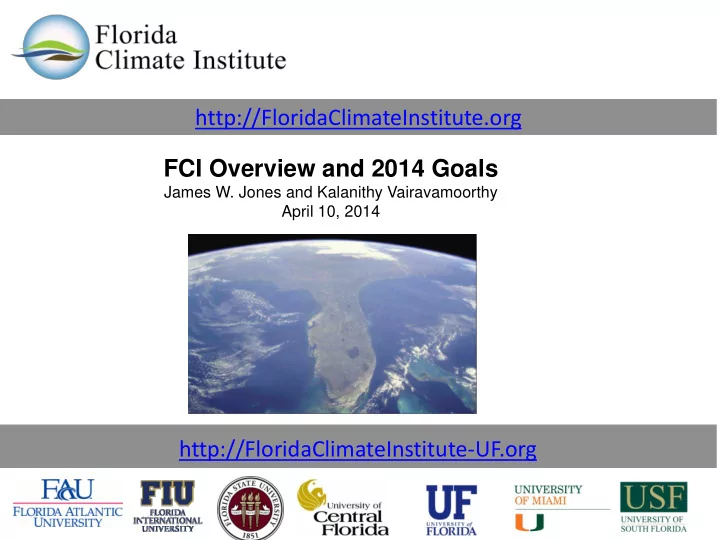
http://FloridaClimateInstitute.org FCI Overview and 2014 Goals James W. Jones and Kalanithy Vairavamoorthy April 10, 2014 http://FloridaClimateInstitute-UF.org Outline Brief History Achievements Where We Are Now Coastal Management Future

slide-1
SLIDE 1

http://FloridaClimateInstitute.org FCI Overview and 2014 Goals

James W. Jones and Kalanithy Vairavamoorthy April 10, 2014

http://FloridaClimateInstitute-UF.org

slide-2
SLIDE 2

Brief History Achievements Where We Are Now Future Plans of FCI

Outline

Coastal Management

slide-3
SLIDE 3

FCI to date

  • 2010 – UF and FSU form joint institute
  • 2011– SUS Board of Governors Project (Climate Change Task Force –

UF, FAU, FSU) – Symposium at UF in November (www.FloridaClimate.org) (175 attendees)

  • 2012– Expansion of FCI to 6 universities
  • Proposals submitted- cumulative (20) and funded (11) thru 2012
  • 2013—Added 7th university (FIU)
  • Will be submitting an LBR this summer to support our research and
  • utreach efforts toward a more climate-resilient Florida
slide-4
SLIDE 4

Where We Are Now

James W. Jones (Director), W. Graham, Carolyn Cox (UF Coordinator)

Eric Chassignet, Vasu Misra, Meredith Field (FSU Coordinator) Len Berry, Nicole Hammer (FAU Coordinator) Scott Hagen, Reed Noss, Sonia Stephens (UCF Coordinator) Ben Kirtman, Dave Letson Kalanithy Vairavamoorthy, Gary Mitchum Rich Olson, Mike Sukop

slide-5
SLIDE 5

FCI Special Publication

Special Publication (Led by V. Misra, FSU):

  • FCI Special Issue of Journal of Environmental Change

The Florida Climate Institute, the Southeast Climate Consortium, and UF Water Institute researchers partnered to produce a special issue in the Journal of Environmental Change to be released in August 2013. 15 UF faculty contributed to this

  • publication. See full list of titles, authors, and collaborators at

http://www.floridaclimateinstitute-uf.org/wp- content/uploads/2013/06/recauthors.pdf

slide-6
SLIDE 6

Benefits to the State of Florida

  • Produce and provide region-specific climate and sea level data used to reduce

risks to Florida’s economy and natural resources

  • Design adaptation strategies for the increased resiliency of coastal communities

for tourism, real-estate, infrastructure, and natural systems

  • Foster the protection of ecosystems that provide habitat, water supply, and
  • pportunities for recreation and tourism
  • Develop crop varieties, technologies, and management systems to increase

economic benefits and protect agricultural investments

  • Work with urban water managers to design sustainable practices in the face of

climate change and sea level rise

  • Coordinate a broad range of STEM-based programs toward a climate-smart

workforce

  • Advance public climate literacy toward understanding climate vulnerability and

making scientifically informed and environmentally sound decisions

slide-7
SLIDE 7

FCI Working Groups

The FCI has formed 6 working groups which include representatives from all 7 universities, agencies, and industry in the state. The aim

  • f the FCI is to position Florida to become a center of excellence and

leader in climate change and variability adaptation technologies, strategies, and expertise

  • I. Climate and Sea Level Rise Information for Florida, region
  • II. Beach and Coastal Resilience
  • III. Urban Water Management
  • IV. Ports and Navigational Channels
  • V. Agriculture and Forestry
  • VI. Public Health Impacts
slide-8
SLIDE 8

FCI 2014 Working Group Goals

These groups will each  Produce a set of Frequently Asked Questions and answers for the state of Florida about the climate impacts and potential economic impacts on these various sectors  Develop key partnerships for research and outreach activities to which state $ will be allocated  Develop a budget for institutional support along with criteria for prioritization of projects likely to be of interest to state leaders  Build a compelling argument for the appropriation of state funds to benefit the state of Florida and its economy

slide-9
SLIDE 9

Each Working Group will partner with industry and agencies through an idea-driven iterative process to:

1) Identify economic and environmental vulnerabilities 2) Assess and identify needs for research and education, including ideas for specific projects that would: a) Identify and employ best practices to reduce risks to our economy, natural resources, and infrastructure a) Capitalize on opportunities associated with anticipated changes in clilmate

slide-10
SLIDE 10

Draft Criteria for Selecting Activities

  • Clear target outcomes and pathway to achieve impacts in Florida’s

economy, workforce, environment

  • Project has external support from external partners through in-kind,

$, or personnel commitments.

  • Project is well represented across partner universities; at least two

FCI institutions must be involved

  • Project activities are aligned with Florida’s identified priorities and

advance major economic sectors in Florida (Trade, Tourism, Ag)

  • Project has explicit plan for use of research for the benefit of the
  • state. Include plan, mechanism, and people who will assure project

results are shared with stakeholders (business, agencies, and citizens) and not only other researchers

Coastal Management

slide-11
SLIDE 11

HOW CAN WE DO ‘MORE WITH LESS’ (RETHINK THE HE WAY Y WE USE AND ND REUS USE E WATER) TER)

We’re trying to address many questions….but need your help

slide-12
SLIDE 12

It’s clear that our 19 c. approaches are not suited to deal with these challenges?

  • Linear systems – use once

and throw away

  • Drinking water used for all

purposes

  • Systems centralized and

fixed (no adaptive capacity)

  • Stormwater viewed as a

waste (not a resource).

  • Institutions not conducive

for integrated thinking

  • Regulations stall

innovation, are inflexible

  • Urban form - no input from

water professionals

Prod, Int

slide-13
SLIDE 13

Surface water Demand management Leakage management Stormwater/ Rainwater Black water Groundwater Grey water

Productivity requires an integrated perspective of the urban water cycle

slide-14
SLIDE 14

Integrated modelling allows us to connect all flows with productive uses

SURFACE WATER/GROUNDWATER/DESALINATION) WATER SUPPLY COMM/DOM/IND/USE IRRIGATION GREYWATER REUSE WASTEWATER TREATMENT RECEIVING BODY (SUSRFACE/GROUNDWATER) RAINWATER/ STORMWATER HARVESTING POTABLE WATER RAIN/STORMWATER GREY WATER

BLACK WATER

KEY

RECLAIMED WATER

slide-15
SLIDE 15

Change in perspectives leads to new thinking…that makes us more resilient

slide-16
SLIDE 16

Biogas/CHP Heat Recovery Nutrient Recovery

FO

Wastewater effluent Concentrated Wastewater effluent Seawater Diluted seawater

Post-treatment (lower salinity) Post-treatment (concentrated WW)

  • Energy Reduction

Change in perspectives leads to new thinking…that makes us more resilient

slide-17
SLIDE 17

Grey water Brownwater Urine Solid waste Surface Water Ground Water Rain Water Energy

Potable Water Reclaimed non-potable Quality A,B,C

Hygienized Sludge Nutrients Bioplastic

Change in perspectives leads to new thinking…that makes us more resilient

slide-18
SLIDE 18

These perspectives lead to a more decentralized type of thinking?

Decentralization well suited for:

  • Energy recovery (heat recovered

and used close to source)

  • Minimizing energy consumption

(for moving water)

  • Source separation (to maximize

nutrient recovery)

  • Adjusted growth (to deal with

rapid growing cities)

  • Increased resiliency (dampens the

propagation of failures)

Inund

slide-19
SLIDE 19

1990 2010 2020 2030 2040 2050

We need to be adaptive in an uncertain world

slide-20
SLIDE 20

Time

Modular systems gives you adaptive capacity

Rural Semi-Urban Urban

Green roofs Bio Retent ntion

  • n

SWD Open trenc nches hes Permeable eable pavers ers

slide-21
SLIDE 21

Helm 2007

Sewers SUDS

Case Study: Kupferzell Germany

Eckart, Sieker, Vairavamoorthy (2010)

SUDS provide higher flexibility than sewers

slide-22
SLIDE 22

Choices Before Us

What You Know.. What You Don’t Know.. What You Know.. Stay in Lane - Business as Usual Try Harder, Spend More for Traditional Sys Truly Different Approach

slide-23
SLIDE 23

Questions-to be revised

1. What research and education projects are needed to help water utilities obtain the climate and sea level information they need to manage water supplies and make more “climate smart” decisions? 2. How can FCI work with WCA members to bridge the gap between researchers, innovators and the water sector in order to maximize the uptake of research and innovation to influence practice and policy…..describe possible mechanisms to

  • perationalize this?

3. What critical needs and problems are you facing that the LBR support can help to develop solutions for AND support the continuing evolution of WCA? 4. What benefits can be accrued in relation to climate resiliency by changing our perspectives of urban water management (i.e. productive use, integration, beneficiation)?

Questions for Discussion