http://www.gizmag.com/intelligent-t-shirt-monitors-vital-signs/19903/ - - PDF document

http gizmag com intelligent t shirt monitors vital signs
SMART_READER_LITE
LIVE PREVIEW

http://www.gizmag.com/intelligent-t-shirt-monitors-vital-signs/19903/ - - PDF document

Out of Sight, Out of Control: Uncovering the Hidden Data Security Risks of Connected Medical Devices February, 2013 http://www.gizmag.com/intelligent-t-shirt-monitors-vital-signs/19903/ 3 1 How is this Compliance related? HIPAA


slide-1
SLIDE 1

1

Out of Sight, Out of Control:

Uncovering the Hidden Data Security Risks of Connected Medical Devices

February, 2013

3

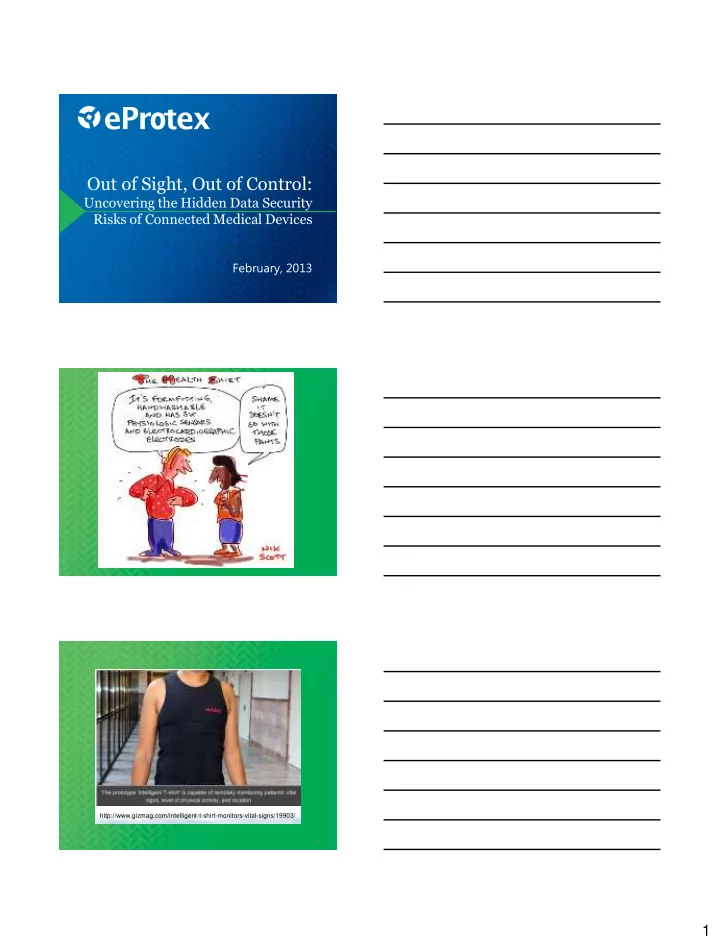
http://www.gizmag.com/intelligent-t-shirt-monitors-vital-signs/19903/
slide-2
SLIDE 2

2

How is this “Compliance” related?

  • HIPAA
  • First “Implementation Specification”

– 45 CFR § 164.308(a)(1)(ii)(A) – Risk Analysis (risk of what?)

  • Often mistakenly thought of as an IT compliance issue
  • Meaningful Use
  • Stage 1 - Core Objective and Measure 15
  • Conduct or review a HIPAA security risk analysis
  • Positive reinforcement but what are the penalties for

falsely attesting?

Device #1

Operating System: Windows NT (1996) Patches/Updates: Periodically Anti-virus: No Application Software: one off Year Introduced: 2001 GE CIC Pro Patient Monitoring System

slide-3
SLIDE 3

3

Device #2

Operating System: Windows 2000 (2000) Patches/Updates: Yes (from manufacturer) Anti-virus: No Application Software: one off Year Introduced: 2003 Kodak – DirectView CR Radiology Plate Reading Device

Device #3

Operating System: Windows NT (1996) Patches/Updates: At owners risk Anti-virus: At owners risk Application Software: one off Year Introduced: 2004 Sysmex X-Series Automated Hematology Analyzer

Device #4

Operating System: Windows NT (1996) Patches/Updates: No Anti-virus: No Application Software: one off Year Introduced: 1996 Siemens - Sireskop Fluoroscopy Machine

slide-4
SLIDE 4

4

Device #5

Operating System: MS DOS 3.3 (1986) Patches/Updates: No Anti-virus: No Application Software: one off Year Introduced: unknown GE 9600 C-Arm Radiology/Flouroscopy Mobile C-Arm

Really?

  • Pyxis Medstation 3000

Windows 2000

  • Siemens MagicView 1000

Windows XP

  • Hologic Fluoroscan C-Arm

Windows XP Prof

  • Philips Sonos 5500 US

Windows XP Embed

  • FocalSim Radiology System

Windows Server 2003

  • Fuji Smart CR FCR XG-1

Windows XP SP1

  • GE Multi C MPI Vasc Lab

Windows 2000

  • SHIMADZU YSF-300 Flouro

Windows 2000

So what?

slide-5
SLIDE 5

5

Background: the need

  • CMS starts Meaningful Use attestation audits
  • “The Centers for Medicare & Medicaid Services (CMS) has quietly begun to audit

providers who have received payments under the EHR incentive program . . .” (FierceEMR, 23 July 2012)

  • OCR’s Leon Rodriguez: HIPAA enforcement more

critical with transition to EHR’s

  • “One issue with the security rule in the audits is electronic protected health

information,” Rodriguez said. “With EHR’s, there’s a wide variety of places where ePHI is stored. So you need a real analysis of where it exists . . .” (FierceEMR, 12 October 2012)

  • Energy Department Is the Latest Victim of an Online

Attack

  • “It’s a continuing story of negligence,. . . the agency continued to have security

issues despite the fact that it manages the most sophisticated military and intelligence technology the country owns.” (The New York Times, 04 February 2013)

Background: the need

  • Healthcare cyber attacks up 85% in 2007 (Healthcare
  • rganizations feeling cyber attacks growing, NetworkWorld.com, 27

February 2008)

  • Cyber Attacks on Healthcare Organizations Double in

4Q (Secureworks, 27 February 2010)

  • Cyber attacks up 400% since 2011 (infosecurity-magazine.

com/view/27876/cyberattacks-up-400-since-2011/, 05 February 2013)

  • Main Sources of Data Breaches: Lost or Stolen Computing

Device (46%); Employee Mistakes or Unintentional Actions (42%) and Third Party Snafus (42%) (Third Annual Benchmark

Study on Patient Privacy & Data Security, Ponemon)

  • Criminal Attacks: Increased from 20% in 2010 to 33% (ibid.)
slide-6
SLIDE 6

6

Background: the need

  • Over 21,471,000 Breached records reported since

September 2009 (http://www.hhs.gov/ocr/privacy/hipaa/

administrative/breachnotificationrule/breachtool.html)

  • Over 500 Breaches of >500 records
  • Nearly half due to theft
  • Nearly 1/3 involve laptops/portable devices
  • Nearly ¼ involve business associates
  • 34,000+ reports of breaches <500 records
  • Privacy & Security Rule related complaints total
  • ver 70,000 (almost 2/3 have corrective action)

Background: the need

  • Misdirected spyware infects Ohio hospital (IDG News

Service, 18 September 2009)

  • 94% of all respondents have had a breach in the

past 24 months (Third Annual Benchmark Study on Patient

Privacy & Data Security, Ponemon, December 2012)

  • Security "All e-PHI created, received, maintained, or

transmitted by an organization is subject to the HIPAA Security Rule” (10 IT initiatives your hospital should

undertake in 2012, Healthcare IT News)

Background: the need

slide-7
SLIDE 7

7

Background: the need Background: the need Background: the need

http://www.geek.com/articles/geek-cetera/birth-monitor-demands- windows-restart-as-mom-begins-to-push-20110415/

slide-8
SLIDE 8

8

Background: the need

  • Jailed – Former UCLA Healthcare System surgeon

illegally accessed medical records (4 months and

$2,000 fine)

  • Unauthorized user accessed and encrypted ePHI

for ransom (SEND2PRESS NEWSWIRE, 20 July 2012)

  • State Attorney General – CT files first HIPAA-

related lawsuit (USDC CT CIV. NO. 3:10-CV-57 (PCD))

  • HHS imposes first CMP for HIPAA violations

(www.hhs.gov/news/press/2011pres/02/20110222a.html)

Background: the need

  • Hospital Hack: As healthcare goes digital, infiltrators

arrive over the internet (Divided we stand, 01 December 2012)

  • Health-care sector vulnerable to hackers, researchers

say (The Washington Post, 25 December 2012)

  • Ransom, implant attack highlight need for healthcare

security (www.csoonline.com/article/725880, 08 January 2013)

  • Vulnerable medical devices: A clear and present

danger (TechRepublic 14 January 2013)

  • Patient data revealed in medical device hack (SC

Magazine, 17 January 2013)

Background: the need

  • Historic gap between IT and CE
  • Increased funding = increased scrutiny
  • Economic environment demands reduced risk
  • f downtime/patient diversion
  • Vast Variety of Operating Systems
  • Easier target for hackers?
  • Casual treatment of medical devices as

general platforms

  • No built in way to detect “attacks”
slide-9
SLIDE 9

9

Okay, what now?

Issues to Address

  • Policy & procedure alignment
  • Do they address all Security Issues?
  • Do they reflect actual practice?
  • How often are they reviewed?
  • Who reviews them?
slide-10
SLIDE 10

10

Issues to Address

  • Comprehensive networked medical device

inventory

  • Does it contain every device that generates, stores or

transmits ePHI? (mobile, intermittent connections)

  • Do you maintain a record of the OS version,

application version, updates and patches?

  • Who owns the device?
  • Who is responsible for repairs or upgrades?
  • Who reviews what logs?

Issues to Address

  • Network information for connected

medical devices

  • Does the device connect to the network?
  • How does it connect? (can be more than one way)
  • Is the connection continuous or intermittent?
  • Do you know the IP Address, MAC Address?
  • Who is the device permitted to communicate with?
  • Who decides what patches or updates get applied?

Issues to Address

  • Centralized MDS2 database
  • Do you maintain such a database?
  • Who is responsible for obtaining the MDS2’s? (supply

chain, device owner, CE, IT)

  • When are they obtained?
  • Is the database centralized or located at each

department or at the individual device?

  • Who updates it as patches or updates are applied?
slide-11
SLIDE 11

11

Issues to Address

  • Risk assessment
  • Has one been done that includes networked medical

devices?

  • Does it include devices that are not connected but

generate or store ePHI?

  • Who participates in its development?
  • Who is responsible for reducing risks discovered?
  • Is it updated regularly (at least as often as changes

are implemented)?

Issues to Address

  • Comprehensive list of recommended

actions

  • Has such a list been generated from the risk

assessment?

  • Who updates it?
  • Who is responsible for reducing risk?
  • Who are they responsible to?

Issues to Address

  • Action Plan in the event of a breach
  • What is the plan?
  • Who gets contacted/notified?
  • Who is your Privacy Officer? Security Officer?
  • Who is responsible for remediation?
  • Who are they responsible to?
  • Who pays for it?
  • Who determines the device’s usability?
  • Who regularly reviews the plan?
slide-12
SLIDE 12

12

Issues to Address

  • Device Security
  • When do you start asking these questions?
  • Does the device have internet access? Why?
  • What is it used for when not “testing”?
  • Is it in a “secure” area?
  • Does it require a unique logon?
  • Does it automatically log off after a predetermined

period of time?

  • Who is it allowed to communicate with?

Issues to Address

  • Device Security
  • Can you add anti-virus software?
  • Does the device display ePHI?
  • If so, can it be viewed by a casual observer?
  • Does it transmit or receive ePHI?
  • If so, how and to whom?
  • Are login attempts monitored?
  • Are passwords required to be changed?
  • Is there a data recovery procedure for the device?
  • Is the storage media reused?
  • Lifecycle Management
  • End of life data removal (verified, documented, etc.)

Issues to Address

  • Device Security
  • VLAN?
  • NIDS/NIPS?
  • Security Research Vendor?
  • Vulnerability Analysis Vendor?
  • Encryption?
  • MDDS Final Rule?
  • Mobile Medical Applications - Draft Guidance?
  • Business Associates?
slide-13
SLIDE 13

13

Change Management

◆Equipment Owner ◆Clinical Engineering ◆Risk Management ◆Supply Chain ◆Information Technology ◆Facilities/Infrastructure ◆Clinicians ◆Device Operators

Additional Resources

  • HIPAA: 45 CFR 160, 162 and 164
  • Security Rule: 45 CFR 160
  • Subparts of 164 A and 164 C
  • www.hhs.gov/ocr/privacy/index.html
  • HIPAA Security Series (7 parts)
  • /www.hhs.gov/ocr/privacy/hipaa/administrativ

e/securityrule/security101.pdf

  • NIST www.nist.gov
slide-14
SLIDE 14

14

Additional Resources

  • Privacy and Security in Health Care:

A fresh look (Deloitte Center for Health Solutions, February 2011)

Thank you. Questions?

Earl.Reber@eProtex.com www.eProtex.com (317) 275-1506