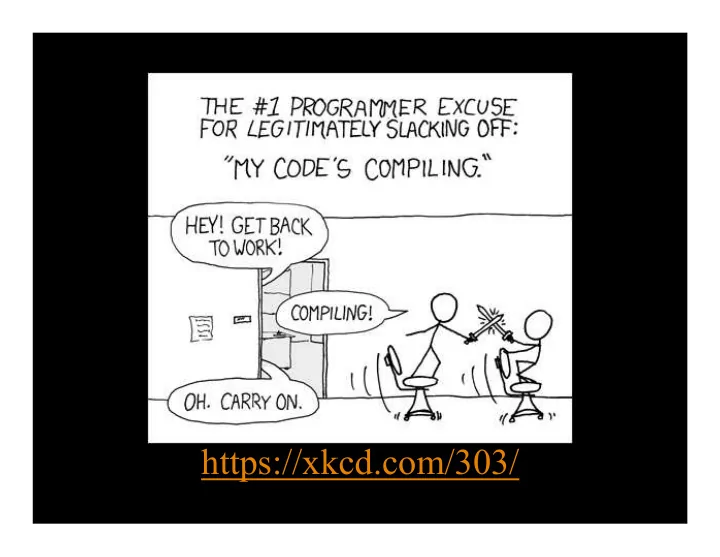
https://xkcd.com/303/ CS 152: Programming Language Paradigms Rust - - PowerPoint PPT Presentation

https xkcd com 303
SMART_READER_LITE
LIVE PREVIEW

https://xkcd.com/303/ CS 152: Programming Language Paradigms Rust - - PowerPoint PPT Presentation

https://xkcd.com/303/ CS 152: Programming Language Paradigms Rust Prof. Tom Austin San Jos State University What is wrong with C/C++? Painfully slow build times Not memory safe No good concurrency story "When the three of us


slide-1
SLIDE 1

https://xkcd.com/303/

slide-2
SLIDE 2

CS 152: Programming Language Paradigms

  • Prof. Tom Austin

San José State University

Rust

slide-3
SLIDE 3

What is wrong with C/C++?

  • Painfully slow build times
  • Not memory safe
  • No good concurrency story
slide-4
SLIDE 4

"When the three of us [Ken Thompson, Rob Pike, and Robert Griesemer] got started, it was pure research. The three

  • f us got together and decided that we

hated C++."

  • -Ken Thompson on the motivation for Go
slide-5
SLIDE 5

"C makes it easy to shoot yourself in the foot; C++ makes it harder, but when you do it blows your whole leg off."

  • -Bjarne Stroustrup

C++ is a horrible language.

  • -Linus Torvalds
slide-6
SLIDE 6

Tony Hoare's billion dollar mistake

"But I couldn't resist the temptation to put in a null reference, simply because it was so easy to implement. This has led to innumerable errors, vulnerabilities, and system crashes, which have probably caused a billion dollars of pain and damage in the last forty years."

slide-7
SLIDE 7

Challenges with C

(in-class)

slide-8
SLIDE 8

Rust history

  • Developed by Graydon Hoare of Mozilla
  • Latest version: Rust 1.13
  • Used in

– Project Servo: layout engine for Firefox – The Rust compiler

  • Emphasis:

– Safety – Control of memory layout – Concurrency

slide-9
SLIDE 9

hello_world.rs

fn main() { println!("Hello, world!"); }

$ rustc hello_world.rs $ ./hello_world Hello, world!

Denotes that println is a macro

slide-10
SLIDE 10

Simple Rust program

(in-class)

slide-11
SLIDE 11

Primitive Types

  • signed integers: i8, i16, i32, i64
  • unsigned integers: u8, u16, u32, u64
  • pointer sizes: isize (signed),

usize (unsigned)

  • floating point: f32, f64
  • char, bool
  • arrays [1,2,3] and tuples (1,true)
  • the unit type ()
slide-12
SLIDE 12

Memory management approaches

  • C/C++

– manually managed – let the programmer beware

  • Java

– Garbage collected – Run-time enforcement of key properties – Performance overhead

slide-13
SLIDE 13

Rust memory management

  • No run-time or garbage collection
  • Compiler statically enforces memory

safety

  • Uses RAII strategy

– Resource Acquisition Is Initialization – resource allocation done at initialization – resource deallocation done when the

  • bject goes out of scope
slide-14
SLIDE 14

Handling arrays in C, Java, & Rust

(in-class)

slide-15
SLIDE 15

Ownership & borrowing

  • Creating a variable grants ownership
  • Assignment transfers ownership
  • "Borrowing" allows a section of

code to use a variable without taking

  • wnership. At one time, you can

have either

– 1 mutable borrow, OR – Limitless immutable borrows

slide-16
SLIDE 16

Complex number example

(in-class)

slide-17
SLIDE 17

Rust documentation

Rust programming language "book" https://doc.rust-lang.org/nightly/book/ Rust by Example http://rustbyexample.com/

– Section 13.1-13.3 reviews ownership and borrowing.

slide-18
SLIDE 18

Lab: Implement Quicksort

  • Use sort0.rs, sort1.rs, and sort2.rs

for reference (available online)