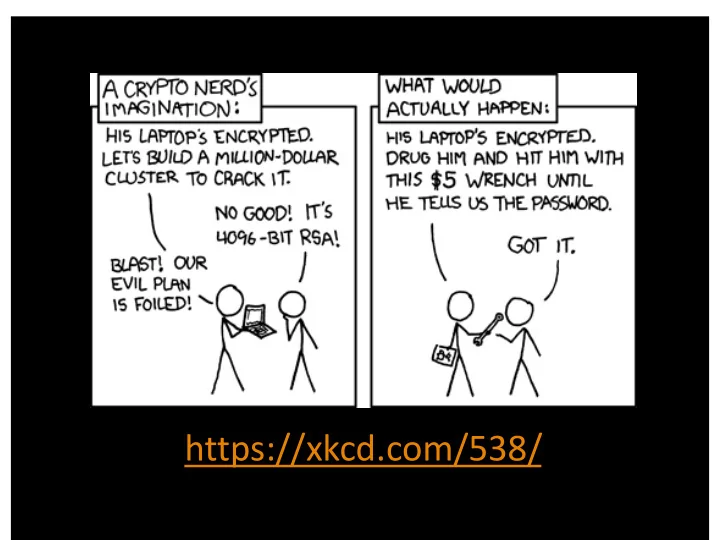
https://xkcd.com/538/ CS 166: Information Security Crypto Basics - - PowerPoint PPT Presentation
https://xkcd.com/538/ CS 166: Information Security Crypto Basics Prof. Tom Austin San Jos State University Crypto Terminology Cryptology art and science of making and breaking secret codes Cryptography making secret
CS 166: Information Security
- Prof. Tom Austin
San José State University
Crypto Basics
Crypto Terminology
- Cryptology – art and science of
making and breaking “secret codes”
- Cryptography – making “secret
codes”
- Cryptanalysis – breaking “secret
codes”
- Crypto – all of the above
How to Speak Crypto
- A cipher or cryptosystem is used to encrypt
the plaintext
- The result of encryption is ciphertext
- We decrypt ciphertext to recover plaintext
- A key is used to configure a cryptosystem
- A symmetric key cryptosystem uses the same
key to encrypt as to decrypt
- A public key cryptosystem uses a public key to
encrypt and a private key to decrypt
Crypto as Black Box
plaintext
key key
plaintext ciphertext
A generic view of symmetric key crypto
encrypt decrypt
Two Approaches to Security
To secure your house, you can:
- 1. Have a secret entrance that
- nly you know about
- 2. Lock your door and
keep the key in your pocket Which approach is better?
Kerckhoffs’ Principle
Assume that the system is completely known to the attacker.
- Crypto algorithms
are known
- Only the key is secret
Auguste Kerckhoffs
Why do we follow Kerckhoffs’ Principle?
- Secret algorithms are often
weak when exposed
- Secret algorithms never remain
secret
- Better to find weaknesses
beforehand
Security by Obscurity
- When the security of the system
instead depends on secrecy, it is security by obscurity.
- In security circles, this is almost
an insult.
- But it still shows up sometimes.
Early History of Cryptography
- 36th century BC – earliest known
forms of writing (Sumerian cuneiform & Egyptian hieroglyphics)
- 600-500 BC – Atbash cipher
developed by Hebrew scholars (early substitution cipher)
- 400 BC – Spartan scytale developed
- <100 BC – Caesar cipher created
Spartan Scytale
- Early transposition cipher.
- Message is written on a leather strap
wrapped around a rod.
- To read the message, a commander
would wrap it around a similar rod.
- Used for confidentiality and
possibly integrity.
Double Transposition
Plaintext: attackxatxdawn
Permute rows and columns
Þ
Ciphertext: xtawxnattxadakc Key is matrix size and permutations: (3,5,1,4,2) and (1,3,2)
col 1 col 2 col 3 row 1 a t t row 2 a c k row 3 x a t row 4 x d a row 5 w n x col 1 col 3 col 2 row 3 x t a row 5 w x n row 1 a t t row 4 x a d row 2 a k c
Caesar Cipher
- Substitution cipher developed by Julius Caesar
- Each letter is shifted by 3 positions
Plaintext Ciphertext a X b Y c Z d A e B f C … …
Caesar Shift Example
Ciphertext:
SBKF SFGF SFZF
Plaintext:
veni vidi vici
There is nothing magical about a shift of 3.
Instead, we could shift:
- any number of characters
- a different amount for each
character
Cryptanalysis I: Try Them All
- A simple substitution (shift by n) is used
– But the key is unknown
- Given ciphertext: CSYEVIXIVQMREXIH
- Only 26 possible keys ¾ try them all!
– Exhaustive key search
- Solution: key is n = 4
Least-Simple Simple Substitution
- In general, simple substitution key can be any
permutation of letters
– Not necessarily a shift of the alphabet
- For example
a b c d e f g h i j k l m n o p q r s t u v w x y z J I C A X S E Y V D K W B Q T Z R H F M P N U L G O Plaintext Ciphertext
Then 26! > 288 possible keys!
Cryptanalysis II: Be Clever
- We know that a simple substitution is used
- But not necessarily a shift by n
- Find the key given the ciphertext:
PBFPVYFBQXZTYFPBFEQJHDXXQVAPTPQJKTOYQWIPBVWLXTOXBTFXQWAXBVCXQWA XFQJVWLEQNTOZQGGQLFXQWAKVWLXQWAEBIPBFXFQVXGTVJVWLBTPQWAEBFP BFHCVLXBQUFEVWLXGDPEQVPQGVPPBFTIXPFHXZHVFAGFOTHFEFBQUFTDHZBQP OTHXTYFTODXQHFTDPTOGHFQPBQWAQJJTODXQHFOQPWTBDHHIXQVAPBFZQHC FWPFHPBFIPBQWKFABVYYDZBOTHPBQPQJTQOTOGHFQAPBFEQJHDXXQVAVXEBQ PEFZBVFOJIWFFACFCCFHQWAUVWFLQHGFXVAFXQHFUFHILTTAVWAFFAWTEVOIT DHFHFQAITIXPFHXAFQHEFZQWGFLVWPTOFFA
Cryptanalysis II
- Cannot try all 288 simple substitution keys
- Can we be more clever?
- English letter frequency counts:
0.00 0.02 0.04 0.06 0.08 0.10 0.12 0.14 A B C D E F G H I J K L M N O P Q R S T U V W X Y Z
Cryptanalysis II
Ciphertext:
PBFPVYFBQXZTYFPBFEQJHDXXQVAPTPQJKTOYQWIPBVWLXTOXBTFXQWAXBVCXQWAXFQJVWLE QNTOZQGGQLFXQWAKVWLXQWAEBIPBFXFQVXGTVJVWLBTPQWAEBFPBFHCVLXBQUFEVW LXGDPEQVPQGVPPBFTIXPFHXZHVFAGFOTHFEFBQUFTDHZBQPOTHXTYFTODXQHFTDPTOGH FQPBQWAQJJTODXQHFOQPWTBDHHIXQVAPBFZQHCFWPFHPBFIPBQWKFABVYYDZBOTHPB QPQJTQOTOGHFQAPBFEQJHDXXQVAVXEBQPEFZBVFOJIWFFACFCCFHQWAUVWFLQHGFXVA FXQHFUFHILTTAVWAFFAWTEVOITDHFHFQAITIXPFHXAFQHEFZQWGFLVWPTOFFA
A B C D E F G H I J K L M N O P Q R S T U V W X Y Z
21 26 6 10 12 51 10 25 10 9 3 10 1 15 28 42 27 4 24 22 28 6 8
Ciphertext frequency counts:
Analyze this message using statistics below
Cryptanalysis: Terminology
- Cryptosystem is secure
–best known attack is an exhaustive key search (i.e. try all possible keys)
- Cryptosystem is insecure
–any shortcut attack is known
- Insecure cipher might be harder
to break than a secure cipher
Beyond Simple Substitutions
- We could use different substitutions for
every character position. E.g.:
–Shift positions 1, 4, 7, … by 7 characters –Shift positions 2, 5, 8, … by 12 characters –Shift positions 3, 6, 9, … by 2 characters
- Is this a better system?
- Logical extreme of this approach?
–The one-time pad
One-Time Pad: Encryption
e=000 h=001 i=010 k=011 l=100 r=101 s=110 t=111
h e i l h i t l e r
001 000 010 100 001 010 111 100 000 101 111 101 110 101 111 100 000 101 110 000 110 101 100 001 110 110 111 001 110 101
s r l h s s t h s r Encryption: Plaintext Å Key = Ciphertext
Plaintext: Key: Ciphertext:
One-Time Pad: Decryption
e=000 h=001 i=010 k=011 l=100 r=101 s=110 t=111
s r l h s s t h s r
110 101 100 001 110 110 111 001 110 101 111 101 110 101 111 100 000 101 110 000 001 000 010 100 001 010 111 100 000 101
h e i l h i t l e r Decryption: Ciphertext Å Key = Plaintext
Ciphertext: Key: Plaintext:
One-Time Pad
e=000 h=001 i=010 k=011 l=100 r=101 s=110 t=111
s r l h s s t h s r
110 101 100 001 110 110 111 001 110 101 101 111 000 101 111 100 000 101 110 000 011 010 100 100 001 010 111 100 000 101
k i l l h i t l e r
Double agent claims sender used following “key”
Ciphertext: "Key": "Plaintext":
One-Time Pad
e=000 h=001 i=010 k=011 l=100 r=101 s=110 t=111
s r l h s s t h s r
110 101 100 001 110 110 111 001 110 101 111 101 000 011 101 110 001 011 101 101 001 000 100 010 011 000 110 010 011 000
h e l i k e s i k e
Or sender is captured and claims the key is…
Ciphertext: "Key": "Plaintext":
One-Time Pad Summary
- Provably secure…
– Ciphertext provides no info about plaintext – All plaintexts are equally likely
- …but, only when be used correctly
– Pad must be random, used only once – Pad is known only to sender and receiver
- Note: pad (key) is same size as message
- So, why not distribute msg instead of pad?
Real-World One-Time Pad
- Project VENONA
– Encrypted spy messages from U.S. to Moscow in 30’s, 40’s, and 50’s – Nuclear espionage, etc. – Thousands of messages
- Spy carried one-time pad into U.S.
- Spy used pad to encrypt secret messages
- Repeats within the “one-time” pads made
cryptanalysis possible
VENONA Decrypt (1944)
[C% Ruth] learned that her husband [v] was called up by the army but he was not sent to the front. He is a mechanical engineer and is now working at the ENORMOUS [ENORMOZ] [vi] plant in SANTA FE, New
- Mexico. [45 groups unrecoverable]
detain VOLOK [vii] who is working in a plant on ENORMOUS. He is a FELLOWCOUNTRYMAN [ZEMLYaK] [viii]. Yesterday he learned that they had dismissed him from his work. His active work in progressive
- rganizations in the past was cause of his dismissal. In the
FELLOWCOUNTRYMAN line LIBERAL is in touch with CHESTER [ix]. They meet once a month for the payment of dues. CHESTER is interested in whether we are satisfied with the collaboration and whether there are not any misunderstandings. He does not inquire about specific items of work [KONKRETNAYa RABOTA]. In as much as CHESTER knows about the role of LIBERAL's group we beg consent to ask C. through LIBERAL about leads from among people who are working on ENOURMOUS and in other technical fields.
q “Ruth” == Ruth Greenglass q “Liberal” == Julius Rosenberg q “Enormous” == the atomic bomb
Codebook Cipher
- Literally, a book filled with “codewords”
- Zimmerman Telegram encrypted via
codebook:
Februar 13605 fest 13732 finanzielle 13850 folgender 13918 Frieden 17142 Friedenschluss 17149
Modern block ciphers are codebooks
Codebook Cipher: Additive
- Codebooks also (usually) use additive
- Additive: book of “random” numbers
– Encrypt message with codebook – Then choose position in additive book – Add additives to get ciphertext – Send ciphertext and additive position – Recipient subtracts additives before decrypting
- Why use an additive sequence?
Zimmerman Telegram
- Perhaps most
famous codebook ciphertext ever
- A major factor in
U.S. entry into World War I
Zimmerman Telegram Decrypted
q British had
recovered partial codebook
q Then able to fill in
missing parts
Election of 1876
- “Rutherfraud” Hayes vs “Swindling” Tilden
– Popular vote was virtual tie
- Electoral college delegations for 4 states
(including Florida) in dispute
- Commission gave all 4 states to Hayes
– Vote on straight party lines
- Tilden accused Hayes of bribery
– Was it true?
Election of 1876
- Encrypted messages by Tilden supporters
later emerged
- Cipher: Partial codebook, plus transposition
- Codebook substitution for important words
ciphertext plaintext
Copenhagen Greenbacks Greece Hayes Rochester votes Russia Tilden Warsaw telegram
Election of 1876
- Apply codebook to original message
- Pad message to multiple of 5 words (total length,
10,15,20,25 or 30 words)
- For each length, a fixed permutation applied to
resulting message
- Permutations found by comparing several
messages of same length
- Note that the same key is applied to all messages
- f a given length
Election of 1876
- Ciphertext: Warsaw they read all
unchanged last are idiots can’t situation
- Codebook: Warsaw == telegram
- Transposition: 9,3,6,1,10,5,2,7,4,8
- Plaintext: Can’t read last telegram.
Situation unchanged. They are all idiots.
- A weak cipher made worse by reuse of key
- Lesson? Don’t overuse keys!
Early 20th Century
- WWI ¾ Zimmerman Telegram
- “Gentlemen do not read each other’s mail”
– Henry L. Stimson, Secretary of State, 1929
- WWII ¾ golden age of cryptanalysis
– Japanese Purple (codename MAGIC) – German Enigma (codename ULTRA)
The Battle of the Atlantic
- England was heavily dependent on imported goods.
- From June until October 1940, German U-Boats sank
270 Allied ships.
- From January 13, 1942 to
February 6, the "wolf packs" sank 397 ships in US waters.
- "...the only thing that ever
frightened me during the war was the U-boat peril" --Winston Churchill
Enigma
- German WWII cipher
machine, thought by many to be unbreakable
- Several variants of
Enigma were used
- The German Navy
used the strongest variants and procedures
Enigma & the Battle of the Atlantic
- In 1941, Alan Turing and his
team broke Naval Enigma
– Merchant losses dropped by 2/3
- In 1942, the German Navy
switched to TRITON (an even stronger variant of Enigma); Allied shipping losses climbed.
- Turing broke TRITON, and shipping losses
declined once more.
War in the Pacific
- In 1942, The Imperial Japanese
Navy dominated the Pacific
- Seeking to eliminate the
United States as a naval power, they attacked Midway
Joseph Rochefort
- Joseph Rochefort broke the
Japanese Navy's JN-25
- Allies knew that "AF" was
going to be attacked, when it was going to be attacked, and in what strength
- Through a little subterfuge,
they verified that the target was Midway
Results of Midway
- The United States Navy defeated
the larger Japanese force, sinking all 4 Japanese aircraft carriers involved in the conflict
- The battle has been called "The
turning point of the Pacific"
Turing and Rochefort
- Turing was forced to undergo hormonal
treatment (he was homosexual) and later committed suicide
- Rochefort's superiors had predicted an
attack in the Aleutian Islands
–Rochefort was reassigned from cryptanalysis to command a floating dry dock at San Francisco
- Both men received honors
posthumously
Post-WWII History
- Claude Shannon – father of the science of
information theory
- Computer revolution – lots of data to protect
- Data Encryption Standard (DES), 70’s
- Public Key cryptography, 70’s
- CRYPTO conferences, 80’s
- Advanced Encryption Standard (AES), 90’s
Claude Shannon
- The founder of Information Theory
- 1949 paper: Comm. Thy. of Secrecy Systems
- Fundamental concepts
– Confusion – obscure relationship between plaintext and ciphertext – Diffusion – spread plaintext statistics through the ciphertext
- Proved one-time pad is secure
- One-time pad is confusion-only, while double
transposition is diffusion-only
Taxonomy of Cryptography
- Symmetric Key
– Same key for encryption and decryption – Two types: Stream ciphers, Block ciphers
- Public Key (or asymmetric crypto)
– Two keys, one for encryption (public), and one for decryption (private) – digital signatures
- Hash algorithms
– Can be viewed as “one way” crypto
Taxonomy of Cryptanalysis
- From perspective of info available to Trudy
– Ciphertext only – Known plaintext – Chosen plaintext
- “Lunchtime attack”
- Protocols might encrypt chosen data
– Adaptively chosen plaintext – Related key – Forward search (public key crypto) – And others…