HUMAN GRASPING Can robots grasp as well? DATA-DRIVEN GRASPING OF - - PowerPoint PPT Presentation

human grasping
SMART_READER_LITE
LIVE PREVIEW

HUMAN GRASPING Can robots grasp as well? DATA-DRIVEN GRASPING OF - - PowerPoint PPT Presentation

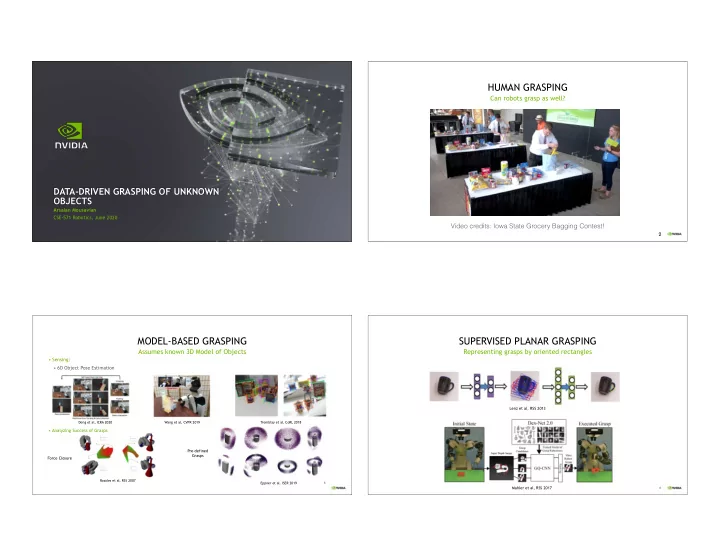
HUMAN GRASPING Can robots grasp as well? DATA-DRIVEN GRASPING OF UNKNOWN OBJECTS Arsalan Mousavian CSE-571 Robotics, June 2020 1 Video credits: Iowa State Grocery Bagging Contest! 2 2 MODEL-BASED GRASPING SUPERVISED PLANAR GRASPING


slide-1
SLIDE 1

Arsalan Mousavian CSE-571 Robotics, June 2020

DATA-DRIVEN GRASPING OF UNKNOWN OBJECTS

1

HUMAN GRASPING

Can robots grasp as well? Video credits: Iowa State Grocery Bagging Contest!

2

2

Assumes known 3D Model of Objects

MODEL-BASED GRASPING

  • Sensing:
  • 6D Object Pose Estimation

Wang et al, CVPR 2019 Deng et al, ICRA 2020 Rosales et al. RSS 2007

Force Closure

Eppner et al. ISER 2019

Pre-defined Grasps

Tremblay et al, CoRL 2018

  • Analyzing Success of Grasps

3

Representing grasps by oriented rectangles

SUPERVISED PLANAR GRASPING

Lenz et al, RSS 2013 Mahler et al, RSS 2017

4

slide-2
SLIDE 2

Learn from large scale robot object interaction

RL FOR PLANAR GRASPING

Levine et al, ISER 2016 Kalashnikov et al, CoRL 2018

5

Planar grasping is limiting.

ARE WE DONE?

  • Limitations of planar grasping:
  • Limited workspace
  • Does not leverage the full capability of joints kinematics space.
  • Not suitable for grasping objects from enclosed spaces such as cabinets.
  • 6-DoF Grasping:
  • Less constrained
  • Combinatorially larger space (6D vs 3D)

6

Ten Pas et al, IJRR 2017

7

Our Method: 6-DoF GraspNet

Generate 6D Grasp Poses from Input Point Cloud

6-DOF GRASPNET

Grasp Sampler Grasp Evaluator Grasp Refinement

Object Point cloud Sampled Grasps Assessed Grasps Input Image

8

[Mousavian-Eppner-Fox, ICCV 2019]

slide-3
SLIDE 3

Background: Variational Auto-encoder

GRASP SAMPLER

Objective: Having a generator model that samples from the distribution of the data:

9

Representation of VAE as Graphical Model (Figure credits: Doresch, arXiv 2016)

[Kingma-Welling, ICLR 2014]

Background: Variational Auto-encoder

GRASP SAMPLER

Objective: Having a generator model that samples from the distribution of the data: is zero for most of the zs -> find likely zs with another network

10

Figure credits: [Doresch, arXiv 2016] Figure credits: [Kingma-Welling, arXiv 2016]

During inference, decoder Q is discarded and latent zs are sampled from prior distribution of z.

11

Background: Variational Auto-encoder

GRASP SAMPLER

Figure credits: Doresch, arXiv 2016

Conditional VAE for Generating Grasps

GRASP SAMPLER

12

Encoder Decoder (R, T) (R, T)

Successful grasp

2D latent value Loss on Gripper Pose Reconstruction

slide-4
SLIDE 4

Decoder generates grasps by moving through latent space

2D LATENT SPACE

13

OVERVIEW

Grasp Sampler Grasp Evaluator Grasp Refinement

Object Point cloud Sampled Grasps Assessed Grasps Input Image

14

Pointnet++ model trained to discriminate successful from unsuccessful grasps

GRASP EVALUATOR

  • Representation captures the relative pose of gripper and object.
  • Point cloud with binary feature indicating object point or gripper

point.

  • Trained as binary classification to evaluate the likelihood of

success for each grasp.

15

OVERVIEW

Grasp Sampler Grasp Evaluator Grasp Refinement

Object Point cloud Sampled Grasps Assessed Grasps Input Image

16

slide-5
SLIDE 5

Evaluator provides gradient with respect to the grasp pose

GRASP REFINEMENT

17 18

TRAINING

Trained on 126 random mugs, bowls, bottles, boxes, and cylinders. Pointclouds are generated by rendering

  • bjects.

Training grasps are evaluated in NVIDIA Flex. Tested on 17 unseen objects in real experiments. No Domain Adaptation is Needed Training is done with synthetic data

19

QUALITATIVE RESULTS

20

GENERATING DIVERSE GRASPS MATTERS

6-DOF GraspNet GPD [1] [1] Ten Pas et al, IJRR 2017

Not all predicted grasps are kinematically feasible -> Generate Diverse Grasps

slide-6
SLIDE 6

GRASPING OBJECTS FROM CLUTTER

21

APPROACH

22

Retrieve unknown target object in structured clutter

[Murali-Mousavian-Eppner-Paxton-Fox, ICRA 2020]

23

Single-view RGB-D Observation

APPROACH

RGB-D Observation

24

RGB-D Observation Instance Segmentation Get Target Information with Instance Segmentation

[Xie, Xiang, Mousavian, Fox, CoRL 2019]

APPROACH

slide-7
SLIDE 7

25

3D Point Cloud Point Cloud Observation

Assumption during learning: Focused on collisions between gripper and scene

APPROACH

grasp is the SE(3) pose of an open-gripper which when closing will stably lift the object

26

APPROACH

Cropped Point Cloud

Complex for cluttered scenes, depends on (1) Geometry of the target object (2) Arrangement of objects in the scene

27

Contribution #1: Cascaded 6-DoF Grasp Generation

(1) Object-centric grasp sampling (2) Clutter-centric evaluation with CollisionNet

APPROACH

28

(1) Object-centric grasp sampling with VAE

Cascaded 6-DoF Grasp Generation

VAE Decoder Grasp Evaluator

APPROACH

slide-8
SLIDE 8

29

CollisionNet

Collision Scores

Contribution #2: (2) Clutter-centric evaluation with CollisionNet, a learnt collision-checker

Cascaded 6-DoF Grasp Generation

APPROACH

30

APPROACH

Training in Simulation

Object-centric Grasps Collision labels and Point Clouds rendered from simulated clutter

31

Grasp performance of 80.3% on 23 unknown objects in clutter (for a total of 9 scenes) on a real robot; outperforms baseline by 17.6% CollisionNet outperforms a voxel-based approach in robot experiments (by 19.6%) Transfer to real robot and data!

EXPERIMENTAL EVALUATION

Real Robot Experiments

32

EXPERIMENTAL EVALUATION

Application: Remove Blocking Objects

Target object specified by human user

slide-9
SLIDE 9

33

Target object is initially not reachable; grasps will collide with surrounding clutter

EXPERIMENTAL EVALUATION

Application: Remove Blocking Objects

34

Blocking objects are ranked using CollisionNet (red has the highest score and green is the lowest)

EXPERIMENTAL EVALUATION

Application: Remove Blocking Objects

35

New goal: remove the object with the highest blocking score

EXPERIMENTAL EVALUATION

Application: Remove Blocking Objects

36

Blocking object is removed from the scene

EXPERIMENTAL EVALUATION

Application: Remove Blocking Objects

slide-10
SLIDE 10

37

Target object is now reachable and can be retrieved Grasp success!

EXPERIMENTAL EVALUATION

Application: Remove Blocking Objects

38

EXPERIMENTAL EVALUATION

Ablations in Simulation Contribution #1: Cascaded grasp generation

  • utperforms

1) single-stage by AUC 0.12 2) instance-agnostic approach by AUC 0.20 Success Rate: Proportion of generated grasps that lift the target

  • bject and do not

collide with clutter Coverage: Proportion of ground truth grasps that are close to generated grasps

39

Contribution #2: CollisionNet outperforms traditional voxel- based collision checking by AUC 0.12

[Hornung et. al. Autonomous Robots 2013]

False Positives from Voxel-based approach

EXPERIMENTAL EVALUATION

Ablations in Simulation

CONCLUSIONS

New approach to generate 6-DoF grasps from object point cloud for unknown objects. The method does not need any semantic information about the objects -> scalable. Works directly on raw sensory data -> more robust. Limitations and Future Works: Closing the loop Consider Robot trajectory during grasp generation Use learned modules in task planning applications

40

slide-11
SLIDE 11

REFERENCES

6-DoF Grasping: “6-DoF GraspNet: Variational Grasp Generation for Object Manipulation”, Mousavian et al. ICCV 2019 “6-Dof Grasping for Target Driven Object Manipulation”, Murali et al. ICRA 2020 Instance Segmentation: “The best of both modes: Separately leveraging RGB and Depth for Unseen Object Instance Segmentation”, Xie et al. CoRL 2019 Variational Auto-encoder: “Tutorial on Variational Autoencoders”, Doresch, arXiv 2016 “An introduction to Variational Autoencoders”, Kingma et al, arXiv 2019 Neural network for point cloud: “Pointnet++: Deep Hierarchical Feature Learning on Point Set in a Metric Space”, Qi et al. NeurIPS 2018