
SLIDE 1
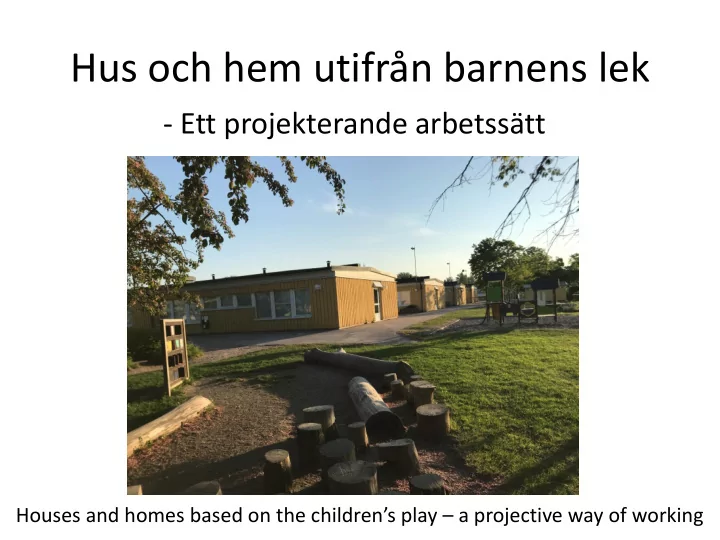
Hus och hem utifrån barnens lek
- Ett projekterande arbetssätt
Houses and homes based on the children’s play – a projective way of working
Hus och hem utifrn barnens lek - Ett projekterande arbetsstt Houses - - PowerPoint PPT Presentation
Hus och hem utifrn barnens lek - Ett projekterande arbetsstt Houses and homes based on the childrens play a projective way of working Uppstarten How it all began We observed that the children enjoyed constructing buildings and started
Houses and homes based on the children’s play – a projective way of working
We observed that the children enjoyed constructing buildings and started moving in to them. The houses became homes.
We added material to the pre-school environment, a large cardboard box. This became a house and the children began discussing rooms, furniture and even floorplans.
The cardboard house moved out to
got a coat of paint. After a while the house was all broken because the children enjoyed playing with it so much.
After changes in the seasons the children picked up an interest for bugs and started discussing where the bugs lived. They gathered wood and started building houses for the insects.
Keynote
Läroplan för förskolan Lpfö 98, reviderar 2016 The Swedish pre-school curriculum
Do the pre-school teachers live at the kindergarten? Or do they have homes as we do? We visit the children’s houses in the neighborhood and with help of Google Maps.
Here are a few examples of how we have used projections of the childrens houses and different types of houses.
s
Educational documentation. We put pictues of all the children’s houses on the floor to make them avalible for the children at all times. The children started lying on the floor and reflected on the differences between their houses.
A memorable moment is how a parent e-mails pictures of their house and we get two pictures. One at the house in their home country and one at their house in Sweden. The father usually drops his son of right inside of the door very quickly. One day he sees the documentation of their two houses on the floor and starts participating in a whole different way than before. He takes an interest in his son's time at the preschool through the project. He’s sitting on the floor talking about the pictures with the boy and myself (in the staff) and discusses the different homes and shows interest in how we work.
When the children
pictures of their houses, they noticed that two of the houses had different colors on the doors. One was blue and the other
subject for some lively discussions. We introduced the book "Knock Knock Knock”.
A book called Knock, knock, knock was introduced to the childern and was projected to the walls. This is a movie of the children exploring the book.
We extended the project with a Blue-Bot after noticing their facination for robots. We combined the childrens interests for robots with their interesets for Babblarna (a Swedish pedagogical language material) and the homes of Babblarna. In to the project now came the Blue-bot. It made visits to the homes
The children are listening to a book of Babblarna called ”Dadda visits”. After the book I continue the storyline to introcude the robot and how to program it to visit its friend Dadda’s house.
This is how it can look after the children have discussed a path home to Dadda and programmed the robot.
We’re using an app called Puppet Pals that lets the children create movies. They choose a background picture and we use a picture of the child as a puppet.
Diskutera * Använder ni teknologi i era förskolor? * På vilket sätt? * Hur berikar det barnens lek?
Tack för oss! Om ni har några funderingar får ni gärna höra av er till oss. Thank you! If you have any questions, feel free to contact us.
Monica Cervin Lindefalk, förskollärare Nordanby förskola monica.cervin.lindefalk@vasteras.se Eva Svanbäck-Lidman, förskollärare Nordanby förskola eva.svanback.lidman@vasteras.se