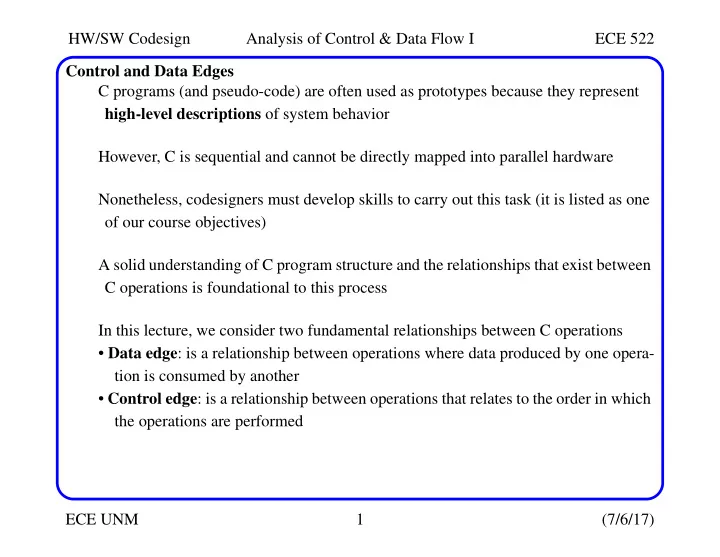
SLIDE 1 HW/SW Codesign Analysis of Control & Data Flow I ECE 522 ECE UNM 1 (7/6/17) Control and Data Edges C programs (and pseudo-code) are often used as prototypes because they represent high-level descriptions of system behavior However, C is sequential and cannot be directly mapped into parallel hardware Nonetheless, codesigners must develop skills to carry out this task (it is listed as one
A solid understanding of C program structure and the relationships that exist between C operations is foundational to this process In this lecture, we consider two fundamental relationships between C operations
- Data edge: is a relationship between operations where data produced by one opera-
tion is consumed by another
- Control edge: is a relationship between operations that relates to the order in which
the operations are performed
SLIDE 2
HW/SW Codesign Analysis of Control & Data Flow I ECE 522 ECE UNM 2 (7/6/17) Control and Data Edges Consider the following example that returns the max of a or b int max(int a, b) // operation 1 - enter the function { int r; if (a > b ) // operation 2 - if-then-else r = a; // operation 3 else r = b; // operation 4 return r; // operation 5 - return max } As you can see, our analysis treats each of the C statements as individual operations To find the control edges in this program, we need to identify all possible paths through this program
SLIDE 3
HW/SW Codesign Analysis of Control & Data Flow I ECE 522 ECE UNM 3 (7/6/17) Control and Data Edges For example, operation 2 will always execute after operation 1 We can use a control flow graph (CFG) to capture this relationship, by adding a directed edge between these operations (which are represented as bubbles) The if-then-else operation includes two out-going edges to represent each of the two execution paths Control Flow Graph (CFG)
SLIDE 4
HW/SW Codesign Analysis of Control & Data Flow I ECE 522 ECE UNM 4 (7/6/17) Control and Data Edges The data flow graph (DFG) is constructed by analyzing the data production (writes) and consumption (reads) patterns for each of the variables int max(int a, b) { // operation 1 - produce a, b int r; if (a > b ) // operation 2 - consume a, b r = a; // operation 3 - consume a and (a>b), // produce r else r = b; // operation 4 - consume b and (a>b), // produce r return r; // operation 5 - consume r } Data edges are added between operations which write and then read a variable For example, operation 1 defines (writes) the values of a and b Variable a is read by operation 2 and 3 while b is read by operation 2 and 4 This produces data edges from 1 to 2 for a and b, and to 3 for a and 4 for b
SLIDE 5
HW/SW Codesign Analysis of Control & Data Flow I ECE 522 ECE UNM 5 (7/6/17) Control and Data Edges Control statements in C also generate data edges For example, the if-then-else statement evaluates a flag (a > b), which reads a and b The boolean flag carries the value of (a > b) from operation 2 to operations 3 and 4 Note that unlike CFGs, edges in DFGs are labeled with a specific variable Data Flow Graph (DFG)
SLIDE 6 HW/SW Codesign Analysis of Control & Data Flow I ECE 522 ECE UNM 6 (7/6/17) Implementation Issues CFGs and DFGs capture the behavior of the C program graphically This leads naturally to the following question: What are the important parts of a C program that MUST be preserved in any implementation of that program?
- Data edges reflect requirements on the flow of information
Important note: If you change the flow of data, you change the meaning of the algorithm
- Control edges, on the other hand, provide a nice mechanism to break down the algo-
rithm into a sequence of operations (a recipe) They are not fundamental to preserving correct functional behavior in an imple- mentation It follows then that data edges MUST be preserved while control edges can be removed and/or manipulated
SLIDE 7 HW/SW Codesign Analysis of Control & Data Flow I ECE 522 ECE UNM 7 (7/6/17) Implementation Issues Parallelism in the underlying architecture can be leveraged to remove control edges, e.g., superscalar processors can execute instructions out-of-order On the other hand, parallel architectures MUST always preserve data dependen- cies otherwise, the results will be erroneous int sum(int a, b, c) { // operation 1 int v1; v1 = a + b; // operation 2 v2 = v1 + c; // operation 3 return v2; } // operation 4 A fully parallel hardware implementation
- f this program can in fact carry out both
additions in a single clock cycle The sequential order specified by the CFG is eliminated in the hardware implementa- tion
SLIDE 8 HW/SW Codesign Analysis of Control & Data Flow I ECE 522 ECE UNM 8 (7/6/17) Construction of the Control Flow Graph Let’s define a systematic method to convert a C program to a CFG assuming:
- Each node in the graph represents a single operation (or C statement)
- Each edge of the graph represents an execution order for the two operations con-
nected by that edge Since C executes sequentially, this conversion is straightforward in most cases The only exception occurs when multiple control edges originate from a single
Consider the for loop in C for (i = 0; i < 20; i++) { // body of the loop } This statement includes four distinct parts:
- loop initialization
- loop condition
- loop-counter increment operation
- body of the loop
SLIDE 9
HW/SW Codesign Analysis of Control & Data Flow I ECE 522 ECE UNM 9 (7/6/17) Construction of the Control Flow Graph The for loop introduces three nodes to the CFG Dashed components, entry, exit and body, are other CFGs of the C program which have single-entry and single-exit points The do-while loop and the while-do loop are similar iterative structures for loop contributes multiple operations
SLIDE 10
HW/SW Codesign Analysis of Control & Data Flow I ECE 522 ECE UNM 10 (7/6/17) Construction of the Control Flow Graph Consider the CFG for the GCD algorithm. A control path is defined as a sequence of control edges that traverse the CFG For example, each non-terminating iteration of the while loop will follow the path 2->3->4->2 or else 2->3->5->2 Control paths are useful in constructing the DFG 1: int gcd (int a, int b) { 2: while (a != b) { 3: if (a > b) 4: a = a - b; else 5: b = b - a; } 6: return a; } 1 2 6 3 4 5
SLIDE 11 HW/SW Codesign Analysis of Control & Data Flow I ECE 522 ECE UNM 11 (7/6/17) Construction of the Data Flow Graph Let’s also define a systematic method to convert a C program to a DFG assuming
- Each node in the graph represents a single operation (or C statement)
- Each edge of the graph represents a data dependency
Note that the CFG and the DFG will contain the same set of nodes -- only the edges will be different While it is possible to derive the DFG directly from a C program, it is easier to create the CFG first and use it to derive the DFG The method involves tracing control paths in the CFG while simultaneously identif- ing corresponding read and write operations of the variables Our analysis focuses on C programs that do NOT have arrays or pointers Text includes discussion and examples on how to handle these more complex data structures
SLIDE 12 HW/SW Codesign Analysis of Control & Data Flow I ECE 522 ECE UNM 12 (7/6/17) Construction of the Data Flow Graph Ad-hoc method:
- Start at the node where a variable is read (which is referred to as a read-node)
- Identify the CFG nodes that assign to that variable (referred to as write-nodes)
- Introduce a data edge between a read and write node under the condition that the
control path does NOT pass through another write-node for that variable
- Repeat for all read nodes
This procedure identifies all data edges related to assignment statements, but not those originating from conditional expressions in control flow statements However, these data edges are easy to find They originate from the condition evaluation and affect all the operations whose execution depends on that condition Let’s derive the DFG of the GCD program We first pick a node where a variable is read
SLIDE 13 HW/SW Codesign Analysis of Control & Data Flow I ECE 522 ECE UNM 13 (7/6/17) Construction of the Data Flow Graph Consider stmt 5: There are two variable-reads in this statement, one for a and one for b Consider b first Find all nodes that reference b by tracing backwards through predecessors
- f node 5 in the CFG -- this produces the ordered sequence 3, 2, 1, 4, and 5
Both nodes 1 and 5 write b and there is a direct path from 1 to 5 (e.g. 1, 2, 3, 5), and from 5 to 5 (e.g. 5, 2, 3, 5) Therefore, we need to add data edges for b from 1 to 5 and from 5 to 5 1: int gcd (int a, int b) { 2: while (a != b) { 3: if (a > b) 4: a = a - b; else 5: b = b - a; } 6: return a; } 1 2 6 3 4 5
SLIDE 14
HW/SW Codesign Analysis of Control & Data Flow I ECE 522 ECE UNM 14 (7/6/17) Construction of the Data Flow Graph A similar process can be carried out for variable-read of a in node 5 Nodes 1 and 4 write into a and there is a direct control path from 1 to 5 and from 4 to 5 Hence, data edges are added for a from 1 to 5 and from 4 to 5 To complete the set of data edges into node 5, we also need to identify all conditional expressions that affect the outcome of node 5 From the CFG, node 5 depends on the condition evaluated in node 3 (a > b) AND the condition evaluated in node 2 (a != b) Partial DFG for node 5
SLIDE 15
HW/SW Codesign Analysis of Control & Data Flow I ECE 522 ECE UNM 15 (7/6/17) Construction of the Data Flow Graph The final DFG for all nodes and all variable-reads for GCD is shown below. Note: this DFG leaves out the data edges originating from conditional expressions Being able to abstract a complex C program to a DFG is essential for codesign 1: int gcd (int a, int b) { 2: while (a != b) { 3: if (a > b) 4: a = a - b; else 5: b = b - a; } 6: return a; } 1 2 6 3 4 5 a,b a,b a,b a,b a a a a a a b b b b