Hybrid Ablation of AF in the MAZE III Procedure Operating Room: I s - - PowerPoint PPT Presentation

hybrid ablation of af in the maze iii procedure operating
SMART_READER_LITE
LIVE PREVIEW

Hybrid Ablation of AF in the MAZE III Procedure Operating Room: I s - - PowerPoint PPT Presentation

9/8/2012 Hybrid Ablation of AF in the MAZE III Procedure Operating Room: I s There a Need? Paul J. Wang, MD Amin Al-Ahmad, MD Gan Dunnington, MD Stanford University Cox J, et al. Ann Thorac Surg. 1993;55:578-580. Treatment Algorithms for AF:


slide-1
SLIDE 1

9/8/2012 1

Hybrid Ablation of AF in the Operating Room: Is There a Need?

Paul J. Wang, MD Amin Al-Ahmad, MD Gan Dunnington, MD Stanford University

Cox J, et al. Ann Thorac Surg. 1993;55:578-580.

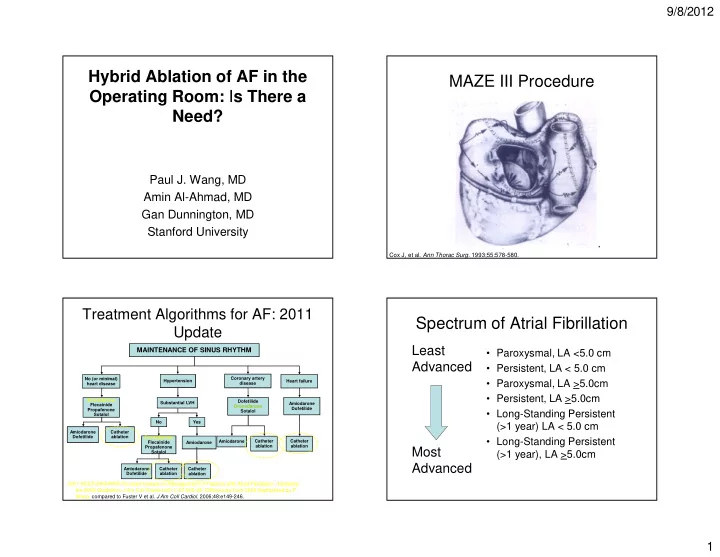
MAZE III Procedure

Treatment Algorithms for AF: 2011 Update

MAINTENANCE OF SINUS RHYTHM

No (or minimal) heart disease Dronedarone Flecainide Propafenone Sotalol Amiodarone Dofetilide Catheter ablation Hypertension Substantial LVH No Yes Dronedarone Flecainide Propafenone Sotalol Amiodarone Amiodarone Dofetilide Catheter ablation Catheter ablation Coronary artery disease Dofetilide Dronedarone Sotalol Amiodarone Catheter ablation Amiodarone Dofetilide Catheter ablation Heart failure

. 2011 ACCF/AHA/HRS Focused Update on Management of Patients with Atrial Fibrillation (Updating the 2006 Guideline) J Am Coll Cardiol 2011; 57:223-42. Differences from 2006 Highlighted by P Wang compared to Fuster V et al. J Am Coll Cardiol. 2006;48:e149-246.

Spectrum of Atrial Fibrillation

  • Paroxysmal, LA <5.0 cm
  • Persistent, LA < 5.0 cm
  • Paroxysmal, LA >5.0cm
  • Persistent, LA >5.0cm
  • Long-Standing Persistent

(>1 year) LA < 5.0 cm

  • Long-Standing Persistent

(>1 year), LA >5.0cm

Least Advanced Most Advanced

slide-2
SLIDE 2

9/8/2012 2

Spectrum of Atrial Fibrillation

  • Paroxysmal, LA <5.0 cm
  • Persistent, LA < 5.0 cm
  • Paroxysmal, LA >5.0cm
  • Persistent, LA >5.0cm
  • Long-Standing Persistent

(>1 year) LA < 5.0 cm

  • Long-Standing Persistent

(>1 year), LA >5.0cm

Least Advanced Most Advanced

Catheter Ablation

Spectrum of Atrial Fibrillation

  • Paroxysmal, LA <5.0 cm
  • Persistent, LA < 5.0 cm
  • Paroxysmal, LA >5.0cm
  • Persistent, LA >5.0cm
  • Long-Standing Persistent

(>1 year) LA < 5.0 cm

  • Long-Standing Persistent

(>1 year), LA >5.0cm

Least Advanced Most Advanced

What is your estimate of freedom from AF at 1 year of 1 catheter ablation procedure with LA 6.0 cm and AF persistently for 5 years?

2

  • 3

% 5 % 7 % 9 %

86% 0% 3% 10%

  • A. 20-30%
  • B. 50%
  • C. 70%
  • D. 90%

Which single (not repeat) procedure has the highest success for achieving freedom from AF?

Catheter ablat... Thoracoscopic ... Thoracoscopic ...

29% 67% 5%

  • A. Catheter ablation
  • B. Thoracoscopic Maze
  • C. Thoracoscopic Maze plus

Catheter ablation

slide-3
SLIDE 3

9/8/2012 3

Rationale for a Hybrid AF Procedure

  • Does any catheter ablation procedure have a

single procedure success of 50%, 80% or more in these patients at 1yr, 2yr, 5yr? For example, patient with AF 5 years and LA 6.0 cm

– Long-standing persistent AF – Large atria

  • Highest single procedure success
  • Rapid procedural recovery
  • Reasonable risk

Procedure Methodology – Hybrid Approach

12

Hybrid Epicardial Ablation Procedure

Lesion Set Lesions consist of:

  • Pulmonary Vein Isolation
  • Roof and inferior connecting

lesions

  • Lesion from the left superior

pulmonary vein to the left atrial appendage

  • LA isthmus lesion from LI PV

to AV groove

  • Patient is intubated with double lumen

endotracheal tube

  • Patient is prepped in usual manner
  • Small incisions are made for 5mm or

10mm diameter access ports

  • Access ports are inserted in the right chest
slide-4
SLIDE 4

9/8/2012 4

Epicardial Surgical Ablation- Right Side

  • Right Side GP Testing and Ablation
  • Right Antral Ablation
  • Start Right Roof line through Transverse Sinus using Ablation

Pen (approximately half of the line to be completed from the right side)

  • Start Right sided inferior line using Ablation (approximately

half of the line to be completed from the right side)

  • Optional: SVC to IVC linear line with Ablation Pen or

Transpolar Pen (discontinue line at junction of IVC at area of no recorded electrograms)

  • Optional: Encircling SVC lesion using the bipolar clamp

and/or Ablation Pen

Epicardial Surgical Ablation- Left Side

Left Side GP Testing and Ablation

  • Obliterate Ligament of Marshall
  • Left Antral Isolation
  • Finish ablation of the Roof Line and

extend from LSPV to left atrial appendage using Ablation Pen

  • Finish ablation of the Inferior Line using

Ablation Pen

Epicardial Surgical Ablation Lines

  • A line from the inferior (caudad) box lesion

towards the mitral annulus using the Ablation Pen

  • Ablation will stop 1-2 cm before reaching the

atrioventricular groove, to avoid injury to the left circumflex coronary artery.

Setup

slide-5
SLIDE 5

9/8/2012 5

Marking Port

Breaking Through Skin to Make Port

Maneuvering Devices Maneuvering Scope

slide-6
SLIDE 6

9/8/2012 6

Right PV Dissection. Pulm Artery Aorta Head of Patient Right superior PV svc La ap La dome pa svc Post la dome rspv Waterston’s Groove RSPV Waterson’s groove SVC PA RIPV Grabber holds end of the Lighted Dissection tape and will advance behind the PV Waterstone;s groove Lighted dissection under RIPV comes in transverse sinus RPA and below SVC SVC PA RS PV

slide-7
SLIDE 7

9/8/2012 7

Pinching tool pulls off the Lighted Dissection tape from the lighted articulated dissection tool Lung pericardium Hilum of lung where pv enter lung LA AP LIPV LSPV common trunk

Endocardial Catheter Ablation

  • Insert multipolar Coronary Sinus catheter into

CS for standard EP mapping and ablation techniques

  • Place multi electrode diagnostic HIS catheters

in position for guidance of CS cannulation and transseptal puncture

  • Create Right Cavotricuspid Isthmus Lesion
  • Check for bidirectional Right Cavotricuspid

Isthmus block

slide-8
SLIDE 8

9/8/2012 8

Endocardial Catheter Ablation

  • Perform Transseptal puncture
  • Assess the LAA surgical lesion for presence of

bidirectional block. If incomplete block exists, complete the ablation lesion using an endocardial approach.

Endocardial Catheter Ablation

  • Complete ablation to the Mitral Valve Isthmus

Lesion

  • Test for bidirectional Mitral Valve block
  • Check for both Right and Left entrance and

exit block PVIs

  • Check Posterior Box for isolation

Endocardial Catheter Ablation

  • Re-Check bidirectional block for Right

Cavotricuspid Isthmus Lesion

  • Check Encircling SVC Lesion for entrance and

exit block

Hybrid Endocardial Ablation Procedure

  • Endocardial Right Atrial Isthmus Lesion:
  • RA Isthmus lesion will be

completed by the EP

slide-9
SLIDE 9

9/8/2012 9

Right Superior Pulmonary Vein Post-Epicardial Ablation Right Inferior Pulmonary Vein Post-Epicardial Ablation Left Superior Pulmonary Vein Post-Epicardial Ablation Left Inferior Pulmonary Vein Post-Epicardial Ablation

slide-10
SLIDE 10

9/8/2012 10

N=47

Courtesy of Mark La Meir: Netherlands/Belgium and Univ Virginia Courtesy of Mark La Meir: Netherlands/Belgium and Univ Virginia

What is the Contribution of Endocardial catheter ablation stage?

  • 27 patients; EP study within 4 days:

2.2+1.8 days

  • 10 persistent; 17 long-standing persistent
  • Iso: 13 patients had 1 atrial flutter
  • All patients had antral and SVC isolation
  • 28 gaps in 17 patients
  • Roof near LSPV 10/27 (37%); floor near

RIPV 4/27 (15%); mitral line 10/12 (83%)

Mahapatra S et al Heart Rhythm Journa 2011:S315

What is the Contribution of Endocardial catheter ablation stage?

  • All gaps were ablated
  • 16.9 + 9 months
  • 23 patients free of AF and off AAD (85%)
  • 3 free off AF with AAD (11%)
  • 1 patient had AF despite AAD(4%)
  • No atrial flutter requiring repeat ablation

Mahapatra S et al Heart Rhythm Journa 2011:S315

slide-11
SLIDE 11

9/8/2012 11 Which single (not repeat) procedure has the highest success for achieving freedom from AF?

Catheter ablat... Thoracoscopic ... Thoracoscopic ...

12% 84% 4%

  • A. Catheter ablation
  • B. Thoracoscopic Maze
  • C. Thoracoscopic Maze plus

Catheter ablation

Take Home Messages

  • Success of single procedure is low in

patients with large atria and long-standing persistent AF

  • Hybrid approach appears to result in a low

AF recurrence rate with low likelihood of atrial flutters

  • Further studies are needed to examine

this approach in a larger patient population

Thank You

Paul.J.Wang@stanford.edu