Hydrogeology Journal HJ I SI I mpact Factor MISSION Foster - - PDF document

hydrogeology journal
SMART_READER_LITE
LIVE PREVIEW

Hydrogeology Journal HJ I SI I mpact Factor MISSION Foster - - PDF document

Hydrogeology Journal Session, including 01/10/2015 Tips for Writing a Knock Out Paper INTE RNATIONAL ASSOCIATION OF HYDROGE OLOGISTS INTE RNATIONAL ASSOCIATION OF HYDROGE OLOGISTS the worldwide groundwater organisation the worldwide


slide-1
SLIDE 1

Hydrogeology Journal Session, including Tips for Writing a Knock Out Paper 01/10/2015 Clifford Voss, Executive Editor, Hydrogeology Journal. 1

Early Career Hydrogeologists‘ Network (ECHN) and Hydrogeology Journal (HJ) Session

Tips for writing a knock-out paper Meet the editor(s) of Hydrogeology Journal – Question time for Early Career Hydrogeologists

INTE RNATIONAL ASSOCIATION OF HYDROGE OLOGISTS the worldwide groundwater organisation

 Worldwide forum for hydrogeology and related sciences  Theory and practice  Inclusive of studies and authors in all countries  Peer-reviewed articles (3+ reviews)  English language support

INTE RNATIONAL ASSOCIATION OF HYDROGE OLOGISTS the worldwide groundwater organisation

Hydrogeology Journal provides…

INTE RNATIONAL ASSOCIATION OF HYDROGE OLOGISTS the worldwide groundwater organisation

 In HJ’s first 20 years:

Published > 1600 articles Authors from > 65 countries

 Currently submitted

~ 400 manuscripts/year

 Accepted for publication

~ 30% of those submitted (~ 120 each year)

publisher: Heise publisher: Springer ~ 1600 issues per year: 4 6 8

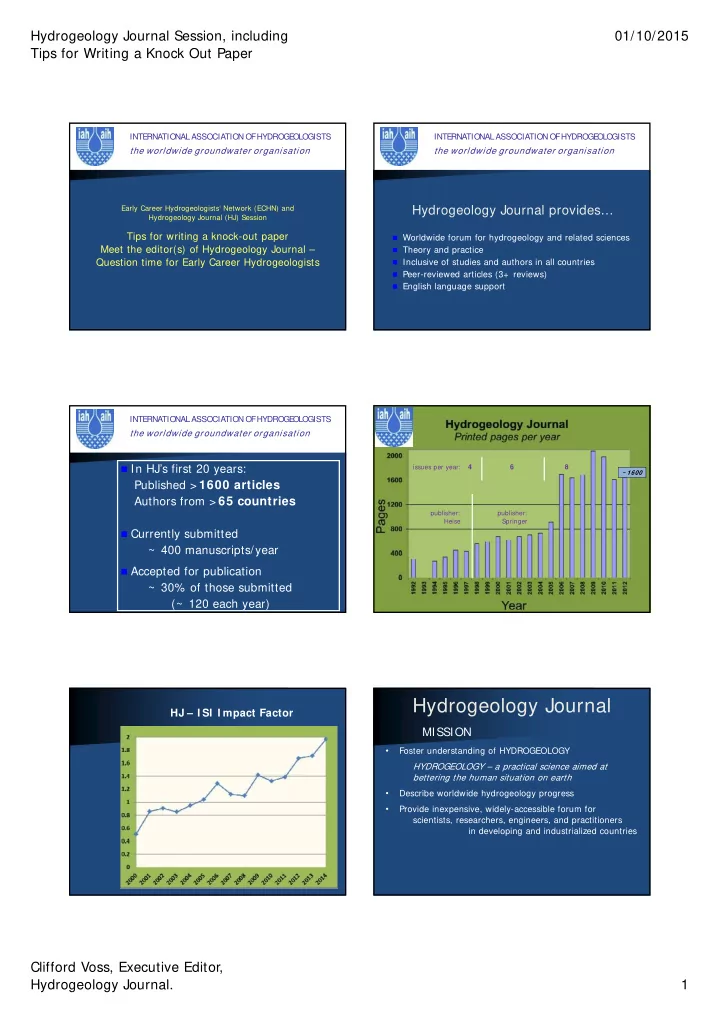
HJ – I SI I mpact Factor

Hydrogeology Journal

MISSION

  • Foster understanding of HYDROGEOLOGY

HYDROGEOLOGY – a practical science aimed at bettering the human situation on earth

  • Describe worldwide hydrogeology progress
  • Provide inexpensive, widely-accessible forum for

scientists, researchers, engineers, and practitioners in developing and industrialized countries

slide-2
SLIDE 2

Hydrogeology Journal Session, including Tips for Writing a Knock Out Paper 01/10/2015 Clifford Voss, Executive Editor, Hydrogeology Journal. 2

Hydrogeology Journal

SCOPE

Theoretical + Applied Hydrogeologic Science

  • Theoretical and field studies
  • Scale: Local areas - short time periods to regional/global

problems and geologic time

  • New lab-field techniques/instrumentation
  • Water-resource evaluations
  • Reports of observed hydrogeologic phenomena

Hydrogeology Journal

SCOPE

Theoretical + Applied Hydrogeologic Science

  • Overviews of hydrogeologic systems of interest in various

regions

  • State-of-the-art-reviews
  • Philosophy of scientific methods in hydrogeology

Hydrogeology Journal

SCOPE

Theoretical + Applied Hydrogeologic Science

  • Interaction between populations and hydrogeologic

systems

  • Economics of hydrogeologic systems
  • Ramifications of hydrogeology on environmental protection

and optimal employment of natural resources

  • History of hydrogeology
  • Biographies of eminent hydrogeologists

Hydrogeology Journal

SCOPE

Mainstream HJ paper integrates subsurface hydrology and geology with other supporting disciplines: geochemistry, geophysics, geomorphology, geobiology, surface-water hydrology, tectonics, mathematics, numerical modeling, economics, sociology, … to explain observed or expected phenomena

Hydrogeology Journal

SCOPE

Mainstream HJ paper integrates subsurface hydrology and geology with other supporting disciplines Focus of paper must be ‘hydrogeology’ (usually interaction of water and geology) Focus of paper may not be ‘supporting discipline’

Location of Studies Reported in a 2-year period (2005-2006)

Argentina 2 Ireland 1 Pakistan 1 Australia 4 Italy 2 Palestine 3 Bangladesh 1 Japan 1 Poland 1 Belgium 1 Jordan 1 Portugal 2 Canada 4 Korea 1 Saudi Arabia 1 Chad 1 Kyrgyzstan 1 Spain 2 China 7 Lebanon 1 Sweden 1 Egypt 1 Lithuania 1 Switzerland 1 Ethiopia 1 Mexico 5 Turkey 2 Finland 1 New Zealand 1 UK 1 Germany 1 Nicaragua 1 USA 12 Greece 1 Nigeria 2 Vietnam 1 India 10 Norway 1 Zimbabwe 1 Iran 1 Oman 2

slide-3
SLIDE 3

Hydrogeology Journal Session, including Tips for Writing a Knock Out Paper 01/10/2015 Clifford Voss, Executive Editor, Hydrogeology Journal. 3

HJ Theme Issues

1998 Tribute to Eugene S. Simpson Shlomo Neuman and Michael Campana 1999 Groundwater as a Geologic Agent Joseph Toth 2000 Groundwater and Microbial Processes Barbara Bekins 2001 Confining Units Vicki Remenda 2002 Groundwater Recharge Bridget Scanlon and Peter Cook 2003 Hydromechanics in Geology and Geotechnics Ove Stephansson 2004 Groundwater ‐ from Development to Management Karin Kemper 2005 The Future of Hydrogeology Clifford Voss 2006 Social and Economic Aspects of Groundwater Governance Ramon Llamas, Aditi Mukherji and Tushaar Shah 2007 Satellite and Remote Sensing in Hydrogeology Jörn Hoffman and Per Sander 2009 Hydrogeoecology and Groundwater Dependent Ecosystems Peter Hancock, Randall Hunt and Andrew Boulton 2010 Saltwater and Freshwater Interactions in Coastal Aquifers Vincent Post and Elena Abarca 2011 Insights from Environmental Tracers in Groundwater Systems Ward Sanford, Werner Aeschbach‐Hertig and Andrew Herczeg 2012 The Economics of Groundwater Management Peter Reinelt, Nicholas Brozović, Ejaz Qureshi and Petra Hellegers 2013 Cold Regions: Hydrogeology and Climate Change Larry Hinzman, Georgia Destouni, Ming‐Ko Woo 2014 Hydrogeology of Shallow Thermal Systems Allen, D.M., Bayer, P. Ferguson, G. and Blum, P. 2015 Optimization for groundwater characterization and management Bithin Datta, George Kourakos, Brian Wagner

Guest Editors

HJ - Current Staff

 Editors – Executive Editor

  • Cliff Voss – USA

– Editors

  • Martin Appold – USA
  • Jean-Michel Lemieux – Canada
  • Maria Schafmeister – Germany
  • Liz Screaton – USA
  • RECENT: Jimmy Jiao - China, Vincent Post - Australia

 Editorial Office – Manager – Susanne Schemann – Germany – Technical Editorial Advisor – Sue Duncan – UK  Abstract Translation Managers

  • Han Zaisheng – China
  • Nathalie Dörfliger – France
  • Rodrigo Lilla Manzione – Brazil
  • Eduardo Kruse – Argentina

HJ Editorial Board

2015

Australia 8 Mexico 1 Austria 1 Netherlands 2 Canada 2 New Zealand 1 China 7 Russia 1 Denmark 1 Spain 1 Finland 1 Sweden 3 Germany 5 Switzerland 1 India 1 UK 7 Israel 1 USA 19 Japan 1

Associate Editors TOTAL 62 62

Time to publication

 1st Decision following submittal – within 4 months  Publication – ONLINE (Springer HJ Website)

10 months from submittal

– in PAPER journal

2 – 3 months later

HJ - Types of Articles Published

 PAPER

idea 45 %

 REPORT

place 42 %

 TECHNICAL NOTE

method 3 %

 COMMENT/REPLY

discussion 3 %

 ESSAY

  • pinion

3 %

 PROFILE

person 1 %

New HJ Developments

 Editors’ Choice Articles

– 5 articles each year – selected for recognition and Open Access

 Review Articles – (State of the Art Treatises)

– Hydrogeology of a Region – Hydrogeologic Science – Pedagogy

 Open Choice (open online public access)

slide-4
SLIDE 4

Hydrogeology Journal Session, including Tips for Writing a Knock Out Paper 01/10/2015 Clifford Voss, Executive Editor, Hydrogeology Journal. 4 Editors’ Tips How to structure a manuscript

 ABSTRACT

– Statement of scientific fact and scientific method – 1st sentence should summarize main finding – NOT ‘we did this and this’, NOT summary of paper.

 I NTRO

– Background – Why this is interesting/important

 RESULTS

– How/What you did (details often best in an Appendix) – Presentation of findings (text, tables, figures)

 DI SCUSSI ON

– Interpretations, generalizations, (limitations)

 CONCLUSI ON

– Clear re-statement of what was found – Implications for this and other systems/cases/situations

Editors’ Tips Being concise

 Only include what is important to

show/prove results

Don’t include it, just because you did it… (Remove extra stuff !)  Avoid many details in main article Use ESM (Electronic Supplementary Material)  COMMUNICATE! Try to write the essence of the paper in max 3 sentences.

Editors’ Tips How long, how many figures?

 Typical HJ Paper/Report:

~ 12-14 journal pages = 36-40 text-only pages (double-spaced) = 30-35 text-only pages plus 10 figures

 If exceeded, author must shorten!  Essays – max 4 journal pages

Editors’ Tips English Language

 Manuscripts are reviewed for technical content –

regardless of the quality of English language. (but - poor language tends to make a negative impression on reviewers)

 To make it easier for reviewers, and to have the

greatest chance of technical acceptance – authors who are concerned about their ‘English’ should find a capable colleague to review the ‘English’ before submittal.

Editors’ Tips Authorship

 No rules! Do whatever seems right.  Possibilities: – Student listed first, if it is their project work – Main professor listed first, if this person led the project – Main professor listed last, indicating that all of the authors were guided by this person (work conducted by this professor’s laboratory) – Person who wrote/organized most of the text comes first, irrespective of who did most work

  • n project

Editors’ Tips Ethics

 Avoid Plagiarism

– unreferenced copying of information and ideas from others – unclear referencing of others’ work

 Avoid Self-Plagiarism

– publishing your own results in more than one place with no reference – ‘dual publication’

 Distributing your published HJ article

– Springer owns published version –> No redistribution (unless author has purchased Open Choice) – You own only the final submitted version

slide-5
SLIDE 5

Hydrogeology Journal Session, including Tips for Writing a Knock Out Paper 01/10/2015 Clifford Voss, Executive Editor, Hydrogeology Journal. 5

Question 1: How many papers of all submissions are rejected because they are not in the scope of HJ? Answer: About 40 % .

Questions & Discussion

Question 2: Are conference papers “grey papers” or “white papers”? Answer: Conference papers are marginal cases of publications, depending

  • n their accessibility. Conference proceedings with I SBN are

quotable.

Questions & Discussion

Question 3: I s it a problem to publish reports that are already posted online? Answer: I t depends. You can for example publish short versions of longer research reports that are already published online.

Questions & Discussion

Question 4: I s it ok to publish more than one paper out of one longer report? Answer: I t depends on who you report to. Also, you need to distinguish the subjects of the paper properly. You could for example publish your results in one paper and then compare them to the results of other studies in another paper.

Questions & Discussion

Question 5: What is the next HJ theme issue for 2016? Answer: The theme issue for 2016, on the subject of ‘subsidence’, is in preparation and is planned to appear as the first issue of 2016. The issue will focus on subsidence caused by decrease in pressure due to pumping, dissolution of carbonates and salt beds, decay of peat layers, thaw of permafrost. Guest Editors: Devin Galloway, Eve Kuniansky and Joel Rowland (USA), Gilles Erkens (Netherlands)

Questions & Discussion

Question 6: Can everyone submit articles for a theme issue? Answer:

  • No. Only invited articles are considered for publication in theme
  • issues. But if you know about an upcoming theme issue and are

interested in submitting, contact the Exec Editor, or one of the Guest Editors with your suggestion.

Questions & Discussion

slide-6
SLIDE 6

Hydrogeology Journal Session, including Tips for Writing a Knock Out Paper 01/10/2015 Clifford Voss, Executive Editor, Hydrogeology Journal. 6

Question 7: I s there a shortcut to quickly publish papers for your thesis for theses that are composed of several (already) published articles? Answer: No.

Questions & Discussion

Question 8: I s there a way to submit your paper in Latex format? Answer:

  • No. Only Word format is accepted at the moment. There have

been a few exceptions where HJ accepted Latex and in those cases, the interaction with the technical editor Sue Duncan was carried out via pdf – not ideal for effectively editing manuscripts for publication. Perhaps Latex format will be accepted in the future.

Questions & Discussion

Question 9: Are articles and essays handled in the same way during the review process? Answer: Essays are handled differently during the review process. Their review is more flexible. The same applies for profiles and book

  • reviews. Usually, these manuscript types mostly get reviewed by
  • ne reviewer before a publication decision is made by an Editor.

Questions & Discussion

Question 10: How can you make sure you stay in the scope of HJ with your paper? Answer: HJ rejects papers that don’t focus on hydrogeology or

  • groundwater. I f you are not sure about whether your paper is in

the scope of HJ, you are welcome to contact an Editor beforehand and give an outline of the paper before submitting.

Questions & Discussion

Final advice: Before submitting your manuscript to any journal – Give it to as many people as possible for scientific-technical review, proof- reading, advice and suggestions! I t can only be improved and this would surely shorten the HJ review process and help your chances

  • f having your manuscript accepted for publication!

Questions & Discussion

slide-7
SLIDE 7

Hydrogeology Journal Session, including Tips for Writing a Knock Out Paper 01/10/2015 Clifford Voss, Executive Editor, Hydrogeology Journal. 7

Year Publisher Editor Office Staff 1992 Heise Simpson 1994 Voss/ Wilson Wilson

Applied Hydrogeology Hydrogeology Journal

HJ HI STORY

4 Managing Editors 1 Technical Editor 1 at Springer Year Publisher Executive Editor Office Editors 1995 Heise Voss/ Wilson Wilson 1998 Springer 2001 Voss/ Schneider 1 at I AH 2002 Voss/ Schneider / Olcott 2005 Voss 4 Managing Editors 1 Technical Editor 2006 1 at Springer

Hydrogeology Journal

HJ HI STORY

Manuscript flow

 Author submits online  Editorial Office (EO) content/format check  EO assigns Editor (1 of 4 EDs)  ED – Reviews for HJ scope (reject or review?) – Selects Associate Editor (AE)

Manuscript flow

 AE – Reviews for technical content – Selects 3 Reviewers (RVs) – RVs conduct technical review – AE compiles reviews and makes Recommendation  ED makes publication decision – Accept – Accept with Major or Minor Revisions – Reject

Manuscript flow

 Author revises and resubmits online  ED reviews revision, makes pub decision  When Accepted by ED, manuscript goes to

Technical Editorial Advisor (TEA)

Manuscript flow

 TEA – Interacts with author regarding expression and HJ style (author revises manuscript) – Issues Final Accept decision – to SPRINGER  SPRINGER – Copy editing, proof production – (Author reviews proof) – Publishes article “Online First” – Publishes article in paper journal (content selected/organized by Exec Editor)