Hyper-Resolution AUTOMATED REASONING Hyper-resolution generalises - - PowerPoint PPT Presentation

hyper resolution automated reasoning
SMART_READER_LITE
LIVE PREVIEW

Hyper-Resolution AUTOMATED REASONING Hyper-resolution generalises - - PowerPoint PPT Presentation

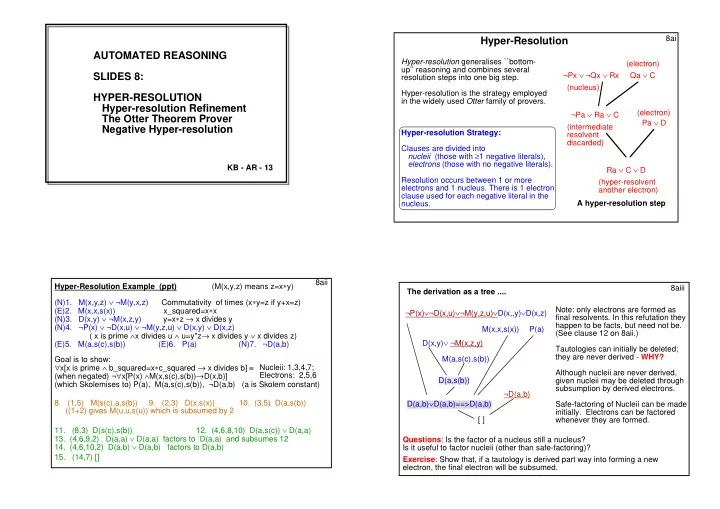
8ai Hyper-Resolution AUTOMATED REASONING Hyper-resolution generalises ``bottom- (electron) up reasoning and combines several Px Qx Rx Qa C SLIDES 8: resolution steps into one big step. (nucleus) Hyper-resolution is the


slide-1
SLIDE 1

AUTOMATED REASONING SLIDES 8: HYPER-RESOLUTION Hyper-resolution Refinement The Otter Theorem Prover Negative Hyper-resolution

KB - AR - 13 8ai Hyper-resolution generalises ``bottom- up’’ reasoning and combines several resolution steps into one big step. Hyper-resolution is the strategy employed in the widely used Otter family of provers. Hyper-resolution Strategy: Clauses are divided into nucleii (those with ≥1 negative literals), electrons (those with no negative literals). Resolution occurs between 1 or more electrons and 1 nucleus. There is 1 electron clause used for each negative literal in the nucleus.

Hyper-Resolution

¬Px ∨ ¬Qx ∨ Rx Qa ∨ C ¬Pa ∨ Ra ∨ C Pa ∨ D Ra ∨ C ∨ D (nucleus) (electron) (hyper-resolvent another electron) (intermediate resolvent discarded) (electron) A hyper-resolution step 8aii Hyper-Resolution Example (ppt) (M(x,y,z) means z=x∗y) (N)1. M(x,y,z) ∨ ¬M(y,x,z) Commutativity of times (x∗y=z if y+x=z) (E)2. M(x,x,s(x)) x_squared=x∗x (N)3. D(x,y) ∨ ¬M(x,z,y) y=x∗z → x divides y (N)4. ¬P(x) ∨ ¬D(x,u) ∨ ¬M(y,z,u) ∨ D(x,y) ∨ D(x,z) ( x is prime ∧x divides u ∧ u=y*z→ x divides y ∨ x divides z) (E)5. M(a,s(c),s(b)) (E)6. P(a) (N)7. ¬D(a,b)

  • 8. (1,5) M(s(c),a,s(b)) 9. (2,3) D(x,s(x)) 10. (3,5) D(a,s(b))

((1+2) gives M(u,u,s(u)) which is subsumed by 2 Goal is to show: ∀x[x is prime ∧ b_squared=x∗c_squared → x divides b] ≡ (when negated) ¬∀x[P(x) ∧M(x,s(c),s(b))→D(x,b)] (which Skolemises to) P(a), M(a,s(c),s(b)), ¬D(a,b) (a is Skolem constant) Nucleii: 1,3,4,7; Electrons: 2,5,6

  • 11. (8,3) D(s(c),s(b)) 12. (4,6,8,10) D(a,s(c)) ∨ D(a,a)
  • 13. (4,6,9,2) D(a,a) ∨ D(a,a) factors to D(a,a) and subsumes 12
  • 14. (4,6,10,2) D(a,b) ∨ D(a,b) factors to D(a,b)
  • 15. (14,7) []

Note: only electrons are formed as final resolvents. In this refutation they happen to be facts, but need not be. (See clause 12 on 8aii.) Tautologies can initially be deleted; they are never derived - WHY? Although nucleii are never derived, given nucleii may be deleted through subsumption by derived electrons. Safe-factoring of Nucleii can be made

  • initially. Electrons can be factored

whenever they are formed. 8aiii The derivation as a tree .... [ ] D(a,b)∨D(a,b)==>D(a,b) ¬D(a,b) D(a,s(b)) ¬P(x)∨¬D(x,u)∨¬M(y,z,u)∨D(x,,y)∨D(x,z) P(a) M(x,x,s(x)) D(x,y)∨ ¬M(x,z,y) M(a,s(c),s(b)) Exercise: Show that, if a tautology is derived part way into forming a new electron, the final electron will be subsumed. Questions: Is the factor of a nucleus still a nucleus? Is it useful to factor nucleii (other than safe-factoring)?

slide-2
SLIDE 2

8aiv

Properties of Hyper-Resolution

Hyper-resolution is Complete: An inductive proof is considered in the problem sheets so is not given here. Hyper-resolution can be combined with both predicate ordering and locking: Predicate ordering: Only need to use ordering in electrons (Why?) Only resolve on minimal atoms from an electron. eg if R<Q<P then from P(a,x)∨Q(x,y) can only use Q(x,y) Locking: Lock negative literals lowest of all literals to force their use Locks on positive literals in electrons and nucleii must be > than any negative lock eg Given ¬P(a)∨¬Q(x)∨R(x)5, P(a), Q(b)4∨Q(c)7 can derive R(b)5∨Q(c)7 Notice that intermediate nucleii can only be used to derive electrons. They cannot resolve with each other as the lowest locked literals in two nucleii are both negative. If all positive literals are locked at 1, and all negative literals are locked at 0, then locking effectively simulates hyper-resolution. Exercise: Justify the above statement. 8av Hyper-Resolution: Hyper-resolution forms the basis of a family of theorem provers originally from Argonne. OTTER (which you'll use in the lab) was the first, and is best for beginners; its most recent descendant is called Prover9. In hyper-resolution each ''step'' is actually one or more resolution steps, made according to a simple syntactic principle: only (final) resolvents with positive literals (called electrons) are allowed to be derived. To form them, a clause with one

  • r more negative literals (called a nucleus) is sequentially resolved with electrons, each time

removing 1 negative literal, until an electron is produced. If the nucleus has 5 negative literals there would be 5 intermediate steps. Note that a particular electron may be used in more than 1 intermediate step, but for each use a fresh copy is taken. As each hyper-resolution step is generally more than one resolution step there are fewer possible steps overall, so the search space is reduced (compared with that for binary resolution). Initially, the clauses are divided into nucleii and electrons. If the clauses in S are unsatisfiable then there will always be at least one nucleus and at least one electron – why must this be so if S are unsatisfiable? Generally, a saturation search process can be applied, whereby each nucleus is used to find all hyper-resolvents from the current electrons. At the end of all the processing, and after applying subsumption, if there is at least one new electron then the process is repeated. [By the way, the answer to the question above is that if all clauses are electrons, then they have a model - just assign T to all atoms. If no clause is an electron, then again the given clauses have a model - assign F to all atoms. For an unsatisfiable set of clauses S neither can happen, so S must contain at least one each of an electron and nucleus. ] 8bi

  • For a given problem the clauses are divided into two sets, the SOS (set-of-

support) and the rest.

  • Resolvents may be formed only if at least one clause contributing to the

resolution step is from the SOS, or is derived from such a clause (i.e. it has an SOS clause as an ancestor).

Set of Support Strategy

As a consequence, note that two clauses not initially in SOS will never be resolved with each other. Therefore, if C and D are initial clauses and C is to be resolved with D, then at least one of them must be in SOS. Such clauses behave a little like the nucleii in Hyper-resolution.

√ √ √ √ x

In SOS or derived from SOS Not in SOS and not derived from SOS

√ √ √ √

8bii

Set of Support Strategy (2)

Why is the Set of Support strategy a good one?

  • The clauses not in SOS are often satisfiable. e.g. the clauses in a Horn clause

program could be the complement of the SOS. Resolving between the satisfiable non-SOS clauses may give interesting results, but not results that are useful for the problem in hand. Why? (Hint: The aim is to derive a contradiction)

  • Often, some clauses are known to be required for contradiction and they are

put into the SOS. The Set of Support strategy is used by Otter and combined with hyper-resolution Questions: (1) What happens in this strategy if SOS is initially empty? (2) Prolog uses the SOS strategy. What is its SOS?

slide-3
SLIDE 3

8biii Otter is a very versatile theorem prover with a simple interface. The successor is Prover9, but Otter is used in class as it gives single step and user interaction. Otter makes use of 2 main lists: sos and usable (non-sos clauses). The main loop is: While sos is not empty and empty clause is not derived select given from sos (various criteria for selection) generate resolvents using usable clauses and given (various inference rules are allowed and restrictions can be imposed) move given to usable process new clauses and put kept ones into sos (various criteria for retention) End Selection criteria include number of literals, number of variables, weight of terms, most recent addition, oldest clause, etc. Inference rules include resolution, hyper-resolution, and others. Retention criteria include measures as above, plus factoring, subsumption.

The OTTER Theorem Prover

Otter forms resolvents using the SOS restriction strategy, and processes them according to user defined settings until the empty clause is deduced. 8biv

The OTTER Theorem Prover Main Loop (ppt)

USABLE SOS GIVEN RESOLVENTS ACCORDING TO STRATEGY NEW USABLE AFTER PROCESSING NEW SOS AFTER PROCESSING KEPT RESOLVENTS ACCORDING TO CRITERIA USABLE SOS STOP IF [ ] STOP IF SOS EMPTY 8bv Example1: (All examples use hyper-resolution, for/back subsumption, no factoring) usable: 1: ¬Ha 2: ¬Gz ∨¬Fb 3: ¬Fx ∨¬Hb 4: Gx ∨¬Fx sos: 5: Fx ∨Hx Select 5 as given. Compute resolvents: (5+1= 6): Fa, (5+4=8): Gx ∨Hx (5+5+3=7): Hx ∨Fb (Remember, use Hyper-resolution, and since only 1 electron (5) cannot use (2)) sos is now 6, 7, 8 and usable is 1- 5. Select 6. Compute hyper-resolvents: (6+5+3=9): Fb (subsumes 7), (6+4=10): Ga. sos = 8, 9,10 and usable = 1- 6. Select 10. Compute hyper-resolvents: (10+2+5=11): Hb. sos = 8, 9,11 and usable = 1 - 6, 10. Select 11. Compute hyper-resolvents: (11+3+6=12):[], (11+3+5=13): Hx. Stop , as empty clause is deduced. Example 2 usable = 1 - 5; sos = empty. Stops immediately! Example 3 usable = 1: H ∨¬G 2: G sos = 3: ¬H Select 3. No hyper-resolvents possible using only 3 and usable. sos = empty, usable = 1 - 3. Stop! even though refutation possible.

Examples (see ppt)

The Otter Theorem Prover 8bvi Otter is a resolution theorem prover developed at Argonne. It is based on the set of support principle. The user can control its deduction cycle in many ways by setting numerous flags and parameters. Otter has a single main loop that forms resolvents and processes them until either the empty clause is deduced or the resources are used up. Otter keeps the clausal data in two main lists called the usable list and sos list. Resolvents are produced using one clause selected from the sos list and one or more clauses taken from the usable list. Its main operating loop is shown on Slide 8biii. Criteria for selecting the given clause are measures such as number of literals, number

  • f variables, weight of terms in the clause, etc. These can be controlled by the user. The

inference rules can be resolution or hyper-resolution, as well as several others (see the

  • n-line manual). Derived clauses are subject to various processing, such as factor

forming, subsumption tests, etc. Again, the user can control which tests are carried out. For example, the user can set a flag so that resolvents that have more than a set number

  • f variables or literals are not kept. Although this will make the search space

incomplete, it may keep it within reasonable bounds. Otter allows user interaction which is helpful for beginners. However, a replacement called Prover9 (See http://www.cs.unm.edu/~mccune/mace4/ ) is recommended for serious work.

slide-4
SLIDE 4

More about Otter There is a third list used by Otter called the passive list. Clauses in this list are not used to form resolvents unless they can be used to derive the empty clause immediately in one step. For instance, perhaps we would like to know if an intermediate literal L is ever derived. In that case, we can put the negation of L into the passive list. If L is ever derived, the empty clause is immediately generated and Otter stops. The clauses in the passive list can also be used to remove subsumed clauses. For example, suppose we know that clauses with a literal of the form P(f(f(f(x)))), for any x, will be

  • useless. Otter uses the passive list to detect additional subsumed clauses: if P(f(f(f(x)))) is

put into the passive list and the subsumption flag is set, then all clauses of this form will be subsumed and removed. Initially, the user puts each initial clause either into the sos-list or into the usable-list. The sos-list acts as a set of support facility. All resolvents will be formed using a clause in the initial sos-list or from a resolvent having at least one ancestor from the initial sos-list. Note therefore, that if the sos-list is initially empty no processing can occur as there is no clause to be the first given-clause. It is possible for the user to interact with Otter to tell it which should be the next given-clause. Otter will find all proofs of the empty clause within the parameters set by the user, who can also constrain Otter to find just one proof. As an experiment, run Otter on the three clauses

  • p(u,v) | -p(v,u), p(x,f(x)), p(f(y),y)

with various combinations of initial assignments of clauses to the sos-list and usable-list. You will have a chance to try Otter on some simple problems. For instance, you could try the three problems from Slides 0 (Otter includes reasoning with equality). You are expected to have used Otter and be familiar with the basic flags as part of the course. 8bvii 8ci

  • Let I be an H-interpretation in which all atoms are False, so all negative

literals are True. A nucleus will be True in I and an electron False in I.

  • A hyper-resolvent (an electron) is False in I.

Hyper-resolution has an interesting feature (1)

  • Resolution occurs between one clause which is True in I (the nucleus) and
  • ther clauses (electrons) that are False in I.
  • Hyper-resolution can be generalised for any H-interpretation I that splits a

given set of clauses S into non-empty S1 and S2 s.t.

  • S1 = clauses which are True in I (still called nucleii)
  • S2 = clauses which are False in I (still called electrons).
  • The strategy is still to resolve between 1 nucleus and ≥1 electrons.

T T F1 F2

  • +

+ F3 F4 F5 + + + F6 F7 + + F1 F2 F4 F5 F7 + + + + +

8cii

  • In the 'standard' hyper-resolution method it is easy to distinguish between

nucleii and electrons:

  • the syntax helps to distinguish between nucleii and electrons
  • every instance of an electron clause is an electron
  • every instance of a nucleus clause is a nucleus
  • for each nucleus literal, either all instances are true, or all instances are false
  • Hence a clause is always either a nucleus or an electron.

Any H- interpretation I that satisfies these criteria is called a uniform H- interpretation and can easily be used to form nucleii and electrons.

Hyper-resolution has an interesting feature (2)

We'll look at a second uniform H-interpretation that assigns True to every atom. In this case, HR is called Negative Hyper-resolution (Neg-HR) (See 8civ and 8cv)

slide-5
SLIDE 5

Generalising Hyper-resolution. As Slides 8ci/8cii argue, hyper-resolution can be generalised. One interesting and simple generalisation is to exchange the roles of positive and negative literals (shown on 8civ/8cv and often called neg-HR). We'll call a clause with only negative literals an N-electron and a clause with at least one positive literal an N-nucleus. Then all positive literals in an N- nucleus are resolved with N-electrons in an N-hyper-resolution step. A special case of this

  • ccurs for Horn clauses – all N-nucleii will have just one positive literal, so each step is a

single resolution step and the result is, in effect, a simulation of a logic programming system. Exercise: Show that this is the case. Slide 8cv shows the relation between hyper-resolution and Neg-HR. It's easy to show that any proof found using Neg-HR is isomorphic to an ordinary hyper- resolution proof, and so Neg-HR is complete too. Here's how. Remember that in Neg-HR the interpretation I sets all atoms True. Rename each atom L as ¬L' for some new L'; i.e. take a new signature in which the predicates are now primed and each occurrence of the literal ¬L is replaced by L' and each occurrence of L is replaced by ¬L'. Consider an interpretation I' for the primed signature, which makes all atoms False. Hence all instances of L' will be false in I'. In effect, L' is equivalent to ¬L, so the interpretation I' will induce the same nucleii and electrons in the primed signature as I did in the original signature. Standard HR on the primed clauses will be isomorphic to neg-HR on the unprimed clauses. This is illustrated for an example on 8cv. NOTE: Optional material in 8e consider more complex examples of uniform and non- uniform interpretations. 8ciii 8civ Suppose I makes all atoms TRUE What do electrons and nucleii look like? Nuclei are TRUE - at least 1 positive literal - resolve on true (positive) literals Electrons are FALSE - no positive literals

Negative Hyper-resolution (Neg-HR)

F1 T T

  • +

+ F2 F3

  • F4 F5
  • F1 F3 F5

If restricted to Horn clauses (maximum of 1 positive literal) HR and Neg-HR simulate well-known reasoning mechanisms. FACT: for Horn clauses standard Hyper-resolution is just forward reasoning by 'Modus Ponens', whereas neg-HR can simulate "top down" refutations (as in Prolog). Exercise: Confirm the FACT is true An example is on 8cv 8cv Neg-HR - a Uniform Interpretation in Hyper-resolution (ppt) We can turn a Neg-HR refutation into a standard HR refutation by renaming: Rename each atom A as ¬A' (I makes A true ==> ¬A' is true ==> A' false) ==> (1) ¬P'∨ Q' ∨R' (N) (2) ¬Q' (N) (3) ¬R' ∨ Q' (N) (4) P' (E) Now use standard hyper-resolution - proof is same as above EG Given the (Horn) clauses and using the interpretation making atoms TRUE: (1) P∨¬Q ∨¬R (N) (2) Q (N) (3) R ∨¬Q (N) (4) ¬P (E) (Remember - electrons are FALSE, nucleii are TRUE) A neg-HR refuation (using I) can resolve (N) on underlined literals: (1+4=5) ¬Q ∨¬R (5+2=6) ¬R (6+3=7) ¬Q (2+7=8) [ ] (Do you notice any pattern? HINT: Think of a logic programming trace) NOTE: Renaming can be used to show completeness for any uniform interpretation I. (See OPTIONAL slides 8e) 8di

Summary of Slides 8

  • 1. Hyper-resolution is a refinement in which each step consists of one or more

linked resolution steps made according to a specific restriction.

  • 2. Each clause is classified either as an Electron (no negative literal) or as a

Nucleus (at least one negative literal). Each step is made by resolving one nucleus clause with one or more electron clauses in turn, until the resolvent is an electron. Only electrons are generated by hyper-resolution.

  • 3. Otter is one of a famous family of theorem provers which uses the Hyper-

resolution strategy, together with the set-of-support strategy. In searching for Hyper-resolvents, at least one clause in the linked resolutions making up a hyper-resolution step must be derived from the so-called SOS.

  • 4. The SOS strategy allows a user to prevent the theorem prover making

potentially non-useful steps by resolving clauses from some satisfiable theory.

  • 5. Standard hyper-resolution is complete. One proof uses an induction proof

(see solutions to Problems), although there are others.

slide-6
SLIDE 6
  • 6. Standard hyper-resolution is based on the H-Interpretation which assigns

False to every ground atom. Nucleii are true in this interpretation and electrons are false.

  • 7. Neg-HR uses the uniform interpretation that assigns all atoms True.

Nucleii have at least one positive literal and are true, and electrons have no positive literals and are false.

  • 8. Predicate Ordering can be combined easily with Hyper-resolution. Each

electron is restricted in its use to resolving on the lowest atom in the order.

  • 9. Locking also can be combined with hyper-resolution. Both extensions, of

Predicate ordering and locking, can be shown to be complete by choosing a suitable set of indices for literals so that a locking refutation produces a simulated hyper-resolution refutation. There is no need to index negative literals as they muct be resolved in each step anyway. (See Problems for examples and discussion.) 8dii

S ST TA AR RT T

  • f

f O OP PT TI IO ON NA AL L M MA AT TE ER RI IA AL L ( (S SL LI ID DE ES S 8 8) )

Generalised Hyper-resolution Outline Hyper-resolution in Prolog

Suppose I is a uniform interpretation that makes R, P True and Q false, and given: (1) P∨Q (N) (2) ¬P∨R (N) (3) ¬Q∨R (N) (4) ¬R (E) A refutation using this uniform interpretation (true literals underlined) is (4+2 =5): ¬P (5+1=6): Q (6+3+4): [ ] Notice all electrons and resolvents are false in I. 8ei General Uniform Interpretations in Hyper-resolution Remember: electons are false in an interpretation I and nucleii are true. We now rename literals in the original clauses so that under the standard interpretation (when all atoms false) electrons are false and nucleii are true. Rename P to ¬P' and R to ¬R'. Since I makes P and R true it makes P' and R' false, and it still makes Q false. (¬P becomes P' and ¬R becomes R') Then: (1) ¬P' ∨ Q (N) (2) P' ∨ ¬R' ( N) (3) ¬Q ∨ ¬R' (N) (4) R' ( E) A standard HR-refutation is (4+2 =5): P' (5+1=6): Q (6+3+4): [ ] which is exactly the same as the original refutation after renaming. SUMMARY: For each atom that I makes false - do nothing; For each atom A that I makes true rename A as ¬A' (so I makes A' false) Then can use standard hyper-resolution 8eii How might a suitable uniform interpretation I be found?

  • If clauses T are a theory about something or other, they will be satisfiable

and have a model M. With respect to M, the clauses in T are nucleii.

  • Suppose a conclusion C, when negated, yields clauses G.

If T |= C then T+ ¬C is inconsistent, and the clauses T+G are not satisfiable. That is, any model M of T must make at least one clause in G false and that clause would be an electron with respect to M.

  • So we look for a uniform I such that (if possible)
  • nucleii = clauses in T (I makes clauses in T True)
  • electrons = clauses in G (I makes clauses in G False)

then hyper-resolution allows resolution between a clause in T and clauses in G or derived from G, but never between two clauses in T. It is unlikely this can be achieved exactly; for any selected I, usually at least some clauses in G are nucleii or some clauses in T are electrons, but the idea is good - divide clauses into 2 sets, called the major and minor sets, such that resolvents must be formed using at least one clause derived from the major set and clauses in the minor set are never resolved together.

  • The set-of-support strategy considered earlier is the result.
slide-7
SLIDE 7

Example Show ∀xy[(x<y∨x=y) ∧ y<c→x<c] (Use E for = and L for <)

  • 1. Exx x=x 2. {¬Exy,¬Eyz,Exz} x=y ∧y= z →x=z
  • 3. {¬Exy,Eyx} x=y → y=x 4. {¬Lxy,¬Lyz,Lxz} x<y ∧ y<z → x<z
  • 5. {¬Lxy,¬Lyx} x <y → ¬y<x 6. {Lxy,Exy,Lyx} x<y ∨ y<x ∨ x=y
  • 7. {¬Exy,¬Lxy} x=y → ¬x<y
  • 8. {Lab,Eab} 9. Lbc 10. ¬Lac

8eiii Let I = {Exy all True, Lxy all false.}; (a uniform interpretation) Then all except 9 are nucleii with True literals positive E or negative L. 9 is the only electron. Electrons have negative E and positive L literals The True literals in nucleii for resolving are underlined - all the resolvents are electrons so no true literals. negated goal is ≡ ∃xy[(x<y ∨ x=y) ∧ y<c ∧¬x<c] which becomes after Skolemising (a < b ∨ a=b ) ∧ b < c ∧ ¬a < c (i.e. 8,9,10)

  • 11. (7+9). ¬Ebc
  • 12. (2+11). {¬Eby, ¬Eyc}
  • 13. (12 +6). {Lyc, Lcy, ¬Eby}
  • 14. (13+10) {Lca, ¬Eba}
  • 15. (14+4+9) {Lba, ¬Eba}
  • 16. (7+15). ¬Eba
  • 17. (3+16). ¬Eab
  • 18. (8+17). Lab
  • 19. (18+4+9). Lac
  • 20. (19+10) []

Generalising Hyper-resolution. Slide 8eiii shows a more complex example of a uniform interpretation. On the other hand, a non-uniform interpretation for the clauses on 8eiii is the following: Lxx = false, Lab=Lbc=Lca=true and Lba=Lcb=Lac=False. Exx = true and Exy = false if x≠y. In fact, non-uniform interpretations are not often considered because there are some problems in detecting nucleii/electrons for general clauses. For example, consider the non- uniform interpretation above and the clauses on 8eiii. Clause 3 (¬Exy ∨ Eyx) is a nucleus because ¬Exy is true, except if x=y. In that case it becomes a tautology, which is perhaps not too bad. Clause 5 (¬Lxy ∨ ¬Lyx ) is also a nucleus, but when x/a, y/b, the literal ¬Lyx is true, whereas when x/b and y/a , then ¬Lxy is

  • true. So sometimes this nucleus should be used by resolving on ¬Lxy and sometimes on

¬Lyx. But if resolving with Luv (say) how can you tell which to use? Perhaps this too is a special case as it is a symmetric clause. Finally, look at Clause 4 (¬Lxy ∨ ¬Lyz ∨ Lxz). The instance ¬Lab ∨ ¬Lbc ∨ Lac is an electron, as it is false, but the instance ¬Lab ∨ ¬Lba ∨ Laa is a nucleus, with ¬Lba (from ¬Lyz) the true literal. 8eiv Relation between Standard Hyper-resolution and using any Uniform Interpretation. If you were to attempt hyper-resolution for the clauses on Slide 8eiii using the non-uniform interpretation suggested on slide 8eiv, it would be difficult. You might resolve on a literal in an electron only to find later that the implicit instance used was a nucleus! It is for this reason that uniform interpretations are the best. Even then, they may not be so efficient for humans

  • r machines to process as the standard interpretation.

A uniform interpretation may appear to be a useful generalisation, but in fact, any proof found using it is isomorphic to an ordinary hyper-resolution proof, and so the generalised version using uniform interpretations is complete too. This is shown next by adapting the argument given for Neg-HR. In a uniform interpretation, for any literal occurring in a clause either all its instances will be true or all its instances will be false. Thus each literal in a clause can be given a label t or f and it can be determined whether a clause is an electron or a nucleus, and, in the latter case, which literals are true. (In the standard interpretation, where all atoms are assigned false, each negative literal is true and each positive literal is false.) Let I be a uniform interpretation. We can rename each atom L, such that L is true in I, as ¬L' for some new L', which will be false in I, and hence all instances of ¬L' will be true. That is, L' is equivalent to ¬L and for the renamed atoms, each occurrence of the literal ¬L will be replaced by L' and each occurrence

  • f L will be replaced by ¬L'. Atoms that are already false in I are not affected. I now makes

all atoms false (the unaffected ones were already false and the renamed L' type of atoms were constructed to be false). The clauses that were nucleii are still nucleii (but now in the usual sense) and the same literals are true in them. For example, if C was a nucleus and included atom S, which was true in I, then S will be replaced by ¬S', where S' is false in I. Similarly, the clauses that were electrons are still electrons (now in the usual sense). See Slides 8ei for an example. (Continued on Slide 8evi.) 8ev 8evi (Continued from Slide 8ev). Each step in the original derivation (using the original uniform interpretation) corresponds exactly to a step in the renamed version (made using the standard rules). On the other hand, after the transformation the standard hyper-resolution strategy can be used to find a refutation, always possible since the standard strategy is complete. Since only syntactic changes have been made, a refutation from the original clauses respecting the

  • riginal interpretation, if desired, can be recovered from the standard one that is found using

the transformed clauses. (See Slide 8ei again.) In the particular case of Neg-HR, when the interpretation makes every atom true, all literals must be renamed, as we saw. Any Horn clause with one positive literal now becomes a nucleus with one negative literal, and any negative clause with no positive literals becomes an electron. Since only one negative clause is necessary for a Horn clause refutation, the resulting electron may be the only one. There is at least one class of problems when a non-uniform interpretation can be useful. It is when the clauses represent a problem with a sorted Herbrand universe. That is, the terms are divided into disjoint subsets (called sorts). For example, a predicate A(x,y) may occur in two kinds of places - those in which x and y would both be bound to elements of one sort, or those in which x and y would both be bound to elements of another sort. It may also be the case that when x and y were of different sorts A(x,y) would never participate in a successful

  • refutation. Then, we might be tempted to divide the clauses containing A(x,y) or its

instances into those in which x and y belong to the first sort and those in which x and y belong to the second sort and to ignore the others. Then, if required, A(x,y) could be made true for the first sort and false for the second, or vice versa. An example of this idea is described on 8evii.

slide-8
SLIDE 8

8evii Example of a non-uniform interpretation making use of a sorted universe. Let the signature = <{A,B,C}, {g}, {a,b,c,k,m}> and A and B be of arity 1, and C be of arity 2. Also, let g, of arity 1, return sort 1, whatever its argument, a and b be of sort 1, and c, k, m be of sort 2. Assume arguments of A, B and C can be of either sort. Consider an interpretation in which A(x) is assigned true iff x is of sort 1 and B(x) is assigned true iff x is of sort 2 and suppose an assumption is made that the only useful instances of the clause ¬A(x)∨¬B(y) ∨ C(x,y) are when x is of sort1 and y is of sort 2. In this clause C(x,y) instances can be assumed to be of the kind C(sort1, sort2) and all these can be given the same truth value. On the other hand, in ¬A(x)∨¬A(y) ∨ C(x,y) perhaps the useful instances can be assumed to be of kind C(sort1 ,sort1), which can also all be given the same truth value. but not necessarily the same one as was given to the C(sort1,sort2) instances. Thus in transforming from the non-standard interpretation to the standard interpretation by renaming, as explained on Slide 8evi, C(x,y) might be renamed in one clause (say the first one), but not in another. If the predicates A and B were not explicitly in the sorted signature the singleton clause C(x,y) could still be split into two clauses as above, by implicitly introducing the predicates A and B in order to control the sorts of the arguments in the clause. Applying this approach to the so-called “Steam-roller” problem, makes it quite easy, whereas

  • therwise it appears hard for theorem provers. See more about this in Problem Sheet.

8fi Outline PROLOG program for Hyper-resolution hyper(Ns, OldN,Es,Num):- member(empty,Es). hyper([],OldN,Es,0):- writenl(['fail']), fail. hyper([],OldN,Es,Num):- Num>0, not member(empty,Es), hyper(OldN,[],Es,0). hyper([N|RestN],OldN,Es,Num):-N_is_subsumed_by_Es(N,Es), hyper(RestN,OldN,Es,Num). hyper([N|RestN],OldN,Es,Num):- hyperresolve(N,Es,NewEs,Es1), append(NewEs,Es1,E2,Count),Num1 is Num +Count, hyper(RestN,[N|OldN],E2, Num1). Initial call: hyper(N,[],E,0). hyper(A,B,C,D) holds if Nucleii A and B and electrons C yield the empty

  • clause. D is a flag to indicate no new resolvents can be formed.

append(A,B,C,D) appends A and B to give C and D=length(A). hyperresolve(N,E,NewE,RestE) holds if nucleus N yields non subsumed hyper-reolvents NewE , no clauses in RestE, a subset of E, are subsumed, clauses in E-RestE are subsumed (by clauses in NewE). The 2nd and 4th args of hyper are used to maintain fairness. The nucleii are processed again and again, unless there are no new electrons, in which case there is failure. 8fii Outline Prolog program for Hyper-Resolution: Recall that in hyper-resolution each ''step'' is actually one or more resolution steps, made according to a simple syntactic principle: only (final) resolvents with positive literals (called electrons) are allowed to be derived. To form them, a clause with one or more negative literals (called a nucleus) is sequentially resolved with electrons, each time removing 1 negative literal, until an electron is produced. The outline Prolog program on Slide 8fi performs a saturation search to find the empty clause by hyper-resolution. Initially, the clauses are divided into nucleii and electrons. Remember from slide 8av that for an unsatisfiable set of clauses there are some of each. At the end of all the processing, and after applying subsumption, the number of new electrons produced is recorded. If there is at least one, then the process is repeated on the list of (non-subsumed) nucleii, otherwise there is failure. If the empty clause (an electron) is produced there will be success. All the hard work is performed by Hyper- resolve. 8gi

Summary of OPTIONAL Slides 8

  • 1. Recall that standard Hyper-resolution is based on the H-interpretation that

assigns false to every atom, and Neg-HR is based on the H-interpretation that assigns true to every atom. Other uniform interpretations can assign either true or false to atoms, restricted so that, for each literal occurring in the given clauses, all instances are assigned the same value. Nucleii are clauses that are True under the uniform interpretation and electrons are clauses which are false. Uniform interpretations with at least 1 each of a nucleus and electron can always be found for refutable sets of clauses, but not always for satisfiable sets of clauses. (Why?) Hyper-resolution is still complete for any uniform interpretation.

  • 2. Non-uniform interpretations are rarely used.
  • 3. The intuition for the set-of-support strategy can be justified by looking for a

uniform interpretation that exactly sets the given data as (true) nucleii and clauses derived from the conclusion as (false) electrons.

  • 4. An outline Prolog program for Hyper-resolution was shown.