i-dialogue Modeling Agent Conversation by Streams and Lazy - - PowerPoint PPT Presentation

i dialogue
SMART_READER_LITE
LIVE PREVIEW

i-dialogue Modeling Agent Conversation by Streams and Lazy - - PowerPoint PPT Presentation

i-dialogue Modeling Agent Conversation by Streams and Lazy Evaluation Clement Jonquet & Stefano A. Cerri (International Lisp Conference 2005 Stanford University June 19-22, 2005) Context Interaction modeling In DAI and MAS


slide-1
SLIDE 1

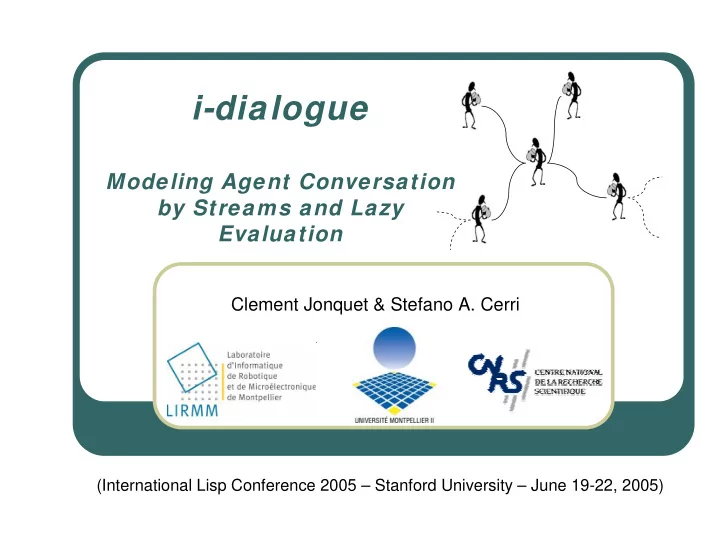
i-dialogue

Modeling Agent Conversation by Streams and Lazy Evaluation

Clement Jonquet & Stefano A. Cerri

(International Lisp Conference 2005 – Stanford University – June 19-22, 2005)
slide-2
SLIDE 2

Context – Interaction modeling

In DAI and MAS communities: interacting entities

  • interaction + autonomy + intelligence = agents

To enhance agent’s autonomy

  • Communicate without knowing something about the other
  • Managing the entire conversation dynamically

I-dialogue = abstraction of interaction inspired:

  • The dialogue abstraction [O’Donnell, 1985]
  • The STROBE agent model [Cerri, 1999; Jonquet, 2004]

(International Lisp Conference 2005 – Stanford University – June 19-22, 2005)

slide-3
SLIDE 3

Speech overview

Agent communication and

conversation modeling

The dialogue abstraction The i

  • d

ialogue abstraction

The STROBE model Providing services applications Conclusion and perspectives

(International Lisp Conference 2005 – Stanford University – June 19-22, 2005) A B

slide-4
SLIDE 4

Agent communication

ACLs (speech act

  • riented, FIPA, KQML)

Communication

protocols (FSM, Petri Nets)

☺ Semantics Reduce agent autonomy

(International Lisp Conference 2005 – Stanford University – June 19-22, 2005)

slide-5
SLIDE 5

The dialogue abstraction (1/2)

Interactive session

between 2 agents, which take turns sending messages to each other:

Each agent computes a

new state and a new

  • utput from its previous

state and the last input it received from the other agent, using its transition function:

(International Lisp Conference 2005 – Stanford University – June 19-22, 2005) A B

A B

O

B A

O

A B

I

B A

I

B A

f

A B

f

slide-6
SLIDE 6

The dialogue abstraction (2/2)

Applicative/Functional programming constructs:

  • Higher order functions
  • Streams [Abelson and Sussman, 1996] […]
  • Lazy evaluation [Landin, 1965] [Friedman and Wise, 1976] […]

The dialogue function take 4 parameters and

returns 3 values:

(International Lisp Conference 2005 – Stanford University – June 19-22, 2005)

slide-7
SLIDE 7

The dialogue function

Transition function applied recursively

  • n inputs and state

and produces

  • utputs, new state,

unused-inputs, and a boolean has 4 parameters returns 3 elements

(International Lisp Conference 2005 – Stanford University – June 19-22, 2005)

slide-8
SLIDE 8

The dialogue abstraction limits

Distributed systems: more than 2 agents. Several dialogue (serially or in parallel) do not

model conversation among several agents

Interpretation of one agent inputs produces not

the outputs for this agent but another outputs intended to another agent.

(International Lisp Conference 2005 – Stanford University – June 19-22, 2005)

slide-9
SLIDE 9

The i-dialogue abstraction

Modeling intertwined-dialogue Conversations between an agent and a group of agents

(International Lisp Conference 2005 – Stanford University – June 19-22, 2005) Cn C2 C1 B A

slide-10
SLIDE 10

The 3 agents case

Agent B should consumes 2 input streams and

produces 2 output streams

Transition functions of B, do not produce respectively

an output stream for A and B but the opposite

(International Lisp Conference 2005 – Stanford University – June 19-22, 2005) A B C

B C

f

A B

f

C B

f

B A

f

slide-11
SLIDE 11

The trialogue function

Different transition function applied in the given order on the different inputs and state and produce different

  • utputs, new states, and

different unused-inputs, and booleans has 6 parameters returns 5 elements

(International Lisp Conference 2005 – Stanford University – June 19-22, 2005)

slide-12
SLIDE 12

The i-dialogue function

  • Generalization of the function trialogue:
  • List of inputs,
  • List of transition functions.
  • Classic list recursion !
  • The ordering of the elements of the lists corresponds to the

semantics

  • For agent B in the previous figure:
slide-13
SLIDE 13

The STROBE model

Agent communication and representation

model

STReams of messages exchanged by

agents represented as OBjects and interpreted in multiples Environments

Scheme specification/implementation

(International Lisp Conference 2005 – Stanford University – June 19-22, 2005)

slide-14
SLIDE 14

STROBE Agent architecture (1/2)

ENV: Cognitive Environments (as knowledge

base and context of evaluation of messages)

INT: Cognitive Interpreters included in ENV Agents as interpreters: map the classical REP

loop from FP to REPL

  • i.e: map the context of evaluation (eval e r) of

Scheme expressions to interpretation of messages

(International Lisp Conference 2005 – Stanford University – June 19-22, 2005)

slide-15
SLIDE 15

STROBE Agent architecture (2/2)

Agent = set of Cognitive Environments and mental states Cognitive Environment = set of bindings + an interpreter + 2 input/output streams A Cognitive Interpreter is an evaluate function Mental states = agent own objectives, tendencies, behaviour, reasoning rules etc.

(International Lisp Conference 2005 – Stanford University – June 19-22, 2005)

slide-16
SLIDE 16

Message interpretation

Messages’ interpretation is done:

in a given environment with a given interpreter

both dedicated to the interlocutor both able to change

(International Lisp Conference 2005 – Stanford University – June 19-22, 2005)

slide-17
SLIDE 17

STROBE / i-dialogue integration

Seeing the Cognitive Interpreters of

STROBE as the transition functions (step-fcns) of i-dialogue. Changing step-fcns dynamically while communicating (i.e. during message interpretation)

(International Lisp Conference 2005 – Stanford University – June 19-22, 2005)

slide-18
SLIDE 18

Airplane Ticket

Providing service applications

An agent executing an i-dialogue function provides a

service realized by its stef-fcns

i-dialogue models the composition of all the services

(International Lisp Conference 2005 – Stanford University – June 19-22, 2005) Hotel Reservation Travel Agency User

slide-19
SLIDE 19

Dynamic Service Generation

Opposed to classical product delivery

  • Buying ready-to-wear clothes

having clothes made by a tailor

Services constructed on the fly by the

provider according to the conversation it has with the user.

Importance of the communication model

STROBE developed as a toolkit for DSG

Highly dynamic service with on the fly modification of the step-fcns

slide-20
SLIDE 20

Conclusions and perspectives

3 main contributions:

  • To spread the elegant dialogue abstraction to more complex situations

implying several entities

  • To consider this abstraction for agent communication as it was

suggested by STROBE

  • To open a new kind of consideration in service generation

2 main advantages:

  • Not reduce agent’s autonomy
  • Allows to deal with the entire conversation

2 main perspectives:

  • Achieve the in progress integration with the STROBE model
  • Dynamic ordering of the inputs and step-fcns lists from i-dialogue

(International Lisp Conference 2005 – Stanford University – June 19-22, 2005)