I n the nuclear power industry, knowing the status of have some - - PDF document

i
SMART_READER_LITE
LIVE PREVIEW

I n the nuclear power industry, knowing the status of have some - - PDF document

DAILY CHECK-IN FOR SAFETY: From Best Practice to Common Practice By Carole Stockmeier, MHA, CMQ-OE; and Craig Clapper, PE, CMQ-OE 0759 hours, 58 seconds: The plan-of-the-day (POD) meeting begins at Black Fox Nuclear Power Plant. The plant


slide-1
SLIDE 1

30

Patient Safety & Quality Healthcare ■ September/October 2011 w w w . p s q h . c o m

n the nuclear power industry, knowing the status of plant operations and early identification of potential problems is safety critical. At nuclear generating sta- tions across the country, like the Black Fox plant (a pseudonym), each day begins with a plan-of-the-day meeting of plant leaders. A typical agenda includes a review of emergent safety issues, status of the plant’s Top 10 problem list, routine reports,and priorities for the day.The meeting is a lead- ership method for providing awareness of front line operations, identifying problems, assigning ownership for issue resolution, and ensuring common understanding of focus and priorities for the day. In Managing the Unexpected, Weick and Sutcliffe (2007) describe five defining characteristics of high reliability organiza- tions:sensitivity to operations,preoccupation with failure,reluc- tance to simplify, commitment to resilience, and deference to expertise.All five characteristics can be found in nuclear power’s Plan of the Day meeting.In fact,all high-reliability organizations have some variation of a Plan of the Day meeting.Many health- care organizations are applying best practices from high-reliabil- ity industries, such as aviation and nuclear power, to improve patient safety and clinical outcomes.Let’s look at the application

  • f this high-reliability best practice in the healthcare industry.

Daily Check-In for Safety – Healthcare’s Plan

  • f the Day Meeting

The plan-of-the-day equivalent in healthcare is the “daily check- in”(DCI) for safety.DCI is a deliberate,focused report and con- versation among leaders about safety events and safety risks. In this real-time risk assessment—reflecting the words of Admiral Hyman G. Rickover, known as the “Father of the Nuclear Navy”(Rockwell, 2002)—the leaders in charge must concern themselves with the details. If they do not consider them important, neither will their subordinates. And, leaders in the field must face the facts and make the necessary changes to prevent harm to patients, families, and workers.

By Carole Stockmeier, MHA, CMQ-OE; and Craig Clapper, PE, CMQ-OE

DAILY CHECK-IN FOR SAFETY:

From Best Practice to Common Practice

I

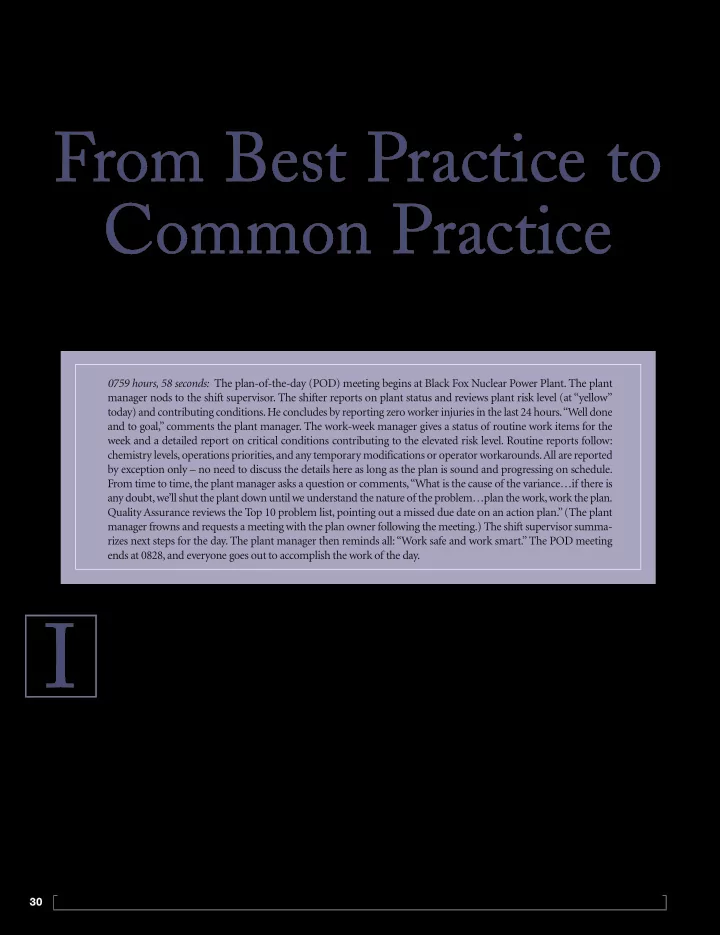
0759 hours, 58 seconds: The plan-of-the-day (POD) meeting begins at Black Fox Nuclear Power Plant. The plant manager nods to the shift supervisor. The shifter reports on plant status and reviews plant risk level (at “yellow” today) and contributing conditions.He concludes by reporting zero worker injuries in the last 24 hours.“Well done and to goal,” comments the plant manager. The work-week manager gives a status of routine work items for the week and a detailed report on critical conditions contributing to the elevated risk level. Routine reports follow: chemistry levels,operations priorities,and any temporary modifications or operator workarounds.All are reported by exception only – no need to discuss the details here as long as the plan is sound and progressing on schedule. From time to time,the plant manager asks a question or comments,“What is the cause of the variance…if there is any doubt,we’ll shut the plant down until we understand the nature of the problem…plan the work,work the plan. Quality Assurance reviews the Top 10 problem list, pointing out a missed due date on an action plan.”(The plant manager frowns and requests a meeting with the plan owner following the meeting.) The shift supervisor summa- rizes next steps for the day. The plant manager then reminds all:“Work safe and work smart.”The POD meeting ends at 0828,and everyone goes out to accomplish the work of the day.

slide-2
SLIDE 2

31

September/October 2011 ■ Patient Safety & Quality Healthcare

Commonly,DCI is a 15-minute meeting of the senior lead- er with all department leaders of the organization,and a three- point agenda is used:

  • 1. Look back: Significant safety or quality issues from the

last 24 hours

  • 2. Look ahead: Anticipated safety or quality issues in next

24 hours

  • 3. Follow-up: Status reports on issues identified today or

days before Healthcare organizations across the country are initiating DCI as a high-reliability leadership method.Five organizations, all practicing DCI for at least 1 year, share their insight and experiences in this article. The organizations included:

  • Community Hospital North of Community Health

Network (CHN)—a 289-bed acute care hospital in Indianapolis, Indiana

  • Helen DeVos Children’s Hospital of Spectrum Health

(HDVCH)—a 212-bed pediatric hospital in Grand Rapids, Michigan

  • Virginia Commonwealth University Health System

(VCUHS)—a 779-bed academic medical center in Richmond, Virginia

  • Wyoming Medical Center (WMC)—a 207-bed acute

care hospital in Casper, Wyoming

  • Yakima Valley Memorial Hospital (YVMH)—a 225-

bed acute care hospital in Yakima, Washington In all five organizations,a senior leader facilitates the meet- ing,and other senior leaders and all operational leaders partic-

  • ipate. The meeting occurs in the morning and is scheduled for

15 minutes. Three organizations—Community Hospital North,Helen DeVos Children’s Hospital,and Wyoming Medi- cal Center—hold DCI 7 days a week. Most organizations have a fixed order in which partic- ipants report, with an “everyone checks-in” expectation (no report by exception). When safety-critical issues are identified, all organizations have a mechanism, such as a rapid-response list for urgent issues and/or a top-10 safe- ty list for longer-term issues, for tracking issues, and issue resolution.“If the issue requires follow-up, it is written on a white board in the administrative conference room and is addressed in the safety briefing the following day,” says Vickie Diamond, president and CEO of Wyoming Medical

  • Center. “The issue stays on the white board until it has

been resolved.” Wyoming Medical Center also begins DCI each day by sharing a “safety success story” of an individ- ual who practiced a behavior expectation for error prevention and made a difference. Yakima Valley Memorial Hospital and VCU Health System report “days since last serious safety event” as a means of making explicit what traditionally has been an implicit daily goal—creating a safe day—by focusing the staff today on “What will it take today?” to make this a safe patient care day.

Table 2. Common DCI Practices Table 1. Sample of Healthcare Organizations Practicing Daily Check-In

slide-3
SLIDE 3

A High-Leverage Leadership Method Bill Corley, president emeritus of Community Health Network views daily check-in as “the most transformational leadership practice I’ve experienced.”DCI indeed is a high-leverage leader- ship method—one that requires little time and, when practiced well, has high impact on influencing organizational perfor- mance.In fact,DCI doesn’t take time,it saves time for leaders.

Shared Situational Awareness

A chasm exists in many organizations between the blunt end and the sharp end of the system.1 Leaders at the blunt end lose sight of realities and challenges at the front line. At the sharp end, risk becomes normalized and workers desensitized to the high-consequences of failure and the impact that local actions have on the system as a whole.DCI closes the blunt-end/sharp- end disconnect by creating shared situational awareness. For the senior leader,DCI provides awareness and real-time understanding of what’s happening at the front line. “Daily check-in has become a quick and efficient way to take the pulse

  • f the organization,” observed Shirley Gibson, interim vice

president for nursing operations at Virginia Commonwealth University Health System.For operational leaders,DCI enables them to begin their day with an awareness of what’s going on in other areas. “As other leaders are reporting,I’m listening to hear if what they are presenting affects my area and how. The call becomes my opportunity to be proactive in my thinking and to speak

  • ut on how to resolve the issue,”commented a leader who par-

ticipates in Community Hospital North’s daily safety call.

Heightened Risk Awareness

When an event occurs,risk awareness within the organization is at an all-time high. Attention is given to managing behaviors and processes to prevent event recurrence.As time passes,a nat- ural decay in memory sets in. This is depicted as the “forgetting curve.”2 The rate of forgetting is accelerated by overconfidence following periods of successful operations,turnover in the orga- nization,and diversions and distractions of projects and priori-

  • ties. DCI provides a forum for talking about risk every day,

keeping it top of mind. All organizations reported increased risk sensitivity of lead- ers since implementing DCI. Here is one DCI story that demonstrates this.During a recent safety huddle at Yakima Val- ley Memorial Hospital, the nursing supervisor shared that a physician called to admit a patient and had requested a bed with telemetry monitoring. Upon learning that there were no monitored beds available, the physician downgraded the admission request to a general medical bed. Shortly after the patient arrived, care team members assessed that the patient needed to be transferred to the ICU. The nursing supervisor reported the situation with a renewed recognition of safety risk: “I should have thought and questioned the physician,‘If the patient needed monitoring 30 seconds ago, why don’t they need monitoring now?’ I’ll think about that differently next time.”Sharing this as a threat to safety in the safety huddle con- tributed to heightening the risk awareness of other leaders in thinking about parallel situations that occur in their areas. “The call has led to better realization of clinical safety issues by non-clinical folks and vice versa.There are a thousand ways to hurt a patient, and any one person probably only knows a handful of them. Talking and thinking about them as a group helps raise everyone’s awareness of all types of risks and dan- gers,”shared an operational leader and participant in the daily safety call at Community Hospital North.

Early Identification and Resolution of Problems

A good leader analyzes events of harm to determine causes and corrective actions to prevent recurrence.A great leader identifies the metaphorical holes in the Swiss cheese before system weak- nesses aggregate as an event.3 DCI promotes a questioning atti- tude about existing issues and evolving conditions that threaten safe,quality outcomes. A resounding benefit expressed by all organizations is early identification and rapid resolution of issues that could impact patient care.“There is a shared sense of urgency for finding and fixing,”says Susan Teman, manager of patient safety and qual- ity at Helen DeVos Children’s Hospital.“And the credibility of leadership has risen.Staff know that daily check-in occurs,and they have renewed confidence that safety issues are being addressed.” DCI promotes systems thinking, the hallmark of high-relia- bility organizations.Systems thinking focuses on understanding the structures in a system and how those structures guide the actions and interactions of the people who work in the system. Recognizing this interconnectedness between and among struc- tures and people in a system is fundamental to the ability to pre- vent,detect,and correct problems that occur in an organization. “Silo thinking can be devastating in a high-consequence industry,” says Russ Myers, chief operating officer of Yakima Valley Memorial Hospital.“After implementing the safety hud- dle, silos in our hospital are beginning to disappear. Depart- ment leaders share ideas and resources,and they often stay after safety huddle to begin problem solving immediately.Problems are resolved efficiently.”

34

Patient Safety & Quality Healthcare ■ September/October 2011 w w w . p s q h . c o m

DAILY CHECK-IN

1 The terms “blunt end” and “sharp end” were coined by James

Reason and first depicted as the “Sharp End Model” by Richard Cook and David Woods in Operating at the Sharp End: The Complexity of Human Error (1994), which is available at http://www.ctlab.org/documents/operatingatthesharp.pdf.

2 Hermann Ebbinghaus was the first to describe the exponen-

tial nature of forgetting and to depict the shape of the forget- ting curve in his study, Memory: A Contribution to Experimental Psychology (1885/translated into English in 1913).

3 In Managing the Risk of Organizational Accidents (1997),

James Reason first depicted the “Swiss cheese model” to describe the role of active errors and latent system weakness- es in organizational accidents.

slide-4
SLIDE 4

The following are questions a leader can ask during DCI to promote a risk-averse mindset and risk-averse actions in others:

  • How do you know you had no problems in the past 24

hours?

  • What immediate, remedial actions did you take?
  • Is this happening in other places? Could this happen in
  • ther places?
  • What other areas does this issue impact?
  • How are you preparing your team for that high-risk task?
  • What error prevention behaviors should be used?

When a mistake, event, or high-risk condition is reported, choose your words carefully. Your tone and the words you say make it either more likely or less likely that the individual – and

  • thers who observe your response – will speak up in the future.

When you hear about a mistake or an event,let your first words be, “Thank you.” Then say, “Lets’ understand how that hap- pened.” When a deficiency is identified that could compromise safe- ty,the role of the leader is to convey a sense of urgency and pri-

  • rity for issue resolution: “That’s a safety critical issue that

requires a rapid response. Who will own the issue? Let me know if you encounter any difficulties, and page me by 3 this afternoon with a status report.” All organizations practicing DCI report an evolution in high-reliability thinking of leaders and participants. The evo- lution toward high-reliability thinking is shown in Figure 1. “It’s a never-ending, ever-evolving process,” says Barbara Summers.She continually looks for ways to optimize DCI and keep it fresh over time. On Community Hospital North’s daily safety call, several leaders each day conclude their routine check-in reports by saying,“And today is my day to report.”As a practice recently implemented, Summers assigned leaders to a rotating schedule of reporting a specific thing they are doing to keep safety top of mind in their department. As for a nuclear power practice that could be applied to healthcare’s DCI,the senior leader can give operational leaders a “What would you do if…”scenario or a safety condition to look for in their departments and then randomly call on one leader to report on their findings the next day! Here is one example of this from Wyoming Medical Center: “When the nursing supervisor reported that the patient trans- port service was short-staffed, the director of the operating room immediately volunteered to have her staff come to the patients’ rooms and take over transport of the patients to surgery for that day to take the burden off the transport staff and to maintain the surgical schedule.There is a strong sense

  • f teamwork and accomplish-

ment when an issue is brought up during the safety briefing and participants are able to come together to resolve the issue,sometimes while on the call.”

Accountability for Safety

DCI fosters internal transparency and accountability for safety. “Before, event reporting lived on paper. Now, leaders have to

  • wn the events that happen on their watch…and on our

watch,” says Sandy Dahl, chief clinical officer at Yakima Valley Memorial Hospital.“Rather than being a number on a page, a leader has to say,‘A patient on my unit has V AP (ventilator asso- ciated pneumonia).’” “Talking about perfect care has become easier,”says Barbara Summers, president of Community Hospital North.“We sin- cerely believe that zero is possible and achievable.We are more aggressive now in our leadership for zero events of harm. At Community, this is the foundation of what we call the ‘excep- tional patient experience.’” The Responsibility of the Senior Leader: Set the T

  • ne and Accelerate the Pace

Daily check-in is not hard to do,however,leaders at all the orga- nizations certainly encountered challenges in implementing DCI.The top three challenges cited by the organizations includ- ed:

  • Overcoming resistance to “everyday, everyone”—as the

leader, emphasize the role that every leader plays in problem solving and in learning from the problems experienced by others.

  • Keeping it focused on safety—as the leader, course cor-

rect when unrelated issues or conversations emerge.

  • Keeping it brief—as the leader, coach on concise briefs

and off-line problem solving. Once DCI is initiated, high-reliability thinking doesn’t just happen; it evolves over time. And leaders determine the pace. Leadership for high reliability requires two things: 1) a risk- averse mindset (how leaders perceive situations and look for risk) and 2) risk-averse actions (what leaders say and do to pro- mote and influence individual and team behaviors that prevent failures).

35

September/October 2011 ■ Patient Safety & Quality Healthcare Figure 1. The DCI Evolution Toward High-Reliability Thinking.

slide-5
SLIDE 5

36

Patient Safety & Quality Healthcare ■ September/October 2011 w w w . p s q h . c o m

DAILY CHECK-IN Oh yes…across the organizations responding to the survey, what is the number-one focus in taking DCI to the next level? The answer: engaging physician leaders in routine participation in DCI. Measuring the Impact In “Executive Leadership Development in US Health Systems” Dr.Ann McAlearney (2010) comments,“The lack of evaluation standards and general difficulty reported around [Executive Leadership Development] program evaluation highlight the

  • pportunity…to focus on developing consistent evaluation

metrics and attempting to explicitly tie program results to orga- nizational performance.” The same challenge may be true in measuring the impact of DCI on safety and overall performance excel-

  • lence. DCI is one of many things that leaders do to deliver
  • n safety and overall performance excellence. So the direct

impact indeed is difficult to measure. With that said, orga- nizations in this survey have reduced their serious safety-event rate (SSER)4 by 39% to 75% since beginning efforts to forge a reliability culture that drives results in safety and overall performance excellence. Specific to daily check-in, two of the organizations have measured perceptions of operational leaders regarding impact

  • f DCI on safety.VCU Health System conducted a survey of

DCI participants 3 months after implementation. 74% of respondents indicated a “somewhat-to-significant”impact of DCI on safety in their areas. At the 2-year mark after imple- mentation, Community Health Network conducted a survey. On a scale of 1 to 5 (1 = high added value—best thing we’ve done for safety,to 5 = redesign ASAP – this call adds no value),

  • perational leaders responded with an overall score of 1.35.

In addition to perceptional measures, the following are

  • ffered as specific process measures of DCI:

“Just Do It!” These exact words were listed by organizations when asked to provide advice to leaders who may consider implementing a daily check-in.Here’s what else they had to say:

  • Be inclusive; whether in a clinical or non-clinical role,

everyone supports safety.

  • Work hard to make the meeting non-threatening and

systems-focused.

  • Start and commit; improve the process along the way.
  • Make it mandatory; the meeting that trumps all others.
  • Lead from the top; a senior leader facilitates and all

senior leaders participate. What differentiates leaders and high-reliability leaders?

  • Habits. High reliability leaders adopt best practice leadership

methods as their day-in and day-out common practices. At one time or another every leader has held a meeting like daily check-in.When adopted and practiced as a leadership method, daily check-in serves as a high-leverage technique in fostering a reliability culture that drives results in safety and overall per- formance excellence. ❙PSQH

Carole Stockmeier is the managing partner and chief operating

  • fficer of Healthcare Performance Improvement (HPI). HPI is a

consulting firm that specializes in improving human performance in complex systems using evidence-based methods derived from high- consequence industries. Prior to the formation of HPI, Stockmeier served as the director of safety & performance excellence at Sentara

  • Healthcare. She holds a bachelor-of-science degree in public health

from the University of North Carolina at Chapel Hill and a master’s degree in health administration from the Medical College of Virginia

  • f Virginia Commonwealth University. She is certified as a manager of

quality and organizational excellence by the American Society for

  • Quality. Stockmeier may be contacted at carole@hpiresults.com.

Craig Clapper is a founding partner and the chief knowledge

  • fficer of HPI. Clapper has 25 years of experience improving reliability

in nuclear, power, transportation, manufacturing, and healthcare. He holds a bachelor-of-science degree in nuclear engineering from Iowa State University and a professional engineering license in mechanical engineering from the State of Arizona. He is certified as a manager of quality and organizational excellence from the American Society of

  • Quality. Clapper may be contacted at craig@hpiresults.com.

4 Serious Safety Event Rate (SSER) is a volume-adjusted mea-

sure of events resulting in moderate harm to severe harm or

  • death. The SSER is based on the Safety Event Classification

(SEC) and was developed by HPI as a methodology for mea- suring patient harm in healthcare.

McElearney, A. S. (2010). Executive leadership development in US health

  • systems. Journal of Healthcare Management, 55(3), 206-224.

Rockwell, T. (2002). The Rickover Effect: How One Man Made a Difference. Lincoln, NE: iUniverse. Weick,. K. E. & Sutcliffe, K. M. (2007). Managing the unexpected, 2nd ed. San Francisco: Jossey-Bass.

REFERENCES

The authors extend appreciation to the following individuals for their contributions: Community Health Network: Barbara Summers, president, and Trudy Hill, patient safety officer Helen DeVos Children’s Hospital: Thomas Peterson, MD, execu- tive director of patient safety & quality; and Susan Teman, BSN RN, manager, patient safety and quality VCU Health System: Shirley Gibson, RN, MSHA, interim vice pres- ident for nursing operations; L. Dale Harvey, MS, RN, director for performance improvement; and Jenifer K. Murphy, MHA, opera- tions manager for performance improvement Wyoming Medical Center: Vickie Diamond, president & CEO Yakima Valley Memorial Hospital: Sandy Dahl, chief clinical officer; and Russ Myers, chief operating officer American Society for Quality: The authors also would like to thank ASQ for its support in the development of this manuscript.

ACKNOWLEDGMENTS