
SLIDE 1
IERG 5330 Network Economics Repeated and Supermodular Games
Instructor: Prof. Jianwei Huang∗ November 27, 2016
1 Repeated Games
In many strategic situation, players interact repeatedly over time, therefore it is important to understand the effect of repetition on the play of the game. The repeated game model we will present in this section is a simple model to capture the ongoing interaction. In particular,
- The players face the same stage game at all periods.
- Overall payoff is the sum of discounted payoffs at each stage.
We will see how repeated play of the same strategic game introduces new (desirable) equi- libria by allowing players to condition their actions on the way their opponents played in the previous periods.
1.1 Illustrative Examples
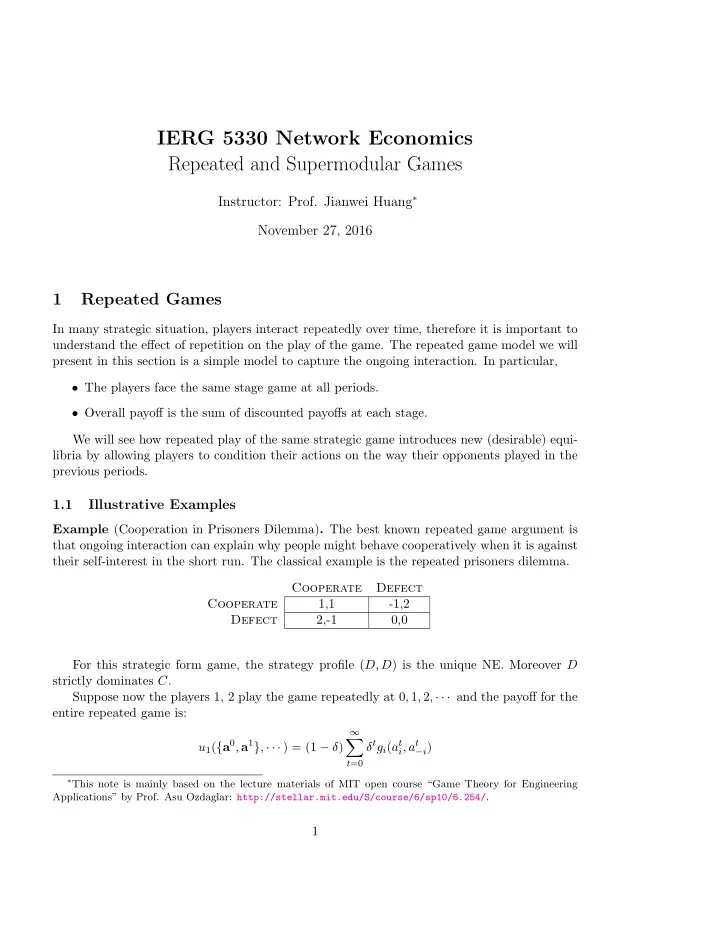
Example (Cooperation in Prisoners Dilemma). The best known repeated game argument is that ongoing interaction can explain why people might behave cooperatively when it is against their self-interest in the short run. The classical example is the repeated prisoners dilemma. Cooperate Defect Cooperate 1,1
- 1,2
Defect 2,-1 0,0 For this strategic form game, the strategy profile (D, D) is the unique NE. Moreover D strictly dominates C. Suppose now the players 1, 2 play the game repeatedly at 0, 1, 2, · · · and the payoff for the entire repeated game is: u1({a0, a1}, · · · ) = (1 − δ)
∞
- t=0
δtgi(at
i, at −i)
∗This note is mainly based on the lecture materials of MIT open course “Game Theory for Engineering