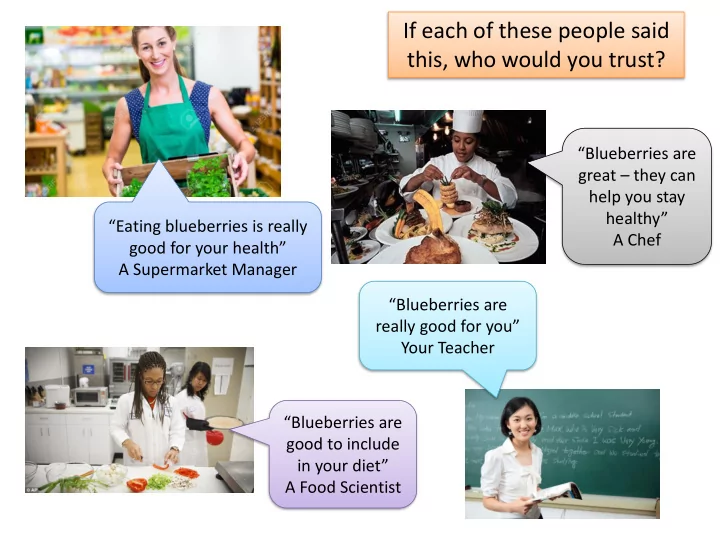
If each of these people said this, who would you trust? Blueberries - - PowerPoint PPT Presentation

if each of these people said
SMART_READER_LITE
LIVE PREVIEW

If each of these people said this, who would you trust? Blueberries - - PowerPoint PPT Presentation

If each of these people said this, who would you trust? Blueberries are great they can help you stay healthy Eating blueberries is really A Chef good for your health A Supermarket Manager Blueberries are really good for


slide-1
SLIDE 1

If each of these people said this, who would you trust?

“Eating blueberries is really good for your health” A Supermarket Manager “Blueberries are really good for you” Your Teacher “Blueberries are good to include in your diet” A Food Scientist “Blueberries are great – they can help you stay healthy” A Chef

slide-2
SLIDE 2

Bias

“Eating blueberries is really good for your health” A Supermarket Manager “Blueberries are good to include in your diet” A Food Scientist

slide-3
SLIDE 3

How can we avoid being taken in by bias?

  • Think
  • Ask
slide-4
SLIDE 4

“Researchers found that a large helping of the fruit … boosts concentration and memory…”

Daily Mail, 14th September 2009

Do you think this news headline might be biased? Why/why not?

slide-5
SLIDE 5

“After eating their daily dose of berries, the rodents learned faster, had better short-term memory and had improved balance and co-

  • rdination”

Daily Telegraph 23rd January 2015

slide-6
SLIDE 6

What claims are being made here?

Do you believe them?

slide-7
SLIDE 7

How could we find out if the claim is true?

“Eating blueberries improves your memory”

slide-8
SLIDE 8

We can carry out a trial to test this claim. We need to try to make sure it is fair. We need to have something we can compare.

“Eating blueberries improves your memory”

slide-9
SLIDE 9

Our trial

  • One group will eat some blueberries, one

group won’t.

– (The no-blueberries group can have some at the end of the session if they want.)

  • You don’t have to participate

– If you don’t like blueberries, you can be in the ‘no blueberries group’. – If you would rather not take part, that’s fine too, but I hope you would like to be involved.

slide-10
SLIDE 10

Groups

  • Pick a card – this will tell you which group you

are in.

  • Group A won’t eat the blueberries
  • Group B will
slide-11
SLIDE 11

Memory test

  • On the tray are some items.
  • I’m going to give you 1 minute to look at the

items – try to remember what is there.

  • I’m then going to cover the tray.
  • Write down the names of as many of the

items as you can remember in 3 minutes. (Spelling doesn’t matter in the memory test.)

slide-12
SLIDE 12
slide-13
SLIDE 13

Calculation

  • Count how many items you remembered

correctly

  • Write the number on your piece of paper
  • Group A – work out the average of your scores
  • Group B – work out the average of your scores
slide-14
SLIDE 14
slide-15
SLIDE 15

What can you find out about the trial that these researchers did from the newspaper summary?

slide-16
SLIDE 16

Finding out a bit more

Look at the press release from the university

  • What did the rats eat?
  • What did the rats do?
  • What was the difference between the groups
  • f rats?
slide-17
SLIDE 17

Is the press release saying the same thing as the newspaper article?

slide-18
SLIDE 18

Memory test

  • On the tray are some items.
  • I’m going to give you 1 minute to look at the

items – try to remember what is there.

  • I’m then going to cover the tray.
  • Write down the names of as many of the

items as you can remember in 3 minutes. (Spelling doesn’t matter in the memory test.)

slide-19
SLIDE 19
slide-20
SLIDE 20

Calculation

  • Count how many items you remembered

correctly

  • Write the number on your piece of paper
  • Group A – work out the average of your scores
  • Group B – work out the average of your scores
slide-21
SLIDE 21

Our results

Group Average in first memory test Average in second memory test Difference between memory tests % change (difference / first test x 100)

A B

slide-22
SLIDE 22

Summary

  • Can you always believe things you read in

newspapers or things that are claimed by people on TV?

– Think about the bias – Think about what trial was done – Ask for the evidence

slide-23
SLIDE 23

Allocation

A B A B A B A B