Impact of Community Health Workers on Older Adult Chronic Disease - - PowerPoint PPT Presentation

impact of community
SMART_READER_LITE
LIVE PREVIEW

Impact of Community Health Workers on Older Adult Chronic Disease - - PowerPoint PPT Presentation

Impact of Community Health Workers on Older Adult Chronic Disease Management and Healthcare Costs Dr. Cheryl J. Dye Oconee Medical Center Presentation Dr. Deborah Willoughby 1-28-2009 Dr. Begum Aybar-Damali Project funded by HRSA Clemson


slide-1
SLIDE 1

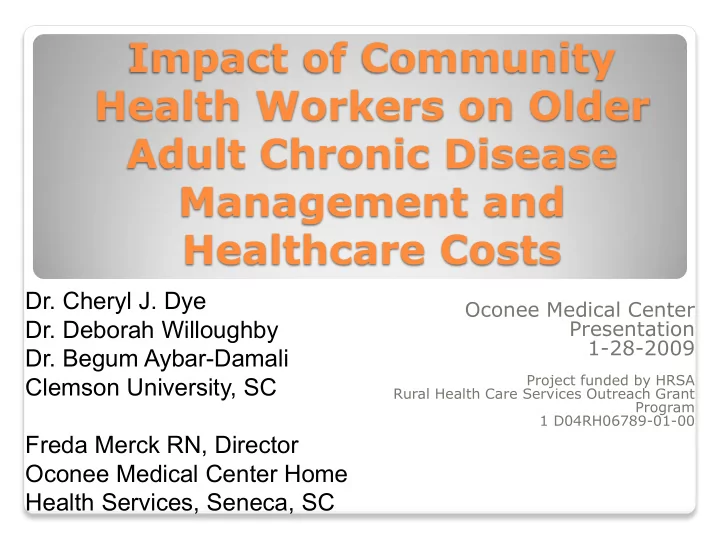
Impact of Community Health Workers on Older Adult Chronic Disease Management and Healthcare Costs

Oconee Medical Center Presentation 1-28-2009

Project funded by HRSA Rural Health Care Services Outreach Grant Program 1 D04RH06789-01-00

  • Dr. Cheryl J. Dye
  • Dr. Deborah Willoughby
  • Dr. Begum Aybar-Damali

Clemson University, SC Freda Merck RN, Director Oconee Medical Center Home Health Services, Seneca, SC

slide-2
SLIDE 2
slide-3
SLIDE 3

Oconee County, SC

slide-4
SLIDE 4

Map of service area for Oconee Medical Center

slide-5
SLIDE 5

Oconee County, SC

 Adults over the age of 65 years residing in

Oconee County have higher rates of many chronic diseases and risk behaviors than their state and national counterparts.

 This county ranks 2nd in the state for the

percentage of the population over 65 years of age at 15.6% (10,330).

 Of this population, 13.6% (1,405) live in

poverty, compared to the national average

  • f 9.9%.
slide-6
SLIDE 6

Chronic Conditions and Risk Behaviors

Variable 65 years and older Appalachia I Health District – Oconee & Anderson Counties SC US High blood pressure *** 57.4% 57.7% 54.1% High Cholesterol (yes)*** 58.7% 52.9% 47.9% Obesity**** 24.2% 25.0% 23.1% Diabetes (yes)**** 21.2% 19.4% 16.1% Not enough exercise* 64.6% 53.8% 52.8% Current smoker**** 12.3% 8.6% 9.1%

*Defined as those not meeting the physical activity recommendation of moderate physical activity for 30 or more minutes per day for 5 or more days per week, or vigorous activity for 20 or more minutes per day on 3 or more days. ***2003 Behavioral Risk Factor Surveillance Study ****2004 Behavioral Risk Factor Surveillance Study

slide-7
SLIDE 7

Rural Home Health Agencies

 Compared to urban elders, rural elders receive

fewer home health care services, have worse

  • utcomes and are more likely to be hospitalized

(Schlenker, 2002).

 Rural and urban home health patients differ in a

number of ways, with rural patients more likely to have long-term care needs versus urban beneficiaries who are more likely to need post- acute care.

 At discharge, rural residents were less likely to

have their goals met and more likely to have a poor prognosis (Gamm & Hutchison, et al, 2003).

slide-8
SLIDE 8

SC Home Health Patients (age 65+) Hospitalization and ED Rate for 2001-2003*

SETTING COUNTY HH 2000 TOTALS

2001 2002 2003

TOTAL PERCENT TOTAL PERCENT TOTAL PERCENT

ED All Counties 40090 10870 27.11% 8548 21.32% 6915 17.25% ED Oconee 745 185 24.83% 170 22.82% 153 20.54% IP All Counties 40090 14827 36.98% 11239 28.03% 8887 22.17% IP Oconee 745 311 41.74% 236 31.68% 181 24.30%

  • The percentage of home health patients over the age of

65 years in Oconee County admitted to the Emergency Department was greater than the average of all South Carolina counties in 2002 and 2003. Hospitalization rates have been higher for the past three years (2001, 2002

and 2003).

Note: Percentages based on number of home health patients by county identified in 2000 Note: ED = Emergency Department, IP = Inpatient Hospitalization *SC Office of Research and Statistics, 8-2005

slide-9
SLIDE 9

Emergent Care of Oconee County Home Health Patients - 2005**

Quality Measures for Oconee County, SC (OASIS indicators) % for OMH Home Health % for Appalachia I Home Health (DHEC) State Average National Average

Percentage of patients who had to be admitted to the hospital

34% 38% 30% 28%

Percentage of patients who need urgent, unplanned medical care

30% 26% 23% 21%

** Source: CMS website (www.medicare.gov/HHCompare), updated 7-14- 2005

slide-10
SLIDE 10

OMC Discharge Data for Patients over 65 yr (12-03-03 to 11-30-04)

Discharge data Pneumonia 261 Acute respiratory failure 247 Congestive heart failure 158 Septicemia 127 Osteoarthros 114 Hypovolemia 73 Atrial fibrillation 63 Acute renal failure 61 OBS chronic bronchitis 57 Readmission data Congestive heart failure 46 Acute respiratory failure 45 Pneumonia 36 Septicemia, NOS 25 Hypovolemia 19 Acute renal failure 17 OBS Chronic bronchitis 10 Acute pancreatitis 9 Pulmonary Embolism 8

slide-11
SLIDE 11

Emergency Department Visits, OMH 2003, Aged 65 Years and Older

Diseases of Circulatory System Diagnosis* # of Visits Total Charges Acute Ischemic Heart Disease 8 $32,829 Angina Pectoris 9 $30,797 Arteriosclerotic Heart Disease 83 $700,067 Cardiac Dysrhythmias 134 $898,501 Congestive Heart Failure 123 $648,904 Heart Attack 69 $984,852 Hypertensive Heart Disorder 5 $91,147 Pulmonary Heart Disease 16 $416,244 Other Heart Disease 33 $380,272 Diabetes # of Visits Total Charges Diabetes with Complications 45 $136,585 Diabetes without Complications 12 $23,472 Selected Diseases of Respiratory System # of Visits Total Charges Influenza* Pneumonia (All Forms) 293 $2,469,620

Total: # of visits= 480 Total Charges= $4,183,613

*Diagnoses with fewer than 5 visits are not reported.

slide-12
SLIDE 12

Inpatient Hospitalizations for Oconee County Residents, 2003, Aged 65 and Older

Diseases of Circulatory System Diagnosis* # of Visits Total Charges Acute Ischemic Heart Disease 4 $20,635 Acute Myocardial Infarction 111 $3,187,507 Arteriosclerotic Heart Disease 189 $6,500,866 Atherosclerosis 18 $368,477 Cardiac Dysrhythmias 154 $2,705,225 Congestive Heart Failure 161 $1,992,979 Hypertensive Heart Disease 9 $108,785 Pulmonary Heart Disease 28 $799,308 Other Diseases of the Arteries 8 $247,373 Other Heart Diseases 63 $1,516,368 Diabetes # of Visits Total Charges Diabetes w/ Complications 37 $433,234 Diabetes w/o Complications 5 $22,556 Selected Diseases of Respiratory System # of Visits Total Charges Influenza* Pneumonia - All Forms 341 $4,774,305

Total: # of visits=745 Total Charges= $17,447,523

*Diagnoses with fewer than 5 visits are not reported.

slide-13
SLIDE 13

In 2004, there were 482 OMH HHS Oconee County patients over 65 years of age and 150 DHEC HHS patients for a total of 632

  • clients. The majority of these clients had

either CVD, CHF or DM

slide-14
SLIDE 14

OMC HHA Strategic Planning

 OMH HHA goals for 2006:

  • reduce ER admissions,
  • reduce hospital readmissions,
  • reduce futile care and/or inappropriate care.

 Home health client challenges:

  • difficulty understanding role of home health and

emergency plan,

  • lack of chronic care management skills,
  • nonadherence with medication and dietary regimen,
  • need for ongoing support,
  • need for socialization, and
  • need for advocate to attend physician visits.
slide-15
SLIDE 15

SC DHEC HHA Strategic Planning

 decrease hospitalization of HHS patients;  decrease emergent care for HHS patients;  increase patients ability to self manage

  • ral medications after discharge.
  • Challenges include: increased level acuity of

in home patient care requiring more resources and more staff time; increased paperwork required for all disciplines; and maintaining fiscal stability.

slide-16
SLIDE 16

Barriers to Health Management

 Barriers that impact the ability of

chronically ill older adults and their caregivers to manage their illnesses:

 changes in the older adult’s, and often the caregiver’s, physical and mental health,  low educational levels,  limited financial resources,  risk behaviors; e.g. inactivity, smoking

slide-17
SLIDE 17

Specific Challenges

 Inability to follow recommended health care

regimen due to a lack of understanding and recall and a lack of support

 Inability to take medications as prescribed and to

recognize significant side effects

 Inability to recognize “red flag” signs and

symptoms that indicate a worsening of a chronic illness that requires intervention.

slide-18
SLIDE 18

Specific challenges, con’t

 Characteristics of the “rural culture” of independence,

self-reliance, privacy and willingness to endure hardship, including serious health problems, that influence a rural elder to wait until they are more ill before seeking health care services (Parker, et al, 1992; Magilvy, et

al.,1994).

 Lack of knowledge of community resources  Lack of coordination of health care and related

resources

 Lack of transportation, especially for those in remote

areas of Mountain Rest, Long Creek and Fair Play.

slide-19
SLIDE 19

Lay Health Advisors

 Consortium partners, stakeholders, and

focus group participants concluded that Lay Health Advisors or “Health Coaches” could play a key role in improving the ability of older adults to manage their chronic diseases.

slide-20
SLIDE 20

Lay Health Advisors, con’t

 The use of paraprofessionals such as

Health Coaches to provide education and health care services is supported in the literature

 Lay health advisors have also proven

effective in linking older adults to needed social services (Forti & Koerber, 2002).

slide-21
SLIDE 21

The Chronic Care Model

 A plan was then

developed to integrate this paraprofessional within the established care protocols of home health services, guided by the Chronic Care Model framework.

Source: http://www.improvingchroniccare.org/change/model/components.html

slide-22
SLIDE 22

Project Focus

 Three chronic illnesses, CHF, diabetes, and CVD,

were chosen for intervention for several reasons.

 First, these illnesses are common among older

adults, with the prevalence of each increasing significantly as age increases and they significantly impact the ability of older adults to maintain their independence.

 Second, these illnesses require extensive daily

management by the patient and/ or the family

  • caregiver. Each of these illnesses requires

significant lifestyle modification, along with pharmacological treatment, in order to prevent progression of the disease.

slide-23
SLIDE 23

Project Focus, con’t

 Further, each of these illnesses is a common

cause for costly preventable emergency room visits and hospitalizations when not managed adequately.

 Finally, each of these illnesses has “red flag”

signs and symptoms that, if recognized, can cue the patient and caregiver to seek medical advice at an earlier stage and therefore, avoid more expensive ED or hospital care

(Coleman, Smith, Frank, Min, Parry, & Kramer, 2004)

slide-24
SLIDE 24

Project Focus, con’t

 The Congressional Budget Office has found

that among the small group of “high-cost” beneficiaries, who account for 75% of Medicare spending, more than 40% have coronary artery disease, 30% have CHF, and 30% have diabetes (Remington, 2005)

 The 14% of Medicare beneficiaries who have

CHF account for 43% of Medicare spending. 62% of these patients had one or more hospitalizations per year between 1996 and 2003.

slide-25
SLIDE 25

Project Focus, con’t

 In 2001, nearly one in three patients with

diabetes had two or more hospitalizations, with the cost per stay being three times higher than the average hospital stay. Low- income patients with diabetes are even more likely to have multiple hospitalizations than are higher income patients (Remington, 2005)

 As indicated in OMH discharge and

readmission data and home health services data for those over 65 years of age, cases related to CHF, CVD and diabetes are prevalent

slide-26
SLIDE 26

Recruitment

 Organization meetings  Organization newsletters  Newspaper ads  Newspaper stories about Health Coaches  Current Health Coaches

slide-27
SLIDE 27

Health Coach Role

 Health Coaches are trained to:

  • Educate client about “red flags” as part of

disease management

  • Conduct home safety check for fall and fire

prevention

  • Arrange for appointments and transportation,
  • Educate about and encourage appropriate use
  • f medications,
  • Educate about, encourage and monitor needed

lifestyle changes, including changes in diet and activity levels,

  • Make referrals for other needed services such

as smoking cessation, home repairs, utility bill assistance, etc.

slide-28
SLIDE 28

Health Coach Training (30 hours)

Module 1 - Introduction

 Pretests  Role of Health Coach

  • Parameters of role
  • Responsibilities

 Background Check from SLED  Completion of IRB certification  Monthly meetings  Confidentiality  Paperwork – Informed Consent, Personal Health Records, OASIS items, Client contact log, Travel log needed for reimbursement

slide-29
SLIDE 29

Health Coach Training, con’t

 Module 2: Home Safety  Module 3: Communication Skills  Module 4: Psychosocial & Physical Aspects of

Aging

 Module 5: Heart and Circulation  Module 6: Stroke and Congestive Heart Failure  Module 7: Diabetes  Module 8: Pneumonia and Flu  Module 9: Medications  Module 10: Changing Health Behaviors  Module 11: Improving adherence

slide-30
SLIDE 30

Health Coach Training, con’t

 Module 12: Human Subjects Protection  Module 13: Community Resources  Module 14: Review and posttest

 Stipend and Travel reimbursement forms  Protocol  Evaluation of modules  Knowledge posttest  Equipment  Patient materials

 Visit from Current Health Coaches

slide-31
SLIDE 31

Protocol

 During the HHS episode of care, RNs

determine which patients are eligible by using the patient selection criteria.

  • over the age of 65 years,
  • reside in Oconee County or rural areas of

Pickens & Anderson counties

  • have a diagnosis of CHF, DM, or CVD, and
  • have inadequate caregiving or care taking skills

(according to OASIS)

slide-32
SLIDE 32

Protocol, con’t

 The RN then informs the patient about the

Health Coach program.

 If the patient is interested, the RN faxes

the following information to the Project Director, so that she can arrange for a Health Coach to accompany the HHS RN

  • n the next visit.
  • Name of patient
  • Directions to their residence
  • Scheduled visitation dates and time for last two

week of HHS

  • Cell phone number of HHS RN so that Health

Coach can schedule home visit for introduction.

slide-33
SLIDE 33

Protocol, con’t

 The Project Director contacts a Health

Coach about accepting the client. If the Coach can accept the client, the PD gives the Health Coach the RN contact information and sends directions to the client’s home.

 The Health Coach arranges to meet the

HHS RN on one home visit during the last two weeks of HHS to get to know the patient and the care plan.

slide-34
SLIDE 34

Protocol, con’t

 If, after the home visit, the patient is still

interested in participating in the program, the RN

  • btains their signature on a Health Information

release form which grants permission to release their care plan to the Health Coach.

 The Health Coach collects a signed informed

consent from the patient.

 The patient, HHS RN and the Health Coach then

determine priority areas for the Health Coach and the patient to address after HHS discharge.

slide-35
SLIDE 35

Protocol, con’t

 The Health Coach transfers relevant information

such as parameters for acceptable glucose levels from the patient’s care plan to a simpler Personal Health Diary that is then used by the patient to log their health status.

 After the client has been discharged from Home

Health Services, the Health Coach continues to make home visits and phone calls according to the table below.

slide-36
SLIDE 36

Health Coach Contact (X) With Client

Weekly Contact 5 hrs X X 4 hrs X 3 hrs X 1 hr X Enter HHS Month 1 Month 2 Discharge from HH Month 1 Month 2 Month 3 Month 4 Schedule of Contact Hours

 After discharge from HHS, the Health Coach makes two one-hour

home visits and three phone contacts each week for month 1 and 1 one-hour home visit and four phone contacts in month 2. In month 3, the HC makes no home visits with four phone calls weekly and in month 4, the HC makes no home visits with three phone calls per week.

slide-37
SLIDE 37

Evaluative Measures

Developed by Dr. Amy Martin, Evaluation Consultant Deputy Director & Research Assistant Professor, SC Rural Health Research Center

 The Outcome and Assessment

Information Set (OASIS), which is used by home health agencies and CMS, is used to assess the impact and outcomes.

 Selected OASIS items are used by the

Health Coach to measure variables of interest at 2 months post HHS discharge, 4 months post HHS and 10 months post- HHS discharge.

slide-38
SLIDE 38

Outcome Measures

 Outcome Objective 1:Number of

emergency department visits related to CVD, CHF, DM, pneumonia, or influenza (will include OMH or other hospitals or urgent care providers).

slide-39
SLIDE 39

Outcome Measures, con’t

 Outcome Objective 2: Number of

hospitalizations related to CVD, CHF, DM, pneumonia, or influenza (will include OMH

  • r other hospitals or urgent care

providers).

slide-40
SLIDE 40

Impact Measures

 Performing ADL’s and IADL’s.  Medication adherence.  Clients reporting reduced smoking levels.  Clients referred for pneumonia or influenza

immunization who receive immunization.

 Clients with home safety risks who reduced risk.

slide-41
SLIDE 41

Impact Measures, con’t

 Ability of client with hypertension to measure and monitor

BP.

 Ability of client with PCP recommendation to lose weight or

with CHF to measure and monitor changes in weight.

 Ability of clients with CHF to measure and monitor

shortness of breath.

 Ability of clients with CHF to measure and monitor edema.  Ability of clients with DM to measure and monitor blood

glucose levels.

 Ability demonstrated by completing at least one week of

Personal Health Diary

slide-42
SLIDE 42

Health Coach Inaugural Class

slide-43
SLIDE 43

Health Coach Materials

slide-44
SLIDE 44

Health Coach Materials con’t

slide-45
SLIDE 45

Name: ________ Day/Date: Monday Tuesday Wednesday Thursday Friday Saturday Sunday Daily Weight (same time/clothes & empty bladder) Blood Pressure (same time each day, left arm) Blood Sugar Hb A/C Signs and Symptoms (circle symptoms and report changes)

Problems catching your breath Problems catching your breath Problems catching your breath Problems catching your breath Problems catching your breath Problems catching your breath Problems catching your breath Can’t breath lying down Can’t breath lying down Can’t breath lying down Can’t breath lying down Can’t breath lying down Can’t breath lying down Can’t breath lying down Chest pain Chest pain Chest pain Chest pain Chest pain Chest pain Chest pain Tired feeling Tired feeling Tired feeling Tired feeling Tired feeling Tired feeling Tired feeling Cough describe Cough describe Cough describe Cough describe Cough describe Cough describe Cough describe Restlessness / anxiety Restlessness / anxiety Restlessness / anxiety Restlessness / anxiety Restlessness / anxiety Restlessness / anxiety Restlessness / anxiety New or increased swelling New or increased swelling New or increased swelling New or increased swelling New or increased swelling New or increased swelling New or increased swelling

slide-46
SLIDE 46
slide-47
SLIDE 47
slide-48
SLIDE 48

PRELIMINARY RESULTS

slide-49
SLIDE 49

Clients with NO Emergent Care

N clients = 33 Clients with No Emergent Care N=19/33 (57.6%)

Client # Age Enrolled in HH Enrolled in HC Program HH Diagnosis ER / OMC Visits – Updated: October 8 Cost of Care 140 86 8/20/08 9/26/08 CHF, CVD NO EMERGENT CARE $0.00 121 79 2/14/07 8/13/07 CHF, CVD NO EMERGENT CARE $0.00 137 80 3/22/08 7/1/08 CVD NO EMERGENT CARE $0.00 60 77 1/25/07 8/13/07 CVD NO EMERGENT CARE $0.00 61 76 10/1/07 11/19/07 CVD, DM NO EMERGENT CARE $0.00 139 66 8/7/08 8/26/08 CVD, DM NO EMERGENT CARE $0.00 19 82 3/12/07 8/13/07 DM NO EMERGENT CARE $0.00 991 78 12/30/07 6/6/08 DM NO EMERGENT CARE $0.00 17 83 4/19/07 6/12/07 DM NO EMERGENT CARE $0.00 80 63 8/5/07 9/27/07 DM NO EMERGENT CARE $0.00 15 81 2/6/08 6/12/07 DM, CVD NO EMERGENT CARE $0.00 133 84 3/11/08 7/14/08 DM, CVD NO EMERGENT CARE $0.00 136 71 2/25/08 6/13/08 DM, CVD NO EMERGENT CARE $0.00 35 77 4/24/08 6/19/08 DM, CVD NO EMERGENT CARE $0.00 33 66 5/10/07 7/23/07 DM, CVD NO EMERGENT CARE $0.00 210 72 6/14/08 9/8/08 DM, CVD NO EMERGENT CARE $0.00 81 84 4/25/08 5/28/08 CVD NO EMERGENT CARE $0.00 51 68 3/6/07 7/20/07 CVD NO EMERGENT CARE $0.00 122 80 7/25/07 7/20/07 CVD NO EMERGENT CARE $0.00 Sub Total: $0.00

slide-50
SLIDE 50

N clients = 33 Clients with Emergent Care N=14 / 33 (42.4%) Client # Age Enrolled in HH Enrolled in HC Prog. HH Diag. ER / OMC Visits – Updated: October 8 Cost of Care (n=14) 21 91 8/22/06 11/30/06 CVD 10/28/07 END STAGE RENAL FAILURE, HTN, ANEMIA $9,643 135 73 12/3/07 6/17/08 DM 9/20/08 URINARY PROBLEM $897 13 61 8/23/06 3/1/07 DM 10/5/07 CHF, ACUTE RENAL FAILURE $6,482 22 96 9/8/06 3/8/07 CHF 1) 6/14/07 WEAKNESS; 2) 8/15/07 ABP PAIN; 3) 9/2/07 NOSE BLEED; 4) 9/15/07 NOSE BLEED 1) $1,542 2) $715 3) $765 4) $1,039 26 92 3/15/08 4/23/08 CVD 6/24/08 AMS (ALTERED MENTAL STATUS) $1,696 28 84 4/16/08 6/13/08 CVD 7/15/08 ABD PAIN DEMENTIA, INCONTINENCE $4,368 14 71 2/15/07 2/22/07 DM, CVD 9/12/07 ADM: GI BLEED $29,380 27 63 4/5/08 6/15/08 DM 1) 6/21/08 DEHYDRATION, DIARRHEA, 2) 7/13/08 RESP/FAILURE, COPD, CHF 1) $16,430 2) $22,283 132 86 2/28/08 4/22/08 CVD, CHF 1) 8/31/08 TIA (TRANSIENT ISCHEMIC ATTACK), 2) 9/4/08 LTC, 3) 9/26/08 KNEE PAIN 1) $10,761 2) $10,635, 3) $988 10 69 9/25/07 11/8/07 CHF, DM, CVD 1/29/08 PNEUMONIA, CHF, COPD $1,063 34 75 4/21/08 6/6/08 CVD, DM 1) 7/25 BLOOD IN URINE – SIGNED OUT AMA 2) 7/28/08 ANEMIA, CRD, HYPONATREMIA, DM 1) 0 2) $5,362 130 68 1/30/08 3/6/08 DM, CVD 1) 3/16/08 BLOOD SUGAR PROBLEM, 2) 4/7/08 DIZZNESS, 1) $178, 2) $2,911 23 78 3/18/07 6/15/07 DM 12/04/07 DM, WEAKNESS, HTN $5,111 70 62 7/8/07 9/25/07 CVD, DM 12/15/07 DIABETIC KETOACIDOSIS, MI,CRI $23,999 Sub Total $156,248 Average Cost of Care (per person) $11,161

Clients with Emergent Care

CELLULITIS: Infection of skin, often related to diabetes and poor circulation / DSYPNEA: Shortness of breath / SYNCOPE: Brief loss of consciousness / OCB: Obstructive Chronic Bronchitis / HYPERKALEMIA: Greater than normal amount of potassium in the blood; seen frequently with acute renal failure.
slide-51
SLIDE 51

Comparison Group with NO Emergent Care

N Comparison = 38 No Emergent Care, N=17/ 38 (44.7%)

Patient # Age Enrolled in HH HH Diagnosis Emergent Care/Adm to Hospital Cost of Care 10806 83 10/29/06 CVD NO EMERGENT CARE $0.00 7440 68 12/13/06 CVD NO EMERGENT CARE $0.00 10980 87 12/13/06 CVD NO EMERGENT CARE $0.00 11776 73 6/13/07 CVD NO EMERGENT CARE $0.00 13484 87 6/18/08 CVD NO EMERGENT CARE $0.00 12491 86 6/22/08 CVD NO EMERGENT CARE $0.00 13884 73 8/30/08 CVD NO EMERGENT CARE $0.00 12437 91 11/6/08 CVD NO EMERGENT CARE $0.00 11518 80 4/14/07 CVD NO EMERGENT CARE $0.00 11861 83 7/1/07 DM NO EMERGENT CARE $0.00 11714 62 5/27/07 DM NO EMERGENT CARE $0.00 13056 72 3/17/08 DM NO EMERGENT CARE $0.00 9911 91 3/30/07 DM NO EMERGENT CARE $0.00 11158 81 1/25/07 DM NO EMERGENT CARE $0.00 11622 89 7/2/07 DM NO EMERGENT CARE $0.00 13425 68 6/6/08 DM NO EMERGENT CARE $0.00 12425 71 10/27/08 DM, CVD NO EMERGENT CARE $0.00 Sub Total $0.00

slide-52
SLIDE 52

Comparison Group with Emergent Care

N Comparison = 38 Comparison Group with Emergent Care N=21 / 38 (55.3%)

Patient # Age Enrolled in HH HH Diagnosis Emergent Care/Adm to Hospital Cost of Care (n=21) 10608 91 9/14/06 DM, CHF, CVD 1) 10/5/07 PNEUMONIA, 2) 10/20/07 FLU LIKE SYMPTOMS 1) $46,250, 2) $917 11067 73 7/26/07 DM 1) 8/1/07 NAUSEA/VOMITING, 2) 9/2/07 PROFOUND WEAKNESS 1) $1,433 2) $5,214 12723 62 1/5/08 DM 3/14/08 SEIZURE $13,233 11574 84 1/8/08 DM 1) 3/16/08 FALL, 2) 4/30/08 LEG PAIN, 3) 5/1/08 LEG PAIN 4) 5/6 OPO CVA/TIA, 5) 5/18, 6) 6/9/08 TIA, 7) 7/20/08 CONSTIPATION 1) $1,892, 2) $2,370 , 3) $1,523, 4) 9,534, 5) $2,983, 6) $23,837, 7) $548 12863 83 2/5/08 CVD 2/7/08 GROIN PAIN/SWELLING $639 13077 64 4/24/08 DM, CHF, CVD 6/26/08 COPD, PNEUMONIA $18,794 13343 84 5/19/08 CVD, DM 8/27/08 FALL $389 13745 63 8/6/08 CVD 9/8/08 RIB/HAND PAIN $3,618 10508 87 8/24/06 DM 1) 1/4/07 FALL FX, 2) 1/22/08 CVA DECEASED 1) $11,600, 2) $29,661 11130 85 1/18/07 CVD, CHF 9/07 SYNCOPE* $363 11776 73 6/13/07 CVD 6/29/07 DIABETES, WOUND HTN $1,780 11255 82 2/20/07 CVD, CHF 7/22/07 EMS LOW BLOOD SUGAR $367 12179 73 2/13/08 DM 8/29/08 TIA $31,327 10344 80 7/14/06 CHF, DM, CVD 1) 11/13/06 HYPERKALEMIA, CKD, DM, 2) 11/17/06 EMS RESP/ DISTRESS/ DECEASED 1) $3,835, 2) $722 13175 61 4/14/08 CVD 1) 7/15/08 HAND INJURY, 2) 9/20/08 AFIB, PNEMONIA, CHF 1) $130 , 2) $65,608 9298 87 11/30/06 DM, CVD 1) 9/20/07 FALLS, 2) 9/29/07 DSYPNEA*, R/O PE, 3) 9/5/07 CHF, AFIB, COPD 1) $1,970 2) $6,047, 3) $47,392 11267 72 2/21/08 CHF, CVD, DM 1) 6/18/08 CHF, HTN , 2) 7/12/08 BACKPAIN , 3) 8/19/08 BREAST PAIN 1) $12,493, 2) $292, 3) $724 11229 77 2/13/07 DM, CHF, CVD 1) 5/13/07 ELEVATED BLOOD SUGAR, 2) 6/18/08 ELEVATED BLOOD SUGAR, 3) 9/27/08 RESPIRATORY FAILURE 1) $755 2) $28,379, 3) $40,737 12154 73 9/6/07 CHF 4/18/08 CELLULITIS*, PNEMONIA, COPD,CVD $19,721 5155 72 3/23/07 CVD 7/25/07 OPO CHEST PAIN $13,846 10549 73 8/30/06 DM 12/6/06 CELLULITIS*, OSTEOMYELITIS, DM, DIABETIC FOOT WOUND/AMPUTATION $23,347 Sub Total $474,270 Average Cost of Care (per person) $22,584

CELLULITIS: Infection of skin, often related to diabetes and poor circulation / DSYPNEA: Shortness of breath / SYNCOPE: Brief loss of consciousness / OCB: Obstructive Chronic Bronchitis / HYPERKALEMIA: Greater than normal amount of potassium in the blood; seen frequently with acute renal failure.

slide-53
SLIDE 53

Pneumonia & Fall (Comparison and Clients)

Patient # Enrolled in HH HH Diagnosis Emergent Care/Adm to Hospital Cost of Care 12154 9/6/07 CHF 4/18/08 CELLULITIS PNEUMONIA, COPD,CVD $19,721 13175 4/14/08 CVD 9/20/08 AFIB, PNEUMONIA, CHF $65,608 10608 9/14/06 DM, CVD, CHF 1) 10/5/07 PNEUMONIA 2) 10/20/07 FLU LIKE SYMPTOMS 1) $46,250 2) $917 13077 4/24/08 DM, CVD, CHF 6/26/08 COPD, PNEUMONIA $18,794 Total Cost: $151,290 Patient # Enrolled in HH HH Diagnosis Emergent Care/Adm to Hospital Cost of Care 11574 1/8/08 DM 3/16/08 FALL $1,892 10508 8/24/06 DM 1/4/07 FALL FX $11,600 9298 11/30/06 DM, CVD 9/20/07 FALLS $1,970 13343 5/19/08 DM, CVD 8/27/08 FALL $389 Total Cost: $15,851 Client # Enrolled in HH HH Diagnosis Enrolled in HC Program ER / OMC Visits – Updated: October 8 Cost of Care 10 9/25/07 CHF, DM, CVD 11/8/07 1/29/08 PNEUMONIA CHF, COPD $1,063 Total Related Cost: $1,063

slide-54
SLIDE 54

Client Enrolled in HC Program HH Diagnosis ER / OMC Visits –Updated: October 8 Health Diaries Kept for at least 7 Days Weight BPs BPd BS 15 6/12/07 DM, CVD NO EMERGENT CARE

  • 17

6/12/07 DM NO EMERGENT CARE 10 117 117 117 51 7/20/07 CVD NO EMERGENT CARE

  • 5

5 4 33 7/23/07 DM, CVD NO EMERGENT CARE 96 91 89 100 60 8/13/07 CVD NO EMERGENT CARE 19 27 25 19 121 8/13/07 CHF, CVD NO EMERGENT CARE 92 91 91 92 19 8/13/07 DM NO EMERGENT CARE 13 13 13 42 122 9/7/07 CVD NO EMERGENT CARE 86 88 88

  • 80

9/27/07 DM NO EMERGENT CARE 20 27 27 27 61 11/19/07 CVD, DM NO EMERGENT CARE

  • 81

5/28/08 CVD NO EMERGENT CARE

  • 991

6/6/08 DM NO EMERGENT CARE 11 16 16 19 136 6/13/08 DM, CVD NO EMERGENT CARE 109 110 110 109 35 6/19/08 DM, CVD NO EMERGENT CARE

  • 14

14 27 137 7/1/08 CVD NO EMERGENT CARE

  • 133

7/14/08 DM, CVD NO EMERGENT CARE

  • 28

28 82 139 8/26/08 CVD, DM NO EMERGENT CARE

  • 210

9/8/08 DM, CVD NO EMERGENT CARE

  • 140

9/26/08 CHF, CVD NO EMERGENT CARE

  • 21

11/30/06 CVD

  • 14

2/22/07 DM, CVD 88 93 93 93 13 3/1/07 DM 396 406 405 406 22 3/8/07 CHF 28 28 28

  • 10

11/8/07 CHF, DM, CVD

  • 132

4/22/08 CVD, CHF 39 36 36

  • 26

4/23/08 CVD

  • 103

103

  • 28

6/13/08 CVD

  • 27

6/15/08 DM

  • 135

6/17/08 DM

  • 23

6/15/07 DM 16 16 16 16 70 9/25/07 CVD, DM 17 17 17 21 130 3/6/08 DM, CVD

  • 34

6/6/08 CVD, DM 48 49 49 106

Emergent Care & Health Diary Reports, 12/19=63%, 8/14=57%

slide-55
SLIDE 55

Examples from Cases

slide-56
SLIDE 56

20 40 60 80 100 120 140 160 180 200 1 8 15 22 29 36 43 50 57 64 71 78 85 Blood Pressure

Blood Pressure (Daily)

bp_systolic bp_diastolic 260 265 270 275 280 285 290 295 300 305 1 8 15 22 29 36 43 50 57 64 71 78 85 Weight (in pounds)

Weight (Daily)

Weight 0.0 50.0 100.0 150.0 200.0 250.0 300.0 1 8 15 22 29 36 43 50 57 64 71 78 85 Blood Glucose

Blood Glucose (Daily)

Average LOW AVRG HIGH

Client #136 (Male, 71yrs old, DM, CVD)

slide-57
SLIDE 57

Client #121 (Female, 80yrs old, Hypertension & CHF)

166 168 170 172 174 176 178 180 1 8 15222936435057647178859299 Weight (in pounds)

Daily Weight

Weight 20 40 60 80 100 120 140 160 180 200 1 31 61 91 Blood Pressure

Blood Pressure (Daily)

bp_systolic bp_diastolic

slide-58
SLIDE 58

Client #17 (Female, 82yrs old, Diabetes)

50 100 150 200 250 1 10 19 28 37 46 55 64 73 82 91 100 109 118 Blood Glucose

Blood Glucose (Daily)

Report 1 LOW AVRG HIGH 20 40 60 80 100 120 140 160 180 200 1 11 21 31 41 51 61 71 81 91 101 111 Blood Pressure

Blood Pressure (Daily)

bp_systolic bp_diastolic

slide-59
SLIDE 59

Client #33 (Female, 65yrs old, Diabetes & Hypertension)

20 40 60 80 100 120 140 160 180 200 1 10 19 28 37 46 55 64 73 82 91 100 Blood Pressure

Blood Pressure (Daily)

bp_systolic bp_diastolic 50 100 150 200 250 1 9 17 25 33 41 49 57 65 73 81 89 97 Blood Glucose

Blood Glucose (Daily)

Report 1 LOW AVRG HIGH 235 240 245 250 255 260 265 1 9 17 25 33 41 49 57 65 73 81 89 97 Weight (in pounds)

Daily Weight

Weight

slide-60
SLIDE 60

Client #13 (Female, 60yrs old, Diabetes)

50 100 150 200 250 300 350 400 1 34 67 100 133 166 199 232 265 298 331 364 397 430 Blood Glucose

Blood Glucose (Daily)

Report 1 Report 2 LOW AVRG HIGH 50 100 150 200 250 1 34 67 100 133 166 199 232 265 298 331 364 397 430 Blood Pressure

Blood Pressure (Daily)

bp_systolic bp_diastolic 190 200 210 220 230 240 250 1 31 61 91 121 151 181 211 241 271 301 331 361 391 421 451 Weight (in pounds)

Weight (Daily)

Weight

slide-61
SLIDE 61
  • Dr. Cheryl J. Dye

tcheryl@clemson.edu

  • Dr. Deborah Willoughby

willoud@clemson.edu