Impact of dust on biogeochemical processes in the East Mediterranean - - PowerPoint PPT Presentation

impact of dust on biogeochemical processes in the east
SMART_READER_LITE
LIVE PREVIEW

Impact of dust on biogeochemical processes in the East Mediterranean - - PowerPoint PPT Presentation

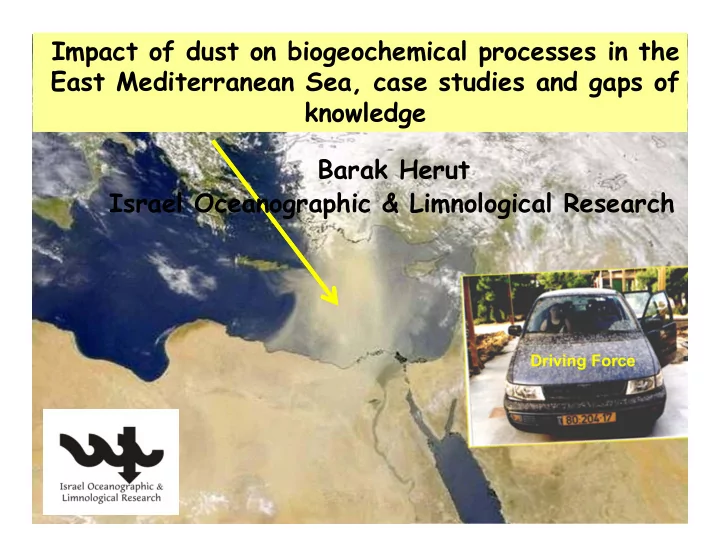
Impact of dust on biogeochemical processes in the East Mediterranean Sea, case studies and gaps of knowledge Barak Herut Israel Oceanographic & Limnological Research Driving Force The Levantine basin Most Sensitive System Natural


slide-1
SLIDE 1

Impact of dust on biogeochemical processes in the East Mediterranean Sea, case studies and gaps of knowledge Barak Herut

Driving Force
Israel Oceanographic & Limnological Research

slide-2
SLIDE 2

The Levantine basin – Most Sensitive System

Natural

  • Most Extreme S, T, Chl, Nut
  • LIW formation
  • Long term changes (S,T,O2,Nut)
  • Changes in circulation intensity

Anthropogenic

  • Change in Nile floods and Damming
  • Suez Canal, shipping
  • Marine Infrastructures
  • Climate change

Nile Delta Suez Canal

Levantine Basin

SSS

2003/06/17

SST PP SSS

slide-3
SLIDE 3
  • rganic

rich sapropel

History of eutrophic/anoxic periods

Sensitive system to Environmental Change

slide-4
SLIDE 4
  • A series of dams were built on

the Nile since the early 20th century with the 1st built in 1902.

  • Since 1965 the Aswan High Dam

started to operate. Since than all sediments are accumulating in Lake Nasser.

The Nile’s dams

High Aswan Dam

The opening of the Suez Canal 140 years ago opened the gates to a major one-way faunal invasion from the Red Sea to the SE Mediterranean and a major transfer of relatively more saline and nutrient-poor seawater.

Suez canal, 1869

Suez canal

slide-5
SLIDE 5

Shifting sediment properties following Nile damming

Almogi-Labin & Herut

20 40 60 80 1890 1900 1910 1920 1930 1940 1950 1960 1970 1980 1990 2000

G / 33 m

20 40 60 80

% >63 m size fraction

20 40 60 80

E / 40 m B / 40 m

Year

1965 S N

Aswan Damming

The sedimentary regime is undergoing major changes and consequently might

affect the living ecosystem.

34.5 34.6 34.7 34.8 34.9 35 31.6 31.7 31.8 31.9 32 32.1 32.2 32.3 32.4 32.5 32.6 32.7 32.8

Ashqelon

Tel Aviv

Taninim river Netanya

Haifa August 2008

Salinity

32o 32o 33o 35o

20מ ק הפיח ביבא לת ןולקשא

תוחילמ-יווש םיווק ,םיה ינפב ( ) 1956 רבמטפס

(Hecht, 1956)

% %

Hecht, 1992

1956

Pre–High Aswan Dam

<33 psu

At present

39.85 psu

2008

Nile floods and shifting SSS of the Israeli shelf

slide-6
SLIDE 6

Shifting sediment properties following Nile damming

20 40 60

% >63m size fraction

1890 1900 1910 1920 1930 1940 1950 1960 1970 1980 1990 2000

Year

10 20

% CaCO3

0.5

TOC(wt.%)

  • 24
  • 22
  • 20

13Corg (‰)

20 40 60

% Silt

50 100

Mode

2 4 6 8 10

% Al

  • Rapid sediment coarsening reflect sharp reduction in silt flux
  • Moderate and a delayed increase in CaCO3 result from decrease in sediment

dilution

  • The two step decrease in organic carbon and the gradual decrease in 13Corg

reflect significant depletion in nutrients and a change in the organic carbon source Almogi-Labin, Herut

slide-7
SLIDE 7
  • B. Galil

Alien species in the Mediterranean: A Region at High Risk

slide-8
SLIDE 8
  • B. Galil
slide-9
SLIDE 9

Israel coastal waters – activities in the new millennium

Ports expansion Artificial islands constructions Desalination plants Marine outfalls for brines Mariculture development Gas drilling Increase in marine transportation Power plants Red Sea – Dead Sea Water Conveyance Program

ימי רוטינב ךרוצהלארשיב

slide-10
SLIDE 10

Impact of dust on biogeochemical processes in the East Mediterranean Sea, case studies and gaps of knowledge Barak Herut

Driving Force

Israel Oceanographic & Limnological Research

slide-11
SLIDE 11

10 20 30 40 50 60 70 80 2000 2030 Year

Global Emission to Atmosphere million ton Nitrogen/yr

Atmospheric input of Nitrogen is high and increasing

slide-12
SLIDE 12
slide-13
SLIDE 13

Measurements of short and long-term records of dry atmospheric deposition for the Eastern Mediterranean Sea (EMS) indicates a significant role of Mediterranean aerosols as a major supplier of macro and micro nutrients (N, P, Fe and other trace metals) to the Low Nutrient Low Chlorophyll EMS.

slide-14
SLIDE 14

Atmospheric Fluxes

Haifa Erdemly Heraklion

slide-15
SLIDE 15

Atmospheric Nutrient Supply Assessment for East Mediterranean

Fluxes in mmol m-2 yr-1

Sources: Herut et al., 1999, 2002, 2005; Krom et al. 2004; Kouvarakis et al. 2001; Markaki et al., 2003; Carbo et al., 2005;

Bioavailable Wet Dry Nutrient

~70 20 50

N

~0.7 0.3 1

P

The soluble dry fraction is dominant

slide-16
SLIDE 16

Kocak et al., 2010

slide-17
SLIDE 17

Krom et al., 2010

slide-18
SLIDE 18

Leachability is dependent on aerosol sources

Release of IN: Dust events << European aerosols IP solubility: Dust events << European aerosols Leachable N/P: Dust events << European aerosols

West Mediterranean Dust Storm, 20 October 2001, R/V Meteor

slide-19
SLIDE 19

100 200 300 400 500 100 1000 10000 100000 Al ng m-3 air LIN:LIP molar ratio

Storm Background

y = -86 ln(x) + 900 R = 0.72 100 200 300 400 500 100 1000 10000 100000 ng Al in m3 air LINLIP in m3 air

Herut et al., 2002 Carbo et al., 2005

Redfield

Average N/P ratio of bioavailable atmospheric inputs is 80-120

slide-20
SLIDE 20

The average elemental N/P requirement for many plankton species and for bulk organic matter in the oceans has been found to be relatively constant at 16 (mol/mol) [i.e., Redfield, 1934, 1958]

Krishnamurthy et al., 2010 JGR

Biological requirement

slide-21
SLIDE 21

Anthropogenic Pb Angelidis et al., 2011, MPB

slide-22
SLIDE 22

Kocak et al., 2012

slide-23
SLIDE 23

Paytan et al., 2009 PNAS

Saharan aerosol Toxic Cu - # months

slide-24
SLIDE 24
slide-25
SLIDE 25
  • Trichodesmium accelerates the rate of iron

dissolution from oxides and dust, through as yet unspecified cell-surface processes, and thereby increases cellular iron uptake rates.

  • Natural puff (ball-shaped) colonies of

Trichodesmium are particularly effective at dissolving dust and oxides, attributed to efficient dust trapping in their intricate colony morphology, followed by active shuttling and packaging of the dust within the colony core.

  • Colony formation in Trichodesmium is an adaptive

strategy that enhances iron acquisition from particulate sources such as dust.

slide-26
SLIDE 26

Recent experimental studies have applied dust enrichments to bottle or mesocosm incubations of seawater from different

  • ceanic regions to explore its biogeochemical

impact. In the Mediterranean few on-board dust microcosm and a mesocosm experiment were performed with dust applied to surface seawater in the low-nutrient-low-Chlorophyll waters of the western Mediterranean (Corsica, www.obs-vlfr.fr/LOV/DUNE).

slide-27
SLIDE 27

Dust Microscosm Experiment on board R.V. Aegaeo, May 2002

Bottle No Dust Loading (mg/L) 1

  • - no dust control

2

  • - no dust control

Natural Dust 3 4.88 4 4.88 5 2.0 6 0.7 7 0.2 Pre-leached dust 8 4.94 9 4.75 10 1.95 11 0.69 12 0.21

Herut et al., 2005 DSR

slide-28
SLIDE 28

y = 31.106x + 38.923 R

2 = 0.9979

50 100 150 200 250 1 2 3 4 5 6

Dust concentration (mg/L)

Chl a (ng/L)

FD LD Control T0

10 20 30 40 50 60 70 1 2 3 4 5 6

Dust concentration (mg/L)

Pigment (ng/L)

FD 19’-hexa LD 19’-hexa Control 19'-hexa Control Zeax FD Zeax LD Zeax

y = 0.1011x + 0.0595 R

2 = 0.9971

0.0 0.1 0.2 0.3 0.4 0.5 0.6 1 2 3 4 5 6

Dust concentration (mg/L)

Primary production (mgC/m3/h)

FD LD Control

5-fold increase in Chl-a and PP, linearly related to fresh dust gradient

Herut et al., 2005 DSR

slide-29
SLIDE 29

Parameters Response to fresh dust addition

Dissolved Inorganic Nutrients Increase Dissolved Organic P (UVL) No change 33P turnover Increase Bacterial activity Increase Bacterial density No change Flow cytometry Variable Chl-a Increase Phytoplankton Variable Primary Production Increase Phytobiomass (HPLC) Increase Ciliates Variable Flagellates HNF-decrease, ANF-increase

Dust Microscosm Experiment on board R.V. Aegaeo, May 2002

slide-30
SLIDE 30

Does a single dust storm have a fast impact?

R.V. Aegaeo, May 2001

slide-31
SLIDE 31

0.000 0.001 0.002 0.003 0.004

129-31 131-33 133-34 134 134-36 136-37

Julian day (8-16 May 2001) LIP mmol m

  • 2 d
  • 1

0.00 0.02 0.04 0.06 0.08 0.10 LIN mmol m

  • 2 d
  • 1

LIP LIN

0.000 0.004 0.008 0.012 0.016 0.020

129-31 131-33 133-34 134 134-36 136-37

Julian day (8-16 May 2001) TIP mmol m

  • 2 d
  • 1

20 40 60 80 100 Al mg m

  • 2 d
  • 1

TIP Al

~0.08 mg dust/L 10m mixed layer

y = 31.106x + 38.923 R

2 = 0.9979

50 100 150 200 250 1 2 3 4 5 6

Dust concentration (mg/L)

Chl a (ng/L)

FD LD Control T0

slide-32
SLIDE 32

Average Chla in top 15 m 0.015 0.020 0.025 0.030 0.035 0.040 0.045

1

  • M

a y

  • 1

1 1

  • M

a y

  • 1

1 2

  • M

a y

  • 1

1 3

  • M

a y

  • 1

1 4

  • M

a y

  • 1

1 5

  • M

a y

  • 1

1 6

  • M

a y

  • 1

1 7

  • M

a y

  • 1

Chla ug/l

dust storm

In-situ response: *Small detectable change in Chla *Release of P *No detectable change in

  • Bact. abundance.

*Maybe small increase in Bact. activity. *Sharp decline of prochlorophytes. Evidences of micrograzing

Probably grazed away immediately by the ‘hungry starved lions’

slide-33
SLIDE 33

Ternon et al., 2011 BOUM Cruise - SESAME

slide-34
SLIDE 34
slide-35
SLIDE 35

Red – significant increase, Green – insignificant change, Purple – significant decrease Response to dust addition – microcosm experiments with surface seawater

slide-36
SLIDE 36

Increase No change Decrease

Primary productivity response to dust addition – Med Sea

slide-37
SLIDE 37

Sohm et al., 2011 Nature Reviews

slide-38
SLIDE 38

To better understand the interactions between natural and anthropogenic atmospheric deposition, community structure and biogeochemical cycling in LNLC areas a better quantification of key processes in surface waters is needed

slide-39
SLIDE 39

Objective Study the impact of Saharan dust and mixed aerosols on the autotrophic and heterotrophic surface microbial populations in the EMED during a transitional spring season that is characterized by high inputs of dust events.

~30 participants

MESOAQUA-ATMOMED Experiment

Crete May 2012 (HCMR)

EC FP7 contract

  • no. 228224
slide-40
SLIDE 40
slide-41
SLIDE 41

Dust and Aerosol on filters, day 1

slide-42
SLIDE 42

Parameter SD – Saharan dust A – mixed aerosol Days

PO4

+ +

All PO4-Tt PO4-Uptake rate

+, ++ +, ++

3-6 APA

  • Except T6

Chla

+ +

1-5 Syn + Het Bac

+ +

1-7 PP

+ +

1-5 BP

+ +

1-3

AUTOMED Responses

slide-43
SLIDE 43
  • Better information on the nutrient atmospheric, riverine

and diffused inputs contributing the steady-state budget of the EMS.

  • Mechanisms controlling the solubility of atmospheric

particles and the release of P into seawater in the EMS.

  • Potential chemical interaction and modifications during

transport of aerosols across the Mediterranean to enable a better understanding of the role of dust material as a provider of active surface for chemical interactions and transport of bioavailable anthropogenic materials.

  • Information on the bioavailability of nutrient compounds -

further examination using seawater

  • f

different Mediterranean provinces and different dust characteristics (sources/atmospheric processes).

Gap in knowledge to better assess the biogeochemical role of atmospheric inputs to the EMS