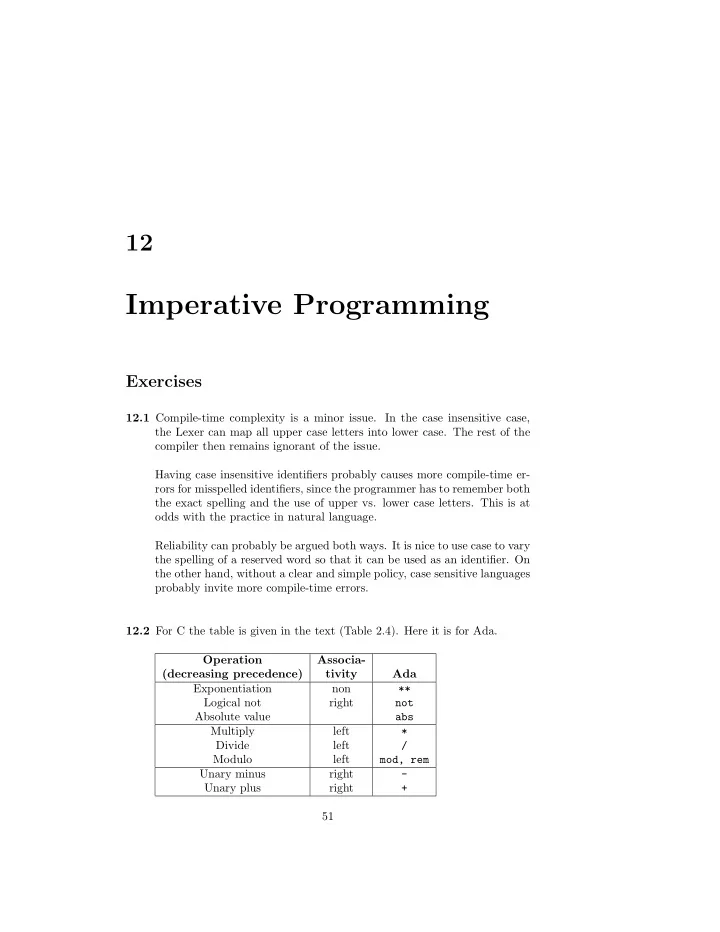
SLIDE 3 53 In C strings are arrays of characters terminated by a nul character (ASCII code 0). Thus, a common error is: char s[4] = "abcd"; /* length should be 5 */ For many of the C string functions, there are two versions: one which uses the null terminator (e.g., strcpy) and one which does not (e.g., strncpy). But in general there is no escaping the fact that strings are arrays of characters with a null byte terminator. In contrast, strings in Ada are also arrays of characters, but once created, they cannot vary in length. Thus the string s: string(1..7); will always hold exactly seven characters. In contrast, strings in Perl are truly dynamic; a string can always vary in
- size. Perl also supports regular expression operations on strings.
12.4 In C and Ada arrays can be statically sized or dynamically sized using a malloc or new operation. In Perl all arrays are dynamic; you can change the size of an array by assigning a value at an arbitrary index; the values at unassigned indexes are undefined. Similarly, Perl provides the operations push/pop which shift new values
- n/off the high end of an array. Similarly Perl also provides shift/unshift
- perations which accomplish the same at the low end of an array.
In C and Ada an array must be homogeneous; that is, all values must be
- f the same type (e.g., int). In Perl different subscript positions within
the array may be of different types. In fact, some subscripts positions may have scalar values while others have list values (or even objects). Perl provides a foreach statement for iterating over the values of an array. Neither C nor Ada provides this. 12.5 One major difference among the three versions is in typing. Another is the syntax of function declarations. The original version of C was based on a language named B The original version of Unix was developed for an 8K (18 bit word) PDP-7 and was written in PDP-7 assembler. Thompson then developed a language named B which was based on BCPL. Both B and BCPL were basicallly typeless with memory viewed as a contiguous array of words; there was no direct support for characters or strings. Variables were delcared as either static
auto a, b, c; static i, j, k; The arrival of the PDP-11 exposed several inadequacies of B’s semantic
- model. Its character handling facilities were clumsy, with characters being
packed and unpacked into words. This was both silly and awkward on a