Implementation of After School Education and Safety (ASES) Programs - - PowerPoint PPT Presentation

implementation of after school education and safety ases
SMART_READER_LITE
LIVE PREVIEW

Implementation of After School Education and Safety (ASES) Programs - - PowerPoint PPT Presentation

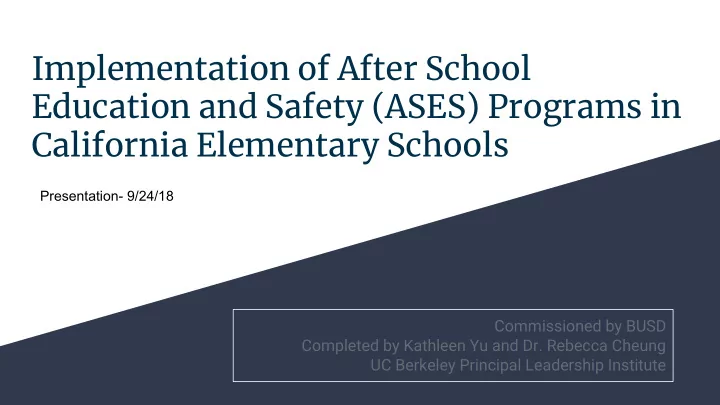
Implementation of After School Education and Safety (ASES) Programs in California Elementary Schools Presentation- 9/24/18 Commissioned by BUSD Completed by Kathleen Yu and Dr. Rebecca Cheung UC Berkeley Principal Leadership Institute ASES


slide-1
SLIDE 1

Implementation of After School Education and Safety (ASES) Programs in California Elementary Schools

Commissioned by BUSD Completed by Kathleen Yu and Dr. Rebecca Cheung UC Berkeley Principal Leadership Institute

Presentation- 9/24/18

slide-2
SLIDE 2

ASES Program Purpose

  • Overseen by the CA Department of Education
  • Funds the establishment of local after school education and

enrichment programs.

  • Programs must be created through partnerships between schools

and local community resources to provide literacy, academic enrichment and safe constructive alternatives for students in kindergarten through ninth grade (K-9).

  • The current funding level for the ASES program is $550 million.
slide-3
SLIDE 3

ASES Program Purpose

After school programs must consist of the two elements:

  • An educational and literacy element- must provide tutoring and/or

homework assistance designed to help students meet state standards in one or more of the following core academic subjects: reading/language arts, mathematics, history and social studies, or science.

  • An educational enrichment element- must offer an array of

additional services, programs, and activities that reinforce and complement the school’s academic program.

slide-4
SLIDE 4

Context of Study

  • Examines and summarizes the design and implementation of ASES

programs of selected elementary schools in CA for the purpose of informing Berkeley Unified School District’s (BUSD) extended learning committee

  • Report is not an evaluation of BUSD’s extended learning programs

nor is it an evaluation of the ASES program school sites

  • An attempt to gather relevant information to inform BUSD’s plans for

their extended learning program

slide-5
SLIDE 5

Method

  • Short timeline
  • Relied heavily on internet research and publicly accessible information
  • Sampling Criteria:

○ Elementary programs ○ Urban location ○ Diverse student population ○ Amount of ASES funding received ○ Existence of economic integration ○ Size of district

slide-6
SLIDE 6

Districts in Final Sample

  • Alameda Unified (AUSD)
  • San Leandro Unified (SLUSD)
  • San Juan Unified (SJUSD) - Near Sacramento
  • San Francisco Unified (SFUSD)
  • Redwood City School District (RCSD)
  • Santa Barbara Unified (SBUSD)
  • Santa Rosa City Schools (SRCS).
slide-7
SLIDE 7

Three Models of Partnership

Co-Sponsorship

Relationship between district and community partner is equal (SFUSD)

Subcontracting

District hires a CBO to carry out the majority of the activities. (AUSD, SLUSD, RCSD, SRCS)

School District Centered

Programs are run by district staff and CBO’s focus primarily on enrichment. (SBUSD, SJUSD)

slide-8
SLIDE 8

Connections to BUSD

It is our understanding that BUSD has both subcontracting and school district centered ASES programs. We did not have any school districts in our sample with two models occurring simultaneously.

slide-9
SLIDE 9

General Issues

  • Funding is both constrained and

in jeopardy ○ Threat of federal “de-funding”

  • f 21st CCLC programs

○ Current ASES funding has not changed since 2006 despite rising costs

  • Funding constraints impact

staffing ○ High turnover ○ Low staff qualification requirements ○ Little professional development opportunities

slide-10
SLIDE 10

General Issues continued

  • Great unmet needs for after school

programming ○ Recent requests for ASES and 21st CCLC funding exceeded $143 million than available ○ More than half of all programs turn away students due to capacity ○ English Learners among those most underserved

slide-11
SLIDE 11

General Issues continued

  • Lack of comprehensive database for

ASES data ○ No common quality indicators/ dashboard ○ No public reporting requirements for websites

slide-12
SLIDE 12

2012 ASES System-wide Evaluation Themes

  • Most common reason parents enrolled children is to provide

academic support

  • Most commonly offered activities were academic enrichment,

homework assistance, math, language arts, art.music, PE/sports, and recreation

  • Target population was at-risk students
slide-13
SLIDE 13

2012 ASES System-wide Evaluation Implementation Strategies

  • Ensure regular attendance
  • Strengthen partnership between school day and after school

program

  • Create developmentally appropriate programming
  • Consider the implementation of After School Quality Standards
slide-14
SLIDE 14

Discussion

How does this presentation/report inform the work of the BUSD Extended Learning Committee?