Implication There is another fundamental type of connectives between - - PDF document

implication
SMART_READER_LITE
LIVE PREVIEW

Implication There is another fundamental type of connectives between - - PDF document

- 1.2 Implication P. Danziger Implication There is another fundamental type of connectives between statements, that of implication or more properly conditional statements. In English these are statements of the form If p then q or p


slide-1
SLIDE 1
  • 1.2

Implication

  • P. Danziger

Implication

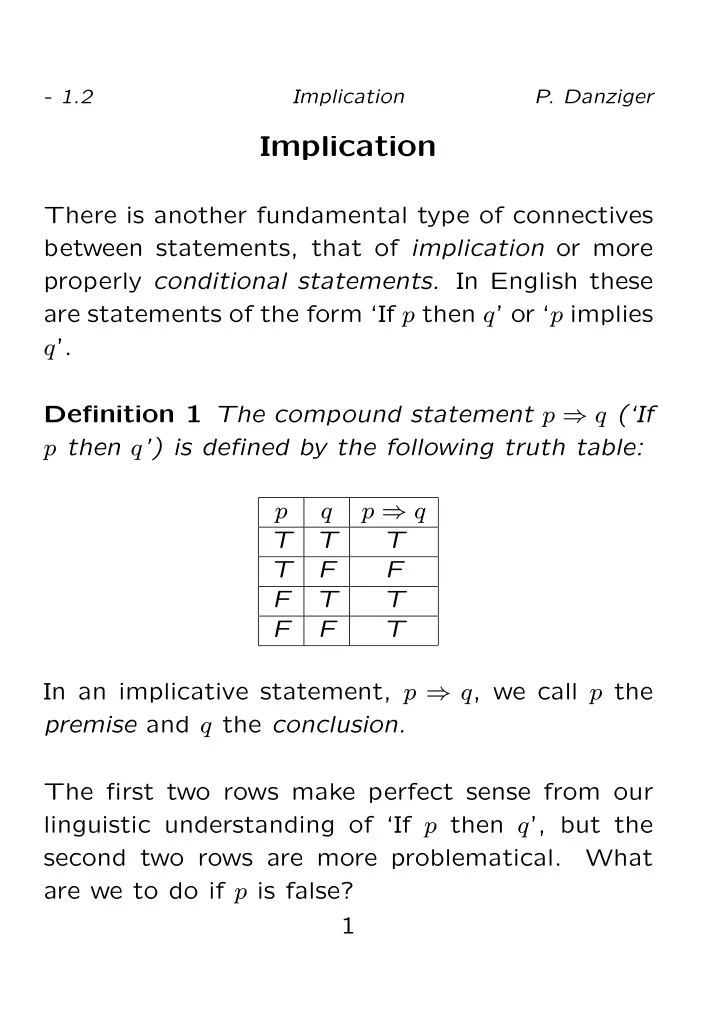
There is another fundamental type of connectives between statements, that of implication or more properly conditional statements. In English these are statements of the form ‘If p then q’ or ‘p implies q’. Definition 1 The compound statement p ⇒ q (‘If p then q’) is defined by the following truth table: p q p ⇒ q T T T T F F F T T F F T In an implicative statement, p ⇒ q, we call p the premise and q the conclusion. The first two rows make perfect sense from our linguistic understanding of ‘If p then q’, but the second two rows are more problematical. What are we to do if p is false? 1

slide-2
SLIDE 2
  • 1.2

Implication

  • P. Danziger

Note that we must do something, otherwise p ⇒ q would not be a well defined statement, since it would not be defined as either true or false on all the possible inputs. We make the convention that p ⇒ q is always true if p is false. The major reason for defining things this way is the following observation. made by Bertrand Russell (1872 - 1970). From a false premise it is possible to prove any conclusion. The word any is very important here. It means literally anything, including things which are true. It is a common mistake in proofs to assume some- thing along the way which is not true, then proving the result is always possible. This is referred to as ‘arguing from false premises’. 2

slide-3
SLIDE 3
  • 1.2

Implication

  • P. Danziger

One problem is that in language we do not gener- ally use implicative statements in which the premise is false, or in which the premise and and conclusion are unrelated. We usually assume that an implicative statement implies a connection, this is not so in logic. In logic we can make no such presumption, who would en- force ‘relatedness’? How would we define it? When we wish to prove an implicative statement of the form p ⇒ q we assume that p is true and show that q follows under this assumption. Since, with

  • ur definition, if p is false p ⇒ q is true irrespective
  • f the truth value of q, we only have to consider

the case when p is true. 3

slide-4
SLIDE 4
  • 1.2

Implication

  • P. Danziger

Converse, Inverse and Contrapositive Given an implicative statement, p ⇒ q, we can define the following statements:

  • The contrapositive is ∼q ⇒ ∼p.
  • The converse is q ⇒ p.
  • The inverse is ∼p ⇒ ∼q.

Theorem 2 p ⇒ q is logically equivalent to its contrapositive. Proof: p q p ⇒ q ¬q ¬p ¬q ⇒ ¬p T T T F F T T F F T F F F T T F T T F F T T T T Note that the converse is the contrapositive of the inverse. 4

slide-5
SLIDE 5
  • 1.2

Implication

  • P. Danziger

A common method of proof is to in fact prove the contrapositive of an implicative statement. Thus, for example, if we wish to prove that For all p prime, if p divides n2 then p divides n. it is easier to prove the contrapositive: For all p prime, if p does not divide n then p does not divide n2. 5

slide-6
SLIDE 6
  • 1.2

Implication

  • P. Danziger

Only if and Biconditionals Definition 3 If p and q are statements:

  • p only if q means ‘If not q then not p’ or equiv-

alently ‘If p then q’. i.e. p only if q means ⇒ q.

  • p if q means ‘If q then p’ i.e. q ⇒ p.
  • The biconditional ‘p if and only if q’ is true

when p and q have the same truth value and false otherwise. It is denoted p ⇔ q. p q p ⇔ q T T T T F F F T F F F T 6

slide-7
SLIDE 7
  • 1.2

Implication

  • P. Danziger

Notes

  • 1. ‘if and only if’ is often abbreviated to iff.
  • 2. In language it is common to say ‘If p then q’

when what we really mean is ‘p if and only if q’ - careful. See the remarks on page 26. Theorem 4 p ⇔ q ≡ (p ⇒ q) ∧ (q ⇒ p). Proof: p q p ⇒ q q ⇒ p (p ⇒ q) ∧ (q ⇒ p) p ⇔ q T T T T T T T F F T F F F T T F F F F F T T T T Thus p ⇔ q means that both p ⇒ q and its converse are true. When we wish to prove biconditional statements we must prove each direction separately. Thus we first prove p ⇒ q (if p is true then so is q) and then independently we prove q ⇒ p (if q is true then so is p). 7

slide-8
SLIDE 8
  • 1.2

Implication

  • P. Danziger

Necessary and Sufficient Definition 5 Given two statements p and q

  • ‘p is a necessary condition for q’ means ∼p ⇒

∼q or equivalently q ⇒ p.

  • ‘p is a sufficient condition for q’ means p ⇒ q.

Notes

  • 1. If p is a necessary condition for q this means

that if q is true then so is p. However if p is true q may not be – there may be other things that must be true in order for q to happen.

  • 2. If p is a sufficient condition for q then if p is

true then q must happen as a consequence (all the conditions for q are fulfilled). However q may happen in some other way – so q True but p False is a possibility 8