
SLIDE 1
Conference on Caucasian Languages balkiz.ozturk@boun.edu.tr Max Planck Institute for Evolutionary Anthropology
- mer.demirok@boun.edu.tr
Leipzig, May 13-15, 2011 gokselas@boun.edu.tr
Implications of case and agreement patterns in three Caucasian dialects spoken in Turkey: Pazar Laz, Ardasheni Laz and İnegöl (Adjarian) Georgian
Balkız Öztürk, Ömer Demirok, and Aslı Göksel Boğaziçi University
- 1. INTRODUCTION
Frequently attested alignment patterns in the morphological marking of arguments (i.e. case
- r verbal indexing) include neutral, accusative, and ergative alignments (Comrie, 1978; Dixon,
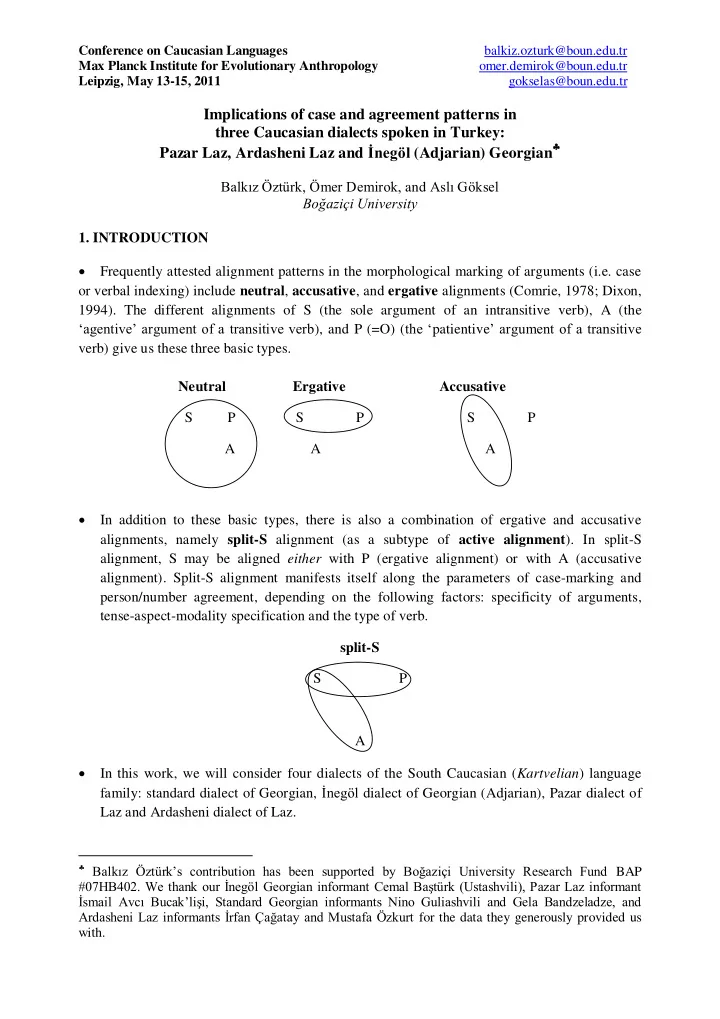
1994). The different alignments of S (the sole argument of an intransitive verb), A (the ‘agentive’ argument of a transitive verb), and P (=O) (the ‘patientive’ argument of a transitive verb) give us these three basic types. Neutral Ergative Accusative S P S P S P A A A In addition to these basic types, there is also a combination of ergative and accusative alignments, namely split-S alignment (as a subtype of active alignment). In split-S alignment, S may be aligned either with P (ergative alignment) or with A (accusative alignment). Split-S alignment manifests itself along the parameters of case-marking and person/number agreement, depending on the following factors: specificity of arguments, tense-aspect-modality specification and the type of verb. split-S S P A In this work, we will consider four dialects of the South Caucasian (Kartvelian) language family: standard dialect of Georgian, Ġnegöl dialect of Georgian (Adjarian), Pazar dialect of Laz and Ardasheni dialect of Laz.
- Balkız Öztürk’s contribution has been supported by Boğaziçi University Research Fund BAP