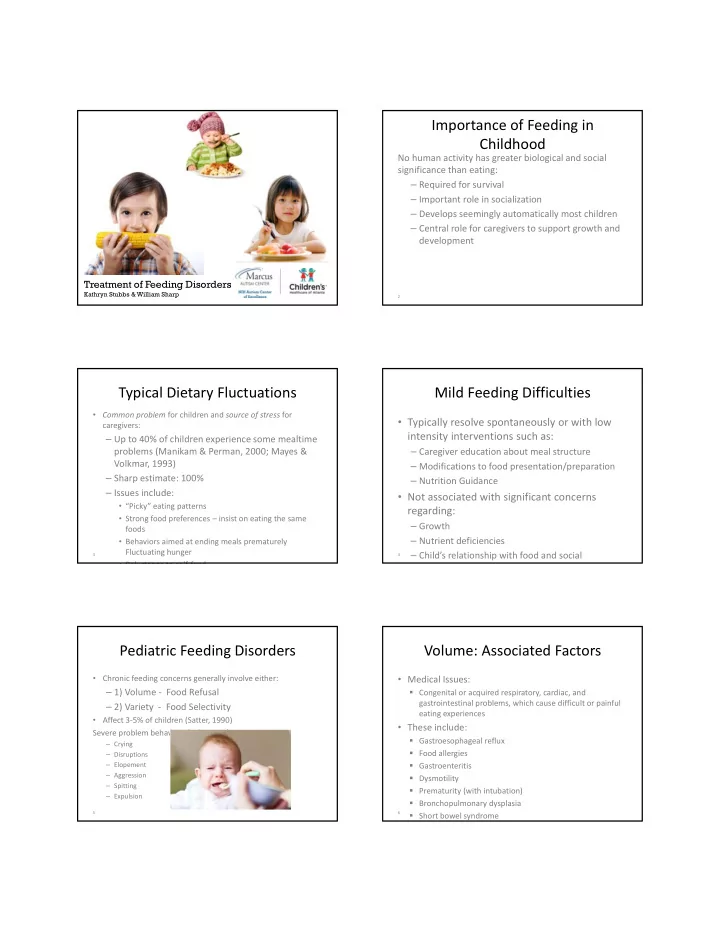
Importance of Feeding in Childhood No human activity has greater - - PDF document

importance of feeding in childhood
SMART_READER_LITE
LIVE PREVIEW

Importance of Feeding in Childhood No human activity has greater - - PDF document

Importance of Feeding in Childhood No human activity has greater biological and social significance than eating: Required for survival Important role in socialization Develops seemingly automatically most children Central role for


slide-1
SLIDE 1

Treatment of Feeding Disorders

Kathryn Stubbs & William Sharp

Importance of Feeding in Childhood

2

No human activity has greater biological and social significance than eating: – Required for survival – Important role in socialization – Develops seemingly automatically most children – Central role for caregivers to support growth and development

Typical Dietary Fluctuations

3

  • Common problem for children and source of stress for

caregivers:

– Up to 40% of children experience some mealtime problems (Manikam & Perman, 2000; Mayes & Volkmar, 1993) – Sharp estimate: 100% – Issues include:

  • “Picky” eating patterns
  • Strong food preferences – insist on eating the same

foods

  • Behaviors aimed at ending meals prematurely

Fluctuating hunger

  • Reluctance to self feed

Mild Feeding Difficulties

  • Typically resolve spontaneously or with low

intensity interventions such as:

– Caregiver education about meal structure – Modifications to food presentation/preparation – Nutrition Guidance

  • Not associated with significant concerns

regarding:

– Growth – Nutrient deficiencies – Child’s relationship with food and social

4

Pediatric Feeding Disorders

  • Chronic feeding concerns generally involve either:

– 1) Volume ‐ Food Refusal – 2) Variety ‐ Food Selectivity

  • Affect 3‐5% of children (Satter, 1990)

Severe problem behaviors during meals:

– Crying – Disruptions – Elopement – Aggression – Spitting – Expulsion

5

Volume: Associated Factors

  • Medical Issues:
  • Congenital or acquired respiratory, cardiac, and

gastrointestinal problems, which cause difficult or painful eating experiences

  • These include:
  • Gastroesophageal reflux
  • Food allergies
  • Gastroenteritis
  • Dysmotility
  • Prematurity (with intubation)
  • Bronchopulmonary dysplasia
  • Short bowel syndrome

6

slide-2
SLIDE 2

Variety: Associated Factors

  • Autism Spectrum Disorder (ASD)

7

Marcus Feeding Disorders Program

8

Multi‐Disciplinary Program: ~ 6,600 annual appointments Core Disciplines: – Behavioral Psychology – Oral‐motor (OT; SLP) – Nutrition – Gastroenterology Levels of Service: – Multidisciplinary Assessment – Outpatient Clinic (all disciplines) – Day Treatment Program Patients: – Not autism specific program – 60% = children with complex medical history and volume concern – 40% = children with autism and variety concerns Metric (small effect = .2, medium = .5, large = .8) d = .45

Marcus Autism Center

MAC Feeding Program

12

Research Mission

  • Expand evidence base to

increase access to care by developing interventions that are:

– Cost‐effective – Time‐efficient

  • With potential for:

– Broad application – Rapid dissemination

slide-3
SLIDE 3

Marcus Autism Center

Programmatic Goals

  • Expand the evidence base

– Set national best practice standards

  • Promote replication and dissemination

– Access to care

  • Explore avenues to increase effectiveness

– Reduce length and cost

Marcus Autism Center

Randomized Clinical Trials

  • The path to accomplishing the programmatic

goals is through RCTs

  • 1. DCS
  • 2. QuickWins

Marcus Autism Center

Randomized Clinical Trials

  • The path to accomplishing the programmatic

goals is through RCTs

  • 1. DCS
  • 2. QuickWins

Use of D‐cycloserine to facilitate extinction of food aversion

Marcus Autism Center

D‐Cycloserine

  • What it is:

– Antibiotic for treatment of tuberculosis – NMDA partial agonist

  • What it’s not:

– Antidepressant – Anti‐anxiety medication – Antipsychotic – Anticonvulsant

Marcus Autism Center

Current Uses in Psychology

  • ERP for anxiety disorders
  • Most effective when administered

immediately prior to or following exposure sessions

  • Hypothesized mechanism of change:

– DCS enhances the acquisition and/or consolidation processes that occur during associative learning, in fear consolidation in particular

  • Adult and pediatric populations (d=.9)
slide-4
SLIDE 4

Marcus Autism Center

Hypotheses

  • Behavioral Intervention + DCS will make more rapid

improvement in mealtime behavior than Behavioral Intervention + Placebo

  • Mealtime behaviors:

– Acceptance – Swallowing – Crying – Disruptions – Expulsions – Pack

Marcus Autism Center

Study Design

  • 16 participants with food aversion randomly assigned

(double‐blind) to one of two groups:

– Behavioral Intervention + Medication (DCS) – Behavioral Intervention + Placebo

  • First manual‐based behavioral intervention targeting feeding

difficulties

  • Study timeline: study evaluation, medical evaluation,

intensive behavioral intervention for one week (3 meals per day for 5 days) including caregiver training, and one month follow‐up with psychology and psychiatry

  • Children also receive DCS or placebo at the beginning of each

treatment day

Marcus Autism Center

Inclusion/Exclusion Criteria

  • Inclusion

– 18 months to 6 years – Partial food refusal with formula, bottle, or tube dependence (50% or greater) OR extreme food selectivity – Organic factor (GERD, food allergy)

  • Exclusion

– Previous behavioral treatment at MAC Feeding Program – Medically compromised, requiring current hospitalization – Unwilling to take study medication

Marcus Autism Center

Treatment Manual

  • Standardized behavioral protocol
  • 8 Modules + increasing the volume of food

– Exposure/Response Prevention – Positive Reinforcement

  • Antecedent manipulations (e.g., bolus,

texture)

  • Consequences (e.g., REP, DRA)

Pre/post Comparison of Differences Between Groups Feeding Behaviors, Grams Consumed, and Weight Status

23 Marcus Autism Center

Conclusion from RCTs

24

  • These studies are an important first step in

extending the evidence base for pediatric feeding disorders

  • The development and evaluation of this

structured intervention establishes a platform for more systematic research in this area

  • Demonstration of feasibility and preliminary

efficacy provide a basis for further study to test the efficacy of iEAT in large‐scale RCTs