Improves Thinking Skills, Academic Vocabulary, and Concept Learning - - PowerPoint PPT Presentation

improves thinking skills academic vocabulary and
SMART_READER_LITE
LIVE PREVIEW

Improves Thinking Skills, Academic Vocabulary, and Concept Learning - - PowerPoint PPT Presentation

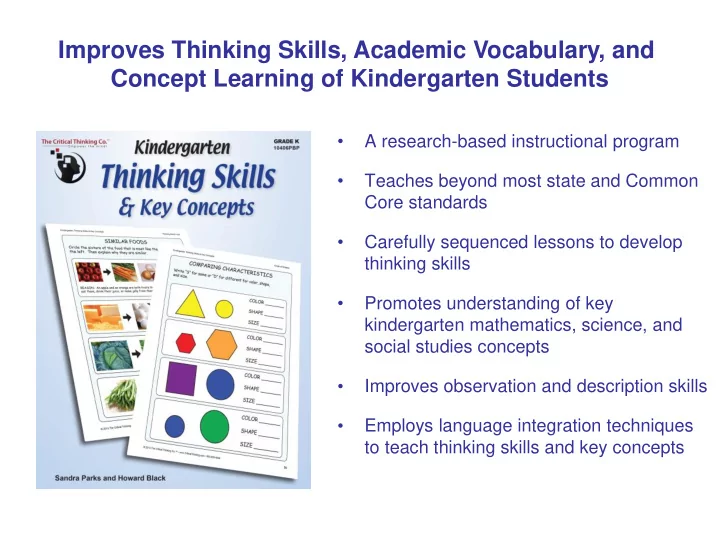
Improves Thinking Skills, Academic Vocabulary, and Concept Learning of Kindergarten Students A research-based instructional program Teaches beyond most state and Common Core standards Carefully sequenced lessons to develop


slide-1
SLIDE 1
  • A research-based instructional program
  • Teaches beyond most state and Common

Core standards

  • Carefully sequenced lessons to develop

thinking skills

  • Promotes understanding of key

kindergarten mathematics, science, and social studies concepts

  • Improves observation and description skills
  • Employs language integration techniques

to teach thinking skills and key concepts

Improves Thinking Skills, Academic Vocabulary, and Concept Learning of Kindergarten Students

slide-2
SLIDE 2
  • Increase the participation
  • f under-served

populations in gifted and advanced classes

  • Eliminate the achievement

gap in kindergarten through second grade

Major Benefits

slide-3
SLIDE 3

THINKING SKILLS INSTRUCTION

Develop basic thinking skills in kindergarten:

  • describe
  • define
  • compare
  • contrast
  • classify
  • sequence
  • part/whole analysis

ACADEMIC VOCABULARY

Develop academic vocabulary for common terms in:

  • mathematics
  • science
  • social studies

CONCEPT DEVELOPMENT

Develop mental models for key concepts in:

  • mathematics
  • science
  • social studies

Program Objectives

slide-4
SLIDE 4
  • Framework for 21st

Century Learning

  • Standards
  • North Carolina Standard Course of

Study

  • Florida Sunshine State Standards
  • Common Core State Standards

Content Selection

slide-5
SLIDE 5

INSTRUCTIONAL METHODS

  • DIRECT INSTRUCTION – prior knowledge, objective,

modeling, practice, metacognition, application

  • DEVELOPMENTAL FORMS – concrete (pictures), semi-

concrete (student book), abstract (discussion)

  • LANGUAGE INTEGRATION ACTIVITIES – developmental

activities, such as drawing, creating big books, telling stories, writing

  • COOPERATIVE LEARNING – paired problem-solving,

think/pair/share, pooled information

  • WHOLE SENTENCE RESPONDING – In thinking skills

activities students and teachers speak in complete sentences.

  • DISCUSSING PICTURE BOOKS – introduction or extension
  • f thinking skills lessons by appropriate nonfiction children’s

books

slide-6
SLIDE 6
  • Increased scores on language

proficiency and cognitive abilities tests

  • Increased scores on normed or criterion-

referenced achievement tests

  • Proficient student writing
  • Increases number of students placed in

advanced classes and subsequent successful performance

HOW WE KNOW IT WORKS

slide-7
SLIDE 7

How do the goals and the methods of this instructional program reflect the needs and strengths of the students I teach?

slide-8
SLIDE 8

MATHEMATICS

  • Properties of Polygons – naming polygons and their properties,
  • bserving sides and angles
  • Reading and Writing Mathematical Terms – recognizing and using

geometry terms, ordinal numbers, directional words

  • Pattern Recognition – rotation, reflection, sequential patterns
  • Similarity and Congruence
slide-9
SLIDE 9

SOCIAL STUDIES

  • Family members – age, gender relationships
  • Occupations – consumer/producer, goods/services, community

helpers

  • Buildings – residences, businesses, government buildings, storage
  • Vehicles – passenger, public transportation, work, recreation, cargo
slide-10
SLIDE 10
  • Food – plant or animal products, preparation, type (dairy, meat,

vegetable, grain, fruit), part of the plant we eat (root, stem, leaf, seed, fruit)

  • Animals – type of animal (fish, bird, mammal, amphibian,

reptile), reproduction (eggs, live birth), habitat, what they eat

SCIENCE

slide-11
SLIDE 11
  • Describing Shapes – naming shapes, finding shapes to match a

description, describing characteristics of a shape

  • Figural Similarities and Differences – matching and combining

shapes, producing equal figures, figure completion

  • Figural Sequences – recognizing and producing the next figure in a

sequence

  • Figural Classification – classifying by shape and/or color, forming

classes, depicting overlapping classes

FIGURAL THINKING SKILLS

slide-12
SLIDE 12

VERBAL THINKING SKILLS

  • Describing Things – matching a picture to a description, describing

people, animals, or objects shown in pictures

  • Verbal Similarities and Differences – selecting similar people,

animals, or objects, explaining similarities and differences

  • Verbal Sequences – ranking objects or people by a significant

characteristic

  • Verbal Classifications – explaining characteristics of a class,

exceptions, sorting into classes

  • Verbal Analogies – naming the kind of analogy or completing the

analogy

slide-13
SLIDE 13

COMMON CORE

THINKING SKILLS INSTRUCTION

  • 1. Emphasizing Informational Texts

Discussing detailed photographs helps students develop the vocabulary used in nonfiction texts and produces a thorough comprehension of each concept.

  • 2. Building Knowledge Within Content Domains

All thinking skills exercises employ or exceed content knowledge in mathematics, science, and social studies in kindergarten.

  • 3. Increasing Complexity

Exercises provide carefully sequenced instruction

  • f key curriculum concepts, describing their

properties in greater detail than common text information.

continues...

slide-14
SLIDE 14
  • 4. Answering From Texts

Students discuss the properties of key concepts in mathematics, social studies, and science. Lessons provide carefully scaffolded writing activities to teach kindergarten students how to write from observations of detailed photographs.

  • 5. Writing From Sources

The lessons address the increasing rigor for writing in the kindergarten grades by modeling the sentence patterns and using the signal words to describe relationships.

  • 6. Developing Academic Vocabulary

The terms used are introduced one year prior to most state standards in order to provide practice for students unfamiliar with these terms.

COMMON CORE

THINKING SKILLS INSTRUCTION

slide-15
SLIDE 15

RESEARCH BASIS

  • 1980s thinking skills initiatives
  • Dade County, Florida T.E.A.M. –

30 years of thinking skills instructions

  • Project Bright Idea, North Carolina

Department of Public Instruction Javits Grant–10 years of implementation and external evaluation

  • Academic vocabulary development

– Robert Marzano

slide-16
SLIDE 16

Thinking Skills

  • Revised Bloom’s Taxonomy
  • Albert Upton model

Instructional Methods

  • Piaget (observe, write, discuss)
  • Madeline Hunter (direct

instruction)

  • Cooperative learning (Johnson

and Johnson)

Metacognition Theory

THEORETICAL FOUNDATION

slide-17
SLIDE 17

METACOGNITION

  • Helps students clarify their thinking processes
  • Helps students remember thinking processes they are

taught

  • Promotes transfer of thinking processes to other

contexts

  • Establishes the habit of students evaluating and

controlling their own thinking processes

  • Promotes students’ confidence as effective learners

Metacognition is analyzing your own thinking to ensure it is clear,

  • rganized, and complete.
slide-18
SLIDE 18

By the end of this book, students should know the significant characteristics of these mental models and how to create new ones.

Mental models outline the characteristics needed to describe or define a concept.

  • Polygons
  • Family members
  • Foods
  • Jobs
  • Vehicles
  • Buildings

MENTAL MODELS

slide-19
SLIDE 19

ANIMALS MENTAL MODEL

Students will:

  • Describe, compare and contrast, and classify animals
  • Discuss an animal’s appearance (color, size, body covering), where

it lives, how it moves, and what it eats

  • Learn types of animals: fish, birds, reptiles, mammals, and insects
slide-20
SLIDE 20

FAMILY MEMBERS MENTAL MODEL

Students will:

  • Describe, compare and contrast, and classify family members
  • Discuss age, gender, roles, relationship to other family members,

and experiences that make various family members special

slide-21
SLIDE 21

FOOD MENTAL MODEL

Students will:

  • Describe, compare and contrast, and classify food
  • Discuss whether food is a plant or animal product, its appearance

and taste

  • Describe food products from plants
  • Identify the parts of a plant: root, stem, leaf, fruit, and/or seed
slide-22
SLIDE 22

JOBS MENTAL MODEL

Students will:

  • Describe, compare and contrast, rank, and classify occupations
  • Discuss whether jobs provide goods or services, how much training is required, the activities
  • f various professions, and the equipment and uniforms associated with the profession
  • Learn types of jobs: producers, health workers, government workers, and service providers
slide-23
SLIDE 23

VEHICLES MENTAL MODEL

Students will:

  • Describe, compare and contrast, rank and classify vehicles
  • Discuss the size, speed, and purpose of various vehicles; where the

vehicles are driven; their appearance; their ownership; and their parts

  • Learn types of vehicles: passenger, public transportation, work,

recreation, and cargo

slide-24
SLIDE 24

BUILDINGS MENTAL MODEL

Students will:

  • Describe, compare and contrast, and classify buildings
  • Discuss the size, purpose, construction, design, materials, and

location of various buildings

  • Discuss who lives or works in a building, and who owns it
slide-25
SLIDE 25

LESSON STRUCTURE

DIRECT INSTRUCTION

  • Introduction

Indicates prior knowledge

  • Stating the Objective

Explains what students will learn in the lesson

  • Conducting the Lesson

Guides the thinking process and provides independent practice

  • Thinking About Thinking (Metacognition)

Clarifies the thinking process

  • Personal Application

Relates the thinking skill to students’ experiences

slide-26
SLIDE 26

SUGGESTIONS FOR TEACHING

  • 20-30 minute sessions, 3-4 times a week
  • Schedule the first five chapters early in the school year. The

remaining chapters can be taught according to your curriculum guide.

  • For the first year use your text materials to supplement each
  • chapter. As you become familiar with this instruction, you may

use these lessons to supplement your text.

  • Keep the sequence of lessons in each chapter in the order

that they appear.

slide-27
SLIDE 27

PICTURE BOOKS

  • Before a lesson, read aloud from a picture book

about an item that students may not know well.

  • Select books that describe the properties taught in

the lesson.

  • Use books with photographs as often as possible.
  • Select books that are interesting and beautiful.
slide-28
SLIDE 28

Student book (160 pages) $21.99 Teacher’s manual (192 pages) $22.99 *Inquire about volume discounts

Contact us

Direct Sales:

800-458-4849 (option 1) 541-982-4593 Service@CriticalThinking.com

Dealers

800-458-4849 (option 2) 541-982-4232 Dealers@CriticalThinking.com

Professional Training Available

If your school or district is interested in professional training from the authors, please contact us at 541-982-4593.

Affordable Pricing!*