Improving the positive impact of disability services on the lives - - PowerPoint PPT Presentation

improving the positive impact of disability services on
SMART_READER_LITE
LIVE PREVIEW

Improving the positive impact of disability services on the lives - - PowerPoint PPT Presentation

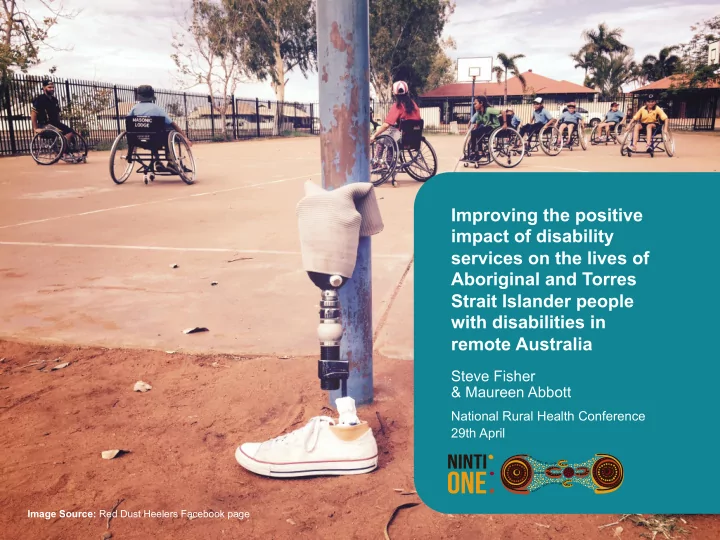
Improving the positive impact of disability services on the lives of Image Source: Red Dust Heelers Facebook page Image Source: Red Dust Heelers Facebook page Aboriginal and Torres Strait Islander people with disabilities in remote Australia


slide-1
SLIDE 1

Image Source: Red Dust Heelers Facebook page Image Source: Red Dust Heelers Facebook page

Improving the positive impact of disability services on the lives of Aboriginal and Torres Strait Islander people with disabilities in remote Australia

Steve Fisher & Maureen Abbott

National Rural Health Conference 29th April

Image Source: Red Dust Heelers Facebook page

slide-2
SLIDE 2

Image Source: Red Dust Heelers Facebook page Image Source: Red Dust Heelers Facebook page

Disability in Aboriginal and Torres Strait Islander communities

(AATSIHS 2013; AIHW 2015)

Aboriginal and Torres Strait Islanders make up 16% of the population in remote areas

slide-3
SLIDE 3

Image Source: Red Dust Heelers Facebook page Image Source: Red Dust Heelers Facebook page

Disability in Aboriginal and Torres Strait Islander communities

(AATSIHS 2013; AIHW 2015)

Aboriginal and Torres Strait Islanders make up 16% of the population in remote areas (48% in very remote areas)

slide-4
SLIDE 4

Image Source: Red Dust Heelers Facebook page Image Source: Red Dust Heelers Facebook page

Disability in Aboriginal and Torres Strait Islander communities

(AATSIHS 2013; AIHW 2015)

Aboriginal and Torres Strait Islanders make up 16% of the population in remote areas (48% in very remote areas) In 2012, only 13% of Aboriginal people accessing disability services nationally lived in a remote or very remote area

slide-5
SLIDE 5

Image Source: Red Dust Heelers Facebook page Image Source: Red Dust Heelers Facebook page

Disability in Aboriginal and Torres Strait Islander communities

(AATSIHS 2013; AIHW 2015)

Aboriginal and Torres Strait Islanders make up 16% of the population in remote areas (48% in very remote areas) In 2012, only 13% of Aboriginal people accessing disability services nationally lived in a remote or very remote area 35.7% of ATSI population living with a disability

slide-6
SLIDE 6

Image Source: Red Dust Heelers Facebook page Image Source: Red Dust Heelers Facebook page

Disability in Aboriginal and Torres Strait Islander communities

(AATSIHS 2013; AIHW 2015)

Aboriginal and Torres Strait Islanders make up 16% of the population in remote areas (48% in very remote areas) In 2012, only 13% of Aboriginal people accessing disability services nationally lived in a remote or very remote area 35.7% of ATSI population living with a disability and are 1.7 times more likely to live with disability than non-Aboriginal Australians

slide-7
SLIDE 7

Image Source: Red Dust Heelers Facebook page Image Source: Red Dust Heelers Facebook page

Participation

Disability-inclusive development

Poverty reduction Equality

Inclusion Integration

Image Source: Summer Foundation

slide-8
SLIDE 8

Image Source: Red Dust Heelers Facebook page Image Source: Red Dust Heelers Facebook page

NDIS: The missing link

Innovation & quality Role of carers Remote Aboriginal context requires more concerted effort to achieve. Advocacy Active empowerment

slide-9
SLIDE 9

Image Source: Red Dust Heelers Facebook page Image Source: Red Dust Heelers Facebook page

Lessons from Ninti One

  • Passive response

to services

  • Low knowledge

about disability

  • Uneven standards
  • Cross-cultural capacity

under-developed

  • Lack of local disability

advocacy groups

  • Transactional rather

than transformative

slide-10
SLIDE 10

Image Source: Red Dust Heelers Facebook page Image Source: Red Dust Heelers Facebook page

Recommendations

Research

  • Alongside Aboriginal people in

remote settings

  • Determine reach, coverage and

character of disability and services

Raise awareness

  • Emphasis: role of the wider

community

  • Aim: tackling local obstacles and

stigma

slide-11
SLIDE 11

Image Source: Red Dust Heelers Facebook page Image Source: Red Dust Heelers Facebook page

Recommendations

Close the Disability Gap

  • Introduce new target into COAG’s

Closing the Gap framework

  • Aim: to decrease the significantly

greater chance of ATSI people to be living with a disability

Build knowledge and skills

  • Augment National Disability

strategy

  • Aim: emphasise importance of

knowledge and inclusion for enabling self-advocacy

slide-12
SLIDE 12

Image Source: Red Dust Heelers Facebook page Image Source: Red Dust Heelers Facebook page

Recommendations

Transformative services

  • Develop specific plan alongside

ATSI organisations

  • Links education and inclusion to

advocacy and empowerment strategies

Culturally appropriate services

  • Train staff to work more effectively

across cultures

  • Aim: increase accessibility of

disability services to Aboriginal and Torres Strait Islander people

slide-13
SLIDE 13

Image Source: Red Dust Heelers Facebook page Image Source: Red Dust Heelers Facebook page

Recommendations

Advocacy and empowerment

  • Build capacity of advocacy

networks empowering Aboriginal leaders

  • Invite advocacy networks to

advise and contribute to service improvement