
SLIDE 1
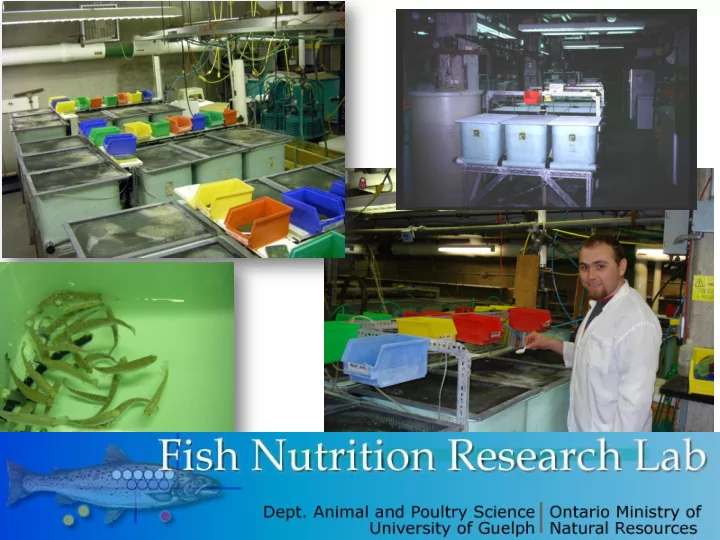
In existence since 1969 (S.J. Slinger & C.Y. Cho) Historically - - PowerPoint PPT Presentation
In existence since 1969 (S.J. Slinger & C.Y. Cho) Historically regarded as a key fish nutrition lab. Mind set, methodologies, equipment, feed formulae Sustained funding by government agencies and industry Core funding from
assistants since 1992
“Percent Replacement” is a Highly Relative Parameter!
Ex: Replacing 25, 50, 75 and 100% of the fish meal of the diet
50 37.5 25 12.5 20 15 10 5
10 20 30 40 50 60 25 50 75 100 25 50 75 100
Fish meal level, % diet
% Replacement
Control diet with 50% fish meal Control diet with 20% fish meal
Let’s get rid of this terminology, please!
– Individual nutrient requirements of animals – Nutrient content of feed ingredients and associated variability – Digestibility and bio-availability of nutrients – Potential limitations (e.g. contaminants, anti-nutritional factors) – Impacts (e.g. physical properties, waste outputs, final product quality) of the ingredients
NRC 2011 Review of state-of-the-art Committee reviewed 1000s of papers Imperfect document and recommendations represent best effort
What Does Fish Meal Bring That Plant Feed Ingredients Don’t?
Trushenski et al. (2012)
Trushenski et al. (2012)
Trushenski et al. (2012)
Trushenski et al. (2012)
Evidence that for some species DHA is the essential fatty acid and that EPA doesn’t have to same efficacy.
This is a lot more informative and accurate than “fish oil replacement value”
45 90 135 180
Soybean meal Canola/rapeseed/mustard … DDGS (EU/NA) Corn gluten meal Poultry by-product meal Meat and bone meal Feather meal Porcine meal Aquatic animal protein Plant products (World) Animal products (North America)
Plant feedstuffs = Most abundant feed commodities!
Main nutrient sources Complementary nutrient sources
Complex mixtures of many different ingredients! In Asia, aquaculture feeds can now be described as “plant-based feeds” with complementary use
and microbial origins
Big Woods)
Michel Charvet Salaisons d’Alsace
Salade de gésiers (Gizzard salad) France Chicken feet dim sum China Tkalia ou Douara (Lamb offals stew) Morocco
Tripes à la mode de Caen (Caen-style tripes) France
Chicago stockyards, ca. 1913. Union Stock Yards, 1866. (CHS ICHi-06898)
"Five hundred animal pens covering 60 acres of land were used to house the livestock, and the whole operation could accommodate 21,000 head of cattle, 75,000 hogs, 22,000 sheep, and 200 horses at one time,"
Stabilized Poultry Fat Stabilized Pet Food Poultry Fat Hydrolyzed Poultry Feather Meal Stabilized Poultry Protein Meal Low Ash Pet Food Poultry Protein Meal Pet Food Poultry Protein Meal
(245º to 290º F.)
friendly way to dispose of the massive amount of meat and food by-products produced every year.
make an excellent media for pathogens to grow and multiply.
processing kill conventional disease- causing organisms, such as bacteria and viruses.
moisture levels, etc.) are closely monitored, controlled, and recorded.
Bacteria Raw Tissue Post-Press Clostridium perfingens 71% 0% Listeria species 76% 0%
8% 0% Campylobacter species 30% 0%
20% 0% Salmonella species 85% 0%
Percentage of samples having pathogens present.
Bacillus Anthracis cells with spores
1970-95 : Review of literature and discussions with feed industry personnel and researchers indicate general lack of trust in nutritive value of animal proteins for fish
Digestibility values of certain animal products reported in the reference literature (up to 1993) were very low, making these ingredients uninteresting to use. USA National Research Council (1993):
Apparent digestibility coefficient (ADC) of protein Feather meal 58% Poultry meal 68%
Data from Cho & Slinger (1979) (U of Guelph)
82-84% N/A Sugiura et al. (1998) 58% 70% Cho et al. (1982)
81-87% 76-80% Bureau (1999) 83% 81% Pfeffer et al. (1995)
HCl hydrolyzed feather meal
Data obtained using the same facilities and methodology. There is value in using standard methodological approaches consistently over many years.
68% 71% Cho et al. (1982) Bureau et al. (1999) 87-91% 77-92% 74-85% 65-72% Hajen et al. (1993) 96% N/A Sugiura et al. (1998)
Data obtained using the same facilities and methodology
Apparent Digestibility Coefficients (%) Ingredients DM CP GE
Trial #1 Feather meal 1
82 81 80
Feather meal 2
80 81 78
Feather meal 3
79 81 76
Feather meal 4
84 87 80
Meat and bone meal 1
61 83 68
Meat and bone meal 2
72 87 73
Trial #2 Meat and bone meal 3
72 88 82
Meat and bone meal 4
66 87 76
Meat and bone meal 5
70 88 82
Meat and bone meal 6
70 89 83
Trial #3 Feather meal 5
86 88 84
Feather meal 6
83 86 81
Feather meal 7
83 88 83
Meat and bone meal 7
78 92 86
Meat and bone meal 8
72 89 81
Meat and bone meal 9
69 88 80 Apparent Digestibility of Processed Animal Proteins in the late 1990s
Cheng and Hardy (2002)
Nutrient Composition of Different Fish Meals and Poultry by-Products Meals
Fish meal Poultry by-Products Meal Composition Herring Menhaden Feed-grade Prime Refined Dry matter, % 93 91 97 96 97 Crude Protein, % 71 61 62 66 70 Crude fat, % 9 9 11 8 10 Ash, % 12 22 15 15 11 Phosphorus, % 2.4 3.1 2.6 2.8 2.0 Lysine, % 5.4 4.2 3.7 3.7 4.6 Methionine, % 1.8 1.5 1.2 1.3 1.5 Histidine, % 2.2 1.2 1.4 1.2 1.5 Threonine, % 3.1 2.4 2.5 2.4 3.0
Fish meal is not fish meal and poultry by-products meal is not poultry by-products meal. These are generic names that regroup ingredients that can be widely different.
Fish meal Poultry by-Products Meal Component Herring Menhaden Feed-grade Prime Refined % Dry matter 81 71 71 72 75 Crude Protein 90 86 83 85 87 Crude fat 92 91 80 83 80 Phosphorus 58 47 49 46 56 Lysine 95 95 89 92 93 Methionine 95 95 92 95 94 Histidine 92 93 85 89 89 Threonine 90 92 82 85 85
Apparent Digestibility of Nutrients of Different Fish Meals and Poultry By-Products Meals
Cheng and Hardy (2002)
Information on EAA content and digestibility is extremely meaningful for the formulation of cost-effective feeds
Formulation of Experimental Diets Used in Feather Meal Trial
Herring meal 50 35 35 35 50 40 30 20 Blood meal, tube-dried 10 10 10 10 6 9 12 15 Feather meal 1 15 Feather meal 2 15 Feather meal 4 15 8 12 16 20 Corn gluten meal 10 10 10 10 6 9 12 15 Whey 12 12 12 12 12 12 12 12 Vitamins + minerals 3 3 3 3 3 3 3 3 Fish oil 15 15 15 15 15 15 15 15
Performance of rainbow trout fed diets with different feather meals
Diet Gain Feed FE RN RE g/fish g/fish g/fish kJ/fish 1- Control 73.5 ab 51.6 1.42 ab 1.9 a 587 a 2- 15% FEM 1 74.3 ab 51.4 1.44 a 1.9 a 553 a 3- 15% FEM 2 71.1 bc 52.0 1.37 bc 1.8 a 561 a 4- 15% FEM 4 73.0 abc 52.3 1.40 abc 1.9 a 547 a 5- 20% FEM-CGM-BM 74.5 a 51.8 1.44 a 1.9 a 574 a 73.2 abc 51.7 1.42 abc 1.9 a 554 a 73.3 abc 52.2 1.41 abc 1.9 a 579a 70.1 c 51.8 1.35 c 1.8 a 537a G:F 6- 30% FEM-CGM-BM 8- 50% FEM-CGM-BM 7- 40% FEM-CGM-BM
Could not highlight differences in the nutritive value of feather meals with different digestible protein levels. Diets 2-4 contained at least 35% fish meal.
Diet Weight Efficiency TGC*
g/fish
1- Control 278 a 1.19 a 0.261 a 2- FEM + MBM 247 bcd 1.04 bc 0.241 bc 3- FEM+MBM+Met 248 bcd 1.06 bc 0.241 bc 4- FEM+MBM+Lys 242 d 1.03 c 0.238 c 5- FEM+PBM 264 ab 1.14 ab 0.252 ab 251 bcd 1.06 bc 0.243 bc 261 abc 1.11 abc 0.250 abc 245 cd 1.04 c 0.239 bc G:F
Duration = 12 weeks Temperature = 15 oC Initial weight = 35 g/fish 6- FEM+PBM+Met 8- MBM+PBM 7- FEM+PBM+Lys Final Feed *TGC = (FBW1/3 - IBW1/3) / (Temp. (oC) * days)
Experimental Diets in Poultry By-Products Meal and Blood Meal Trial
Diet FBW TGC FE g/fish G:F 1- Control 6% BM 209 0.200 1.11 2- 12% BM 215 0.205 1.19 3- 10% PBM 201 0.195 1.11 4- 20% PBM 202 0.199 1.13 5- 30% PBM 209 0.199 1.13
Initial body weight = 17 g/fish, Duration= 16 weeks, Temp. = 15 oC
ADC Protein Energy 96 92 95 91 95 93 94 92 93 92
No significant difference according to Tukey’s HSD test.
1 2 3 4 5 6 Ingredients MM10 MM20 HM10 HM20 NFM
Profishent
Fish meal, herring
200
Fish meal, menhaden 100 200
300 200 300 200 400 + Soybean meal 90 80 120 120 70 + Corn gluten meal 150 150 120 90 150 + Feather meal 50 70 50 70 70 + Wheat 100 100 110 130 100 + Fish oil, herring 120 110 120 110 130 + Poultry Fat 60 60 60 60 50 +
Feeds Based on Herring Meal, Menhaden Meal or Poultry Meal Unit: kg/tonne of feed
Diet Initial weight Final weight Weight gain Feed intake FE TGC (g/fish) (g/fish) (g/fish) (g/fish) (gain/feed intake) (%) MM10 15.5 205 189.2 180.1 1.05b 0.199 MM20 15.5 193 177.3 158.4 1.12ab 0.192 HM10 15.4 203 187.5 161.0 1.16ab 0.199 HM20 15.8 222 206.4 171.7 1.20a 0.208 NFM 16.0 208 192.1 182.2 1.06b 0.199 Profishent 15.9 203 187.5 165.3 1.13ab 0.197 SEM 6.2 6,2 5.2 0.03 0.03
1 Values with different subscript letters are significantly different (P<0.05)
Growth and Feed Efficiency of Rainbow Trout Fed the Test Feeds for 16 weeks at 15ºC.
Magic “nutritional” bullet against bacterial gill disease!
Cumulative mortality of rainbow trout challenged with Flavobacterium branchiophilum and subjected to different feeding regimes
<0.5 ppm
Control: 4 ppm DON: 6 ppm DON: Pair-fed: Reduced feed intake
Image from -billkasal.com
*All curves significantly differed in comparison to control and pair-fed groups (Holm-Sidak, p<0.05)
a a c b
Trial # 1 Replicate trial
a a b c a,b a,b b a
*Pair-fed and 6 ppm
group significantly differed in comparison to the control fed group (Holm-Sidak, p<0.05)
a ab b a
Inhibitory action of DON on the growth of F. psychrophilum
Potential for developing feeding strategies and diets for disease states?
The paradigm “Better nutrition equals better disease resistance” is not always true. In some cases, nutrient supply can have a negative effect on the ability of the animal to cope with pathogens and stress (at least for Flavobacterium spp.
Infections)
Relative to feeding or supply of specific nutrients (needed by pathogens?) Most effective strategy? STOP FEEDING! (for several days)
1.Rapid changes in water temperature (Bruno DW & Raynard RS 1994. Bull. EAFP 14: 86-88) 2.Rapid changes in water salinity (Iwata M et al. 1987. Aquaculture 66; 315-327) 3.UV irradiation (Doughty MJ et al. 1997. J. Photochem. Photobiol. 41:165-172) 4.Gas supersaturation (Krise WF & Smith RA 1993. Prog. Fish Cult. 55: 177-179) 5.Organophosphate treatment (Fraser PJ et al. 1990. Exp. Eye Res. 50:443-447) 6.Corneal damage, especially in marine species (Doughty MJ et al. 1997. J. Photochem.
7.Eye flukes (Ashton et al. 1969. J. Small Anim. Pract. 10: 471-478) 8.Genetic predisposition (Kincaid HL, 1989) 9.Triploidy (Wall AE & Richards RH 1992. Veterinary Record 131: 553-557) 10.Rapid growth rate (Bjerkaas E et al. 1996. Acta vet. Scand 37: 351-360) 11.High summer/early autumn season (Wall AE 1998. Veterinary Record 142, 626-631; Crockford et al. 1990) 12.High seawater temperatures (Crockford et al. 1998) 13.Dietary zinc deficiency (Ketola HG 1979, J. nutr. 109: 965-969) 14.Tryptohan deficiency (Poston HA & Rumsey GL 1983. J. nutr. 113: 2568-2577) 15.Methionin deficiency (Cowey et al. 1992. J. nutr 122: 1154-1163) 16.High-energy diets (Waagbo et al. 1998. Bull. EAFP 18: 201-205) 17.Histidine deficiency 18.Folate / Vit B12 deficiency
Crenshaw, 1991
Electrolyte gradients: required for nutrient transport Electrolyte excretion: energy demanding process
1. Elevated cortisol level (implant) suppressed immunocapacity and increased parasitaemia in rainbow trout (Woo et al., J. Fish Biol, 1987);
multiplication (Woo, 2008 unpld)
Mao Li Department of Integrative Biology, University of Guelph
Weeks Post-Exposure Parasite numbers.ml-1
100x103 200x103 300x103 400x103 Control 10 ng 25 ng 50 ng
2 3 4 5
Li et al., IJP (2013)
Weeks Post-Exposure Parasites.ml-1
500x103 1x10⁶ 2x10⁶ 2x10⁶ Control Cort Cort+RU486 Dex Dex+RU486
Result 2: The type of response of parasite to cortisol is similar to that
2 3 4 5
Weeks Post-Exposure (WPE) Parasites.ml-1
0.0 500.0x10³ 1.0x10⁶ 1.5x10⁶ 2.0x10⁶ 2.5x10⁶ Control 50ng RU486 100ng RU486
a b a a a a
2 3 4 5
Li and Woo, IJP (2014)
How can I meaningfully compare the growth rate or FCR of groups of fish (or shrimp) reared at two different production sites with different
intervals and fed different diets?
Dairy producers have been using mathematical models to manage production, breeding and feeding of dairy cows for decades
Attributable to Genetic Gain, Better Feeding and Better Management Enabled by: 1) systematic recording of performances, 2) sharing of data , 3) very advanced mathematical models and 4) practical tools (genetic selection index, feeding management software, etc.)
Precise Models & Management Tools Quality Data & Information
Combining information and models to improve efficiency of production
From the laboratory to the field…
Iwama and Tauz (1981) Cho (1992)
Growth indice: independent of fish size independent of length of time intervals independent of water temperature dependant of genetics dependant of rearing practices, etc.
(Live w eight)1/3 = 0.019x + 5.38 R2 = 1.000
100 200 300 400 500 600 700 28 56 84 112 140 168 Days Live weight (g/fish) 10 20 30 Live weight (g/fish) 1/3
Rainbow trout fed to near-satiation at reared 8.5oC for 24 weeks Growth Potential Hypothesis : Animals seek to a target growth trajectory unless limited by some constraints or modified by interventions
20 40 60 80 100 120 28 56 84 112 Days Live weight (g/fish) 15 12 9 6
This rational/predictable growth pattern/trajectory remains fundamentally the same across environmental conditions (within certain boundaries)
DGC = 0.1933(Temp.) R2 = 0.9921 0.5 1 1.5 2 2.5 3 3.5 5 10 15 20 Temperature (oC) DGC or TGC DGC TGC
The effects of environmental conditions (e.g. temperature) is also rational/ predictable and can, thus, be described with relative simple mathematics.
200 400 600 800 100 200 300 400 500
Days Live weight (g/fish)
5 10 15 20 25
Temperature (oC)
Observed Predicted Temperature
Bureau et al. (2000)
Dumas et al. (2007)
Precise Models & Management Tools Quality Data & Information
Owen Skipper-Horton, Gord Vander Voort, Flavio Schenkel, Dominique P. Bureau
AB AB B AB AB
0.000 0.050 0.100 0.150 0.200 0.250 A B C D E ELA
TGC Farm ID
Mean
*TGC = (FBW1/3- IBW1/3) / Σ (temp* days)
5 10 15 20 25 100 200 300 400 500 600 700 800 900 50 100 150 200 250 300 350 400
Temperature ( C) ABW (g) Days
Standard TGC Modified TGC Observed Temperature
Farm reported live body weight values from one individual lot
Dip-netting with seine net
Precise Models & Management Tools Quality Data & Information
Feed served (ex.: 1 kg of feed) Biomass gain (ex.: 1 kg of gain)
Key Focus of Research Program of Fish Nutrition Research Laboratory
1- Predict or describe growth 2- Determine energy gains (RE) 3- Estimate heat and metabolic losses 4- Digestible energy requirement = sum
Need an appropriate growth model Need information on carcass composition Carcass gross energy (GE) x Weight gain Maintenance (HeE) + Heat increment (HiE) + Non-fecal losses (UE+ZE) DE = RE + HeE + HiE + (UE+ZE)
Intake of Energy (IE) Fecal Energy (FE) Digestible Energy (DE) Urine Energy (UE) Branchial Energy (ZE) Metabolizable Energy (ME) Net Energy (NE) Recovered Energy (RE) Basal Metabolism (HeE) Voluntary Activity (HjE) Heat increment (HiE)
0.2 0.4 0.6 0.8 1 1.2 1.4 1.6 500 1000 1500 2000 2500 FCR (Feed:Gain) Live weight (g/fish)
Prediction of FCR of rainbow trout of increasing weight using a model developed by the UG/OMNR Fish Nutrition Research Laboratory
Feeding Time on Cage Rainbow Trout Culture Operation
0.4 0.8 1.2 1.6 2 200 400 600 800 1000 Weight (g/fish) FCR (feed:gain) FCRtheo FCRNWF
FCR Data courtesy of NorthWind Fisheries & Gregor Reid
Discrepancies
Dietary Amino Acids Protein gain ~ Biomass gain Dietary energy Carcass energy gain
Food/Feed Biomass gain
0.00 0.50 1.00 1.50 2.00 2.50 200 400 600 800 1000 1200
Body Weight (g/fish) Feed Efficiency (G:F) FishPrFEQ Model Hybrid Protein Bioenergetics Model Farm Data
Bureau and Hua (2006)
0.0 0.2 0.4 0.6 0.8 1.0 1.2 1.4 1.6 1.8 2.0 500 1000 1500
Biological FCR Body Weight (g)
All Commercial Data, Ontario
predictions
The Power of Combining Real Production Data and Model Simulations
Ex: FCR vs. Average Body Weight (ABW)
0.2 0.4 0.6 0.8 1 1.2 1.4 1.6 1.8 2 500 1000 1500
Biological FCR ABW (g)
Median 90th Percentile 10th Percentile
1 2 3 4 5 150 300 450 600 750 900 1050 1200
Biological FCR (feed:gain) Body Weight (g/fish) Farm-Est BFCR TGC-Est BFCR Fish-PrFEQ BFCR
Estimates based on sample weights are highly variable and unrealistic
Never blindly believe “model outputs” or “field data” !!!
Sincere thanks to Salmofood and Nicovita for this kind invitation
National Science and Engineering Research Council (NSERC) Ontario Ministry of Natural Resources (OMNR)
Ontario Ministry of Agriculture, Food and Rural Affairs (OMAFRA) Fats and Proteins Research Foundation (FPRF) United Soybean Board AquaNet, Canadian Network of Centres of Excellence Martin Mills Aqua-Cage Fisheries Ltd. Jefo Nutrition