SLIDE 1
In SVN: explain the concept of backtracking solve the n-queens - - PowerPoint PPT Presentation
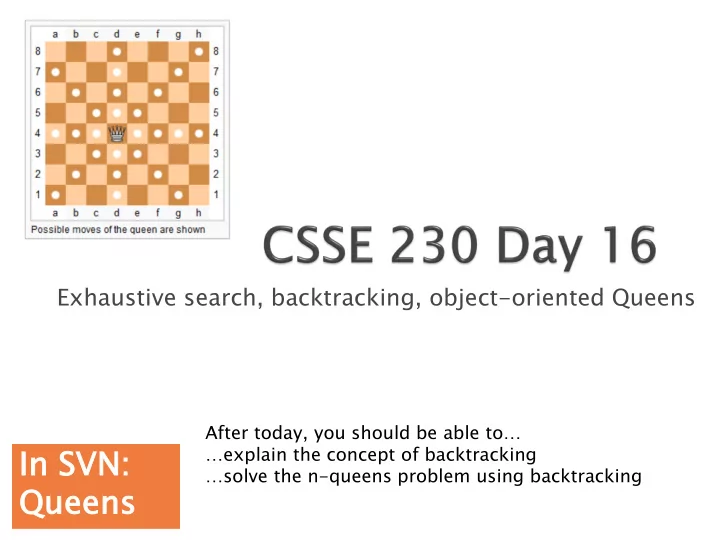
Exhaustive search, backtracking, object-oriented Queens After today, you should be able to In SVN: explain the concept of backtracking solve the n-queens problem using backtracking Qu Queens ens A taste of artificial intelligence
SLIDE 2
SLIDE 3
A taste of artificial intelligence
Check out Queens from SVN
SLIDE 4
Given: a (large) set of possible solutions to a
problem
Goal: Find all solutions (or an optimal
solution) from that set
Questions we ask:
- How do we represent the possible solutions?
- How do we organize the search?
- Can we avoid checking some obvious non-
solutions?
The “search space”
SLIDE 5
Examples: Doublets, solving a maze,
the “15” puzzle.
Taken from:
- http://www.cis.upenn.edu/~matuszek/cit594-
2004/Lectures/38-backtracking.ppt
SLIDE 6
start ? ? dead end dead end ? ? dead end dead end ? success! dead end
http://www.cis.upenn.ed u/~matuszek/cit594- 2004/Lectures/38- backtracking.ppt
SLIDE 7
- In how many ways can N chess queens
be placed on an NxN grid, so that none
- f the queens can attack any other
queen?
- I.e. there are not two queens on the
same row, same column, or same diagonal.
There is no "formula"
for generating a solution.
The famous computer scientist Niklaus
Wirth described his approach to the problem in 1971: Progr
gram am Develop
- pme
ment nt by Stepwis ise Refine inement ment
http://sunnyday.mit.edu/16.355/wirth- refinement.html#3
http://en.wikipedia.org/wiki/Queen_(chess)
SLIDE 8
In how many ways can N chess queens be
placed on an NxN grid, so that none of the queens can attack any other queen?
- I.e. no two queens on the same row, same column,
- r same diagonal.
Two minutes No Peeking!
SLIDE 9
Very naive approach.
- ch. Perhaps
s stupid id is a b better er word! There are N queens, N2 squares.
For each queen, try every possible square,
allowing the possibility of multiple queens in the same square.
- Represent each potential solution as an N-item array of
pairs of integers (a row and a column for each queen).
- Generate all such arrays (you should be able to write
code that would do this) and check to see which ones are solutions.
- Number of possibilities to try in the NxN case:
- Specific number for N=8:
281,474,976,710,656 281,474,976,710,656 1
SLIDE 10
Sligh ght improvem
- vemen
ent.
- t. There are N queens, N2
- squares. For each queen, try every possible
square, notice that we can't have multiple queens on the same square.
- Represent each potential solution as an N-item
array of pairs of integers (a row and a column for each queen).
- Generate all such arrays and check to see which
- nes are solutions.
- Number of possibilities to try in NxN case:
- Specific number for N=8:
178,462,987,637,760 (vs. . 281,474,976,710,656)
SLIDE 11
Slight
ghtly ly better approach.
- ach. There are N queens, N
- columns. If two queens are in the same column, they
will attack each other. Thus there must be exactly one queen per column.
Represent a potential solution as an N-item array of
integers.
- Each array position represents the queen in one column.
- The number stored in an array position represents the row of
that column's queen.
- Show array for 4x4 solution.
Generate all such arrays and check to see which ones are solutions. Number of possibilities to try in NxN case: Specific number for N=8:
16,777,216
SLIDE 12
Still better
ter approac roach There must also be exactly one queen per row.
Represent the data just as before, but notice
that the data in the array is a set!
- Generate each of these and check to see which ones
are solutions.
- How
w to generate? erate? A good thing to think about.
- Number of possibilities to try in NxN case:
- Specific number for N=8:
40,320
SLIDE 13
Ba
Backtrackin ktracking g soluti ution
- n
Instead of generating all permutations of N
queens and checking to see if each is a solution, we generate "partial placements" by placing one queen at a time on the board
Once we have successfully placed k<N
queens, we try to extend the partial solution by placing a queen in the next column.
When we extend to N queens, we have a
solution.
SLIDE 14
Play the game:
- http://homepage.tinet.ie/~pdpals/8queens.htm
See the solutions:
- http://www.dcs.ed.ac.uk/home/mlj/demos/queens
SLIDE 15
>java RealQueen 5 SOLUTION: 1 3 5 2 4 SOLUTION: 1 4 2 5 3 SOLUTION: 2 4 1 3 5 SOLUTION: 2 5 3 1 4 SOLUTION: 3 1 4 2 5 SOLUTION: 3 5 2 4 1 SOLUTION: 4 1 3 5 2 SOLUTION: 4 2 5 3 1 SOLUTION: 5 2 4 1 3 SOLUTION: 5 3 1 4 2
SLIDE 16
Board configuration represented by a linked
list of Queen objects
Fields of RealQue alQueen: column row neighbor
Designed by Timothy Budd http://web.engr.oregonstate.edu/~budd/Books/oopintro3e/info/slides/chap06/java.htm
2-5
SLIDE 17
Each queen sends messages directly to its
immediate neighbor to the left (and recursively to all of its left neighbors)
Return value provides information concerning
all of the left neighbors:
Example: neighbor.canAttack(currentRow, col)
- Message goes to the immediate neighbor, but the
real question to be answered by this call is
- "Hey, neighbors, can any of you attack me if I place
myself on this square of the board?"
SLIDE 18
findFirst() findNext() canAttack(int row, int col)
6-10 10
Your job (part of WA6): Underst erstand nd the job of each of these se method hods. s. Javadoc adoc from m the Qu Queen n interface rface ca can help Fill in the (recursive) details in the RealQueen class Debug ug More detail ils s on next t slide de
SLIDE 19
- 1. Queen asks its neighbors to find the first position
in which none of them attack each other
- Found? Then queen tries to position itself so that it
cannot be attacked.
- 2. If the rightmost queen is successful, then a
solution has been found! The queens cooperate in recording it.
- 3. Otherwise, the queen asks its neighbors to find
the next position in which they do not attack each other
- 4. When the queens get to the point where there is
no next non-attacking position, all solutions have been found and the algorithm terminates
And recu cursi rsion
- n does its magic!