IN THEIR OWN WORDS. HOW IMPERIAL TOBACCO RAN A FEAR Imperial - - PowerPoint PPT Presentation

in their own words
SMART_READER_LITE
LIVE PREVIEW

IN THEIR OWN WORDS. HOW IMPERIAL TOBACCO RAN A FEAR Imperial - - PowerPoint PPT Presentation

IN THEIR OWN WORDS. HOW IMPERIAL TOBACCO RAN A FEAR Imperial Tobacco (ITL) is the largest tobacco CAMPAIGN ABOUT CONTRABAND manufacturer operatjng in Canada. CIGARETTES TO BLOCK TAXES AND The brands it makes include du Maurier, PREVENT


slide-1
SLIDE 1

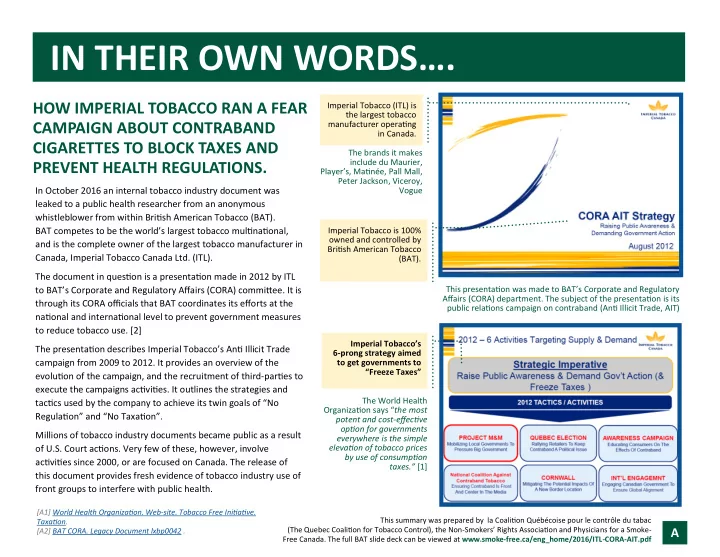
This presentatjon was made to BAT’s Corporate and Regulatory Afgairs (CORA) department. The subject of the presentatjon is its public relatjons campaign on contraband (Antj Illicit Trade, AIT)

IN THEIR OWN WORDS….

The brands it makes include du Maurier, Player’s, Matjnée, Pall Mall, Peter Jackson, Viceroy, Vogue

In October 2016 an internal tobacco industry document was leaked to a public health researcher from an anonymous whistleblower from within Britjsh American Tobacco (BAT). BAT competes to be the world’s largest tobacco multjnatjonal, and is the complete owner of the largest tobacco manufacturer in Canada, Imperial Tobacco Canada Ltd. (ITL). The document in questjon is a presentatjon made in 2012 by ITL to BAT’s Corporate and Regulatory Afgairs (CORA) commituee. It is through its CORA offjcials that BAT coordinates its efgorts at the natjonal and internatjonal level to prevent government measures to reduce tobacco use. [2] The presentatjon describes Imperial Tobacco’s Antj Illicit Trade campaign from 2009 to 2012. It provides an overview of the evolutjon of the campaign, and the recruitment of third-partjes to execute the campaigns actjvitjes. It outlines the strategies and tactjcs used by the company to achieve its twin goals of “No Regulatjon” and “No Taxatjon”. Millions of tobacco industry documents became public as a result

  • f U.S. Court actjons. Very few of these, however, involve

actjvitjes since 2000, or are focused on Canada. The release of this document provides fresh evidence of tobacco industry use of front groups to interfere with public health.

Imperial Tobacco’s 6-prong strategy aimed to get governments to “Freeze Taxes”

HOW IMPERIAL TOBACCO RAN A FEAR CAMPAIGN ABOUT CONTRABAND CIGARETTES TO BLOCK TAXES AND PREVENT HEALTH REGULATIONS.

[A1] World Health Organizatjon. Web-site. Tobacco Free Initjatjve. Taxatjon. [A2] BAT CORA. Legacy Document lxbp0042 .

The World Health Organizatjon says “the most potent and cost-efgectjve

  • ptjon for governments

everywhere is the simple elevatjon of tobacco prices by use of consumptjon taxes.” [1] Imperial Tobacco (ITL) is the largest tobacco manufacturer operatjng in Canada. Imperial Tobacco is 100%

  • wned and controlled by

Britjsh American Tobacco (BAT).

This summary was prepared by la Coalitjon Québécoise pour le contrôle du tabac (The Quebec Coalitjon for Tobacco Control), the Non-Smokers’ Rights Associatjon and Physicians for a Smoke- Free Canada. The full BAT slide deck can be viewed at www.smoke-free.ca/eng_home/2016/ITL-CORA-AIT.pdf

A

slide-2
SLIDE 2

THE FRONT GROUPS….

Sponsorship promotjons were phased out in 2003, smoking in indoor public and work places was eliminated in most of Canada by 2006, and most cigaretue displays were banned as of 2008. These changes resulted in Imperial Tobacco defunding former allies (like the Alliance for Sponsorship Freedom, MyChoice.ca and Team Players) and turning its atuentjon to retailers as new advocates. In 2006 the Canadian Convenience Stores Associatjon (CCSA) was set up, soon followed by regional branches (including L’Associatjon québécoise des dépanneurs en alimentatjon, AQDA and the Atlantjc Convenience Stores Associatjon, ACSA).[2] Imperial Tobacco helped recruit retailers as members for AQDA and was reported to have provided “hundreds of thousands of dollars” to put the organizatjon in place. [3] Much of the leadership of the CCSA and its regional affjliates, as shown later, were recruited from tobacco industry ranks. A second layer of separatjon was created in 2008 when the CCSA recruited non-tobacco-retailers to join a Natjonal Coalitjon Against Contraband Tobacco (NCACT). The invitatjon was extended broadly, including to health organizatjons, but few accepted who were not already aligned with corporate interests. The NCACT is an unincorporated “advocacy group” which functjons as a project actjvity of the CCSA and is managed by a PR fjrm (Impact Public Afgairs) whose clients are not disclosed.[4] Tobacco industry fjnancing of the CCSA and L’AQDA and its coalitjon project has remained veiled. In 2015, the head of L’AQDA and the

  • ffjcial NCACT spokesperson were grilled about industry fjnancing in

a Quebec legislatjve commituee. Both denied knowing the details of their organizatjons funding. [4]

[B1]. Rembiszewski P. “From Great to Gone: Why FMCG Companies are losing the race for customers.” [B2] CCSA was registered as is federal corporatjon 439863-7 on December 7, 2006; AQDA was registered as a Quebec enterprise (NEQ 1168943232) in 2011, although it was actjve in 2008. [B3] Associatjon des détaillants en alimentatjon du Québec. RADAR. April-May 2008. [B4] Coalitjon Québécoise pour le contrôle du tabac. Qui fjnance L’ACDA ? [B5] Isabelle Hachey . L'associatjon des dépanneurs fjnancée par les cigarettjers? La Presse. Novvember 5, 2015

The evidence strongly suggests that the Canadian Convenience Store Associatjon and its Quebec wing were set up and remain fjnanced by Imperial Tobacco.

ITL gradually expanded its relatjonships with front-line retailers, then business and law-and-order communitjes, then municipal governments.

Municipalitjes in Quebec and Ontario were recruited through L’AQDA and the OCSA. The Quebec Convenience Stores Associatjon is “at the beck and call of the tobacco industry”, according to the head of AMDEQ, one of the members of the NCACT. [5] The Natjonal Coalitjon Against Contraband Tobacco is a project actjvity with veiled fjnancing and management

B

slide-3
SLIDE 3

THE PUBLIC FACES ...

Dave Bryans led the Canadian Convenience Stores Associatjon since its establishment in 2006 to 2010, before returning to the Ontario Convenience Store Associatjon which he contjnued to lead since 2003. His relatjons with the tobacco industry were and are

  • strong. In the 1990s he was Director of Natjonal

Sales for RJR-Macdonald (now JTI-Macdonald).[1] This was during the height of the companies’ sales to the contraband market. Testjmony (under oath) made in 2012 by the CTMC’s

  • nly employee indicates

that Mr. Bryans is stjll an

  • ffjcial with JTI-Macdonald.

He was identjfjed as the “corporate afgairs” person at JTI-Macdonald to whom she reported.[2] He does not make public his relatjonship to the tobacco industry.[3] Michel Gadbois was named vice-president of the CCSA and president of its Quebec wing (L’AQDA) in 2007. He came to the retail sector afuer a public relatjons career with two tobacco interests. In the 1980s, he was manager of public relatjons for Benson & Hedges (a company which merged with Rothmans in 1985), and represented the company at the Canadian Tobacco Manufacturers’ Council politjcal actjon commituee in

  • pposing smoke-free laws. [4] He subsequently became spokesperson for

Imperial Tobacco’s holding company, IMASCO.[5] In January 1994, at the culminatjon of the 1990s contraband crisis, Michel Gadbois led retailers in a tax

  • revolt. This was later revealed

by La Presse to have been planned in concert with the

  • CTMC. [6] Imperial Tobacco

described this as “the straw that broke the camel’s back” and led to the February 1994 tax roll-back. [7]

[C1]. RJR-Macdonald Organizatjon Charts. Blais-Létourneau trial exhibits 591 and 40397. [C2] Testjmony of Diane Tacaks. Blais-Létourneau trial, September 4, 2012. [C3] For example, Dave Bryans Linked In Profjle. [C4] CTMC Minutes. Blais-Létourneau trial exhibits , i.e. 479M, 479KK. [C5] Otuawa Citjzen. Imperial bruised but victorious afuer cigaretue price war. June 4, 1987. [C6] André Noel. Les épiciers ont créé de toutes pièces le mouvement des «dépanneurs généreux» . La Presse. January 27, 1994. [C7] Michel Descoteaux. Lobbying for a Tobacco Tax Rollback in Canada. ITL. 1994. [B5] Isabelle Hachey . L'associatjon des dépanneurs fjnancée par les cigarettjers? La Presse. Novvember 5, 2015. [C8] YouTube . htups://www.youtube.com/watch?v=fMpRXLhg2LE

The current NCACT spokespeople are Gary Grant and Michel

  • Rouillard. They were recruited from the ranks of retjred police
  • ffjcers. Michel Rouillard testjfjed that he has no organizatjonal

role, and is hired by Impact Public Afgairs and “paid by the act” for each tjme he speaks. [B5] Jacqueline Bradley is no longer identjfjed on the NCACT web-site as a spokesperson, although she was stjll actjve on the fjle in 2015. She also maintains a very colourful alternate career as “the Bombshell Coach.” [8]

C

slide-4
SLIDE 4

THE EXAGGERATED CLAIMS ...

[D1]. PMI Investor Day Presentatjon. LA&C Reigon. June 21, 2012. [D2] Antj illicit trade: scale and opportunitjes. BAT investor presentatjon. 2012 [D3] E. Guindon et al. Levels and trends in cigaretue contraband in Canada. Tobacco Control. 2016.

The message delivered by Imperial Tobacco and its allied groups was that there was a dangerously high and growing level of contraband tobacco sales in

  • Canada. They claimed that this was expanding criminal gang actjvity,

increasing youth smoking, closing small businesses, and robbing governments

  • f billions in tobacco taxes.

Their claims exaggerated the evidence, distorted legitjmate concerns and drowned out the voices of those who had more reliable data on the scope and nature of illicit tobacco sales. Imperial Tobacco and the other tobacco companies gave more truthful informatjon to their shareholders.

 In 2012, Philip Morris Internatjonal reported to investors that illicit sales in

Canada were 8% of total market (down from 14% in 2007). They noted that contraband sales in Quebec had fallen by more than 50% (from 40% to 15% of total market). [1]

 In 2011, BAT reported to investors that the market share of contraband

tobacco fell from 33% to 19% between 2009 and 2010. [2] A recent independent and peer-reviewed study compared legal sales with surveys of smoking behaviour and concluded that “none of the data … provide support to the tobacco industry narratjve that cigaretue contraband has been increasing in recent years.” Contrary to the media messaging of Imperial Tobacco, the CCSA and the NCACT, Quebec has experienced “relatjvely low levels of cigaretue contraband since 2010, at levels no higher than in the early 2000s.” [3] Philip Morris Int’l[1] Guindon et al. [3] Britjsh American Tobacco [2]

D

slide-5
SLIDE 5

THE OBJECTIVE: LESS TAX, FEWER LAWS.

[E1]. B. Kemball. What’s stopping cigaretue crackdown? Op-Ed. Natjonal Post. February 25, 2009. [E2] Megan Fitzpatrick. Feds move to ban most tobacco print advertjsing. Canwest News. May 2009. [E3] G. Galloway. Plans for scarier cigaretue labels snufged. Globe and Mail. September 28, 2010 [E4] Tobacco Lobbying preceded label retreat. CBC News, December 10, 2010.

In 2004, the RCMP raided the offjces of Imperial Tobacco to gather evidence about the companies’ contraband actjvitjes in the 1990s. In July 2008, Imperial Tobacco entered a guilty plea and was fjned $400 million. At the same time it launched a campaign to fuel fears of a new contraband crisis. This, it claimed, was a the “real tobacco problem” – and a reason that governments should not adopt new tobacco regulations.[1] During the 2008 federal electjon campaign, Imperial Tobacco began to increase the frequency of its contraband messages, and to oppose regulatjons which afgected its products. It did not oppose the C-32 ban on fmavourings in cigaretues and cigars manufactured by its

  • rivals. [2]

The federal, Ontario and Quebec governments implemented no substantjal tobacco tax increases between 2004 and the end of 2012. Between 2008 and 2010, more than a dozen federal government departments had been lobbied by tobacco companies about the threat of contraband sales.[4] Only after media exposure and parliamentary review, did the government re-instated the warnings renewal. In September 2010, the federal Minister of Health, Leona Aglukkaq, announced that the government was abandoning its commitment to renew cigaretue warnings in order to focus its efgorts on fjghtjng contraband.[3] Between 2010 and 2016, the federal government announced no new health regulations on tobacco, although it implemented new laws and measures on contraband. It also terminated most programmatic elements directed at reducing smoking. Mass media was wound down in 2006, support to community groups ended after 2012, as did support for international assistance. The federal government also backed away from banning menthol, although this was eventually adopted by some provincial governments. Because of inflation, the real value

  • f the tax declined over this 8 year

period.

Unambiguous messages:

“C-stores Demand a Freeze

  • n New Regulation and

Taxation on Legal Tobacco”

CCSA Press Release. 21 October 2010.

“Ontario Budget's Tobacco Tax Increase Will Lead to More Illegal Cigarettes”

CCSA press release May 1, 2014

“[Tax increases in] New Brunswick Budget Makes Contraband Tobacco Worse”.

NCACT press release, Feb 2, 2016.

E

Imperial Tobacco measured success in the decisions of governments not to raise taxes.