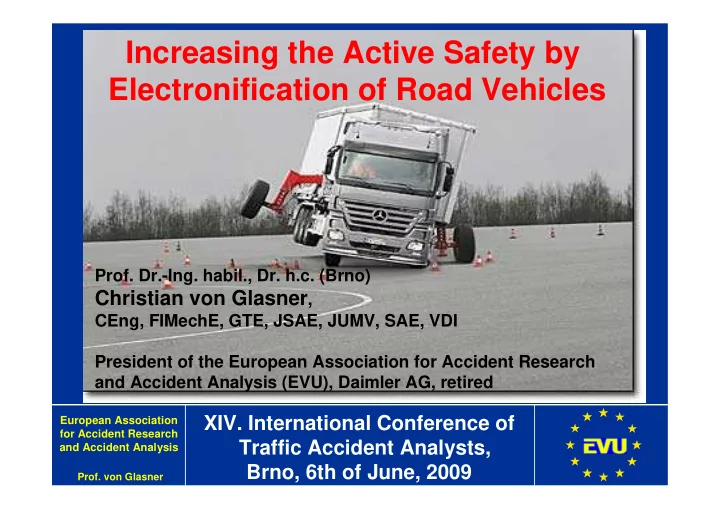
Increasing the Active Safety by Electronification of Road Vehicles - - PowerPoint PPT Presentation

increasing the active safety by electronification of road
SMART_READER_LITE
LIVE PREVIEW

Increasing the Active Safety by Electronification of Road Vehicles - - PowerPoint PPT Presentation

Increasing the Active Safety by Electronification of Road Vehicles Prof. Dr.-Ing. habil., Dr. h.c. (Brno) Christian von Glasner , CEng, FIMechE, GTE, JSAE, JUMV, SAE, VDI President of the European Association for Accident Research and Accident


slide-1
SLIDE 1

European Association for Accident Research and Accident Analysis

  • Prof. von Glasner
  • Prof. Dr.-Ing. habil., Dr. h.c. (Brno)

Christian von Glasner,

CEng, FIMechE, GTE, JSAE, JUMV, SAE, VDI President of the European Association for Accident Research and Accident Analysis (EVU), Daimler AG, retired

  • XIV. International Conference of

Traffic Accident Analysts, Brno, 6th of June, 2009

Increasing the Active Safety by Electronification of Road Vehicles

slide-2
SLIDE 2

European Association for Accident Research and Accident Analysis

  • Prof. von Glasner

Conventional braking- and traction control systems The electronification of vehicles in the nineties of the last century Electronic braking system (EBS) as basis for todays driver assistance systems Future driver assistance systems Autonomous driving (X-by-wire systems, platooning, autopilot, etc.)

Content of the Contribution

slide-3
SLIDE 3

European Association for Accident Research and Accident Analysis

  • Prof. von Glasner

Stability and Preservation of Steerability when Braking

under all driving conditions for every driver in well-balanced optimization for shortest possible braking distance

Main Requirements on Anti-Lock Braking Systems (ABS)

slide-4
SLIDE 4

European Association for Accident Research and Accident Analysis

  • Prof. von Glasner

Brake cylinder Air reservoir Water drain valve Brake pedal (Service brake valve) Solenoid control valve Sensors with pole wheel Brake Electronic unit

Principle of a Conventional ABS-System in a Heavy Commercial Vehicle

slide-5
SLIDE 5

European Association for Accident Research and Accident Analysis

  • Prof. von Glasner

Deceleration time V e h i c l e s p e e d Wheel speed Wheel acceleration Road speed Wheel deceleration Line pressure

ABS-Control Philosophy: Individual Control for Rear Axles

slide-6
SLIDE 6

European Association for Accident Research and Accident Analysis

  • Prof. von Glasner

Low wheel (ice, wet)

Time

Line pressure (bar)

Modified individual control (MIR)

Speed (km/h)

High wheel (concrete, dry) Low wheel (ice, wet) Vehicle speed High wheel (concrete, dry)

Modified Individual Control Philosophy for Front Axle Wheels, when Braking on µ-split-Roads

slide-7
SLIDE 7

European Association for Accident Research and Accident Analysis

  • Prof. von Glasner

1 sensor and pole wheel 2 membrane cylinder 3 solenoid control valve (ABS) 4 engine control 5 membrane spring actuator combination cylinder 6 solenoid control valve 7 two way valve 8 3/2- way solenoid (traction control) 9 electronics (ABS/Traction control) 10 control lights a towing vehicle b towed vehicle c connecting cables 11 reservoir (front axle circuit) 12 reservoir (rear axle) 13 ABS-socket (towed vehicle)

Anti-lock and Traction Control for a Conventionally Braked Commercial Vehicle

slide-8
SLIDE 8

European Association for Accident Research and Accident Analysis

  • Prof. von Glasner
  • When all drive wheels have no traction (spinning

wheels) slip reduction takes place through

  • When only one wheel loses traction,slip reduction takes

place through In this case the wheel without traction will regain traction by slowing it down with the wheel brake

Differential - braking control Engine management Control Philosophies for Traction Control (ASR)

slide-9
SLIDE 9

European Association for Accident Research and Accident Analysis

  • Prof. von Glasner

Electronic Control Unit for ABS and ASR Pole wheels and sensors

Traction Control (ASR)

  • Engine Control

Engine control

Driven wheels spinning on ice

slide-10
SLIDE 10

European Association for Accident Research and Accident Analysis

  • Prof. von Glasner

Time Speed Speed of vehicle Speed of driven wheels ASR-response threshold Driven wheels spinning on ice

Traction Control (ASR) - Engine Control

  • n Icy Road Surface
slide-11
SLIDE 11

European Association for Accident Research and Accident Analysis

  • Prof. von Glasner

Differential brake valve two-way valve Solenoid control valve Pole wheel and sensor Brake cylinder Compressed air tank from brake valve

ABS/ASR- Electronic Control Unit

Traction Control (ASR) – Differential Braking Control Spinning driven wheel on ice

slide-12
SLIDE 12

European Association for Accident Research and Accident Analysis

  • Prof. von Glasner

Spinning driven wheel

  • n ice

Speed of vehicle Line pressure Speed µ-split road surface:

wheel on ice wheel on concrete

Time Speed of driven wheels Wheel on concrete

Traction control response threshold

Traction Control (ASR) – Differential Braking Control

slide-13
SLIDE 13

European Association for Accident Research and Accident Analysis

  • Prof. von Glasner
  • Main Working Areas for Mechatronic

Driver Assistance Systems during the years 1990 - 2000

Electronification

slide-14
SLIDE 14

European Association for Accident Research and Accident Analysis

  • Prof. von Glasner

Mechatronic Drive-by-Wire Systems (1)

slide-15
SLIDE 15

European Association for Accident Research and Accident Analysis

  • Prof. von Glasner

Lenkkräfte können situativ variabel (nach Kennfeldern) eingestellt werden

Weiterer Vorteil:

Steer-by-Wire

slide-16
SLIDE 16

European Association for Accident Research and Accident Analysis

  • Prof. von Glasner

Mechatronic Drive-by-Wire Systems (2)

slide-17
SLIDE 17

European Association for Accident Research and Accident Analysis

  • Prof. von Glasner

Suspension-by-Wire (Damp/spring-by-wire)

slide-18
SLIDE 18

European Association for Accident Research and Accident Analysis

  • Prof. von Glasner

Mechatronic Drive-by-Wire Systems (3)

slide-19
SLIDE 19

European Association for Accident Research and Accident Analysis

  • Prof. von Glasner

Electronic Braking System (EBS) (Hybrid Brake-by-wire)

ECU

Principal Design: von Glasner/Micke, 1987

slide-20
SLIDE 20

European Association for Accident Research and Accident Analysis

  • Prof. von Glasner
  • Rapid build-up of braking pressures
  • Activation of anti-lock- and traction

control

  • Integration of braking forces of

endurance braking systems

  • Tractor/trailer-compatibility control
  • Brake pad wear control
  • Hill holder
  • Braking assistance
  • Vehicle stability control
  • Roll-over protection

Subsystems of an Electronic Braking System EBS (1)

slide-21
SLIDE 21

European Association for Accident Research and Accident Analysis

  • Prof. von Glasner

Opportunities to Shorten Braking Distance

slide-22
SLIDE 22

European Association for Accident Research and Accident Analysis

  • Prof. von Glasner
  • Rapid build-up of braking pressures
  • Activation of anti-lock- and traction

control

  • Integration of braking forces of

endurance braking systems

  • Tractor/trailer-compatibility control
  • Brake pad wear control
  • Hill holder
  • Braking assistance
  • Vehicle stability control
  • Roll-over protection

Subsystems of an Electronic Braking System EBS (2)

slide-23
SLIDE 23

European Association for Accident Research and Accident Analysis

  • Prof. von Glasner

Driver demand Vehicle deceleration Service braking system 2 4 6 [s] 0,1 0,2 0,3 Deceleration Braking time 2 4 6 [s] 1 2 3 Line pressure [bar] 1000 2000 3000 Braking torque of retarder R e t a r d e r Braking time Service braking system

Integration of Retarders into Service Braking Systems

(Iveco)

slide-24
SLIDE 24

European Association for Accident Research and Accident Analysis

  • Prof. von Glasner

Coupling Forces Acting on Tractor, when Decelerating a Tractor-/Trailer Combination

slide-25
SLIDE 25

European Association for Accident Research and Accident Analysis

  • Prof. von Glasner

Pm Correction of the trailer braking pressure within the limits defined by ECE R.13 Band of control possibilities for trailer coupling force control

Tractor / Trailer Compatibility Control

slide-26
SLIDE 26

European Association for Accident Research and Accident Analysis

  • Prof. von Glasner
  • Rapid build-up of braking pressures
  • Activation of anti-lock- and traction

control

  • Integration of braking forces of

endurance braking systems

  • Tractor/trailer-compatibility control
  • Brake pad wear control
  • Hill holder
  • Braking assistance
  • Vehicle stability control
  • Roll-over protection

Subsystems of an Electronic Braking System EBS (3)

slide-27
SLIDE 27

European Association for Accident Research and Accident Analysis

  • Prof. von Glasner

Working Principle

  • f a Braking Assistance
slide-28
SLIDE 28

European Association for Accident Research and Accident Analysis

  • Prof. von Glasner

Control Philosophy of ESP

slide-29
SLIDE 29

European Association for Accident Research and Accident Analysis

  • Prof. von Glasner

B

F = Braking Force

L

F = Lateral Force

with ESP with ESP without ESP without ESP

Working Principle of a Dynamic Stability Control (ESP), when Negotiating a Turn

slide-30
SLIDE 30

European Association for Accident Research and Accident Analysis

  • Prof. von Glasner

Electronic Braking System (EBS) as Platform for Driver Assistance Systems with Integration of ABS and Traction Control as well as Retarder- and/or Engine Braking Control, Vehicle Dynamics Control (ESP/VDC) with Roll-

  • ver-Protection (ROP),

Tractor/Trailer Compatibility Control, Lining/Pad Wear Control, Worldwide Activities on Driver Assistance Systems (1)

(in series production)

slide-31
SLIDE 31

European Association for Accident Research and Accident Analysis

  • Prof. von Glasner

Hill Holder, Rain Sensor (Information on Coefficient of Friction between Tire and Road), Braking Assistant, Intelligent Distance Monitoring including Stop-and-Go-Automatization, Lane Assistant, Systems for Improving the Visibility at Night (Curvature- und Crossroad-dependent Illumination, Night Vision Aids), Worldwide Activities on Driver Assistance Systems (2)

(in series production)

slide-32
SLIDE 32

European Association for Accident Research and Accident Analysis

  • Prof. von Glasner

77 Ghz 24 Ghz 24 Ghz 77 Ghz

Long Range/Short Range Radar

Surveillance of Vehicle‘s Vicinity

slide-33
SLIDE 33

European Association for Accident Research and Accident Analysis

  • Prof. von Glasner

3,75 m 3,75 m

50 100 m

Desired road speed Actual distance to vehicle ahead Symbol by ICC in

Radar Sensor

Intelligent Cruise Control (ACC) with Radar Distance Monitoring

slide-34
SLIDE 34

European Association for Accident Research and Accident Analysis

  • Prof. von Glasner

Warning to driver Start of automatic full braking Small decelerations

Emergency Braking Control

slide-35
SLIDE 35

European Association for Accident Research and Accident Analysis

  • Prof. von Glasner

View of camera on lane: “on lane model” supported marker search within green sector

In center of front wind- screen on dashboard

Lane Assistance (1)

slide-36
SLIDE 36

European Association for Accident Research and Accident Analysis

  • Prof. von Glasner

Parking Assistant, Tire Communication (Information on Tires, i.e. Size, Inflation Pressure, Temperature, etc.), Pedestrian-, Cyclist- and Traffic Sign Detection, Information by Communication with Meeting Vehicles, Precise Definition of the Coefficient of Adhesion between Tire and Road, Worldwide Activities on Driver Assistance Systems (3)

slide-37
SLIDE 37

European Association for Accident Research and Accident Analysis

  • Prof. von Glasner

Vehicle Dynamics Control and Lane Assistance with Automatic Steering Intervention, Warning Advices based on Information from Navigation Systems, Surveillance of Vehicles Vicinity (Crossroad-, Turning-, Backing up- and Blind Spot Warning), Autonomous Driving with Power-by-Wire, Shift-by-Wire, Steer-by-Wire, Suspension- by-Wire und Brake-by-Wire). Worldwide Activities on Driver Assistance Systems (4)

slide-38
SLIDE 38

European Association for Accident Research and Accident Analysis

  • Prof. von Glasner

Detection of Pedestrians (1)

slide-39
SLIDE 39

European Association for Accident Research and Accident Analysis

  • Prof. von Glasner

Detection of Traffic Signs

slide-40
SLIDE 40

European Association for Accident Research and Accident Analysis

  • Prof. von Glasner

Concept for an Autonomous Vehicle Guidance Systems

slide-41
SLIDE 41

European Association for Accident Research and Accident Analysis

  • Prof. von Glasner

Mechatronic Drive-by-Wire Systems (4)

slide-42
SLIDE 42

European Association for Accident Research and Accident Analysis

  • Prof. von Glasner

LIN/CAN Vehicle Networking via Data-Buses

slide-43
SLIDE 43

European Association for Accident Research and Accident Analysis

  • Prof. von Glasner

Mechatronic (= mechanic + electronic) driver assistance systems are able to decrease the number of accidents dramatically. The key for a reduction of accidents lies in electronic systems, as the reaction times of mechatronic systems are significantly shorter compared to mechanic systems. A less concentrated and tired driver can be warned of upcoming accident situations by mechatronic driver assistance systems. The precise detection of all traffic participants like pedestrians, cyclists and traffic signs is important for future driver assistance systems, in order to react in time and to avoid accidents.

Summary

Driver Assistance Systems (1)

slide-44
SLIDE 44

European Association for Accident Research and Accident Analysis

  • Prof. von Glasner

If necessary, driver assistance systems will compensate for erroneous reactions of drivers. The drivers must be relieved from all tasks, which are distracting or stressing. Electronically networked driver assistance systems will help, to increase the safety on roads. Vehicle stability control-, lane assistance- and distance monitoring systems in combination with emergency braking control are able to dramatically reduce the number of accidents. This would be in line with the demand of the European Union, to reduce the number of fatalities on European roads by 50% between the years 2000 and 2010 (White Paper objective of the European Union).

Summary

Driver Assistance Systems (2)