Indemnity, Reps and Warranties, Termination, Damages Provisions - - PowerPoint PPT Presentation

indemnity reps and warranties termination
SMART_READER_LITE
LIVE PREVIEW

Indemnity, Reps and Warranties, Termination, Damages Provisions - - PowerPoint PPT Presentation

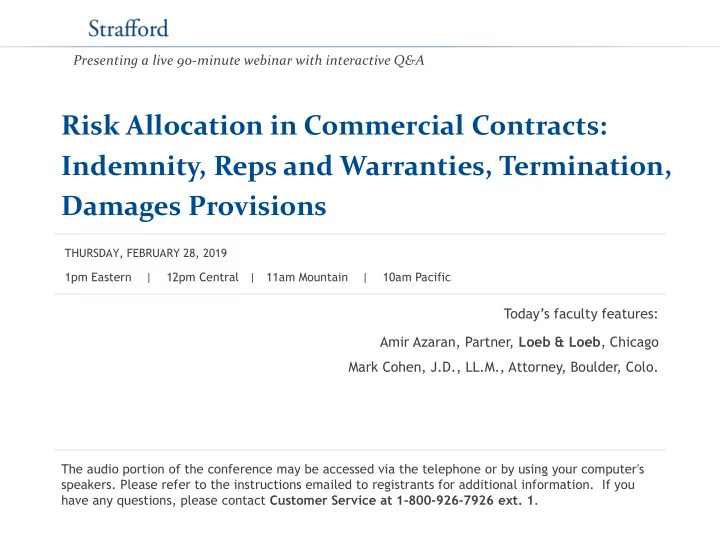
Presenting a live 90-minute webinar with interactive Q&A Risk Allocation in Commercial Contracts: Indemnity, Reps and Warranties, Termination, Damages Provisions THURSDAY, FEBRUARY 28, 2019 1pm Eastern | 12pm Central | 11am


slide-1
SLIDE 1

Risk Allocation in Commercial Contracts: Indemnity, Reps and Warranties, Termination, Damages Provisions

Today’s faculty features:

1pm Eastern | 12pm Central | 11am Mountain | 10am Pacific

The audio portion of the conference may be accessed via the telephone or by using your computer's

  • speakers. Please refer to the instructions emailed to registrants for additional information. If you

have any questions, please contact Customer Service at 1-800-926-7926 ext. 1.

THURSDAY, FEBRUARY 28, 2019

Presenting a live 90-minute webinar with interactive Q&A Amir Azaran, Partner, Loeb & Loeb, Chicago Mark Cohen, J.D., LL.M., Attorney, Boulder, Colo.

slide-2
SLIDE 2

Tips for Optimal Quality

Sound Quality If you are listening via your computer speakers, please note that the quality

  • f your sound will vary depending on the speed and quality of your internet

connection. If the sound quality is not satisfactory, you may listen via the phone: dial 1-866-570-7602 and enter your PIN when prompted. Otherwise, please send us a chat or e-mail sound@straffordpub.com immediately so we can address the problem. If you dialed in and have any difficulties during the call, press *0 for assistance. Viewing Quality To maximize your screen, press the F11 key on your keyboard. To exit full screen, press the F11 key again.

FOR LIVE EVENT ONLY

slide-3
SLIDE 3

Continuing Education Credits

In order for us to process your continuing education credit, you must confirm your participation in this webinar by completing and submitting the Attendance Affirmation/Evaluation after the webinar. A link to the Attendance Affirmation/Evaluation will be in the thank you email that you will receive immediately following the program. For additional information about continuing education, call us at 1-800-926-7926

  • ext. 2.

FOR LIVE EVENT ONLY

slide-4
SLIDE 4

Program Materials

If you have not printed the conference materials for this program, please complete the following steps:

  • Click on the ^ symbol next to “Conference Materials” in the middle of the left-

hand column on your screen.

  • Click on the tab labeled “Handouts” that appears, and there you will see a

PDF of the slides for today's program.

  • Double click on the PDF and a separate page will open.
  • Print the slides by clicking on the printer icon.

FOR LIVE EVENT ONLY

slide-5
SLIDE 5

Risk Allocation in Commercial Contracts: Indemnity, Reps and Warranties, Termination, and Damages Provisions

Mark Cohen, J.D., LL.M. Amir Azaran – Loeb & Loeb LLP Strafford CLE Webinar February 28, 2019

slide-6
SLIDE 6

6

Risk Allocation – Types of Risk

  • Risk of non-performance
  • Risk of flawed performance
  • Risk of foregone opportunities
  • Risk of change circumstances
  • (And I would add risk of poor drafting)
slide-7
SLIDE 7

7

Risk Allocation – Considering Risk

  • What are the client’s expectations?
  • What damages will the client incur from non-performance or

flawed performance?

  • What possible remedies are available?
  • What is the risk that circumstances will change?
  • What is the risk that the client could get a better deal elsewhere?
  • What are the opportunity costs?
slide-8
SLIDE 8

8

Risk Allocation – Two Functions of a Contract

A typical contract serves two functions:

  • 1. Clarify and Express Expectations. Who will do

what, by when, in what manner, and how will the results and proceeds of their efforts (risks, losses, gains) be allocated; and

  • 2. Dealing with Disruption. The contract should

simplify and stream how the parties manage disruptive change and disagreement – how issues are identified, how parties are notified, and how the conflict is engaged and resolved.

Linda Alvarez, Discovering Agreement, American Bar Association, 2016.

slide-9
SLIDE 9

9

Drafting and Litigation: The Three Main Causes of Contract Disputes

  • Ambiguity

When an ambiguity is found to exist and cannot be resolved by reference to other contractual provisions, extrinsic evidence must be considered by the trial court in

  • rder to determine the mutual intent of the parties at the time of contracting. Pepcol
  • Mfg. Co. v. Denver Union Corp., 687 P.2d 1310 (Colo. 1984).
  • Inconsistency

Where it is impossible to reconcile conflicting clauses of a contract, it is proper to receive extrinsic evidence for the purpose of determining the intent of the parties. Ryan v. Fitzpatrick Drilling Co., 342 P.2d 1040 (Colo. 1959).

  • Failure to address an issue altogether

Silence on a matter in a contract creates an ambiguity when it involves a matter naturally within the scope of the contract. Cheyenne Mtn. Sch. Dist. #12 v. Thompson, 81 P.2d 711 (Colo. 1993). Extrinsic evidence is admissible to determine the intent of the parties.

slide-10
SLIDE 10

10

Drafting and Litigation: Questions of Fact and Questions of Law

  • Whether a contract is ambiguous is a question of law. Pepcol
  • Mfg. Co. v. Denver Union Corp., 687 P.2d 1310 (Colo. 1984)
  • However, once a court determines that a contract is ambiguous,

the meaning of the ambiguous term is a question of fact. Dorman v. Petrol Aspen, Inc., 914 P.2d 909 (Colo. 1996)

  • Once a court determines that a contract is ambiguous, the intent
  • f the parties is question of fact. Metropolitan Paving Co. v. City
  • f Aurora, 449 F.2d 177 (10th Cir. 1971)
slide-11
SLIDE 11

11

Drafting and Litigation: Questions of Fact and Questions of Law And If a Question of Fact Exists…

NO SUMMARY JUDGMENT

slide-12
SLIDE 12

12

Drafting and Litigation: The Parol Evidence Rule

  • In the absence of allegations of fraud, accident, or mistake in the

formation of the contract, parol evidence may not be admitted to add to, subtract from, vary, contradict, change, or modify an unambiguous integrated contract. Boyer v. Karahenian, 915 P.2d 1295 (Colo. 1996)

  • Terms used in a contract are ambiguous when they are

susceptible to more than one reasonable interpretation. B&B Livery, Inc. v. Riehl, 960 P.2d 134 (Colo. 1998)

  • An integrated contract is one that contains all the terms the

contracting parties agreed to. Harmon v. Waugh, 414 P.2d 110 (Colo. 1966)

slide-13
SLIDE 13

13

The Main Risk Allocation Provisions

  • Representations and Warranties
  • Indemnification
  • Limitation of liability
  • Termination
  • Exculpatory clauses

Practice tip → reps/warranties, indemnification and limitation of liability provisions form the “core” risk allocation provisions of a contract, and are often “linked” in subtle ways

slide-14
SLIDE 14

14

Representation and Warranties

  • Representations and warranties are different than contract

covenants

  • Covenant – a promise to perform an obligation
  • Representation – a statement of fact as of the time the contract

is formed

  • Warranty – a guarantee that a certain fact will remain true for

the term of the contract

  • Generally, a breach of a representation or warranty allows

the aggrieved party more ways to recover

  • Fraudulent misrepresentation
  • Ziff-Davis Rule – a warranty is a promise of indemnity if a

statement of fact is false

  • CBS Inc. v. Ziff-Davis Publishing Co., 75 N.Y.2d 496 (1990)
slide-15
SLIDE 15

15

Representation and Warranties

  • Common representations and warranties in contracts
  • Authority to enter contract
  • Properly organized and in good standing
  • Compliance with law / all required consents
  • No conflicts with other contracts
  • Ability to perform
  • More “specialized” representations and warranties
  • Ownership / original work
  • No viruses or other harmful code
  • Pass through of third party warranties
slide-16
SLIDE 16

16

Representation and Warranties

  • Implied warranties
  • UCC Article 2 – implied warranties of merchantability and

fitness for a particular purpose

  • Many contracts will seek to disclaim implied warranties,

and limit warranties only to those expressly stated in the contract

  • Practice tip → watch for warranty disclaimers that go too

far

  • Party A’s performance hereunder is “as is” and “with all faults”
slide-17
SLIDE 17

17

Indemnification

  • Indemnity clauses essentially place the entire burden of a

given circumstance on the indemnifying party

  • Practice tip → an indemnity is appropriate where one party is able to

minimize or control for a risk, and it would be difficult or impossible for the other party to do so

  • Often coupled with a duty to defend the other party
  • “Party A shall indemnify, defend, and hold harmless Party B against all

damages, losses, costs, and expenses (including reasonable attorneys’ fees) resulting from…”

  • Common indemnity clauses
  • Failure to comply with law
  • Gross negligence or willful misconduct
  • Breach of (certain) representations and warranties
slide-18
SLIDE 18

18

Indemnification

  • More specialized clauses
  • Third party claims of IP infringement
  • Costs related to a data security breach
  • Drafting considerations
  • Precisely define the breadth of indemnified parties
  • Affiliates, officers, directors, etc.
  • Usually drafted to protect against third party claims
  • What is a “first party” indemnity?
  • Define circumstances where the indemnity will not apply
  • Use of the other party’s materials
  • The other party’s alteration of improper use of the indemnifying

party’s technology

slide-19
SLIDE 19

19

Limitation of Liability

  • Limitation of liability clauses generally have three

components:

  • Exclusion of consequential damages
  • Cap on direct damages
  • Carve-outs to each of the above
  • Exclusion of consequential damages
  • Hadley v. Baxendale, 9 Exch. 341 (1854): damages awarded for

breach only if it was foreseeable at the time of contracting that the type of damage being sought would result from the breach

  • In most contracts, the parties seek to remove the uncertainty of what

is “foreseeable”, and exclude consequential, indirect, punitive, and

  • ther similar kinds of damages
slide-20
SLIDE 20

20

Limitation of Liability

  • Cap on direct damages
  • Goal is to rationally tie a party’s liability for breach to the economic

value of the contract

  • Common formulation:
  • “Party A’s aggregate liability in connection with this Agreement will be limited

to the greater of (i) the amounts paid by Party B hereunder during the [X] months preceding the event giving rise to such liability, and (ii) [$Y]”

  • Carve-outs
  • In certain circumstances it is appropriate to “carve out” certain types of

damages from the exclusion of consequential damages and cap on direct damages

  • Common examples
  • Breaches of confidentiality
  • Indemnification obligations under the contract
  • Gross negligence or willful misconduct
slide-21
SLIDE 21

21

Term and Termination

In general, if a transaction is high risk, clients prefer a short contract term so they are not stuck with a bad deal for a long time. However, if a contract requires the client to make significant investment, the client may prefer a longer term to allow time for it to recoup its investment.

slide-22
SLIDE 22

22

Term and Termination

  • Term of the Contract
  • Specified term versus a contract that continues until

terminated.

  • Automatic renewal unless notice of intent not to renew

provided by a specified date.

  • Contract ends on a specified date, but there is an option to

renew if notice of intent to renew is provided by a specified date.

  • Rights to terminate allow a party to mitigate contract risk
slide-23
SLIDE 23

23

Term and Termination

  • Categories of Termination Rights
  • For cause
  • Material breach
  • Defined circumstances – e.g., “persistent” service level violations
  • Convenience
  • Often heavily negotiated
  • Amount of notice is frequently an issue
  • May require payment of a termination fee to compensate a party for

upfront costs

  • Others
  • Material adverse change
  • Financial stability of counterparty
  • Change in control of counterparty
slide-24
SLIDE 24

24

Term and Termination

  • Consider the financial impact of termination
  • May not easy to exit a deal from an operational perspective
  • Significant transition-out costs
  • Consider whether a transition assistance provision is

needed

  • Upon a party’s election to terminate, certain transition-related
  • r “disentanglement” obligations are undertaken
  • Can allow a party to delay the termination date (extend the

term) in order to “keep the lights on”

  • Survival – specify what provisions continue to apply after

termination

  • Confidentiality
  • Indemnification and limitation of liability
  • Boilerplate provisions
slide-25
SLIDE 25

25

Exculpatory Clauses

  • An exculpatory clause is any provision that limits a party’s

damages or the range of remedies that are available

  • Examples
  • Limitation of liability provisions
  • Liquidated damages
  • Identifying defined remedies as a party’s “sole and exclusive”

remedies for breach

  • Force majeure clauses
slide-26
SLIDE 26

26

Force Majeure Clauses

Is a Force Majeure Clause necessary? The law offers two doctrines that will excuse a party’s obligations when an unanticipated, supervening event fundamentally alters the nature of the parties’ contract: (1) impossibility / impracticability, and (2) frustration of purpose. For a general discussion of these, see Seaboard Lumber Co. v. U.S., 308 F.3d 1283 (5th Cir. 2002).

slide-27
SLIDE 27

27

Force Majeure Clauses

Defining what constitutes a Force Majeure event versus not defining it. Not Defined:

  • “To the extent caused by force majeure, no delay, failure, or default will

constitute a breach of this Agreement.” See, David W. Tollen, The Tech Contracts Handbook, American Bar Association, 2010. The danger of attempting to list every possible Force Majeure event lies in the doctrine of Expressio Unius Est Exclusio Alterius.

  • If your clause says, “Acts of God, fire, or flood,” but doesn’t say

“earthquake,” you may have an issue. An alternative might be:

Each party will be excused from performance under this Agreement while and to the extent it is unable to perform for unforeseen cause beyond its reasonable control. This does not include x, y, and z. This provision does not excuse any party from making timely payment of any amount due under this Agreement.

slide-28
SLIDE 28

28

Force Majeure Clauses

Other Issues with Force Majeure clauses:

  • Is the non-performing party’s performance excused temporarily or

permanently? If temporary, for how long is performance excused?

  • Must the event be unforeseen? Must the event be beyond the control of

the non-performing party?

  • See, Perlman v. Pioneer Ltd. Partnership, 918 F.2d 1244 (5th Cir. 1990)

(Where contract did not require the event be unforeseen or beyond control of a party, trial court erred in reading those terms into the contract).

  • Obligation of the non-performing party to give notice of Force Majeure

event within a specified time.

  • Non-performing party’s duty, if any, to attempt to respond to Force

Majeure event.

  • Right of a party to terminate contract if Force Majeure event continues

for specified time.

slide-29
SLIDE 29

29 The more important the relationship is to the parties, the more willing they will be to be flexible in addressing their changing needs.

Change as an Element of Risk

slide-30
SLIDE 30

30

Change as an Element of Risk

Factors in Determining Importance of the Relationship

  • Importance of the transaction to the parties
  • Alternatives available to the parties
  • Potential for future transactions with the other party
  • The other party’s ability to help develop new customers
slide-31
SLIDE 31

31

Change as an Element of Risk

We tend to think there is tension between flexibility and predictability (stability) in contracts, but if the relationship is important, flexibility may promote long- term stability in the relationship.

See, Flexibility And Stability In Contracts, Thomas D. Barton, Helena Haapio, Tatiana Borisova, 2 Lapland Law Review 8 (2015).

slide-32
SLIDE 32

32

Change as an Element of Risk

The less likely there is to be significant unforeseen change, the less risk there will be associated with a longer contract term

slide-33
SLIDE 33

33

Change as an Element of Risk Some Commons Types of Change:

  • 1. Force Majeure Events.
  • 2. Changes in business / market conditions.
  • 3. Changes of law.
  • 4. Changes in key personnel.
slide-34
SLIDE 34

34

Change as an Element of Risk

Changes in Business / Market Conditions

Changes in costs

  • r

taxes will generally not be considered Force Majeure events unless the contract specifically states otherwise.

See, e.g., Kyocera Corp. v. Hemlock Semiconductor, LLC, 886 N.W.2d 445 (Mich. Ct.

  • App. 2015) (China‘s imposition of tariffs was not a Force Majeure event).
slide-35
SLIDE 35

35

Change as an Element of Risk

Changes in Business / Market Conditions

Government policies that affect the profitability of a contract but do not preclude performance should not be considered “acts of government” for force majeure clause purposes. See, e.g., Langham–Hill Petroleum, Inc. v. S. Fuels Co., 813 F.2d 1327 (4th Cir.1987) (rejecting claim for relief under force majeure where the government of Saudi Arabia acted to cause a collapse in world oil prices, making a contract unprofitable for one party); N. Ind. Pub. Serv. Co. v. Carbon County Coal Co., 799 F.2d 265 (7th Cir.1986) (holding that a government order denying a request from a utility to pass increased coal prices along to its customers did not excuse utility from a long-term contract to buy coal even though contract was unprofitable). “A force majeure clause is not intended to buffer a party against the normal risks of a contract. The normal risk of a fixed-price contract is that the market price will change.” N. Ind. Pub. Serv. Co., 799 F.2d at 275.

slide-36
SLIDE 36

36

Change as an Element of Risk

Changes in Business / Market Conditions In Kyocera, the Court wrote: “Plaintiff opted not to protect itself with a contractual limitation on the degree of market price risk that it would assume. It cannot now, by judicial action, manufacture a contractual limitation that it may in hindsight desire, by broadly interpreting the force majeure clause to say something that it does not.”

slide-37
SLIDE 37

37

Change as an Element of Risk

Changes in Business / Market Conditions Compare: Associated British Ports v Tata Steel UK Ltd[2017] EWHC 694 (Ch). The license agreement provided that after the midway point of the license, “… in the event

  • f

any major physical

  • r

financial change in circumstances … either party may serve notice on the other requiring the terms of this Licence to be renegotiated …. The parties shall immediately seek to agree amended terms reflecting such change in circumstances and if agreement is not reached within a period of six months from the date

  • f the notice the matter shall be referred to an Arbitrator…”

The Court held this provision was not uncertain and was enforceable.

slide-38
SLIDE 38

38

Change as an Element of Risk

Changes in Business / Market Conditions Possible Solutions to Unforeseen Changes in Business / Market Conditions

  • 1. Triggers.

If X occurs, then Y. Y could be a pre-determined price increase, a renegotiation, termination of the contract, or something else.

  • 2. Indexing.

Contract price tied to an inflation index and adjusted periodically or tied to the cost of a key material or component and rises when the cost of the material or component reaches a specified level. (Be specific about which index).

  • 3. Renegotiation.
slide-39
SLIDE 39

39

Change as an Element of Risk

Renegotiation Types of Renegotiation:

  • 1. Post-Deal. Takes place when contract expires.
  • 2. Intra-Deal. Takes place while the contract is in force, according

to predefined conditions.

  • 3. Extra-Deal. Takes place in the absence of a specific clause

authorizing renegotiation due to imperfections in the contract or changed circumstances.

Salacuse, Renegotiating Existing Agreements – How to Deal with “Life Struggling Against Form”, Negotiation Journal, Vol. 17, Number 4 (October 2001).

slide-40
SLIDE 40

40

Change as an Element of Risk

Renegotiation Causes for Extra-Deal Renegotiation:

  • 1. An imperfect contract. (Failure to predict events or conditions that

may impact the transaction).

  • 2. Changed circumstances. A change in circumstances usually

increases the deal's costs or reduces its benefits for one side. When that party concludes that the cost of complying with a contract is greater than the cost of abandonment, it usually abandons the deal

  • r demands renegotiation.

Salacuse, You Cut A Bad Deal. Now What. https://hbswk.hbs.edu/archive/you-cut-a-bad-deal-now-what

slide-41
SLIDE 41

41

Change as an Element of Risk

Differences Between Initial Negotiation and Renegotiation

  • 1. The parties know more about each other.
  • 2. The parties know more about the transaction.
  • 3. As a result of the investment in the initial transaction, the cost of

refusing to renegotiate is higher than the one of walking away initially.

slide-42
SLIDE 42

42

Change as an Element of Risk

Sample Renegotiation Clause After (date), either party may serve on the other a request to renegotiate specific provisions in this agreement. The notice must specify the provisions the party serving the notice wants to renegotiation, the reasons for the request, and that party’s proposal for new provisions. The parties must meet within thirty days of the notice to negotiate. If the parties are unable to reach agreement within ninety days of the notice…

  • the

party serving the notice may terminate the agreement for convenience on X day’s notice.

  • the parties will participate in non-binding mediation.
  • the parties agree to submit to binding arbitration.

A party may not request renegotiation more than once in any X month

  • period. A party may not request renegotiation of these provisions (specify).
slide-43
SLIDE 43

43

Change as an Element of Risk

Changes in Law There is a difference between changes in law that make a contract provision illegal (in which case the parties look to the severability clause) and changes in law that simply render a transaction less favorable for one party such as laws that increase one party’s costs.

slide-44
SLIDE 44

44

Change as an Element of Risk

Sample Change in Law Clause If any legislative, regulatory, or judicial action materially affects the ability of a party to perform any material obligation under this Agreement, the party affected may request renegotiation pursuant to Article X of this Agreement.

slide-45
SLIDE 45

45

Change as an Element of Risk

What Not to Do

  • Avoid agreements to agree later.
  • Avoid vague agreements to negotiate in good faith due to

changed circumstances.

  • Avoid purposely being ambiguous just because change is

possible.

slide-46
SLIDE 46

Questions?

Amir Azaran – Loeb & Loeb LLP aazaran@loeb.com (312) 464-3330

Mark Cohen, J.D., LL.M. mark@cohenslaw.com (303) 638-3410