Indian National Trust for Art and Cultural Heritage (INTACH), India - - PowerPoint PPT Presentation

indian national trust for art and cultural heritage
SMART_READER_LITE
LIVE PREVIEW

Indian National Trust for Art and Cultural Heritage (INTACH), India - - PowerPoint PPT Presentation

Community Involvement in Cultural Mapping and Safeguarding of Intangible Cultural Heritage (ICH) Indian National Trust for Art and Cultural Heritage (INTACH), India Cultural Mapping of a Community Cultural Elements and Resources to look for


slide-1
SLIDE 1

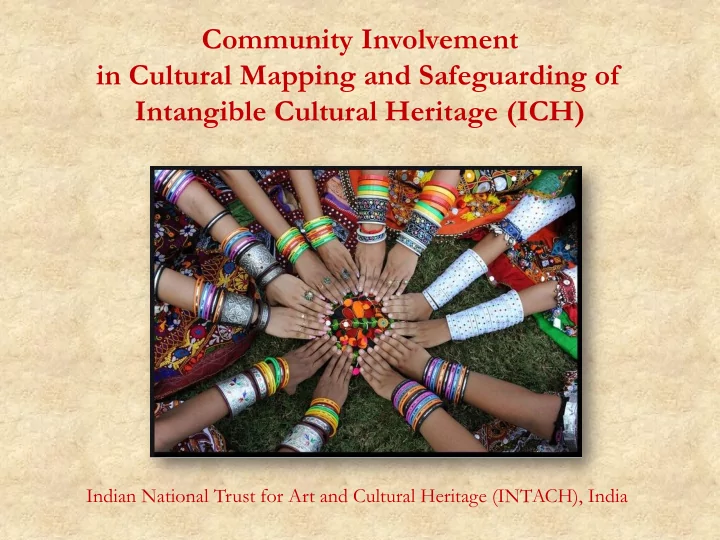
Community Involvement in Cultural Mapping and Safeguarding of Intangible Cultural Heritage (ICH)

Indian National Trust for Art and Cultural Heritage (INTACH), India

slide-2
SLIDE 2

Cultural Mapping of a Community

Cultural Elements and Resources to look for

Intangible Heritage

  • Oral Traditions
  • Folklore
  • Customs and

ceremonies

  • Local Health

Traditions

  • Festivals and Fairs
  • Social and Religious

Practices

  • Skills and

Craftsmanship associated with cultural occupations and creative cultural industries Cultural Occupations and Industries

  • Dance
  • Dance-drama
  • Music
  • Singing
  • Arts and Crafts

(Painting, Pottery, Metal Craft, Carving, Textiles, Organic Food products, Bamboo, Jewelry) Built and Natural Heritage

  • Local monuments or

sites

  • Forests, River, Lakes,

Sacred Groves, Orchards Organizations & Spaces

  • Associated

Organizations (Government agencies, NGOs, University, Zonal Cultural Centres)

  • Associated Spaces

(Village centre, schools)

slide-3
SLIDE 3

Safeguarding of Endangered ICH in India

Our focus area has been the mapping of tribal communities in India. Tribes constitute 8.61% of the total population of India, numbering 104.28 million (2011 Census), and cover about 15%

  • f the country’s area.

The need to focus on the tribal people is spelt out in their low social, economic and participatory

  • indicators. In terms of maternal and child mortality, size of agricultural holdings or access to

drinking water and electricity, tribal communities lag far behind the general population. These indicators underline the significance of livelihood generating activities based on locally available resources so that gainful employment opportunities can be created. This means recognizing and respecting the distinct intangible aspects of their culture, providing wider exposure to their art and crafts, and ensuring transmission of related skills and craftsmanship. Cultural mapping and an assessment of the cultural resources that a community possesses can thus have tremendous value. Special attention needs to be given to a community’s intangible cultural heritage which is, by its very nature, extremely vulnerable, and in many cases, in danger of disappearing altogether

slide-4
SLIDE 4

What do we map for ICH?

Identify and map tribes and communities with respect to their cultural footprint:

  • Cultural expressions: folklore, dance, music,

social and religious practices, dress,

  • rnaments, food ways, fairs and festivals
  • Cultural occupations: performing traditions,

arts and crafts

  • Customary laws, traditional agriculture,

building patterns, traditional knowledge

  • The role of elders and transmission of

their skills/knowledge; the role of women and young people in their cultural practices

Chhau dance Naga folklore Teyyam dance- drama Mandana Art

slide-5
SLIDE 5

Why map ICH?

There may be much diversity in India’s

cultural practices from one region to another, yet these represent a composite culture that binds us in a shared heritage. Documenting and mapping it is the first step towards protecting it...

  • This shared heritage is made up of

elements that impart a unique cultural identity to the people of a particular community or region

  • It fosters self-respect, pride and

creativity amongst them; it has social meaning and relevance even today; it sustains and strengthens traditional communities; and is connected to livelihoods A Konda Dora grandfather in Andhra A Kannaura senior citizen in Himachal shared their tribe’s customs &

slide-6
SLIDE 6

The Kharwa fishing community of Diu (an erstwhile Portuguese colony in India) uses the auspicious lugda , a bridal saree made by traditional weavers, the Vanja, as well as wedding bangles made by the Sangharia. Both these communities, however, have only one or two families making these now, resulting in the loss of these cultural elements for all three communities, directly or indirectly.

An example of cultural loss, and impact on livelihoods

slide-7
SLIDE 7

Before the Start of a Project

  • Before the start of projects, we organize ICH

documentation workshops to discuss/develop methodology with INTACH conveners from different parts of the country, who are local volunteers, and best placed to take the lead in this

  • They are encouraged to bring to the

workshops and include in the research team members of the particular community under study, who understand the needs and aspirations of their people, and who can be empowered to undertake self- documentation, and be involved in follow-up activities after the completion of the project

  • The team leader may, at a later stage, also

bring in local historians and anthropologists, university researchers, and heads of local government agencies for advise, facilitation and help with resources ICH documenting workshops; Understanding the stories behind buildings

slide-8
SLIDE 8

Workshop Themes and Exercises

  • Making a work plan, timetable, budget
  • Creating a team: Since communities

create and keep ICH alive, they must be involved in the documentation process from the very beginning; whether as a facilitator, guide, researcher, or source of information

  • Gathering existing information; doing

secondary research

  • Understanding the documentation

templates that can then be used by the team

  • Making field notes and writing reports

for dissemination

TEMPLATE FOR DOCUMENTING ORAL TRADITIONS AND PERFORMING ARTS

  • Name/Local popular name/

Historical Name (if Different from the rest)

  • Location- State, District, Tehsil,

Panchayat, Village, Pincode, Associated district, Latitude, Longitude

  • History of the form (Written history

available or not)

  • Short Description
  • Characteristic-

Dance/Song/Instrument Playing/Theatre/Story Telling/Narrative/Ritual/Ceremony/ Puppetry/Martial Arts/Other

  • Main components- (descriptive)
  • Nature-

Ritual/Entertainment/Private/Domes tic/Social/Religious/Sacred

  • Context of performances-

Festival/Public Performance/Entertainment/Ceremo nies /Life cycle events/Agricultural/Occupational

  • Period /date-

Seasonal/Cyclical/Specific month /date (in local calendar)/Specific month /date (in Gregorian calendar)

Creating a team and using templates

slide-9
SLIDE 9

Workshop Themes and Exercises

  • Technical sessions - On audio-visual

documentation; recording techniques: Theory and Practice; making a narrative

  • Exercises - Dividing the participants

into groups to film conversations and a dialogue on heritage, using the template if needed (as a guide, not rigid, and not meant to upset the free-flow of conversation)

  • Ethics of documenting
  • IPR and related issues
  • Challenges of working in the field
  • Case studies; sharing of experiences

Workshop components

slide-10
SLIDE 10

What Happens Next?

  • Undertaking projects after fine-tuning during

the workshop

  • Monitoring and mid-way review of these
  • Recommendations in consultation with the

community suggested at the end

  • Dissemination and Archiving Plan

ICH mapping is a first step. It will identify elements

  • f ICH which are vulnerable and where planning

and protection is required. Ultimately, the best preservation will come about through a community-based practice of the ICH in question

  • So we have to look at ways of: Creating
  • pportunities for participation of communities

in their cultural activities, their performing arts and crafts: to recognize, empower, sustain, and improve skills of the ICH knowledge-bearers and practitioners

Traditional story-telling Phad Boat race Hiyang Tannaba in Manipur

slide-11
SLIDE 11

Follow-up Activities

  • Involving them in the local school and

college educational programme; expanding outreach with workshops and cultural festivals

  • Helping master practitioners identify

and develop successor training programmes for the young by helping them get financial support from local

  • r regional agencies
  • Helping them address the economic

imperative with regard to traditional

  • ccupations by bringing the study to

the relevant authorities

  • Most importantly, respecting and

recognizing the value of intangible heritage for its practitioners

Master craftsman workshop for Cheriyal mask Baiga women with their tattoos

slide-12
SLIDE 12

Outcomes of Cultural Mapping

  • The aim of cultural mapping is not just

to create an inventory, but to align all stakeholders: local communities - especially artists, craftsmen and knowledge-holders among them, researchers, schools, government agencies, NGOs, and cultural industries,

  • n what is valued in local cultural

traditions, and needs to be documented at the very least, if not revived.

  • The findings and recommendations

based on this need to be disseminated for planning and policy-making, and exploring the potential of ICH as a resource for community development

Traditional weaving (above); Medicinal plants of the Hrangkhol tribe in Assam

slide-13
SLIDE 13

Thank you

Nerupama Y. Modwel Indian National Trust for Art and Cultural Heritage (INTACH), India Email: intangibleheritage1@gmail.com

Painting by Gond artist Ramesh Tekam