SLIDE 1
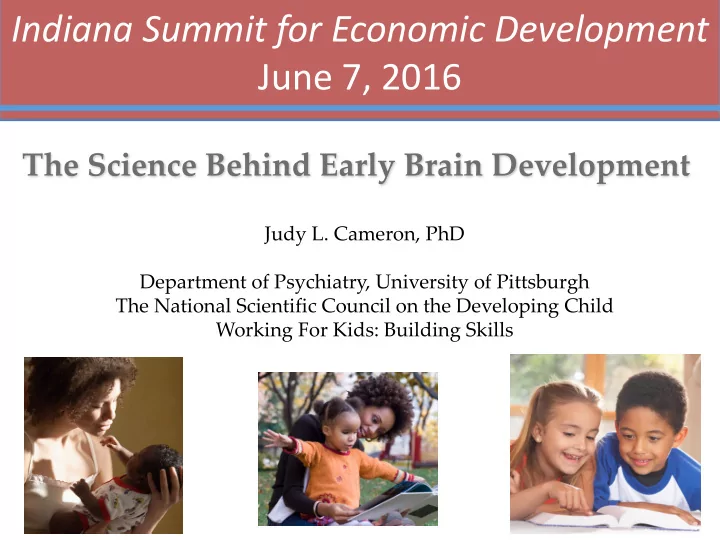
The ¡Science ¡Behind ¡Early ¡Brain ¡Development ¡
Indiana ¡Summit ¡for ¡Economic ¡Development June ¡7, ¡2016
Judy ¡L. ¡Cameron, ¡PhD Department ¡of ¡Psychiatry, ¡University ¡of ¡Pittsburgh The ¡National ¡Scientific ¡Council ¡on ¡the ¡Developing ¡Child Working ¡For ¡Kids: ¡Building ¡Skills
SLIDE 2 The ¡Foundation ¡of ¡a ¡Successful ¡Society ¡ is ¡Built ¡in ¡Early ¡Childhood
Educational Achievement Economic Productivity Responsible Citizenship Lifelong Health Successful Parenting of Next Generation
SLIDE 3
SLIDE 4 Four ¡Core ¡Concepts ¡of ¡Development
1 2 3
Brain Architecture Is Established Early in Life and Supports Lifelong Learning, Behavior, and Health Stable, Caring Relationships and “Serve and Return” Interaction Shape Brain Architecture Toxic Stress in the Early Years
- f Life Can Derail Healthy
Development
4
Resilience can be Built through “Serve and Return” Relationships, improving Self- Regulation, and Executive Functions.
SLIDE 5 www.workingforkids.com
Vocabulary Size (Words)
12 14 16 18 20 22 24 26 800 600 400 200
MOTHER’S SPEECH AND CHILD VOCABULARY
Source: Huttenlocher et al., Developmental Psychology 27: 236-248, 1991
Age in Months
High level of Mother’s Speech Medium level of Mother’s Speech Low level of Mother’s Speech
Working for Kids: Building Skills
TM
SLIDE 6
Experiences ¡Build ¡Brain ¡Architecture
SLIDE 7
Serve ¡& ¡Return ¡Relationships ¡ Support ¡Skill ¡Learning
SLIDE 8
Serve ¡& ¡Return ¡Relationships ¡Buffer The ¡Developing ¡Brain
SLIDE 9 Working for Kids: Building Skills
TM
E n g a g e m e n t S e l f
fj d e n c e I n t e r e s t
Supportive Environments for Brain Development
SUPPORT T R U S T CARE
SLIDE 10
Early ¡Life ¡Stress ¡Impacts ¡Life-‐‒long ¡ Health ¡and ¡Development
SLIDE 11 Source: Finkelhor et al. (2005)
U.S. Children Ages 2-5 (per 1,000) Maltreatment Postpartum Depression
130
Source: O-Hara & Swain (1996)
75 136
Parental Substance Abuse
Source: SAMHSA (2009)
Sources ¡of ¡Toxic ¡Stress ¡in ¡Young ¡Children NEGLECT
SLIDE 12
What are ¡the ¡Long-‐‒term ¡Impacts ¡of ¡ Toxic ¡Stress ¡in ¡Early ¡Life? ¡
SLIDE 13
Categories ¡of ¡Adverse ¡Childhood ¡Experiences
Abuse, ¡by ¡Category Psychological ¡(by ¡parents) 11% Physical ¡(by ¡parents) 28% Sexual ¡(anyone) 22% Forms ¡of ¡Neglect ¡and ¡Household ¡Dysfunction Emotional 15% Physical 10% Alcoholism ¡or ¡drug ¡use ¡in ¡home ¡ ¡ ¡ ¡ ¡ ¡ ¡ ¡ ¡ ¡ ¡ ¡ ¡ ¡ ¡ ¡ ¡ ¡ ¡ ¡ ¡ ¡ ¡ ¡ ¡ ¡ ¡ ¡ ¡ ¡ ¡ ¡ ¡ ¡ ¡ ¡ ¡ ¡ ¡ ¡ 27% Loss ¡of ¡biological ¡parent ¡<18 ¡ ¡ ¡ ¡ ¡ ¡ ¡ ¡ ¡ ¡ ¡ ¡ ¡ ¡ ¡ ¡ ¡ ¡ ¡ ¡ ¡ ¡ ¡ ¡ ¡ ¡ ¡ ¡ ¡ ¡ ¡ ¡ ¡ ¡ ¡ ¡ ¡ ¡ ¡ ¡ ¡ ¡ ¡ ¡ 23% Depression ¡or ¡mental ¡illness ¡in ¡home 17% Mother ¡treated ¡violently 13% Imprisoned ¡household ¡member 5% Prevalence ¡(%)
SLIDE 14 Number of Risk Factors
Source: Barth, et al. (2008)
Children with Developmental Delays
1-2 3 5 4 6 7 20% 40% 60% 80% 100%
Significant ¡Adversity ¡Impairs ¡ Development ¡in ¡the ¡First ¡Three ¡Years
SLIDE 15 2 4 6 8 10 12 14 16 1 2 3 4
Self-Report: Alcoholism Self-Report: Illicit Drugs
Source: Dube et al. (2002) Source: Dube et al. (2003)
% % ACEs
5 10 15 20 25 30 35 40 1 2 3 4 5+
Risk ¡Factors ¡for ¡Adult ¡Substance ¡Abuse ¡Are ¡ Embedded ¡in ¡Adverse ¡Childhood ¡ Experiences
SLIDE 16 ACEs
Source: Dong et al. (2004)
Odds Ratio
1 2 3 4 5,6 7,8 0.5 1 1.5 2 2.5 3 3.5
Risk ¡Factors ¡for ¡Adult ¡Heart ¡Disease ¡are Embedded ¡in ¡Adverse ¡Childhood ¡ Experiences
SLIDE 17
Toxic ¡Stress ¡Derails ¡Development
SLIDE 18 Pathways ¡we ¡are ¡working ¡to ¡understand:
Toxic ¡Stress ACE’s Trauma-‐‒Informed ¡ Care What ¡forms ¡of ¡trauma-‐‒informed ¡care ¡are ¡ effective ¡in ¡treating ¡the ¡long-‐‒term ¡repercussions
SLIDE 19
Can ¡We ¡Prevent Long-‐‒term ¡Behavior ¡ and ¡Health ¡Impacts ¡of ¡Early ¡Life ¡ Stress ¡and ¡Neglect? ¡
SLIDE 20 National ¡Scientific ¡Council ¡on ¡the ¡Developing ¡Child, ¡Working ¡Paper ¡#11
SLIDE 21 National ¡Scientific ¡Council ¡on ¡the ¡Developing ¡Child, ¡Working ¡Paper ¡#11
SLIDE 22 National ¡Scientific ¡Council ¡on ¡the ¡Developing ¡Child, ¡Working ¡Paper ¡#11
SLIDE 23 Capabilities ¡that ¡help ¡with ¡stress management
Focusing Attention Problem Solving Planning Ahead Behavior Regulation Controlling Impulses Adjusting to New Circumstances
Executive ¡Function ¡and ¡Self ¡Regulation ¡Skills
Working ¡For ¡Kids: ¡Building ¡SkillsTM (www.workingforkids.com)
SLIDE 24
Working ¡For ¡Kids: ¡Building ¡SkillsTM
SLIDE 25
Further ¡Information:
Judy ¡Cameron, ¡Ph.D. jcameron@pitt.edu www.workingforkids.com
Center ¡on ¡the ¡Developing ¡Child http://developingchild.harvard.edu/science/