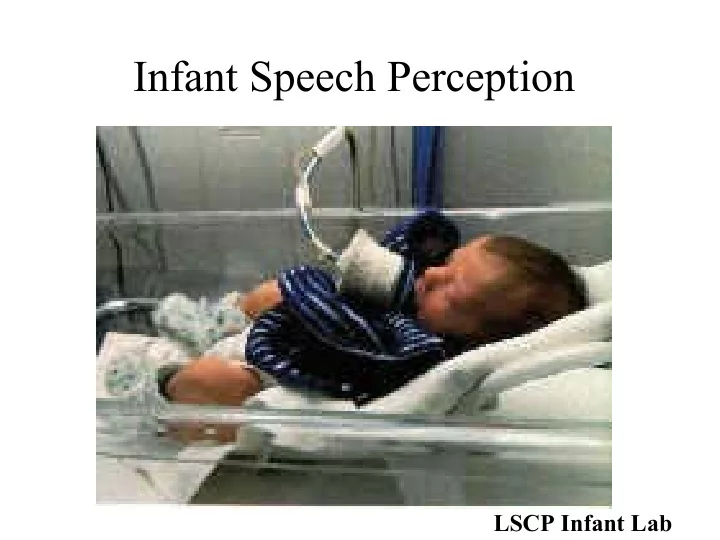
SLIDE 1
Infant Speech Perception
LSCP Infant Lab
SLIDE 2 Outline
- Introduction to Phonology
- Problem of Speech Perception
- Testing two theories of speech perception
– Infant Categorical Perception – Cross-species categorical perception – The use of visual cues
SLIDE 3
Universal Structural Design
_____________________________
SLIDE 4
English Consonants
SLIDE 5
- 1. Introduction to Phonology
15
SLIDE 6 Phonemes
Vowels: unimpeded sound through vibrating vocal cords Vary by:
– ee is high front – ah is low back
SLIDE 7 Phonemes
Consonants: Sound is impeded in some way Vary by:
m, p, b n, t, d ng, k, g
SLIDE 8 Phonemes
Consonants vary by
- 2. Kind of articulation:
- stop: p, b, d
- nasal: n,m
- fricative: ch, th, f
- 3. Voicing, Nasality, Creaky Voice, Clicks
- voiced: b, d, z....
- voiceless: p, t, s...
SLIDE 9 Phonemes are bundles of features
- P: bilabial, voiceless, stop
- B: bilabial, voiced, stop
- S: dental, voiceless, fricative
SLIDE 10
Phonemes are bundles of features
p: bilabial, voiceless, stop s: dental, voiceless, fricative
SLIDE 11 Evidence
- Phonological features participate in speech
errors
- Phonological rules typically refer to features:
– plural marker assimilates the voicing of the consonant before it – cup/s/, beet/s/, back/s/ – cub/z/, bead/z/, bag/z/
SLIDE 12
Phonemes Phonemes
?
SLIDE 13
- 2. A Brief Tour of Speech
Perception
10:25 15
SLIDE 14 The String Fallacy
- Speech sounds seem separable and
sequential: like beads on a string
– Speech sounds overlap (co-articulation) – Each speech sound is affected by the elements around it
SLIDE 15 Two problems of speech perception
– how do we discover where one phoneme ends and the next begins
– How can we identify a phoneme when it’s sound changes depending on context?
We won’t be answering these questions today
SLIDE 16
One Hint: some complex features of a speech sound may stay constant
SLIDE 17
Speech sounds vary along a continuum
SLIDE 18
Yet we perceive them as discrete categories
B D G
SLIDE 19
Categorical Perception: Identification
% identification
SLIDE 20
Categorical Perception: Discrimination
SLIDE 21
- 3. Where does this ability come
from?
10:40 12
SLIDE 22 Two theories
– perception is informed by our innate knowledge
- f articulation
- The Auditory Theory:
– speech perception is based solely on auditory properties of speech
SLIDE 23
We have innate knowledge of how articulation changes depending on context
Motor Theory
SLIDE 24
Innate knowledge of articulation Used to predict changes in sound wave and recover phonemes
Motor Theory
SLIDE 25 Auditory system breaks speech into phonemes
- innate property of sensory system or
- perceptual learning
Auditory Theory
SLIDE 26 Contrasting the two theories
The Motor Theory
- 1. Perception is based on
production
– Determine what articulatory gestures a speaker made – Then identify phoneme
The Auditory Theory
auditory mechanisms
– Auditory system transforms sound wave so phonemes available
SLIDE 27 Contrasting the two theories
The Motor Theory
specific
– Speech production and speech perception evolved together – Only humans speak, so
system
The Auditory Theory
– Production system evolved to make use of existing auditory capacities – No special adaptations to speech
SLIDE 28 Contrasting the two theories
The Motor Theory
– Tacit knowledge of articulation given by evolution
The Auditory Theory
– Innate properties of the auditory system may be adequate to isolate phonemes – Or Perceptual Learning may be required
SLIDE 29
- 4. Is Speech Perception Innate?
10:52 18
SLIDE 30 Do newborns perceive phonemes categorically?
Predictions:
- If categorical perception requires
knowledge of contrastive phonemes: NO
- If it requires exposure to language: NO
- If it is an innate ability: YES
But how can you test immobile infants?
SLIDE 31 High Amplitude Sucking Procedure
- Infant given a pacifier
- Contains sensor to
monitor sucking rates
sucks the paci, a stimulus is played
LSCP Infant Lab
SLIDE 32 High Amplitude Sucking Procedure
increases (novelty)
- Then it decreases
- This decline in
response is habituation
LSCP Infant Lab
SLIDE 33 High Amplitude Sucking Procedure
declines to set point (habituation criterion)
switches the auditory stimulus
LSCP Infant Lab
SLIDE 34 High Amplitude Sucking Procedure
increases
infant has detected the change
is dishabituation
LSCP Infant Lab
SLIDE 35
Stimuli for the Eimas Study
Voice Onset Time: time btw consonant release and vocal cord vibration S1 S2 S3 20 40 60 80 VOT in milliseconds
SLIDE 36
Stimuli for the Eimas Study
Phoneme Category Boundary at 25ms BA PA1 PA2 20 40 60 80 VOT in milliseconds
SLIDE 37
Predictions
Within Category Between Category Innate Categorical Perception
remain habituated dishabituate
Untuned Sensitivity
dishabituate dishabituate
Insensitive
remain habituated remain habituated
SLIDE 38 Stimuli from different phonological categories are distinguished
Time SPM sucks per minute
“PA1” “BA”
Eimas, et al., 1971
SLIDE 39 But stimuli from the same phonological category are not
“PA2” “PA1”
SPM sucks per minute Time
Eimas, et al., 1971
SLIDE 40 Speech Perception is Innate
Predicted by Motor Theory
driven by innate knowledge of articulation Consistent with Auditory Theory
to innate structure of auditory system
SLIDE 41
Species Specific?
11:10 10
SLIDE 42 Do other animals perceive phonemes categorically?
- Kuhl & Miller, 1978: test chinchillas and
humans with identical stimuli
- Human Task: identification (b or p)
- Chinchillas: avoidance conditioning
SLIDE 43
Avoidance Conditioning Procedure
Shock paired with speech sound at one end of continuum (A) 80 VOT in milliseconds
PA
SLIDE 44
Avoidance Conditioning Procedure
Sound at other end (B) paired with safety 80 VOT in milliseconds
BA
SLIDE 45
Avoidance Conditioning Procedure
Animal learns to run to other side of cage when it hears sound A but stay after B What will they do for sounds in between? stay ? ? ? run
SLIDE 46 Predictions
10 20 30 40 50 60 70 80 90 100 10 20 30 40 50 60 70 80
Voice Onset Time (ms) Percent labelled [b]
Categorical Perception Graded Perception
SLIDE 47 Kuhl & Miller, 1978 10 20 30 40 50 60 70 80 90 100 10 20 30 40 50 60 70 80
Voice Onset Time (ms) Percent labelled [b]
English Speakers
SLIDE 48 Kuhl & Miller, 1978 10 20 30 40 50 60 70 80 90 100 10 20 30 40 50 60 70 80
Voice Onset Time (ms) Percent labelled [b]
English Speakers Chinchillas
SLIDE 49 Not all aspects of speech perception are species specific
Contrary to Motor Theory
have knowledge (innate or learned) of articulation Consistent with Auditory Theory
abilities adequate for (some aspects of) speech perception
SLIDE 50
Affected by Knowledge of Articulation?
11:20 10
SLIDE 51 McGurk Effect
- Vary visual information about place of
articulation
– palatal: GA – dental: DA – bilabial: BA
- Vary auditory stimulus (BA→DA→GA)
- Task: phoneme identification
SLIDE 52 McGurk Effect
- Finding: phoneme category boundary
affected by visual information
– sound BA + visual GA = percept DA
- Adult speech perception affected by visual
cues
SLIDE 53 Do infants know visual cues to articulation?
- No evidence of visual cues influencing
categorization
- But can infants match sound with the
correct mouth shape?
SLIDE 54
Preferential Looking (Kuhl & Meltzoff, 1982
[a]-face [i]-face
SLIDE 55
a...a....a...a..a
[a]-face [i]-face
SLIDE 56 Speech Perception is influenced by information about articulation
Predicted by Motor Theory
production and perception Inconsistent with Auditory Theory
auditory theory might explain this
perceptual learning
SLIDE 57 Provisional Conclusions
- Speech Perception makes use of auditory
mechanisms which evolved prior to language
– These abilities are innate
- Speech Perception also makes use of our
knowledge of articulation
– This ability MAY be innate
SLIDE 58 McGurk Effect Revisited
McGurk_large.mov
SLIDE 59
Development of Phonological Representations
SLIDE 60
Working toward a model….
Syntactic Syntactic Phonological Phonological Phonetic Phonetic Auditory Auditory Articulatory Articulatory Lexical Lexical
Innate? Constructed
SLIDE 61 What’s innate?
- Auditory abilities
- Articulatory rudiments
– Not developed – Desire to coo and babble even in deaf infants
Auditory Auditory
Innate
Auditory Auditory Articulatory Articulatory
Innate
SLIDE 62 Newborns are universal listeners
- Infants perceive speech categorically
- Newborns are sensitive to every
phonological distinction yet tested
- What happens to the categories that are not
used in the language that they learn?
SLIDE 63
English VOT perception
SLIDE 64 English VOT production
SLIDE 65 English s - sh
a shift in curve with a or u
SLIDE 66 Developmental changes
versus Japanese r - l
SLIDE 67 Developmental changes
versus Spanish VOT
SLIDE 68 Testing Across the Lifespan
- Habituation paradigms work only with
young infants
- Adults & children can be asked to detect a
change
- The Conditioned Head Turn Paradigm
parallel task for older infants
SLIDE 69
Conditioned Head Turn Paradigm
Kuhl Lab, U Washington, 1992
SLIDE 70
Conditioned Head Turn Paradigm
Kuhl Lab, U Washington, 1992
SLIDE 71 Conditioned Head Turn
- Infant Trained with 2 clearly different
auditory stimuli (bell and whistle)
– each time the sound changes the toy is activated – next toy is activated only if the sound changes AND the baby turn to look at it
SLIDE 72 Conditioned Head Turn
- Child hears Stimulus 1 (/ba/) repeatedly
- Then Stimulus 2 is presented (/da/)
- If child detects difference, they should turn
to look at the toy when the stimulus changes
- If they do not detect it, they shouldn’t turn
until after the toy is activated
SLIDE 73
Contrasting Views
SLIDE 74 Maintenance or Loss Model
- If you don’t use a perceptual ability, you
lose it
- Parallel to aspects of early visual
development
SLIDE 75 Maintenance or Loss Model
Problems:
- Children older than 1yr can acquire a new
language with no accent
- Many of the relevant sounds appear in
child’s input but not meaningful
- Adults can be trained to make distinctions
- Perceptual distinction is readily available
for non-linguistic tasks
SLIDE 76 Functional Reorganization
- The newborn has perceptual categories
- Those which are meaningful in the native
language become speech categories
- The remainder are perceived but not
recruited in speech perception
SLIDE 77
Speech Perception Before Reorganization
Phonetic Phonetic Auditory Auditory Articulatory Articulatory
Innate & Universal
Behavior Behavior
SLIDE 78
Creation of Phonological Representations
Phonology Phonology Phonetic Phonetic Auditory Auditory Articulatory Articulatory
Innate Constructed & Language Specific
Behavior Behavior
SLIDE 79
Functional Reorganization
Syntactic Syntactic Phonological Phonological Phonetic Phonetic Auditory Auditory Articulatory Articulatory Lexical Lexical
Innate Constructed
Appears around 10m Appears around 14m
SLIDE 80 Critical period
- Foreign accent syndrome
- Why are foreign languages hard to
perceive?
- Differences in phonological
categories and phonological rules.
SLIDE 81 Epenthetic Vowels
- French allows consonant clusters
- Japanese does not
- Japanese loan words add vowels to
break up clusters
SLIDE 82 Epenthetic Vowels
- Japanese speakers tend to produce
and perceive additional vowels in L2
- Add epenthetic vowel /u/ to break
up clusters
- For French: “ebuzo” & “ebzo”
distinct
- Not for Japanese learner of French
SLIDE 83 Behavioral results
- Japanese can’t distinguish presence
- r absence of these vowels
Dupoux, Fushimi, Kakehi & Mehler, 1999
ebzo ebuzo
SLIDE 84 ERP experiment
paradigm
– ebuzo…ebuzo…ebzo – ebzo…ebzo….ebuzo
- record EEG & average
- French have early,
middle, late mismatch responses
response
Jacquemot, Pallier, LeBihan, Dehaene & Dupoux, 2002
SLIDE 85
Early Response
SLIDE 86
Middle Response
SLIDE 87
Late response
SLIDE 88 Problem
- Japanese should detect the
difference at phonetic level
- But supress at the lexical level and
in decision process
- Why do they only have the
late response?
- Could the phonetic response be the
late response?
SLIDE 89 When are epenthetic vowels added?
Syntactic Syntactic Phonological Phonological Phonetic Phonetic Auditory Auditory Articulatory Articulatory Lexical Lexical
Innate Constructed
Distinction should be available here…. But gone by here