Influenza Update Max E. Dow, DVM, MPH Region 3 Director Fort Worth, - - PowerPoint PPT Presentation

influenza update
SMART_READER_LITE
LIVE PREVIEW

Influenza Update Max E. Dow, DVM, MPH Region 3 Director Fort Worth, - - PowerPoint PPT Presentation

Highly Pathogenic Avian Influenza Update Max E. Dow, DVM, MPH Region 3 Director Fort Worth, Texas Texas Animal Health Commission HPAI / LPAI No HPAI in Texas to date 2015 US outbreak Avian Influenza viruses are enveloped RNA


slide-1
SLIDE 1

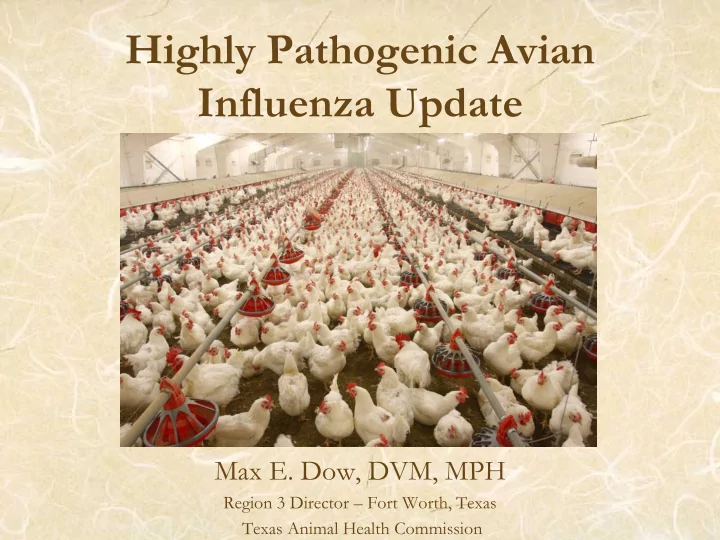
Highly Pathogenic Avian Influenza Update

Max E. Dow, DVM, MPH

Region 3 Director – Fort Worth, Texas Texas Animal Health Commission
slide-2
SLIDE 2

HPAI / LPAI

  • No HPAI in Texas to date – 2015 US outbreak
  • Avian Influenza viruses are enveloped RNA viruses
  • chickens, turkeys, pheasant, quail, ducks, geese, guinea

fowl and other avian species. (Orthomyxovirus family)

  • No evidence that transmission of viruses to man can
  • ccur through properly prepared poultry or eggs.

(Household setting is low risk).

  • Designation of HPAI vs LPAI:
  • 16 H types / 9 N types classified: only H5 and H7 have

been assoc. with HPAI in poultry

slide-3
SLIDE 3

HPAI / LPAI

  • HPAI vs LPAI – Pathogenicity – high mortality
  • Clinically : upper respiratory signs in chickens (mild ,

moderate or severe): ocular-nasal discharge, swollen sinuses, swollen edematous wattles with blue discoloration, redness or hyperemia to legs, acute death, ruffled feathers, loss of appetite, huddling behavior, rapid spread with high death losses.

  • Significance – clinical signs may not be

pathognomonic –depending on environment, age of poultry, immunity etc.

slide-4
SLIDE 4

HPAI / LPAI

  • Significance - trade restrictions – notification of

OIE with any H5 / H7 types. (Texas is number 6 in US for poultry products.)

  • Significance – viral mutation to a HPAI strain

in the host – risk to poultry industry.

  • Significance - Transmission to humans –

Epidemiology of human influenza infection – contact with poultry

slide-5
SLIDE 5

Texas Poultry Industry

  • Total Value: $4 billion
  • Total employment: approx. 18,000 jobs
  • Sectors:

– 14.4 million laying hens; 3.8 billion eggs

  • Sixth nationally

– 640 million broilers

  • Sixth nationally
slide-6
SLIDE 6

Poultry Concentrations

slide-7
SLIDE 7

2015 US HPAI* Outbreak

  • Influenza viruses: H5Nx
  • Index case: wild birds in WA, December 2014
  • Total states affected: twenty-one (21)

– Commercial poultry premises – Backyard flocks – Wild birds

*Avian influenza A viruses are designated as highly pathogenic avian influenza (HPAI) or low pathogenicity avian influenza (LPAI) based on molecular characteristics of the virus and the ability of the virus to cause disease and mortality in chickens in a laboratory setting.

slide-8
SLIDE 8

2015 HPAI Outbreak

  • H5N8 in OR backyard poultry December 2014

– Additional cases H5N8 and H5N2 in NW US (aligned with Pacific flyway) subsequent 3 months

slide-9
SLIDE 9

2015 HPAI Outbreak

  • December 2014 - January 2015

– H5N2 and H5N8 viruses found in wild birds in several states

  • January 2015

– H5N1 virus detected in a wild duck – new re-assortment, genetically different from the Asian avian H5N1 viruses that have caused human infections with high mortality in several other countries (notably in Asia and Africa). – No human infections with this new re-assortment H5N1 virus have been reported.

slide-10
SLIDE 10

2015 HPAI Outbreak

  • H2N2 in commercial turkeys in MN, MO, AR

beginning March 2015

– HIGH (80-90%) mortality – Many commercial flocks affected (MS flyway)

  • H2N2 in Midwest egg-laying hens beginning

April 2015

– Additional turkey, backyard, chicken and layer flocks through June 2015

  • Central flyway – NE and SD all flock types

– Smaller numbers affected than in MS flyway area

slide-11
SLIDE 11

2015 HPAI Outbreak

slide-12
SLIDE 12

2015 HPAI Outbreak

slide-13
SLIDE 13

2015 HPAI Outbreak Depopulation

  • Turkeys: approximately 7.5 million

– 0 % pending depopulation

  • Layer chickens and pullets: approximately 42.1

million

  • Foaming, Heat Assisted Ventilation Shutdown
  • AVMA consensus on humane care
slide-14
SLIDE 14

2015 HPAI Outbreak Impact as of 6/22/2015

  • 3.16% of U.S. annual turkey production, or 7.46% of

average U.S. turkey inventory

  • 10.01% of U.S. average layer inventory
  • 6.33% of U.S. average pullet inventory
  • Broiler infection has been quite limited and represents

less than 0.01% of U.S. broiler inventory.

slide-15
SLIDE 15

H7N8 Outbreak 2016

  • January 2016 Dubois County, Indiana
  • Detected from increased death loss in

commercial turkey industry

  • 1 case of HPAI , 8 cases of LPAI confirmed
  • On-Farm questionnaires found physical and

management characteristics changed due to 2015 HPAI outbreak

slide-16
SLIDE 16
slide-17
SLIDE 17

2015 HPAI Outbreak Epidemiology

  • First cases likely introduced by wild birds
  • Recent USDA report

– No specific pathway, but genetic analysis  independent introductions AND transmission between farms – Insufficient application of recommended biosecurity practices – Environmental factors – spread by wind?

slide-18
SLIDE 18

Migratory bird flyways

slide-19
SLIDE 19

Surveillance Plans- How AI is Monitored

  • USDA/USGS National Surveillance Plan 2015
slide-20
SLIDE 20

Surveillance Plans

Wild Birds

slide-21
SLIDE 21

National Surveillance Plans

  • 1. Poultry Industry
  • National Poultry Improvement Plan- (NPIP)

Cooperative Federal-State-industry mechanism for controlling certain poultry diseases. Mycoplasma, Salmonella , AI.

  • identifies States, flocks, hatcheries, dealers, and slaughter

plants that meet disease control standards. Customers can buy poultry that has tested clean of certain diseases or that has been produced under disease prevention conditions.

slide-22
SLIDE 22

Surveillance Plans

  • 2. Live bird markets (LBM)

– Prevention and Control of H5 and H7 Low Pathogenicity Avian Influenza in the Live Bird Marketing System

  • Live bird market: Any facility (including botanica,

poultry store, or custom slaughter) that sells live poultry for onsite slaughter or for offsite ritual use.

  • Live bird marketing system (LBMS): The LBMS

includes live bird markets and their production and distribution systems.

slide-23
SLIDE 23

Surveillance Plans (LBM)

slide-24
SLIDE 24

Surveillance Plans

  • 3. Foreign animal disease investigations (FAD’s)
  • Sick bird calls to TAHC
  • Practitioner-reported 1-800-550-8242 HOTLINE
  • Laboratory reported surveillance samples from

vets

  • initiates a producer call from RD, field vet,

FAD investigation number, farm visit and sampling; Plum Island or NVSL in Ames IA

slide-25
SLIDE 25

Texas Situation –during the 2015

  • utbreak
  • Poultry and poultry products are safe to eat/use
  • Permitted movement in place for birds and

products from affected areas

  • Tracing and disposal of exposed eggs/birds
  • Weekly national coordination calls
  • Biosecurity awareness and contingency planning

– producer meetings with industry.

slide-26
SLIDE 26

HPAI Preparations in Texas

  • Texas Emergency Disease Management

Committee

– Texas Animal Health Commission – USDA APHIS Veterinary Services – Texas Poultry Federation – Industry representatives – Texas A&M University System Veterinary Medical Diagnostic Laboratory – National Poultry Improvement Program – Texas A&M Agrilife Extension

slide-27
SLIDE 27

HPAI Preparations in Texas

  • Outreach

– Biosecurity – Backyard and non-typical poultry producers – Encourage reporting

  • Surveillance

– National Poultry Improvement Plan – Live bird markets – Foreign animal disease investigations

slide-28
SLIDE 28

HPAI Preparations in Texas

  • Regulation

– Birds and products coming from infected states – Testing requirements – Entry permit requirements

  • Routine movement from other states
  • Movement from HPAI-affected states
slide-29
SLIDE 29

The essential elements to avoid the introduction of avian influenza include:

  • Avoid direct contact between all other avian

species and poultry (waterfowl, etc.).

  • Allow no visitors on to poultry premises.
  • Assure that permit requirements are closely

followed.

  • Train all personnel regarding biosecurity and

monitoring practices.

  • Monitor for avian influenza
  • Promptly react to any suspected outbreak.
slide-30
SLIDE 30
  • National repository of critical veterinary

countermeasures

– (i.e. supplies, equipment, test kits, vaccines, and commercial response support services)

  • Similar in form to Strategic National Stockpile

National Veterinary Stockpile

slide-31
SLIDE 31

National Veterinary Stockpile

slide-32
SLIDE 32

USDA planning resources

slide-33
SLIDE 33

Produced by the Texas Animal Health Commission

“Because livestock & poultry health matters”

www.tahc.texas.gov

800-550-8242

Find us on Facebook & Twitter