Information-Theoretic Implications of Classical and Quantum Causal - - PowerPoint PPT Presentation
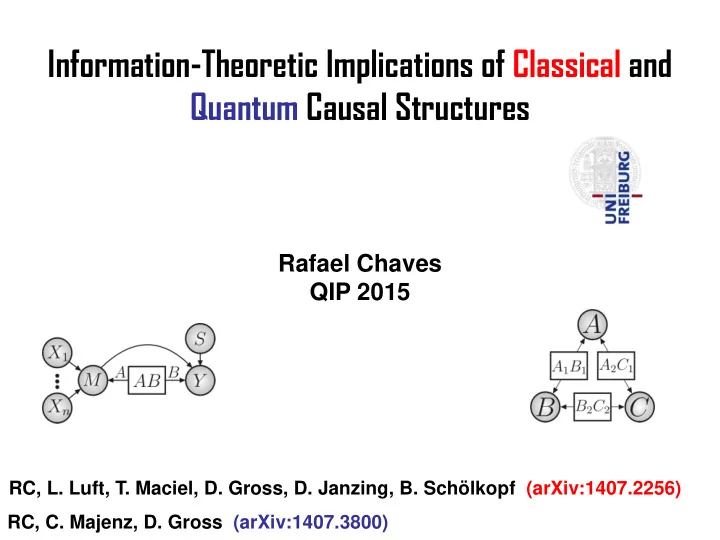
Information-Theoretic Implications of Classical and Quantum Causal Structures Rafael Chaves QIP 2015 RC, L. Luft, T. Maciel, D. Gross, D. Janzing, B. Schlkopf (arXiv:1407.2256) RC, C. Majenz, D. Gross (arXiv:1407.3800) RC, C. Majenz &
Dominik Janzing Bernhard Schölkopf
Thiago Maciel Christian Majenz
A joint work with
Lukas Luft David Gross
RC, C. Majenz & D. Gross, Nature Communications 6, 5766 (2015) RC, L. Luft, T. Maciel, D. Gross, D. Janzing, B. Schölkopf, Proceedings of Uncertainty in Artificial Intelligence 2014
Given some empirically observable variables, which correlations between them are compatible with a presumed causal structure?
- Distinguishing direct influence from common cause… Is obesity contagious?
- Bell’s Theorem: Quantum correlations are incompatible with “local realism”.
- Distinguishing direct influence from common cause… Is obesity contagious?
- Classical causal structures
- The information-theoretic approach to classical causal inference
- The generalization to quantum causal structures
- Where to go from here?
Outline
- Classical causal structures
- The information-theoretic approach to classical causal inference
- The generalization to quantum causal structures
- Where to go from here?
- For n variables X1, ... ,Xn, the causal relationships are encoded in a causal structure,
represented by a directed acyclic graph (DAG)
- ith variable being a deterministic function
xi=fi(pai,ui)
- f its parents pai and „local randomness“ ui
[See J. Pearl, Causality]
Cl Class assical ical Caus Causal S al Str truc uctur tures es
- For n variables X1, ... ,Xn, the causal relationships are encoded in a causal structure,
represented by a directed acyclic graph (DAG)
- ith variable being a deterministic function
xi=fi(pai,ui)
- f its parents pai and „local randomness“ ui
- Causal relationships are encoded in the conditional
independencies (CIs) implied by the DAG [See J. Pearl, Causality]
Cl Class assical ical Caus Causal S al Str truc uctur tures es ...
Is a given probability distribution compatible with a presumed causal structure?
Iff the given probability distribution fullfils all the CIs implied by the DAG
Is a given probability distribution compatible with a presumed causal structure?
Example: Is a given compatible with
Iff the given probability distribution fullfils all the CIs implied by the DAG
?
Is a given probability distribution compatible with a presumed causal structure?
Example: Is a given compatible with
Iff the given probability distribution fullfils all the CIs implied by the DAG
? ...
Is a given probability distribution compatible with a presumed causal structure?
Example: Is a given compatible with
Iff the given probability distribution fullfils all the CIs implied by the DAG
... ?
Is a given probability distribution compatible with a presumed causal structure?
Example: Is a given compatible with
- If the full probability distribution (of all nodes in a DAG) is available, CIs hold
all information required to solve the compatibility problem
However…
Iff the given probability distribution fullfils all the CIs implied by the DAG
? ...
Mar Margina ginal S l Sce cena narios rios
- Usually and for a variety of reasons not all variables in a DAG are observable, i.e., not
all CIs are available from empirical data
Mar Margina ginal S l Sce cena narios rios
- Usually and for a variety of reasons not all variables in a DAG are observable, i.e., not
all CIs are available from empirical data
...
Mar Margina ginal S l Sce cena narios rios
- Usually and for a variety of reasons not all variables in a DAG are observable, i.e., not
all CIs are available from empirical data
...
Mar Margina ginal S l Sce cena narios rios
- CIs impose non-trivial constraints on the level of the
- bservable variables, for example, Bell inequalities.
Pic from [Rev. Mod. Phys. 86, 419 (2014)]
- Usually and for a variety of reasons not all variables in a DAG are observable, i.e., not
all CIs are available from empirical data
...
Challeng Challenge
- Describe marginals compatible with DAGs
Challeng Challenge
- Describe marginals compatible with DAGs
- The observable probability contains the full causal information empirically available...
Challeng Challenge
- Describe marginals compatible with DAGs
- The observable probability contains the full causal information empirically available...
- ..very difficult, non-convex sets (algebraic geometry methods required, see for
instance [Geiger & Meek, UAI 1999])
Picture from [Steeg & Galstyan, UAI 2011]
Challeng Challenge
- Describe marginals compatible with DAGs
- The observable probability contains the full causal information empirically available...
- ..very difficult, non-convex sets (algebraic geometry methods required, see for
instance [Geiger & Meek, UAI 1999])
Picture from [Steeg & Galstyan, UAI 2011]
Our idea Rely on entropic information!
- Concise characterization as a convex set
- Naturally encodes the causal constraints
- Quantitative and stable tool
- Causal structures
- The information-theoretic approach to classical causal inference
- The generalization to quantum causal structures
- Where to go from here?
[T. Fritz and RC, IEEE Trans. Inf. Th. 59, 803 (2013)] [RC, L. Luft, D. Gross, NJP 16, 043001 (2014)] [RC, L. Luft, T. Maciel, D. Gross, D. Janzing, B. Schölkopf, UAI 2014]
Step 1/3: Unconstrained, global object
Caus Causal E al Entr ntrop
- pic
ic co cone ne
- Entropic vector :each entry is the Shannon
entropy H(XS) indexed by subset Example: 2 vars →
- Defines a convex cone. Structure not fully understood, but...
Step 1/3: Unconstrained, global object
- Entropic vector :each entry is the Shannon
entropy H(XS) indexed by subset Example: 2 vars →
Caus Causal E al Entr ntrop
- pic
ic co cone ne
- Defines a convex cone. Structure not fully understood, but...
Step 1/3: Unconstrained, global object
- Entropic vector :each entry is the Shannon
entropy H(XS) indexed by subset Example: 2 vars →
- ...contained in Shannon Cone , defined by strong subadditivity and monotonicity
Caus Causal E al Entr ntrop
- pic
ic co cone ne
- Piece of cake! Conditional independences are
naturally embedded in mutual informations
- We can even relax (stable!)
- C: set of constraints
Step 2/3: Choose candidate structure and add causal constraints
→
- New global cone of entropies subject to causal structure
Caus Causal E al Entr ntrop
- pic
ic co cone ne
- Geometrically trivial:
just restrict to observable coordinates
- Algorithmically costly: represented in
terms of inequalities (use, eg, Fourier-Motzkin elimination) Step 3/3: Marginalize to
- : set of joint observables
Final result: description of marginal, causal entropic cone in terms of „entropic Bell inequalities“
[T. Fritz and RC, IEEE Trans. Inf. Th. 59, 803 (2013)] [RC, L. Luft, D. Gross, NJP 16, 043001 (2014)] [RC, L. Luft, T. Maciel, D. Gross, D. Janzing, B. Schölkopf, UAI 2014]
Caus Causal E al Entr ntrop
- pic
ic co cone ne
App ppli lica cations tions
- Entropic Bell inequalities [Braunstein & Caves PRL 61, 662 (1988)]
- Common ancestors problem: Can the correlations between n observable variables be
explained by independent common ancestors connecting at most M of them? [Steudel
& Ay, arXiv:1010.5720]
- Quantifying Causal Influences [D. Janzing et al, Ann. of Stat. 41, 2324 (2013)]
- Witnessing direction of causation from pairwise information
- Causal structures
- The information-theoretic approach to (classical) causal inference
- The generalization to quantum causal structures
- Where to go from here?
[RC, C. Majenz & D. Gross, Nat. Comm. 6, 5766 (2015)]
Quan Quantum C tum Cau ausal Str sal Struc uctur tures es
- Different formulations have been proposed. For an incomplete list see:
[R. Tucci, arXiv:quant-ph/0701201 (2007)] [M. S. Leifer & R. W. Spekkens, Phys. Rev. A 88, 052130 (2013)] [T. Fritz, arXiv:1404.4812] [J.Henson, R. Lal, M. F. Pusey New J. Phys. 16, 113043 (2014)] [J. Pienaar & C. Brukner, arXiv:1406.0430]
Quan Quantum C tum Cau ausal Str sal Struc uctur tures es
- Different formulations have been proposed. For an incomplete list see:
[R. Tucci, arXiv:quant-ph/0701201 (2007)] [M. S. Leifer & R. W. Spekkens, Phys. Rev. A 88, 052130 (2013)] [T. Fritz, arXiv:1404.4812] [J.Henson, R. Lal, M. F. Pusey New J. Phys. 16, 113043 (2014)] [J. Pienaar & C. Brukner, arXiv:1406.0430]
- We propose a graphical representation that allow us to generalize the information-
theoretic approach
- Informally, a quantum causal structure specifies the functional dependency between a
collection of quantum states and classical variables.
Building Blocks
- Classical variable
- Quantum State
- Quantum Operation (CPTP map)
Quan Quantum C tum Cau ausal Str sal Struc uctur tures es
[RC, C. Majenz & D. Gross, Nat. Comm. 6, 5766 (2015)]
Entr Entrop
- pic desc
ic description ription of
- f Qua
Quant ntum Cau um Causal sal Str Struc uctu tures es
- Replace Shannon entropy with von Neumann entropy
(For purely classical variables both coincide)
[RC, C. Majenz & D. Gross, Nat. Comm. 6, 5766 (2015)]
Entr Entrop
- pic desc
ic description ription of
- f Qua
Quant ntum Cau um Causal sal Str Struc uctu tures es
- Replace Shannon entropy with von Neumann entropy
(For purely classical variables both coincide)
- von Neumann entropy respect strong subadditivity but
not monotonicity (replaced by weak monotonicity)
[RC, C. Majenz & D. Gross, Nat. Comm. 6, 5766 (2015)]
Entr Entrop
- pic desc
ic description ription of
- f Qua
Quant ntum Cau um Causal sal Str Struc uctu tures es
- Measurements disturb/destroy the quantum system
- Replace Shannon entropy with von Neumann entropy
(For purely classical variables both coincide)
- von Neumann entropy respect strong subadditivity but
not monotonicity (replaced by weak monotonicity)
[RC, C. Majenz & D. Gross, Nat. Comm. 6, 5766 (2015)]
Entr Entrop
- pic desc
ic description ription of
- f Qua
Quant ntum Cau um Causal sal Str Struc uctu tures es
- Measurements disturb/destroy the quantum system
Some CIs that are classically valid cannot be defined in the quantum case
- Replace Shannon entropy with von Neumann entropy
(For purely classical variables both coincide)
- von Neumann entropy respect strong subadditivity but
not monotonicity (replaced by weak monotonicity)
[RC, C. Majenz & D. Gross, Nat. Comm. 6, 5766 (2015)]
Entr Entrop
- pic desc
ic description ription of
- f Qua
Quant ntum Cau um Causal sal Str Struc uctu tures es
- Measurements disturb/destroy the quantum system
Some CIs that are classically valid cannot be defined in the quantum case
- Replace Shannon entropy with von Neumann entropy
(For purely classical variables both coincide)
- von Neumann entropy respect strong subadditivity but
not monotonicity (replaced by weak monotonicity) Independecies still hold
[RC, C. Majenz & D. Gross, Nat. Comm. 6, 5766 (2015)]
Entr Entrop
- pic desc
ic description ription of
- f Qua
Quant ntum Cau um Causal sal Str Struc uctu tures es
- Measurements disturb/destroy the quantum system
- We need a rule mapping the quantum states to classical variables (data processing)
Some CIs that are classically valid cannot be defined in the quantum case
- Replace Shannon entropy with von Neumann entropy
(For purely classical variables both coincide)
- von Neumann entropy respect strong subadditivity but
not monotonicity (replaced by weak monotonicity) Independecies still hold
[RC, C. Majenz & D. Gross, Nat. Comm. 6, 5766 (2015)]
Entr Entrop
- pic desc
ic description ription of
- f Qua
Quant ntum Cau um Causal sal Str Struc uctu tures es
Inf Infor
- rma
mation tion ca causa usali lity ty
[Pawlowski et al, Nature 461, 1101 (2009)]
Task: Bob must output a guess YS about the s-th bit XS of Alice
Inf Infor
- rma
mation tion ca causa usali lity ty
[Pawlowski et al, Nature 461, 1101 (2009)]
Task: Bob must output a guess YS about the s-th bit XS of Alice IC inequality
Inf Infor
- rma
mation tion ca causa usali lity ty
[Pawlowski et al, Nature 461, 1101 (2009)]
Task: Bob must output a guess YS about the s-th bit XS of Alice
- Implicitly restricting to the marginal scenario: {Xi, Yi}, {M}, with i=1,...,n
IC inequality
Inf Infor
- rma
mation tion ca causa usali lity ty
[Pawlowski et al, Nature 461, 1101 (2009)]
Task: Bob must output a guess YS about the s-th bit XS of Alice
- Implicitly restricting to the marginal scenario: {Xi, Yi}, {M}, with i=1,...,n
- Most general marginal scenario: {X1,...,Xn,Ys,M} with s=1,...,n
IC inequality
Inf Infor
- rma
mation tion ca causa usali lity ty
[Pawlowski et al, Nature 461, 1101 (2009)]
Task: Bob must output a guess YS about the s-th bit XS of Alice
- Implicitly restricting to the marginal scenario: {Xi, Yi}, {M}, with i=1,...,n
Tigher IC inequality
- Most general marginal scenario: {X1,...,Xn,Ys,M} with s=1,...,n
IC inequality
Inf Infor
- rma
mation tion ca causa usali lity ty
[Pawlowski et al, Nature 461, 1101 (2009)]
Task: Bob must output a guess YS about the s-th bit XS of Alice
- Implicitly restricting to the marginal scenario: {Xi, Yi}, {M}, with i=1,...,n
Tigher IC inequality
- Most general marginal scenario: {X1,...,Xn,Ys,M} with s=1,...,n
IC inequality
- The new inequality witness the non quantumness of distributions that could not be
detected by the original one.
Inf Infor
- rma
mation tion ca causa usali lity ty
[Pawlowski et al, Nature 461, 1101 (2009)]
Task: Bob must output a guess YS about the s-th bit XS of Alice
- Implicitly restricting to the marginal scenario: {Xi, Yi}, {M}, with i=1,...,n
Tigher IC inequality
- Most general marginal scenario: {X1,...,Xn,Ys,M} with s=1,...,n
IC inequality
- Can be easily generalized to the case of a quantum message (Dense Coding)
- The new inequality witness the non quantumness of distributions that are not
detected by the original one.
- Causal structures
- The information-theoretic approach to (classical) causal inference
- The generalization to quantum causal structures
- Where to go from here?
- Entropies allow for a non-trivial, quantitative and operational discrimination between
causal relationships...
What we know...
... both in classical and quantum problems
- Entropies allow for a non-trivial, quantitative and operational discrimination between
causal relationships...
...and what we would like to know
- Beyond Bell‘s theorem? Nonlocality in quantum networks... see [T. Fritz, NJP 14,
103001 (2012)]
- New information-theoretical principles? Multipartite Information Causality?
What we know...
... both in classical and quantum problems
Thanks!
- RC, C. Majenz & D. Gross, ”Information-Theoretic Implications of Quantum Causal Structures”,
Nature Communications 6, 5766 (2015)
- RC, L. Luft, T. Maciel, D. Gross, D. Janzing, B. Schölkopf, “Inferring latent structures via information
inequalities“, Proceedings of Uncertainty in Artificial Intelligence (2014)