Innovation and Societal Challenges (30 ECTS Semester Specialisation) - - PowerPoint PPT Presentation

innovation and societal challenges
SMART_READER_LITE
LIVE PREVIEW

Innovation and Societal Challenges (30 ECTS Semester Specialisation) - - PowerPoint PPT Presentation

Innovation and Societal Challenges (30 ECTS Semester Specialisation) Online Info-meeting Thursday May 14, 2020 13:00-14:00 Increased pressure on firms strategizing, agility, and innovativeness (health crisis; climate change, pollution,

slide-1
SLIDE 1

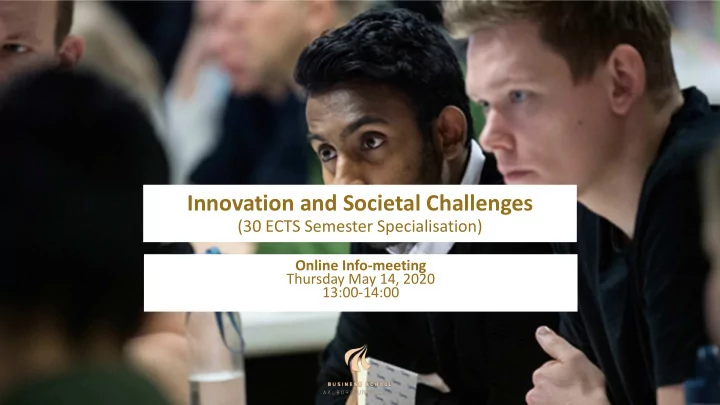
Innovation and Societal Challenges

(30 ECTS Semester Specialisation)

Online Info-meeting Thursday May 14, 2020 13:00-14:00

slide-2
SLIDE 2

Why is it important?

  • Increased pressure on firms’ strategizing, agility, and

innovativeness (health crisis; climate change, pollution, inequality, migration or ageing populations).

  • All illustrates the huge impact societal challenges

may have on firm-level decisions.

  • Pressure for adapting to this new business landscape

stems not only from macro-economic changes and governments, also consumers increasingly demand sustainable products, production processes, and governance structures and –behaviors.

  • In essence, innovation and entrepreneurial thinking

and behavior is key to business management of tomorrow.

slide-3
SLIDE 3

lnnovation and Societal Challenges Overview

  • Context: 9th Semester Specialisation (30 ECTS)
  • Content: You will be provided with theory, concepts and methods to analyse

the role of innovation and entrepreneurship in coping with challenges from economic, social and sustainable development. Connecting macro-societal trends and agendas with micro-level decision-making in the firm.

  • Applicability: available for master’s degree students in the following

programmes:

  • Students enrolled at the Master program in Economics and Business

Administration, Aalborg University, including: International Business, International Marketing, Accounting, Organisation and Strategy.

  • Students from other AAU master’s programs with a pre-approval from

their home study board.

  • Erasmus+/exchange students (Master level) with a pre-approval from

their home university and from the receiving Study Board of Business Administration, AAU.

  • It is possible to enrol in the whole semester or in single courses (M1-

M3). Enrolment in single courses requires pre-approval by the home study board.

slide-4
SLIDE 4

Semester structure:

MODULE 1: CONTEMPORARY ISSUES IN INNOVATION AND ENTREPRENEURSHIP (5 ECTS)

  • Coordinators: Eun Kyung Park (Associate Prof.) & Rasmus Lema (Associate Prof.)
  • 8+ lecturers from IKE (Innovation, Knowledge and Economic dynamics) research

group. MODULE 2: ADVANCED INNOVATION MANAGEMENT (10 ECTS)

  • Professor - Christian Richter Østergaard
  • Associate Professor - Yariv Taran
  • Associate Professor - Ina Drejer

MODULE 3: SEMESTER PROJECT WITHIN INNOVATION AND SOCIETAL CHALLENGES (15 ECTS)

  • Supervisors are allocated, so they match project topics and interests, although

mainly from the IKE-research group.

slide-5
SLIDE 5

Module 1:

Contemporary Issues in Innovation and Entrepreneurship

Why this module? Because it…

  • 1. Brings you the ‘state of the art’ in innovation

and entrepreneurship studies

  • 2. Links diverse emerging topics within the field
  • f innovation and entrepreneurship to the
  • ngoing societal challenges
  • 3. Is taught by researchers who bring their

induvial areas of specialisation to the course

slide-6
SLIDE 6

Module 1:

Contemporary Issues in Innovation and Entrepreneurship

The module covers selected contemporary and emerging research topics within innovation and entrepreneurship studies. Key topics include:

  • Innovation and societal challenges
  • From linear model to transformative innovation
  • Global innovation networks
  • Financing of innovation and entrepreneurship
  • Sustainable and firm strategy
  • Innovation and socio-technical transitions
  • Entrepreneurship and the employment challenge
slide-7
SLIDE 7

Module 1:

Contemporary Issues in Innovation and Entrepreneurship

Lectures by a range of experts from IKE research group

slide-8
SLIDE 8

Module 1:

Contemporary Issues in Innovation and Entrepreneurship

Forms of teaching: § Short and succinct lectures (physical and/or

  • nline)

§ Podcast and other online resources § Case-based group work Presentation Peer-feedback and grading Exam: Individual written exam

slide-9
SLIDE 9

Module 2:

Advanced Innovation Management

Why this module? Because …

  • 1. You will learn knowledge on recent trends in

innovation management and be able to identify relevant issues and problems in practice

  • 2. You will be able to critically reflect on and

select among theoretical and analytical approaches for promoting innovation and solution models

  • 3. Emphasis is placed on frameworks and

methods that are both theoretically sound and practically useful

slide-10
SLIDE 10

Module 2:

Advanced Innovation Management

Key topics include:

§ Introduction to advanced innovation management – what do we need to know § Innovation strategy: Decision Making Under Uncertainty and Complexity § Organising for innovation 1: Absorptive capacity § Sources of innovation: collaboration, networks and user-producer interaction § General overview on innovation management studies § Change Management § Service innovation § Servitization § Business model innovation and sustainability § Organising for innovation 2: Dynamic Capabilities § Evaluating and Selecting Innovation Projects § Disruptive innovation and the innovators dilemma § Organising for innovation 3: The ambidextrous organization § Profiting from innovation: IPR and complementary assets

slide-11
SLIDE 11

Module 2:

Advanced Innovation Management

Forms of teaching:

§ The module contains lectures, online lectures, and exercises § In-class case based exercises § The exercises include

  • discussions of cases
  • student presentations

with the purpose to engage in a more in depth treatment of some core concepts and challenges within innovation management.

Exam:

Individual oral exam, with point of departure in a written group assignment.

slide-12
SLIDE 12

Module 3:

Semester Project within Innovation and Societal Challenges

  • In the semester project you define and analyse a

research problem within the overall theme Innovation and societal challenges.

  • The project can be carried out in collaboration with a

company or other external organisation and/or the project may be connected to ongoing interdisciplinary mega projects in collaboration with students enrolled in

  • ther study programs at master’s level. The project topic

is defined by the project group and approved by the supervisor.

  • Supervision from a broad group of supervisors with

interests and expertise within your topic

  • Oral internal exam based on the project report, 7-point

grading scale

slide-13
SLIDE 13

Examples on topics for semester project

  • How will Covid19 effects X-firm’s future value

chain

  • How to stimulate entrepreneurship?
  • Innovation in emerging economies
  • Green investors - passion or rationality?
  • Sustainable business models transition with point
  • f departure in UN Development Goals (SDGs)
  • Mega projects within:
  • The Circular region
  • Simplifying sustainable living
  • + new themes in 2020
slide-14
SLIDE 14

Time for Q&A

slide-15
SLIDE 15

Thanks for joining

Feel free to contact semester coordinators:

Yariv Taran: Yariv@business.aau.dk or Birgitte Gregersen: bg@business.aau.dk