
SLIDE 1
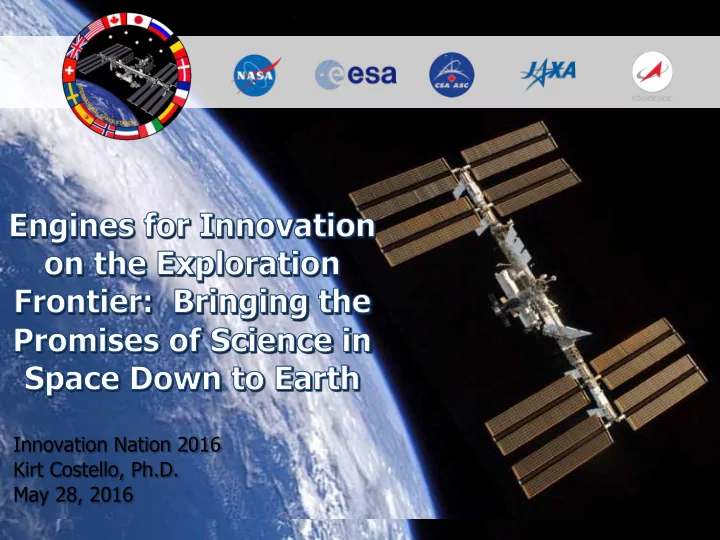
Innovation Nation 2016 Kirt Costello, Ph.D. May 28, 2016
Innovation Nation 2016 Kirt Costello, Ph.D. May 28, 2016 Why do - - PowerPoint PPT Presentation
Innovation Nation 2016 Kirt Costello, Ph.D. May 28, 2016 Why do humans explore? 2 Source: ISS Program Scientist When civilizations stop exploring they cease to exist Only those who will risk going too far, can possibly find out how
Innovation Nation 2016 Kirt Costello, Ph.D. May 28, 2016
2
Source: ISS Program Scientist
3 4
Source: ISS Program Scientist
Captain James Cook, HMS Resolution, Ca. 1771 Charles Darwin, HMS Beagle, ca. 1831 (OOS 1859) 4
5
Source: ISS Program Scientist
Source: ISS Program Scientist
6
Scientific Discovery Enabling Future Exploration Benefits for Humanity
Spacecraft Mass: ~925,000 lb (~419,000 kg) Spacecraft Pressurized Volume: 32,333 ft3 (915 m3) Altitude: ~260 miles (~415 km) Inclination: 51.6° Velocity: 17,500 mph (28,200 kph) Science Capability: Laboratories from four international space agencies – US, Europe, Japan, and Russia.
7
(Expeditions 0 – 42, December 1998 – March 2015, PSF Approved July 2015)
– 1922 Investigations
– >2484 investigators – >1605 scientific publications (journal, conference proceedings, and grey literature) – 95 participating countries/areas
Fluid Shifts, One-Year Mission
8
ACE-H2
Source: ISS Program Scientist
PSF Approved
0% 10% 20% 30% 40% 50% 60% 70% 80% 90% 100%
CSA ESA JAXA NASA/U.S. Roscosmos
Research Discipline of ISS Investigations by Partner Agency: Expeditions 0-42 December 1998 – March 2015 Biology & Biotechnology Earth & Space Science Educational & Cultural Activities Human Research Physical Science Technology Development & Demonstration
4 40 45 115 93
9
Source: ISS Program Scientist
Source: ISS Program Scientist
10
Fluids: No density or buoyancy driven Convection! Combustion
11
12
Source: ¡ISS ¡Program ¡Scien0st ¡
Multi-user Drop Combustion Apparatus (MDCA) / Combustion Integrated Rack (CIR)
Smectic Islands Directional Solidification EML Electromagnetic Levitator Dendritic Formation MSL Materials Science Lab
Changes: Fluid distribution Gene expression Signal transduction Locomotion Differentiation Metabolism Glycosylation Cytoskeleton Tissue morphogenesis
Courtesy of Neal Pellis
15
Source: Dr. Clarence Sams, Human Research Program
16
SAGE III (2016) MUSES (Launch To Be Assigned) CATS (2015) ECOSTRESS (2017) GEDI LIDAR (2018) OCO-3 (Launch To Be Assigned) HDEV (2014) RapidSCAT (2014) ASIM (2017) GEROS (2018) ISERV (2012) METEOR (2015) LIS (2016)
Information as of May 2015
TSIS (2017)
Data products downloadable worldwide CATS (Cloud-Aerosol Transport System) Lidar for aerosols and cloud depth ISS RapidSCAT (Rapid Scatterometer))for sea surface winds
19
industries.
partners of equal standing.
Source: ISS Program Scientist
20
21
Materials Test Bed - MISSE materials test beds have allowed materials to be tested on the space station that have then been applied to commercial aerospace, including the white protective coating used on the SpaceX Dragon cargo module and a different material that is being used to protect the Mars Curiosity’s critical power unit.
Source: ISS Program Scientist
43
3-D Printing in Zero-G is an experiment that allows researchers to study how a 3-D printer can work well enough in space to produce useful replacement parts to support future exploration and long duration missions.
Source: ISS Program Scientist
44
24
Robotic Refueling Mission (RRM) is an external ISS technical demonstration experiment that paves the way for future robotic refueling missions. It demonstrates robotic refueling tasks and servicing technologies in a zero-g environment by using CSA’s ISS Special Purpose Dexterous Manipulator (also known as “Dextre”) to validate tasks, tools, and techniques needed to repair “legacy” satellites not designed to be refueled in orbit. Robotic refueling extends the lifetime of satellites, allowing owners and operators to gain additional years of use from assets already operating in space.
Source: ISS Program Scientist
25
ISS Research (Customer) Helpline Phone: 281-244-6187
Email: jsc-iss-research-helpline@mail.nasa.gov
https://itunes.apple.com/us/app/space-station-research-explorer/id934070569?mt=8
https://play.google.com/store/apps/details?id=gov.nasa.jsc.igoal.ISSResearchExplorer&hl=en
27