INRIA LEAR-TEXMEX: Copy detection task INRIA TEXMEX (RENNES) INRIA - - PowerPoint PPT Presentation

▶
inria lear texmex copy detection task
SMART_READER_LITE
LIVE PREVIEW

INRIA LEAR-TEXMEX: Copy detection task INRIA TEXMEX (RENNES) INRIA - - PowerPoint PPT Presentation

INRIA LEAR-TEXMEX: Copy detection task INRIA TEXMEX (RENNES) INRIA LEAR Herv Jgou (GRENOBLE) Guillaume Gravier Matthijs Douze Patrick Gros Cordelia Schmid INRIA Research centers Introduction INRIA participation in 2008: top results on


slide-1
SLIDE 1

INRIA LEAR-TEXMEX: Copy detection task

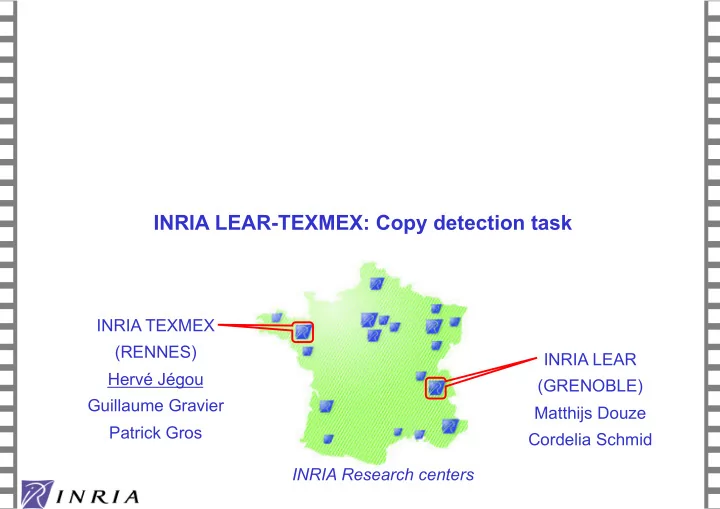
INRIA TEXMEX (RENNES) Hervé Jégou Guillaume Gravier Patrick Gros INRIA LEAR (GRENOBLE) Matthijs Douze Cordelia Schmid INRIA Research centers

slide-2
SLIDE 2

Introduction

INRIA participation in 2008: top results on all transformations

►

focus on accuracy + localization

Video:

►

same system as in 2008: An image-based approach to video copy detection with spatio-temporal filtering Douze, Jégou & Schmid, IEEE Trans. Multimedia 2010

►

+ parameter’s optimization

Audio: new system (no audio in 2008’s evaluation)

►

audio descriptors computed with standard package (spro)

►

novel approximate nearest neighbor search method

In this talk:

►

brief overview of our video and audio systems

►

focus on our ANN method

►

comments on our results

slide-3
SLIDE 3

Short overview of our video system: key components

Local descriptors: CS-LBP

►

Heikkila et al., PR’2010

ANN search: Hamming Embedding

►

Jégou et al., ECCV’08

Score regularization:

Weak geometric consistency

►

Jégou et al., ECCV’08

Burstiness strategy + Multi-probe

►

Jégou et al., ICCV’09

Spatio-temporal fine post-verification

►

Douze et al., IEEE TMM’10

slide-4
SLIDE 4

Short overview of our audio system: key components

Descriptors

►

filter banks

►

Compounding

►

energy invariance

►

1 vector /10 ms

►

  • nline package: https://gforge.inria.fr/projects/spro, filter banks, MFCC, etc

Novel ANN search based on compression paradigm: see next slides

Temporal integration: Hough voting scheme (votes in histogram Δt=tb-tq)

slide-5
SLIDE 5

Video parameter optimization

OBJECTIVE: improve precision with “reasonable” cost w.r.t. efficiency

Decreasing detector threshold

►

number of descriptors 

►

complexity 

►

precision  (with HE)

►

threshold: T200 or T100

Describe flip/half-sized frames

►

  • n database side only

►

threshold: H200 or H100

Multiple assignment (=multi-probe)

►

  • n query side only

query database T200 T200 +H200 T200 +H100 T200 0.483 T100 0.514 0.568 0.583 T100+flip 0.627 0.719 0.738 T100+flip, MA10 0.683 0.749 0.737 T100+flip, MA3 0.650 0.755 0.761 Observation:

  • half sized and flipped frame help a lot
  • small multi-probe (x3) is sufficient

Note: generic system

  • only flipped is specifically to

mAP on a validation dataset

slide-6
SLIDE 6

Huge volumes to index: approximate nearest neighbor search

 Need for powerful approximate search

Locality Sensitive Hashing: memory consuming, need for post-verification on disk, not very good trade-off between precision/efficiency

FLANN: excellent results, memory consuming, need for post-verification (on disk given the dataset size)

We used:

►

Video: Hamming Embedding with 48 bits signature (10B/descriptors+geometry)

►

Audio: Compression based approach  Product quantization method index size (database) Video, T200 d=128 2.48 billion descriptors Video (half, H100) d=128 0.97 billion descriptors Audio d=144 140 million descriptors

slide-7
SLIDE 7

Indexing algorithm: searching with quantization [Jegou et al., TPAMI’11]

Purpose: approximate NN search with limited memory (and no disk access)

Search/Indexing = distance approximation problem

The distance between a query vector x and a database vector y is estimated by where q(.) is a fine quantizer → vector-to-code distance

Distance is approximated in compressed domain

►

typically 8 table look-ups and additions per distance estimation (for SIFTs)

►

proved statistical upper bound on distance approximation error

slide-8
SLIDE 8

Indexing algorithm: searching with quantization [Jegou et al., TPAMI’11]

Combination with inverted file: coarse quantizer to avoid scanning all elements

Here: MA=3

Efficient search: searching in 2 billion SIFT vectors (with MA=1)

►

This method: 3.4 ms / query vector

►

HE: 2.8 ms / query vector Fine representation: 2^64 centroids per cell (typically for SIFTs)

slide-9
SLIDE 9

Comparison with FLANN [Muja & Lowe’09]

Tested on 1 million SIFTs

1.5 to 2 faster than FLANN for same accuracy

Memory usage for 1M vectors (according to “top” command):

►

FLANN: > 250MB

►

Ours: < 25MB

slide-10
SLIDE 10

NDCR: Comparison between 2008 and 2010

Huh?! What’s the problem?

►

“Bug”: a few false positive videos are returned frequently with very high scores

2008 2010

Ranks / 22 participants (BAL, Opt_NDCR)

Rank

1st 2nd 3rd 4th 5th # 6 10 19 18 2

slide-11
SLIDE 11

Results on Trecvid: sub-optimality of our approach

Problem with audio: pseudo-white segments  corrupts similarity measure

Fusion based on invalid assumptions:

►

two first runs: audio and video assumed to have similar performance

►

two last runs: audio assumed to be better than video

slide-12
SLIDE 12

Conclusion

We have learned many things this year:

►

actual decision threshold: need for « cross-databases » setting method

►

audio helps a lot (when working)

►

fusion module is very important

audio ≠ video, room for improvement by score normalization

strong bonus when both agree

What’s might interest the other participants in what we have done

►

approximate nearest neighbor method for billion vectors

Online resources:

►

spro: library for audio descriptors

►

Matlab toy implementation of our compression based search method

►

BIGANN: a billion sized vector set to evaluate ANN methods

►

GIST descriptor in C: OK for several copy transformations [Douze et al., CIVR’09, IBM Trecvid’10]