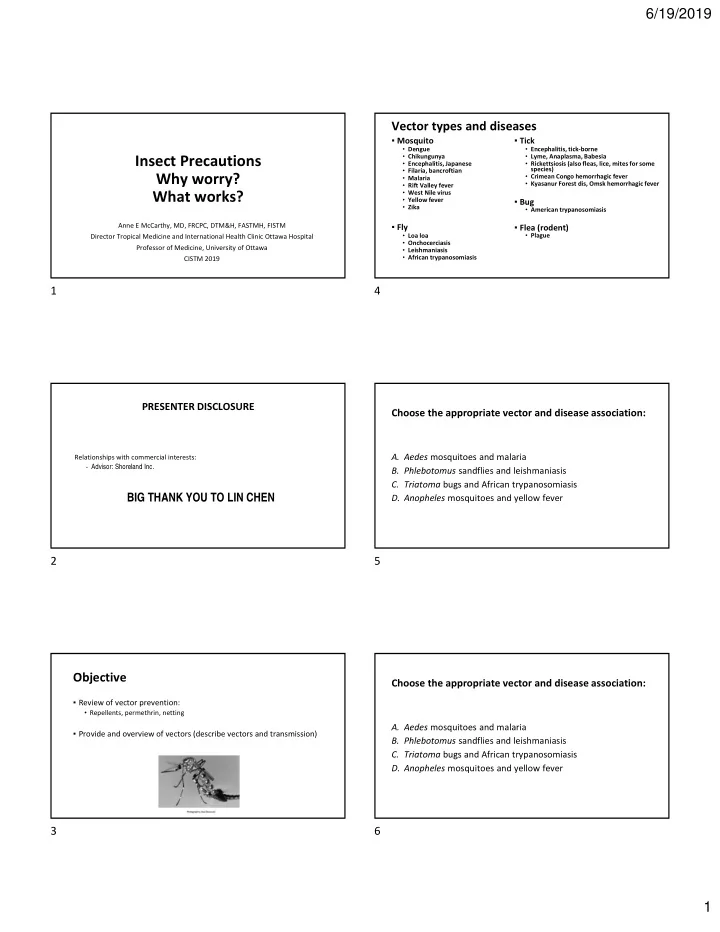
Insect Precautions Chikungunya Lyme, Anaplasma, Babesia - - PDF document

insect precautions
SMART_READER_LITE
LIVE PREVIEW

Insect Precautions Chikungunya Lyme, Anaplasma, Babesia - - PDF document

6/19/2019 Vector types and diseases Mosquito Tick Dengue Encephalitis, tick borne Insect Precautions Chikungunya Lyme, Anaplasma, Babesia Encephalitis, Japanese Rickettsiosis (also fleas, lice, mites for some


slide-1
SLIDE 1

6/19/2019 1

Insect Precautions Why worry? What works?

Anne E McCarthy, MD, FRCPC, DTM&H, FASTMH, FISTM Director Tropical Medicine and International Health Clinic Ottawa Hospital Professor of Medicine, University of Ottawa CISTM 2019

PRESENTER DISCLOSURE

Relationships with commercial interests: ‐ Advisor: Shoreland Inc.

BIG THANK YOU TO LIN CHEN

Objective

▪ Review of vector prevention:

  • Repellents, permethrin, netting

▪ Provide and overview of vectors (describe vectors and transmission)

Vector types and diseases

▪ Mosquito

  • Dengue
  • Chikungunya
  • Encephalitis, Japanese
  • Filaria, bancroftian
  • Malaria
  • Rift Valley fever
  • West Nile virus
  • Yellow fever
  • Zika

▪ Fly

  • Loa loa
  • Onchocerciasis
  • Leishmaniasis
  • African trypanosomiasis

▪ Tick

  • Encephalitis, tick‐borne
  • Lyme, Anaplasma, Babesia
  • Rickettsiosis (also fleas, lice, mites for some

species)

  • Crimean Congo hemorrhagic fever
  • Kyasanur Forest dis, Omsk hemorrhagic fever

▪ Bug

  • American trypanosomiasis

▪ Flea (rodent)

  • Plague

Choose the appropriate vector and disease association:

  • A. Aedes mosquitoes and malaria
  • B. Phlebotomus sandflies and leishmaniasis
  • C. Triatoma bugs and African trypanosomiasis
  • D. Anopheles mosquitoes and yellow fever

Choose the appropriate vector and disease association:

  • A. Aedes mosquitoes and malaria
  • B. Phlebotomus sandflies and leishmaniasis
  • C. Triatoma bugs and African trypanosomiasis
  • D. Anopheles mosquitoes and yellow fever

1 2 3 4 5 6

slide-2
SLIDE 2

6/19/2019 2

www.who.int/campaigns/world‐health‐day/2014/global‐brief/en/

What is needed for transmission of vector‐ borne diseases (VBDs)?

▪ Pathogen presence and amplification ▪ Vector presence and survival ▪ Presence of suitable hosts (reservoirs) ▪ Opportunities for human exposure ▪ Vector competence: can this mosquito transmit this particular virus?

  • Depends on infection, dissemination, transmission

▪ Vector capacity: how important is this mosquito in transmitting this particular virus? Aedes albopictus (Asian tiger mosquito) Anopheles gambiae Aedes aegypti (YF mosquito) Culex

Major mosquito species of interest for travelers Diseases and mosquito species

▪ Disease

  • Malaria
  • Dengue
  • Chikungunya
  • Yellow fever
  • Zika
  • Rift Valley fever
  • Encephalitis, Japanese
  • West Nile
  • Filariasis, lymphatic

▪ Mosquito

  • Anopheles
  • Aedes

(YF ‐ also Haemagogus, Sabethes)

  • RVF (animal blood); Aedes, Culex
  • Culex
  • various mosquito vectors

Global map of dominant malaria vectors

Sinka ME et al. Parasit Vectors 2012

▪ Preferred: clean, unpolluted water. ▪ Larvae of Anopheles gambiae, the major malaria vector in Africa, can breed in diverse habitats. 3 habitats shown: tire tracks, rice fields, irrigation water. ▪ Feeding patterns: most are crepuscular (dusk/dawn) or nocturnal (night).

Anopheles ecology: habitats, feeding

www.cdc.gov/malaria/about/biology/mosquitoes/index.html

7 8 9 10 11 12

slide-3
SLIDE 3

6/19/2019 3

When is the use of repellent most effective to prevent mosquito bites that transmit malaria?

  • A. Mid‐day and early afternoon
  • B. Early morning and late afternoon
  • C. From dusk to dawn
  • D. From dawn to dusk

When is the use of repellent most effective to prevent mosquito bites that transmit malaria?

  • A. Mid‐day and early afternoon
  • B. Early morning and late afternoon
  • C. From dusk to dawn
  • D. From dawn to dusk

Aedes aegypti Aedes albopictus

www.cdc.gov/dengue/entomologyEcology/index.html

Aedes mosquitoes: dengue, chikungunya, YF, Zika

www.cdc.gov/Dengue/entomologyEcology/m_habitats.html

Aedes aegypti are container breeding, adults are indoor dwelling Peak biting ‐ daytime

Culex mosquitoes: JE and West Nile virus

West Nile virus Japanese encephalitis virus Photo: Ames Gathany at phil.cdc.gov/phil/details.asp

13 14 15 16 17 18

slide-4
SLIDE 4

6/19/2019 4

Culex mosquitoes: vector of Japanese encephalitis

▪ Mosquitoes are infected by feeding on domestic pigs and wild birds, in whom the virus is amplified ▪ Biting behavior: dusk to dawn ▪ Often outdoors, but sometimes indoors ▪ Increased risk:

  • Rural areas, outdoors
  • Long‐term travel

A traveler plans to volunteer in a village in Cambodia. Which vector‐disease pair is a significant risk?

  • A. Ixodes ticks and tick‐borne encephalitis
  • B. Aedes mosquitoes and Lyme disease
  • C. Culex mosquitoes and Japanese encephalitis
  • D. Rhipicephalus ticks and chikungunya

A traveler plans to volunteer in a village in Cambodia. Which vector‐disease pair is a significant risk?

  • A. Ixodes ticks and tick‐borne encephalitis
  • B. Aedes mosquitoes and Lyme disease
  • C. Culex mosquitoes and Japanese encephalitis
  • D. Rhipicephalus ticks and chikungunya

Ticks

Ixodes scapularis: Lyme, Babesia, Anaplasma

Ticks

▪ Life: egg 6‐leg larva 8‐leg nymph adult ▪ Diseases:

  • Encephalitis, tick‐borne
  • Lyme, anaplasmosis, babesiosis
  • Rickettsiosis (esp. ATBF; some can be transmitted by fleas, lice, mites)
  • Crimean Congo hemorrhagic fever
  • Kyasanur Forest disease, Omsk hemorrhagic fever

Ixodes scapularis

19 20 21 22 23 24

slide-5
SLIDE 5

6/19/2019 5

Bug: American trypanosomiasis

▪ Protozoan: Trypanosoma cruzi ▪ Vector: Triatoma (reduvid bugs, kissing bugs) ▪ Other transmission modes: transfusion, vertical transmission

Sandflies: leishmaniasis

▪ Protozoan: Leishmania species ▪ Vector: sand flies, Phlebotomus and Lutzomyia

Summary: vectors and travel

▪ Mosquitoes

= Anopheles = Aedes = Culex

▪ Sand flies

= Lutzomyia = Phlebotomus

▪ Black flies

= Simulium

▪ Horse flies/deer flies

= Chrysops

▪ Tsetse flies

= Glossina

▪ Kissing bugs

= Triatoma

▪ Ticks

= Ixodes = Amblyomma = Rhipicephalus

▪ Others:

  • Fleas
  • Lice
  • Mites

ITNs (insecticide‐treated nets) Indoor residual spraying

Sources: USAID, Roll Back Malaria, WHO Global Brief on VBD

Outdoor spraying

Coils

Mosquito proofing is effective

Location Date Intervention Risk ratio after intervention (baseline=1)

Lahore, India 1925‐27 British infantry barracks: wire netting, double doors 0.08 Honduras 1926 Local houses: mosquito proofing 0.23 Mining communities, northern Zambia 1930‐49 Drainage of flooded areas, modification of river boundaries, vegetation management 0.35

  • Keiser. Lancet Infect Dis 2005

25 26 27 28 29 30

slide-6
SLIDE 6

6/19/2019 6

Evidence to support methods

▪ Improve housing design reduced malaria:

  • Modern houses had 47% lower odds of malaria infection/ 45‐65% lower odds of

clinical malaria

▪ Insecticide‐treated nets/curtains/screen: 77% protective efficacy vs. cutaneous leishmaniasis

  • High protective efficacy of:
  • ITS vs. dengue
  • ITNs vs. Japanese encephalitis

▪ Larval source management reduced malaria incidence by ¾:

  • 2 cluster‐RCTs (Sri Lanka): larviciding abandoned mines, streams, irrigation ditches,

rice paddies.

  • 1 trial (India): removal of domestic water containers + weekly larviciding of canals/

stagnant pools.

Tusting et al. Malaria J 2015; Wilson et al. PNTD 2014; Tusting et al. Cochrane 2013

Insecticide: permethrin, deltamethrin, cypermethrin Repellents: EPA approved

*Biopesticides

Active ingredient Chemical name Brands DEET

N,N‐diethyl‐m‐toluamide or N,N‐ diethly‐3‐methyl‐benzamide Off! Cutter Sawyer Ultrathon

Picaridin

2‐(2‐hydroxyethyl)‐1‐ piperidinecarboxylic acid 1‐ methylpropyl ester; KBR 3023, Bayrepel, icaridin Cutter Advanced Skin So Soft Bug Guard Plus Autan

Oil of lemon eucalyptus*

para‐menthane‐3,8‐diol; PMD Repel

IR3535*

3‐[N‐butyl‐N‐acetyl]‐ aminopropionic acid, ethyl ester Skin so Soft Bug Guard Plus Expedition

2‐undecanone

methyl nonyl ketone BioUD

Repellents

Product Active ingredient Complete protection time (mean, minutes) Deep Woods Off DEET 23.8% 301.5 Bite Blocker for Kids Soybean oil 2% 94.6 Skin So Soft Bug Guard Plus IR3535 7.5% 22.9 Natrapel Citronella 10% 19.7 Repello Wristband DEET 9.5% 0.2

Fradin, Day. N Engl J Med 2002 Consumer Reports 2018: www.consumerreports.org/prod ucts/insect‐repellent/ratings‐

  • verview/

Frequently asked questions

Question Answer Evidence Is DEET safe in children? Yes; 2 months and older; adults to apply CDC, AAP Is DEET safe in pregnancy? Yes; trimesters 2‐3 use on Thai‐Myanmar border found no adverse effects on survival, growth, development at birth and 1 year McGready et al. AJTMH 2001. Is controlled‐release DEET more effective? Possibly; polymer formulation touted to last longer Rutledge et al. J Am Mosq Control Assn 1996. In what order should one apply DEET and sun screen? Sun screen 1st, then DEET. Limited data suggest reduction of DEET mean protection time when sun screen applied on top Webb et al. Aust N Z J Public Health 2009. Is permethrin safe to use during pregnancy? Very limited data; no significant, consistent association identified

31 32 33 34 35 36

slide-7
SLIDE 7

6/19/2019 7

Repellents and children

DEET Picaridin (KBR 3023) p‐Methane diol (PMD= oil of lemon eucalyptus) IR3535 CDC >2 mo, up to 50% >2 mo 7%, 15% >3 yrs (EPA) >2 mo AAP >2 mo, up to 30% ‐ ‐ ‐

The following is a safe and effective measure to prevent malaria:

  • A. Taking garlic extract
  • B. Applying picaridin repellent to skin
  • C. Spraying skin with permethrin
  • D. Consuming 1 liter of tonic water every 15 minutes

The following is a safe and effective measure to prevent malaria:

  • A. Taking garlic extract
  • B. Applying picaridin repellent to skin
  • C. Spraying skin with permethrin
  • D. Consuming 1 liter of tonic water every 15 minutes

What does not work?

Garlic Rajan et al. Med Vet Entomol 2005 Vitamin B Ives et al. J Am Mosq Control Assoc 2005 Ultrasound Sylla et al. Wien Klin Wochenschr 2000

Ineffective: repellent‐bracelet ...or...tape A traveler is going to Dominican Republic x 1 week, stay in a hotel. The key preventive measure against chikungunya virus infection is:

  • A. Sleeping under insecticide‐treated nets
  • B. Administering the newly licensed vaccine
  • C. Wearing long sleeves and pants impregnated with p‐

methane‐diol

  • D. Applying effective mosquito repellent to exposed skin

37 38 39 40 41 42

slide-8
SLIDE 8

6/19/2019 8

A traveler is going to Dominican Republic x 1 week, stay in a hotel. The key preventive measure against chikungunya virus infection is:

  • A. Sleeping under insecticide‐treated nets
  • B. Administering the newly licensed vaccine
  • C. Wearing long sleeves and pants impregnated with p‐

methane‐diol

  • D. Applying effective mosquito repellent to exposed skin

New developments

▪ Coating Bed Nets With Antimalarial Drugs To Zap Parasites In Mosquitoes ▪ https://www.mprnews.org/story/2019/02/27/npr‐promising‐new‐ bed‐net‐strategy‐to‐zap‐malaria‐parasite‐in‐mosquitoes ▪ GMO mosquitos

Summary: vector avoidance

▪ What works:

  • Timing of activities
  • Long sleeves, long pants
  • Mosquito proofing
  • Insecticide‐treated nets
  • Insecticide‐impregnated clothing
  • Repellents

Online resources

▪ CDC. www.cdc.gov/DiseasesConditions/ ▪ CDC Travelers’ Health. www.cdc.gov/travel ▪ WHO. www.who.int.ith ▪ CDC Division of Vector‐Borne Diseases www.cdc.gov/ncidod/dvbid/westnile/RepellentUpdates.htm ▪ EPA. http://epa.gov/pesticides/insect/safe.htm ▪ WHO. Global Brief on VBD. www.who.int/campaigns/world‐health‐ day/2014/global‐brief/en/ ▪ PAHO. www.paho.org

References

▪ Fradin MS, Day JF. Comparative efficacy of insect repellents against mosquito bites. N Engl J Med 2002;347:13‐18. ▪ CDC. Protection against mosquitoes and other arthropods. In: Health Information for International Travel 2016. ▪ CATMAT. Statement on Personal Protective Measures to Prevent Arthropod

  • Bites. Canada Communicable Dis Rep 2012;38. Available at

http://www.phac‐aspc.gc.ca/publicat/ccdr‐rmtc/12vol38/acs‐dcc‐3/index‐ eng.php Anopheles gambiae.

From CDC image library

Aedes albopictus Aedes aegypti Culex

From CDC image library

43 44 45 46 47 48

slide-9
SLIDE 9

6/19/2019 9

Anopheles gambiae.

From CDC image library

Aedes albopictus Aedes aegypti Culex

From CDC image library

THANKS QUESTIONS??? THANKS AGAIN LIN FOR YOUR GENEROUS SHARING OF YOUR SLIDES…. 49