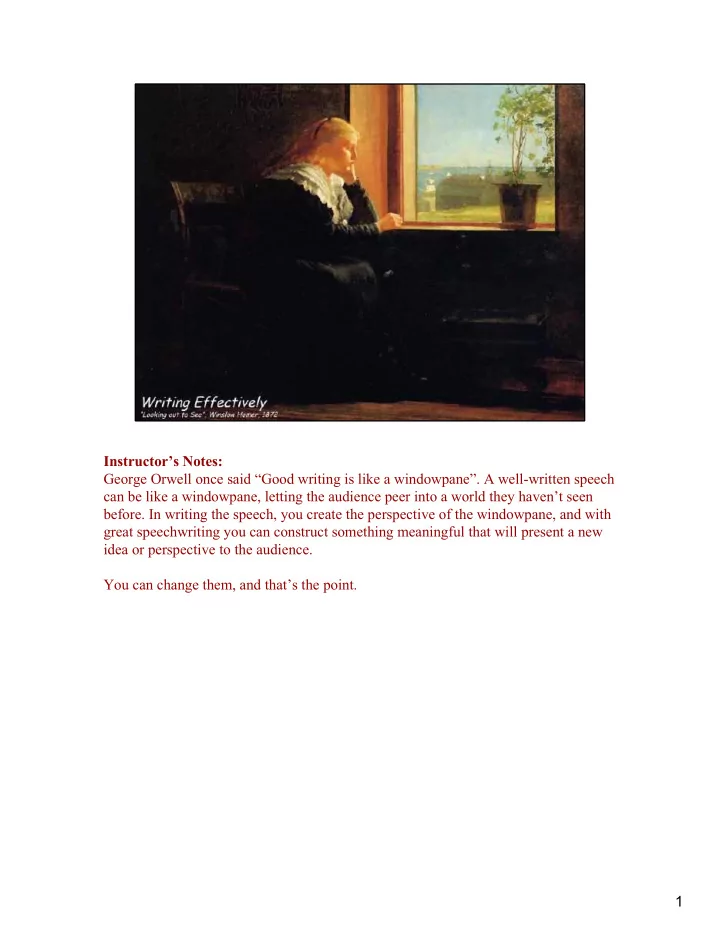
SLIDE 1 Instructor’s Notes: George Orwell once said “Good writing is like a windowpane”. A well-written speech can be like a windowpane, letting the audience peer into a world they haven’t seen
- before. In writing the speech, you create the perspective of the windowpane, and with
great speechwriting you can construct something meaningful that will present a new idea or perspective to the audience. You can change them, and that’s the point. 1
SLIDE 2
2
SLIDE 3
Instructor’s Notes: Read these one by one, and note that they might be important facts that you want the audience to remember them. But they aren’t memorable. <Don't tell the audience, but we’ll revisit them in the next module.> They say what happened, they are all true, and they’re boring. They do not answer why and they don’t take the audience to the place. 3
SLIDE 4 Instructor’s Notes: The key message is that a speech is made up of words. The speakers choice of words can have a great impact on the audience, or not. The words you choose and how you arrange them is an art that makes a great speech. Here are some techniques: Paint a picture: Give a vivid description of a scene that transports the audience to the location in their mind’s eye. If you do, they fully engage and you can take them on a
- journey. Here’s an example from JK Rowlings “Harry Potter and the Sorcerer’s
Stone”: A giant of a man was standing in the doorway. His face was almost completely hidden by a long, shaggy mane of hair and a wild, tangled beard, but you could make out his eyes, glinting like black beetles under all the hair Appeal to the other senses: A vivid description can include what was heard, smelled, tasted and felt. Combining multiple senses brings the audience more fully into the scene you’re creating. Rather than saying “the truck was really cold because the heat was broken”, Rosamund Lupton describes it this way in “The Quality of Silence”: It’s getting so hard to breathe, my lungs are filling up with ants and there isn’t room for air any more. There’s a monster made of cold, hard as the edge of a pavement, 4
SLIDE 5 coming towards us in the dark and it’s cutting through the windscreen and doors and windows and the only weapon against it is heat, but we don’t have any heat. A book can have long descriptions because they’re 100s of pages long. You have 5-7 minutes in most speeches so choose your vivid descriptions carefully. Be concise: what’s the really important image you want to convey. Sometimes I memorize a couple of key phrases to get them just right. Rudimentary lexicon augments comprehensibility: Simple words are easy to
- follow. It’s not about you, it’s not about how you can show off your ability to use the
thesaurus in Microsoft word to impress people, it’s about conveying a message so your audience can follow it. There is a balance, you want to use interesting language to construct the image outside your windowpane, but not overwhelm the audience. Active vs passive voice: Yes, we have to talk about grammar! A lot of sentences have a subject, verb and object. In active voice, the subject of the sentence is doing what the verb says to the object. “The storm snapped the trees.” Passive voice reverses this, so the object is doing it. “The trees were snapped by the storm” Passive voice often has ”by the” in it. It’s not wrong, passive voice can emphasize the action or what happened to something, but active voice is more direct, more immediate and more impactful in a speech. Watch your language and if there isn’t a reason for doing otherwise, use active voice for a compelling speech. Anchor phrases: Ask if anyone knows what these are? Anchor phrases are words or a group of few words related to the theme of your
- speech. They can be repeated periodically throughout your speech to reinforce the
- theme. I’m using one today, any guess what it is?
4
SLIDE 6
Instructor’s Notes: Ethos comes from the Greek word for ethics. It really implies that the speaker has good character and is a credible source of information on the topic. As a speaker, if you’re trying to persuade an audience to adopt your position (or buy a product), you need to convince them you know what you’re talking about. Pathos refers to appealing to the audience’s emotions. Developing a connection with them and make them feel like you feel is very persuasive. Neuroscience is finding that people make most decisions based on emotions, then seek out the evidence to justify them. Logos refers to logic. Even if you’re credible and connect well to the audience, you still have to develop a valid logical argument. Many great speakers follow this order. They establish their credibility, create an emotional connection, and then develop the logic of their argument. Ideally, your introduction builds up your credibility so you can jump directly into pathos-- connecting with your audience. 5
SLIDE 7 Instructor’s Notes: Simile, metaphor and analogy: these rhetorical devices compare two things. They add flair to your speech and can be very effective at highlighting an important attribute of an item or situation by comparing it to something else. Simile draws this comparison using the words “like” or “as”: “It’s like shooting fish in a barrel.” Metaphor is more direct, it doesn’t say one thing is like the other, but that it is the
- ther. It’s not to be taken literally, but it makes the comparison even more deeply.
“All the world’s a stage and the men and women merely players.” from Shakespeare’s As You Like It. Analogies extend the comparison to make a specific point about the comparison. They can include similes or metaphors within them. ”That’s like rearranging the deck chairs
- n the Titanic.” Or a simile and analogy from Rosamund Lupton’s “The Quality of
Silence” about an english woman in Alaska: "It’s FREEZING cold; like the air is made of broken glass. Our English cold is all roly-poly snowmen and ‘woo-hoo! it’s a snow day!’ a hey-there friendly kind of cold. But this cold is mean." Alliteration, Onomatopoeia and Repetition: These all add a rhythmic feel to writing and when delivered in a speech you can enhance the effect to keep the audience interested. 6
SLIDE 8 What’s alliteration? Use of a sequence of words with similar sounds, normally the first consonant of the word. A good example comes from Shakespeare’s MacBeth: “Fair is foul and foul is fair. Hover through the fog and filthy air.” Assonance: the use of repeated vowel sounds, which often rhyme but not always. From My Fair Lady: “The rain in Spain falls mainly on the plain’” Another is the tongue twister ”She sells sea shells by the sea shore.” A similar effect is consonance, which is like alliteration but puts the similar consonant sounds throughout the words. Onomatopoeia: This is simply a word that sounds like what it means. It can describe an animal sound: the howl of a wolf, meow of a cat or buzz of a bee, a loud sound like Crack of lightning, Crash of a car or Boom of the base drum. It can also be rhythmic, the pitter patter of a puppies feet on a hardwood floor or the sound of the babbling brook. Say it over and over and over: there are various forms of repetition that can add clarity, emphasis and rhythm in your speech. Andrew Dlugan’s web site defines a number of variations that include: Anaphora repeats words at the beginning of phrases, as in Churchill’s speech to the British parliament in the lead up to world war 2: We shall fight on the beaches, we shall fight on the landing grounds, we shall fight in the fields and in the streets, we shall fight in the hills; we shall never surrender. Epiphora repeats words at the end of similar clause, as in Abe Lincoln’s line in the Gettysburg address: “this nation, under God, shall have a new birth of freedom, and that government of the people, by the people, for the people, shall not perish from the earth.” Chiasmus is more complex, it repeats a pair of phrases, but in reversed order in similar
- sentences. John Kennedy used it in “Ask not what your country can do for you, as
what you can do for your country”. Triads—if you read about photography, they teach you to put main lines or elements
- n the lines that divide the photo horizontally or vertically into thirds. Similarly in
speeches, people find groups of three ideas to be a complete set that makes them easy to remember. Your speech body may have three points, or you could list words in groups of three like I did above. It feels like a complete list, as the Romans recognized in the latin phrase “omne trium perfectum” (every set of three is complete). 6
SLIDE 9
7
SLIDE 10
Instructor’s Notes: In 2003, psychologist Rod Martin wrote an article in the Journal of Research in Personality in which he classified four types of humor: affiliative, self-enhancing, aggressive and self-defeating. A group of stand-up comics caught up with Rod Martin and let him know how funny they found his article. Humor relaxes your audience and makes them enjoy your speech. By putting them at ease, they will be more open to your message and they’re more likely to remember it. Humor also creates a broader range of emotion if you have a more serious topic, which emphasizes the serious parts even more. Physical Humor: You can incorporate exaggerated gestures and movements into your speech to get a laugh. If you do something really out there, practice so you don’t get hurt. If you do, you might wind up on America’s funniest home videos or tosh.0. Hyperbole: When describing something, make it extreme—larger, meaner, frustrating, think of all those jokes (my mother-in-law is so dumb…”how dumb is she?”) That’s a key that hyperbole is coming. When my kids asked me for a ride to school, like any good parent I explained how when I was six I had to walk 10km up hill to school every day through 2m of snow, and that by the end of the day the earth’s rotation meant that the 10km home were now up hill, too. 8
SLIDE 11 Understatement: Here, you understate what’s happening. For example, calling it a brisk morning when it’s 40 below. Monty Python’s Holy Grail provides an example of
- this. King Arthur approaches the Black Knight, who is guarding a bridge and will not
let him pass. In the ensuing fight, Arthur first chops off one are and then the other, and the Knight calls it a flesh wound. It continues and Arthur cuts off his legs and leaves, with the Knight still calling out to continue the fight. Incongruity: Here, the setup is to describe something and the punch line, or resolution, is where the perspective changes. The Far Side comic had lots of examples
- f these, the graphic has two: the juxtaposition of a modern microscope as tool used
by cave people, as well as fact that they need the microscope to detect a mammoth. Steve Martin once said: “I gave my cat a bath the other day...they love it. He sat there, he enjoyed it, it was fun for me. The fur would stick to my tongue, but other than that..’ Observational Humor: Standup comedians often find humor looking at common situations from a different perspective. A good example is Jim Gaffigan’s discussion
- f camping here. <Watch the first 55 seconds or so>
Word play: This can be effective, but some people will groan no matter how funny it is (like my children). It typically involves a play on words. Instead of "the John," I now call my toilet "the Jim." That way it sounds better when I say I go to the Jim for an hour first thing every morning. 8
SLIDE 12 Instructor’s Notes: 1998 Toastmasters World Champion Craig Valentine works as a professional speaker
- now. He has lots of techniques to add humor to your speeches.
Say what you are thinking: We all have an inner dialog. Thank goodness I can filter mine or I’d be single, unemployed and friendless. <Bill wouldn’t like me at all.> But some of what’s streaming through our head is probably funny, and talking about it out loud can definitely be funny. Say what your audience is thinking: The audience also has an inner dialog. If you follow your speech you may find places where you can be pretty sure what they’re thinking, sometimes you can tell them a story and leave something unsaid. Then you’re pretty sure what they’re thinking. If you can refer to that, “you’re probably wondering…” then you build great engagement. And if you can verbalize some of the funny things they might be thinking they’ll really be entertained. Use present tense and dialog: Dialog is a great way to tell a story. There’s less to explain and if you can change your voice, animate expressions and overplay gestures and reactions for different participants it’s can be very humorous. If you use present tense, it brings immediacy to the speech. 9
SLIDE 13 The rule of 3 or 4: We talked about the rule of three being a number people find comfortably completes an idea. Part of humor is to break the rules and you can do that two ways. First, break the expectation on the third element with something funny or
- bizarre. Another way is to throw in a funny or bizarre fourth item, the audience
thought you were done and now you give them the unexpected. Create a story file: Don’t wait until you’re writing your speech to think up funny
- stories. Keep a file that you can add to any time and make it a habit. It’s a lot easier to
come up with funny situational stories if you have a file you can scan through. You can use this for serious, sarcastic, sad and surreal stories, or ones for emotions that start with any other letter of the alphabet. <Question: serious, sarcastic, sad and surreal stories is an example of what? Answer: Alliteration.> 9
SLIDE 14 Instructor’s Notes: On purpose: If you’re doing stand-up comedy, great. But if you’re trying to work humor into a speech that’s got a broader purpose, don’t tell the one liner your colleague Frank blurted out after one-too-many-drinks at the office Christmas party. Stay on purpose (remember module 1?) Know your audience: What’s funny varies from person to person and culture to
- culture. Whether you think something is funny is irrelevant, it’s not about you!
Consider your audience carefully in deciding what will be funny. Keep it appropriate to their standards, not yours. Funny at the end: Lots of funny stories end with word play or an unexpected
- ccurrence. If you can, write so the last couple of words are where the funny part
comes out. Then pause. Let the audience absorb it. No one laughs: Repeat the punchline in a louder voice with a sarcastic tone while glaring at the audience. Will that help? No. Just move on. Don’t panic, don’t apologize, and whatever you do, don’t pull a Jay Leno. He used to tell a lot of jokes and some of them were even funny. But then he’d mansplain the punchline and that ruin it for me. 10
SLIDE 15
11
SLIDE 16
Instructor’s Notes: Ask the participants for a couple of ideas they took away. 12
SLIDE 17
13
SLIDE 18 Writing a speech is an art, not a science, but even as an art there are common
- elements. Today, we’ve talked about purpose, opening/closing, structure, and
- writing. I’ve presented ideas and hope you’ve all taken something away so you can
change the world. If you’ve been working through the exercises today, I’d love to hear what you will take away. Go forth and invoke change, the world needs it today more than ever we need voices to change the world. I will end with an idea that I hope all Toastmasters can take away, from American poet Maya Angelou. 14
SLIDE 19
Go forth and invoke change. 15