InterCity and AirTrain The Rail Futures blueprint for faster and - - PowerPoint PPT Presentation
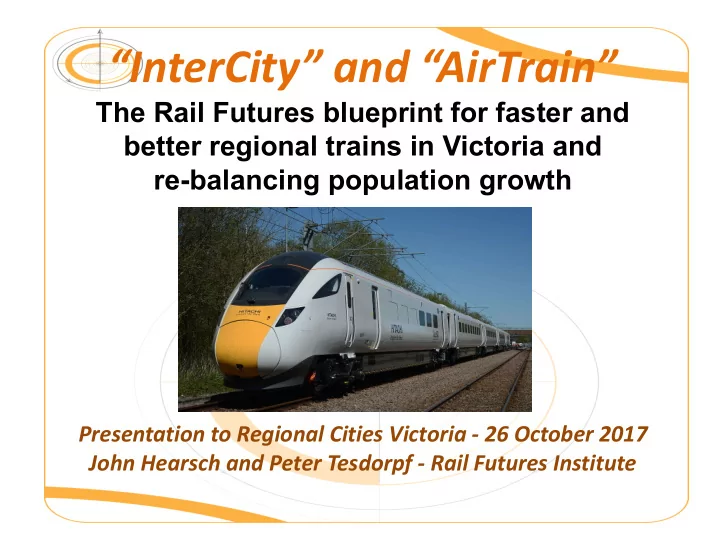
InterCity and AirTrain The Rail Futures blueprint for faster and better regional trains in Victoria and re-balancing population growth Presentation to Regional Cities Victoria - 26 October 2017 John Hearsch and Peter Tesdorpf - Rail
What is Rail Futures?
Rail Futures Institute is an independent non- partisan group. It was formed to advocate cost-effective rail and intermodal solutions for public transport and freight problems based on sound commercial, economic and social reasoning. Rail Futures members include experienced rail professionals, engineers, urban planners and economists.
2
What is InterCity?
InterCity is Rail Futures’ proposal for developing a comprehensive faster and more integrated regional rail network, responding to three main aims -
- more balanced population growth,
- better connectivity and reduced journey times across the
state, and
- meeting widespread demands for improved rail services
throughout regional Victoria. InterCity and AirTrain together provide a 30-year blueprint for a connected rail transport network providing speedy travel between Melbourne and regional Victoria that addresses the State’s transport needs to 2050 and beyond.
3
Why InterCity?
- To lead and support regional growth and development
- To significantly improve connectedness and support new
economic activity
- To expand the area of regional Victoria with good access to
jobs and services
- To significantly improve commuting journeys to Melbourne
and, most importantly, journeys into regional centres
- To create a European-style rail network with greater service
intensity and integration between transport modes
- To have rail travel competitive with travel times by car
- To ensure rail journeys are comfortable and allow the time
to be used productively.
RCV and InterCity objectives are closely aligned
InterCity will be a key enabler of a “State of Cities” and regional growth.
5
Ø Access to jobs, mobility of skilled people Ø Business investment - multiplier effects Ø Leads overall economic development Ø Regional population attractor Ø Affordable housing Ø Lifestyle and environmental benefits Ø Fast rail shrinks distance Ø Closer economic integration of regional economies with Melbourne Ø Supports commuting into regional centres Ø Medical and educational institutions Ø Tourism opportunities Ø Innovation centres
Three Key Propositions
- 1. Population growth needs to be rebalanced
from Melbourne to regional Victoria.
- 2. A State of Cities requires well-defined
development, population and land use policy integrated with transport strategy.
- 3. Investment in faster, more frequent and more
reliable rail services is essential to enable and lead regional growth.
6
Balanced Population Growth
- Victoria’s population is expected to double to 10
million by 2050, with 8 million of those people in Melbourne
- Official figures show the imbalance between
Melbourne and the regions will worsen by 2050 with unchanged policies
- Faster InterCity trains will shrink distance and
extend the area with access to Melbourne and major regional centres for employment and other services like health and education
7
Regional Demands for Train Service Reinstatement and/or Upgrading
- RFR, RRL and VLocity investments demonstrated the strong
impact of modern, faster (160 km/h max) train services
- These investments produced over 200% patronage
increases and significant journey time reductions
- But communities beyond RFR generally receive service
standards established in the 1980s (several are worse)
- And those communities that are served by RRL, particularly
- n the Geelong and Ballarat corridors, now face the
problems of success, such as overcrowding – driven mainly by massive growth in commuting from Melbourne’s west
- n lines that do not have their own metro service.
8
The RFR, RRL and V/Locity investments – now a victim of their own success!
9
10
InterCity proposals – an update
Our InterCity paper was launched in September 2016 by former Deputy Prime Minister, Tim Fischer. Since then there have been important positive developments:
- Emergence of local government rail advocacy groups
- Federal Government interest in regional rail development
- Significant Federal funding for Melbourne-Brisbane Inland Railway
with implications for some Melbourne rail corridors and terminals
- Start of Murray Basin Rail Project works
- Significant Federal and State Government 2016/17 budget funding
for “Regional Rail Revival” of selected passenger services
- Federal and State Government funding of Airport Rail business case
- Major local government sponsored studies concluded for restoring
services to Horsham and Hamilton and for upgraded train services to Shepparton and Gippsland
11
But much remains to be done
- No overarching Transport Plan for the regional rail and coach
network as required by the Transport Integration Act 2010
- No plan to complete segregation of the regional rail network from
the metropolitan rail network
- Serious overcrowding problems on the Geelong line and now
emerging on the Ballarat line not being addressed
- Gippsland services very poor and no plan to address need for
additional tracks to Dandenong
- Inadequate service frequency, slow trip times and old rolling stock
- n Seymour, Albury and Shepparton corridors not addressed
- Other long distance services (Swan Hill, Bairnsdale) not improved
for many years – same rolling stock used for past 35 years
- No commitment yet for restoration of rail passenger services to
Horsham and Hamilton while Mildura remains off the radar
InterCity – main service objectives
- Faster rail services linking Southern Cross and major regional centres,
with more 160 km/h and some 200 km/h operation.
- More frequent trains Geelong, Ballarat, Bendigo, Seymour and Traralgon
routes (4-6 trains per hour weekdays).
- Much improved service reliability by segregation of all regional trains
from suburban trains.
- A 15 minute CBD to Airport AirTrain
every 10 minutes.
- Easy to navigate Melbourne Airport hub served by regional rail and
designed for future High Speed Rail.
- A fully connected network: air > metro rail > regional rail > regional coach
- New long distance trains for Warrnambool, Swan Hill, Albury, Bairnsdale
lines and acceleration to reduce journey times.
- Reinstatement of Horsham and Hamilton train services, Cross-Country
rail routes (Geelong-Ballarat-Bendigo), better coach services linking regional towns and cities and re-work the case for trains to Mildura.
12
13
Segregation of regional from metropolitan services is essential for InterCity implementation
- Geelong line - a new fast line from the CBD via Wyndham Vale
- Interfaces with extension of electrified metropolitan services to
Tarneit and Wyndham Vale via Sunshine and Werribee
- Bendigo , Seymour/Shepparton lines and Albury lines - new fast
lines via Melbourne Airport to Clarkefield and Wallan
- Interfaces with extension of electrified metropolitan services from
Sunbury to Clarkefield and Craigieburn to key interchange at Wallan
- Ballarat and Gippsland lines – enables faster trips by:
- Extension of electrified services to Melton and Bacchus Marsh with
track quadruplication between Sunshine and Melton
- Track quadruplication between Caulfield and Dandenong and an
- vertaking loop between Dandenong and Pakenham
- Ultimate extension of Melbourne Metro tunnels to Caulfield
14
15
16
Major challenges by corridor
Challenges Principal Infrastructure Solutions By when
Geelong and Ballarat lines – massive growth, inadequate infrastructure, suburban and regional services incompatible
- Duplicate South Geelong to Waurn Ponds
- Electrify RRL lines to Wyndham Vale and
Melton/Bacchus Marsh for high capacity trains
- Build “missing link” Werribee to Wyndham Vale
- Construct separate tracks for regional services
2020 2022 2024 2026 Bendigo line – rapid growth, Sunbury suburban and regional services incompatible
- Restore duplication Kyneton to Bendigo
- Extend electrification Sunbury to Clarkefield
- Divert regional trains via Melbourne Airport
with metro interchange at Clarkefield 2026 2030 2030 North Eastern lines – massive metro growth, inadequate infrastructure, suburban and regional services incompatible
- Divert BG regional trains via Upfield corridor
- Extend electrification Craigieburn to Wallan
- Upgrade tracks and standardise beyond Wallan
- Divert regional trains via Melbourne Airport
with metro interchange at Wallan 2024 2030 2030 2030 Gippsland line – rapid growth, inadequate infrastructure, Dandenong suburban and regional services incompatible
- Complete duplication Moe to Traralgon
- Extend MM tunnels South Yarra to Caulfield
- Progressively construct separate tracks for
regional passenger, freight and longer distance suburban services Caulfield to Dandenong 2024 2030 2032
Achievable trip times
Corridor Service
Current rail distance (km) Typical journey times (Minutes)
2017 Phase I (by 2026) Phase II (by 2040)
South-West Melbourne-Geelong 81 60 50 40** Melbourne-Colac 161 130 110 90** Melbourne-Warrnambool 275 220 180 160** West Melbourne-Ballarat 115 75 65 60 Melbourne-Ararat 207 135 125 115 Melbourne-Horsham 327 n/a 200 185 North-West Melbourne-Bendigo 162 110 95 80* Melbourne-Echuca 250 200 170 150* Melbourne-Swan Hill 345 270 235 200* North-East Melbourne-Seymour 99 85 70 60* Melbourne-Shepparton 182 155 130 110* Melbourne-Albury 317 230 185 165* East Melbourne-Warragul 100 100 85 70 Melbourne-Traralgon 158 145 120 105 Melbourne-Bairnsdale 276 225 195 180 ** - via new fast line to Geelong post-2035 * - via Melbourne Airport post-2030
17
Rail Futures AirTrain proposal – an integral part of InterCity
- A new line from Southern Cross to a major new Melbourne Airport
hub served by regional rail and designed for future High Speed Rail
- Melbourne Airport to become a key multi-modal transport hub as
well as an air transport hub
- A CBD to Airport AirTrain every 10 minutes
- Connections at Sunshine with Melbourne Metro lines Sunbury to
Dandenong via Footscray, Parkville, new CBD stations and Domain, and regional lines to Geelong, Warrnambool, Ballarat and Horsham
- Direct regional rail services at the Airport to Castlemaine, Bendigo,
Seymour, Shepparton, Benalla, Wangaratta and Albury
- Connections at Southern Cross to all other suburban lines and to
Warragul, Traralgon, Sale and Bairnsdale
18
19
Why heavy rail for AirTrain ?
- Provides a quick, comfortable trip in dedicated rolling stock
- AirTrain from Southern Cross to the Airport in 15 minutes
with only a Sunshine stop – easy at average speed 106 km/h
- Uses well proven, low risk, off-the-shelf technology
- Much more than simply an Airport railway – a multi-function
corridor for reconfiguring the regional network with full segregation from the metropolitan rail network
- Construction staged to extend beyond Melbourne Airport to
link with the Bendigo line at Clarkefield and the OMR reserved corridor to join the Seymour line at Wallan
- Only a modern heavy rail corridor has the capacity and speed
needed for this application.
Statewide Airport/Rail Connectivity – Metropolitan and Regional Victoria
21
Melbourne Airport Railway
potential timelines
- Strategic review of network integration, demand, rail corridor and
- perational options – 3-6 months (complete 2018)
- Technical studies – 12 months (complete 2018-19)
- Implementation Plan – 6 months (complete 2019)
- Business Case – 12 months (complete 2020)
- Planning, Statutory Approvals and Tender Phase – 36-48 months
(complete 2023-24)
- Construction and Implementation Phase - 48-60 months
(complete 2027-28)
An RCV position regarding Airport Rail and its regional connections needs to be put to government as soon as possible – before decisions are locked in
InterCity – summary of priorities for Victoria
- Regional rail ongoing investment program - faster, more frequent
and reliable services to incentivise opportunities for regional living, access to jobs and much improved housing affordability.
- AirTrain - CBD to Melbourne Airport to be the next major rail
project after Melbourne Metro – 8 to 10 year lead time requires commitment now and planning underway
- Bendigo line and Seymour/Shepparton/Albury lines to be diverted
via Melbourne Airport
- Metropolitan and regional lines to be progressively segregated
- Regional lines to be progressively converted to standard gauge
- Dandenong rail line to become a four track corridor
- Metropolitan growth area corridor extensions (Werribee to
Wyndham Vale and Cranbourne to Clyde)
- Metropolitan growth area electrification extensions (Melton,
Bacchus Marsh, Wyndham Vale, Clarkefield, Wallan)
InterCity - an express track to Victoria’s future
Questions and Discussion Read the full InterCity report
www.railfutures.org.au
24