Interfaces Interfaces n interface : A list of methods that a class - - PDF document

interfaces
SMART_READER_LITE
LIVE PREVIEW

Interfaces Interfaces n interface : A list of methods that a class - - PDF document

10/21/12 Interfaces Interfaces n interface : A list of methods that a class promises to implement. q Interfaces give you an is-a relationship without code sharing. Only method stubs in the interface n Allows object with no common


slide-1
SLIDE 1

10/21/12 ¡ 1 ¡

Interfaces

Interfaces

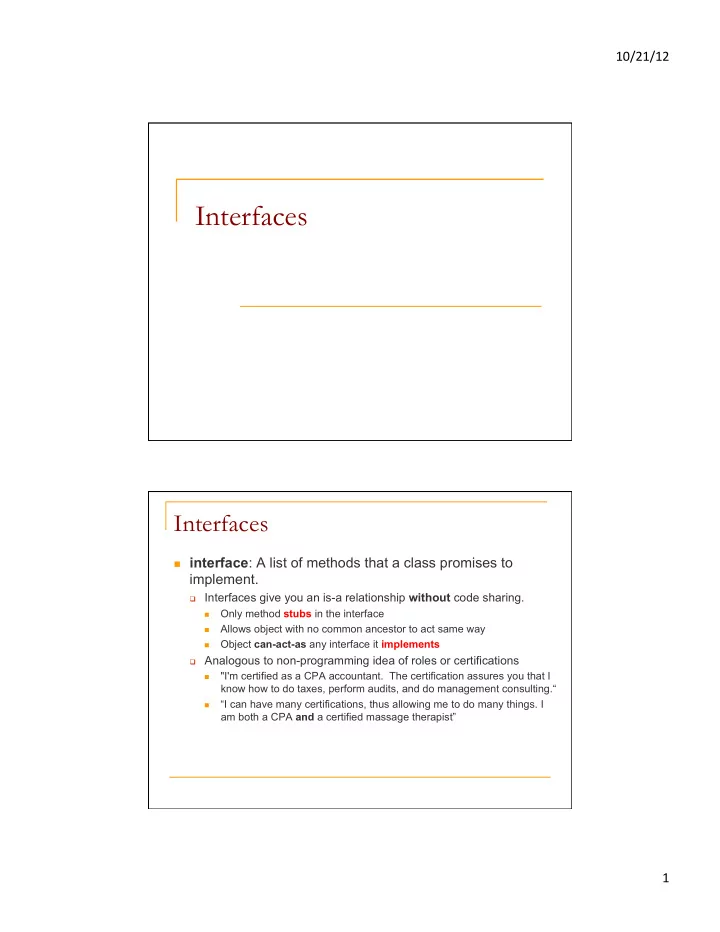
n interface: A list of methods that a class promises to

implement.

q Interfaces give you an is-a relationship without code sharing. n

Only method stubs in the interface

n

Allows object with no common ancestor to act same way

n

Object can-act-as any interface it implements

q Analogous to non-programming idea of roles or certifications n

"I'm certified as a CPA accountant. The certification assures you that I know how to do taxes, perform audits, and do management consulting.“

n

“I can have many certifications, thus allowing me to do many things. I am both a CPA and a certified massage therapist”

slide-2
SLIDE 2

10/21/12 ¡ 2 ¡

English/Spanish Interpreter

n To qualify, one needs to be able to:

q Convert English to Spanish

n public String englishToSpanish (String english)

q Convert Spanish to English

public String spanishToEnglish (String spanish)

public interface EnglishSpanishInterpreter { public String englishToSpanish(String english); public String spanishToEnglist(String spanish); }

Sample English/Spanish Interpreters

slide-3
SLIDE 3

10/21/12 ¡ 3 ¡

Using an Interface

public class PenelopeCruz implements EnglishSpanishInterpreter; public class Chihuahua implements EnglishSpanishInterpreter; public class C3PO extends Robot implements EnglishSpanishInterpreter; EnglishSpanishInterpreter esi = any any object that implements EnglishSpanishInterpreter esi.englistToSpanish(“Hello World”); When you declare a variable of an interface type, you are saying that you are only

  • nly interested in the

methods defined for that interface.

Implementing an interface

n A class can declare that it implements an

interface.

q This means the class contains an implementation

for each of the method stubs in that interface.

(Otherwise, the class will fail to compile. The method stubs are called "abstract methods")

public class <name> implements <interface name> {

... }

slide-4
SLIDE 4

10/21/12 ¡ 4 ¡

Requirements

n If we write a class that claims to be a

EnglishSpanishInterpreter but doesn't implement the englishToSpanish and spanishToEnlish methods, it will not compile.

q Example:

public class Banana implements EnglishSpanishInterpreter { //without implementing methods }

q The compiler error message:

Banana.java:1: Banana is not abstract and does not override abstract method englishToSpanish() in EnglishSpanishInterpreter ^

Comments about Interfaces

n The term interface refers to the set of public

methods through which we can interact with

  • bjects of a class.

n Interfaces are used to define a contract for

how you interact with an object, independent

  • f the underlying implementation.

n Separate behavior (interface) from the

implementation

slide-5
SLIDE 5

10/21/12 ¡ 5 ¡

Commonly used Java interfaces

n The Java class library contains classes and

interfaces

n Comparable – allows us to order the elements

  • f an arbitrary class

n Serializable (in java.io) – for classes

whose objects are able to be saved to files.

n List, Set, Map, Iterator (in

java.util) – describe data structures for storing collections of objects

Comparable

public interface Comparable<E> { public int compareTo(E other); }

n A class can implement the Comparable interface to

define a natural ordering for its objects.

n A call of a.compareTo(b) should return:

a value < 0 if a comes "before" b in the ordering, a value > 0 if a comes "after" b in the ordering,

  • r

0 if a and b are considered "equal" in the ordering.

slide-6
SLIDE 6

10/21/12 ¡ 6 ¡

compareTo tricks

n delegation trick - If your object's fields are

comparable (such as strings), you can use their compareTo results:

// sort by employee name public int compareTo(StaffMember other) { return name.compareTo(other.getName()); }

Comparable and sorting

n The Arrays class in java.util has a (static)

method sort that sorts the elements of an array if they implement Comparable

StaffMember [] staff = new StaffMember[4]; staff[0] = new Executive(…); staff[1] = new Employee(…) staff[2] = new Hourly(…); staff[3] = new Volunteer(…); Arrays.sort(staff);

slide-7
SLIDE 7

10/21/12 ¡ 7 ¡

ArrayList

n The ArrayList declaration:

public class ArrayList<E> implements List<E>… The List interface includes:

Method E get(int index) Returns the element at the specified position int indexOf(Object o) Returns the index of the first occurrence

  • f the specified element

E remove(int index) Removes the element at the specified position E set(int index, E element) Replaces the element at the specified position