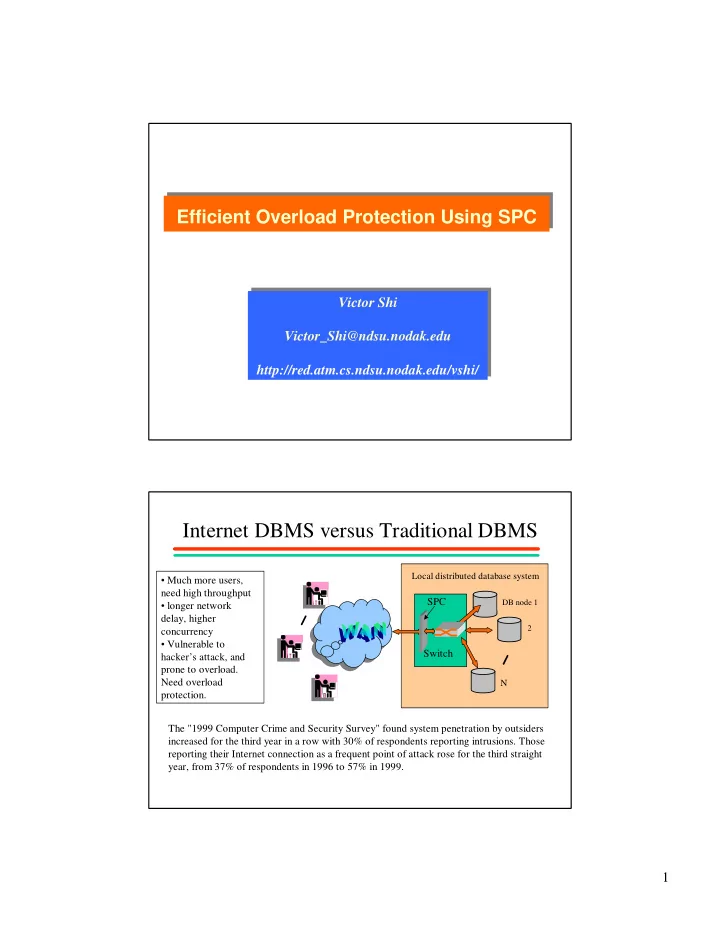
Internet DBMS versus Traditional DBMS Local distributed database - - PDF document

internet dbms versus traditional dbms
SMART_READER_LITE
LIVE PREVIEW

Internet DBMS versus Traditional DBMS Local distributed database - - PDF document

Efficient Overload Protection Using SPC Efficient Overload Protection Using SPC Victor Shi Victor Shi Victor_Shi@ndsu.nodak.edu Victor_Shi@ndsu.nodak.edu http://red.atm.cs.ndsu.nodak.edu/vshi/ http://red.atm.cs.ndsu.nodak.edu/vshi/ Internet


slide-1
SLIDE 1

1

Efficient Overload Protection Using SPC Efficient Overload Protection Using SPC

Victor Shi Victor_Shi@ndsu.nodak.edu http://red.atm.cs.ndsu.nodak.edu/vshi/ Victor Shi Victor_Shi@ndsu.nodak.edu http://red.atm.cs.ndsu.nodak.edu/vshi/

Internet DBMS versus Traditional DBMS

Switch

DB node 1 2

N Local distributed database system

SPC

  • Much more users,

need high throughput

  • longer network

delay, higher concurrency

  • Vulnerable to

hacker’s attack, and prone to overload. Need overload protection. The "1999 Computer Crime and Security Survey" found system penetration by outsiders increased for the third year in a row with 30% of respondents reporting intrusions. Those reporting their Internet connection as a frequent point of attack rose for the third straight year, from 37% of respondents in 1996 to 57% in 1999.

slide-2
SLIDE 2

2

Solutions to “Denial of Service”

Access admission control policies

  • CS (Complete Sharing)
  • CP (Complete Partitioning)
  • TR (Trunk Reservation)
  • UL (Upper Limit bounds)
  • GM (Guaranteed Minimum bounds)
  • UL/GM
  • FP (full preemption), PP (Partial Preemption)
  • CnP (Conditional Preemption)

“The assaults that battered Yahoo and eBay and a variety of major sites were brutally simple. There are programs that fire off streams of data packets like water from a fire hose”.

  • -Bray: An Assault on The Home Front (2/11/00)

More details on the solutions to “denial of service” Access admission control policies

  • CS (Complete Sharing)
  • CP (Complete Partitioning)
  • TR (Trunk Reservation)
  • UL (Upper Limit bounds)
  • GM (Guaranteed Minimum bounds)
  • UL/GM
  • FP (full preemption), PP (Partial Preemption)
  • CnP (Conditional Preemption)
slide-3
SLIDE 3

3

Access Admission Control Policies: overiew

Complete Sharing Complete Partition Upper Limit /Guaranteed Minimum Trunk Reservation Conditional Preemption Partial Preemption

Trunk Reservation (TR)

TR provides a one- way protection against overloads by rejecting requests of lower priority when the available resources in system are less than a pre- specified threshold. j1 j2 2 units are dedicated to j1, 4 units are shared by j1 and j2.

slide-4
SLIDE 4

4

UL, GM & UL/GM

Upper Limit (UL) specifies a maximum amount of resources that each class of requests can use, to limit the overload within a certain degree. Guaranteed Minimum (GM) reserves a minimum amount of resources for each class of requests to protect it from negative effects caused by overloads of other classes of

  • requests. UL/GM is a combination of

UL and GM, which polices the overload

  • f each class of requests while

guaranteeing a minimum performance to it by resource reservation. Thus UL and GM are special cases of the UL/GM policy.

j1 j2

2 units are dedicated to j1, 2 units are dedicated to j2, 2 units shared by j1 and j2

FP, PP and CnP

CnP allows the reserved resources to be shared by requests from all classes

  • f users. When a request

arrives and cannot find sufficient resources, preemption is activated to revoke its reserved resources used by requests of other classes.

j1 j2

j2 reclaims its reserved resources (2 units) j1 reclaims its reserved resources (2 units)

slide-5
SLIDE 5

5

Comparison of Control Policies (cont’d)

  • NEC USA Inc. researchers favor TR
  • S. K. Biswas and B Sengupta,, “Call admissibility for multirate

traffic in wireless ATM networks”, Infocom’97, 1997.

  • AT&T researchers favor UL/GM
  • G. L. Choudhury, K. K. Leung and W. Whitt, “Efficiently

providing multiple grades of service with protection against

  • verloads in shared resources”, AT&T Technical Journal,

July-August, 1995, pp.50-63.

Performance

  • blocking probability: the probability that a newly

arrived service request is rejected for some reason.

  • preemption ratio: the ratio of the number of

requests being preempted in a class to the number

  • f requests being accepted in the same class.
  • System throughput: the number of requests

serviced by the system.

slide-6
SLIDE 6

6

Experiments

  • Symmetric case study

In the symmetric case we assume that all classes of users in the system have the same grade of service requirements and workloads.

  • Asymmetric case study

In the asymmetric case requests from different classes have different requirements.

System Model

We consider a link with two classes of traffic.

  • A service needs one unit of resource.
  • Request arrival processes are Poissonian.
  • The request service times are negative exponential

distributed.

  • The system enforces the access admission control

policies by associating appropriate numbers with each class.

slide-7
SLIDE 7

7

Symmetric Case Study

6

10 ) 2 ( ) 1 (

= = = b b b , ) 2 ( ) 1 ( f f =

  • n the normal workload condition,

K b × =

−6

10 ) 2 ( , ) 1 ( ) 2 ( ) 1 ( x f f + × =

  • n the overload condition 1 and

K b × =

−6

10 ) 1 ( , ) 1 ( ) 1 ( ) 2 ( x f f + × =

  • n the overload condition 2.

K denotes the requirement relaxation under overload conditions, while x denotes the overload percentage. Let K =1, 10, 100 and = x 0.5, 1, 1.5, 2, we experiment with 12 scenarios for both UL/GM and CnP policies.

Table 1: Throughputs of UL/GM policy and CnP policy under

6

10

= b constraint UL/GM Policy K =1 K =10 K =100 Overload (x ) (

2 1,n

n ) Throughput (

2 1,n

n ) Throughput (

2 1,n

n ) Throughput 0.5 (49,49) 48.867 (45,45) 54.257 (42,42) 57.226 1 (49,49) 48.378 (47,47) 51.523 (45,45) 54.335 1.5 (49,49) 47.773 (48,48) 50.273 (46,46) 53.066 2 (50,50) 47.539 (48,48) 50.273 (46,46) 53.066 CnP policy with preemption constraint requirements

7

10 ) 2 ( ) 1 (

= = pt pt Overload(x ) (

2 1,n

n ) Throughput (

2 1,n

n ) Throughput (

2 1,n

n ) Throughput 0.5 (48, 48) 51.894 (48,48) 55.566 (48,48) 59.414 1 (49,49) 48.691 (49,49) 52.822 (49,49) 58.129 1.5 (49,49) 47.441 (49,49) 51.894 (49,49) 57.424 2 (50,49) 47.109 (50,49) 51.601 (50,49) 57.148 CnP policy with preemption constraint requirements

6

10 ) 2 ( ) 1 (

= = pt pt Overload( x ) (

2 1,n

n ) Throughput (

2 1,n

n ) Throughput (

2 1,n

n ) Throughput 0.5 (50,50) 53.085 (50,50) 56.992 (50,50) 61.601 1 (50,50) 49.726 (50,50) 54.082 (50,50) 59.619 1.5 (50,50) 48.769 (50,50) 53.369 (50,50) 59.064 2 (50,50) 48.476 (50,50) 53.085 (50,50) 58.789

slide-8
SLIDE 8

8

Asymmetric Case Study

6

10 ) 1 (

= b ,

3

10 ) 2 (

= b , ) 2 ( ) 1 ( f f =

  • n the normal workload condition,

K b × =

−3

10 ) 2 ( , ) 1 ( ) 2 ( ) 1 ( x f f + × =

  • n the overload condition 1 and

K b × =

−6

10 ) 1 ( , ) 1 ( ) 1 ( ) 2 ( x f f + × =

  • n the overload condition 2. Similarly we experiment with 12

scenarios for the TR, UL/GM and CnP policies (combinations of requirement relaxations K=1, 10, 100 and overloads = x 0.5, 1, 1.5, 2).

Table 2: Throughputs of TR, UL/GM and CnP under

6

10 ) 1 (

= b ,

3

10 ) 2 (

= b constraints TR Policy K =1 K =10 K =100 Overload (x ) (r ) Throughput (r ) Throughput ( r ) Throughput 0.5 5 55.351 6 60.507 6 68.242 1 5 46.054 5 50.800 5 58.925 1.5 4 39.882 4 43.691 5 50.395 2 4 34.853 4 38.378 4 44.414 UL/GM Policy Overload (x ) (

2 1,n

n ) Throughput (

2 1,n

n ) Throughput (

2 1,n

n ) Throughput 0.5 (42,55) 56.806 (0,53) 60.117 (0,52) 61.738 1 (43,55) 55.947 (35,53) 58.535 (0,51) 61.972 1.5 (43,55) 55.507 (38,54) 58.476 (25,52) 60.820 2 (44,56) 55.273 (39,54) 58.476 (30,52) 61.738

slide-9
SLIDE 9

9

CnP policy with preemption constraint requirements

7

10 ) 1 (

= pt ,

4

10 ) 2 (

= pt Overload ( x ) (

2 1,n

n ) Throughput (

2 1,n

n ) Throughput (

2 1,n

n ) Throughput 0.5 (40,56) 58.007 (25,57) 63.945 (20,63) 68.222 1 (42,55) 55.551 (40,56) 61.835 (20,61) 66.799 1.5 (44,55) 55.244 (41,57) 62.070 (35,62) 67.617 2 (44,55) 55.083 (42,56) 61.445 (35,62) 67.617 CnP policy with preemption constraint requirements

6

10 ) 1 (

= pt ,

3

10 ) 2 (

= pt Overload ( x ) (

2 1,n

n ) Throughput (

2 1,n

n ) Throughput (

2 1,n

n ) Throughput 0.5 (41,59) 61.523 (37,63) 67.988 (25,69) 75.239 1 (44,56) 56.914 (42,58) 64.726 (32,68) 74.257 1.5 (44,56) 56.660 (42,58) 64.611 (33,67) 72.382 2 (44,56) 56.523 (42,58) 63.989 (33,67) 70.332

Summary

  • CnP consistently outperforms TR and UL/GM while the

preemption level is acceptably low (Throughput 21% over UL/GM).

  • We plan to use SPC and PBX card for enforcing CnP

policy, so as to efficiently resolve the “denial of service” problem.

slide-10
SLIDE 10

10