Internet in 1990 NSFNET backbone Stanford - - PowerPoint PPT Presentation

internet in 1990 nsfnet backbone stanford isu
SMART_READER_LITE
LIVE PREVIEW

Internet in 1990 NSFNET backbone Stanford - - PowerPoint PPT Presentation

Internet in 1990 NSFNET backbone Stanford ISU BARRNET MidNet regional Westnet regional regional Berkeley PARC UNL KU UNM NCAR UA ECPE/CS 5516 (03/10/2000) Internetworking


slide-1
SLIDE 1

ECPE/CS 5516 (03/10/2000) Internetworking - 1

  • Internet in 1990

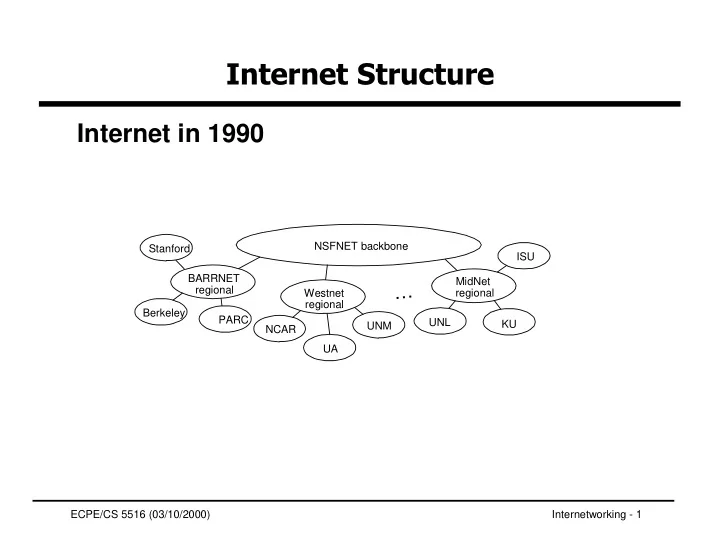
NSFNET backbone Stanford BARRNET regional Berkeley PARC NCAR UA UNM Westnet regional UNL KU ISU MidNet regional
slide-2
SLIDE 2

ECPE/CS 5516 (03/10/2000) Internetworking - 2

  • ■ Add another level to address/routing hierarchy:

subnet

■ Subnet masks define variable partition of host part ■ Subnets visible only within site

Network number Host number Class B address Subnet mask (255.255.255.0) Subnetted address 111111111111111111111111 00000000 Network number Host ID Subnet ID

slide-3
SLIDE 3

ECPE/CS 5516 (03/10/2000) Internetworking - 3

  • Forwarding table at router R1

Subnet Number Subnet Mask Next Hop 128.96.34.0 255.255.255.128 interface 0 128.96.34.128 255.255.255.128 interface 1 128.96.33.0 255.255.255.0 R2

Subnet mask: 255.255.255.128 Subnet number: 128.96.34.0 128.96.34.15 128.96.34.1 H1 R1 128.96.34.130 Subnet mask: 255.255.255.128 Subnet number: 128.96.34.128 128.96.34.129 128.96.34.139 R2 H2 128.96.33.1 128.96.33.14 Subnet mask: 255.255.255.0 Subnet number: 128.96.33.0 H3

slide-4
SLIDE 4

ECPE/CS 5516 (03/10/2000) Internetworking - 4

  • D = destination IP address

for each entry (SubnetNum, SubnetMask, NextHop) D1 = SubnetMask & D if D1 = SubnetNum if NextHop is an interface deliver datagram directly to D else deliver datagram to NextHop

■ Use a default router if nothing matches ■ Not necessary for all 1s in subnet mask to be

contiguous

■ Can put multiple subnets on one physical network ■ Subnets not visible from the rest of the Internet

slide-5
SLIDE 5

ECPE/CS 5516 (03/10/2000) Internetworking - 5

  • ■ Flat versus Hierarchical Addresses

■ Inefficient use of Hierarchical Address

Space

  • class C with 2 hosts (2/255 = 0.78% efficient)
  • class B with 256 hosts (256/65535 = 0.39%

efficient)

■ Still Too Many Networks

  • routing tables do not scale
  • route propagation protocols do not scale
slide-6
SLIDE 6

ECPE/CS 5516 (03/10/2000) Internetworking - 6

  • ■ Supernetting is used to aggregate routes
  • Assign block of contiguous network numbers to

nearby networks

■ Called CIDR: Classless Inter-Domain

Routing

■ Restrict block sizes to powers of 2 ■ Use a contiguous bit mask (CIDR mask) to

identify block size

■ All routers must understand CIDR

addressing

  • Routing involves longest prefix match
slide-7
SLIDE 7

ECPE/CS 5516 (03/10/2000) Internetworking - 7

  • ■ Know a smarter router
  • hosts know local router
  • local routers know site routers
  • site routers know core router
  • core routers know everything

■ Autonomous System (AS)

  • corresponds to an administrative domain
  • examples: University, company, backbone network

■ Two-level route propagation hierarchy

  • interior gateway protocol (each AS selects its own)
  • exterior gateway protocol (Internet-wide standard)